
ChainThink
Stay ahead, master crypto insights
$HYPE sets a new all-time high, why do whales choose to place orders on Hyperliquid?
$HYPE sets a new all-time high, why do whales choose to place orders on Hyperliquid?

2025-05-26 10:44
Editor's Note: Why are whales so fond of Hyperliquid, a decentralized derivatives platform that has become a paradise for high-risk traders with up to 50x leverage, zero Gas fees, and a fully on-chain transparent order book. Recently, according to blockbeat news, several whales opened high-leverage long and short positions after Trump announced the strategic crypto reserve, netting millions of dollars. The platform's low cost and high leverage characteristics, combined with market volatility, have made whales flock to it, making Hyperliquid the new focus of contract trading.
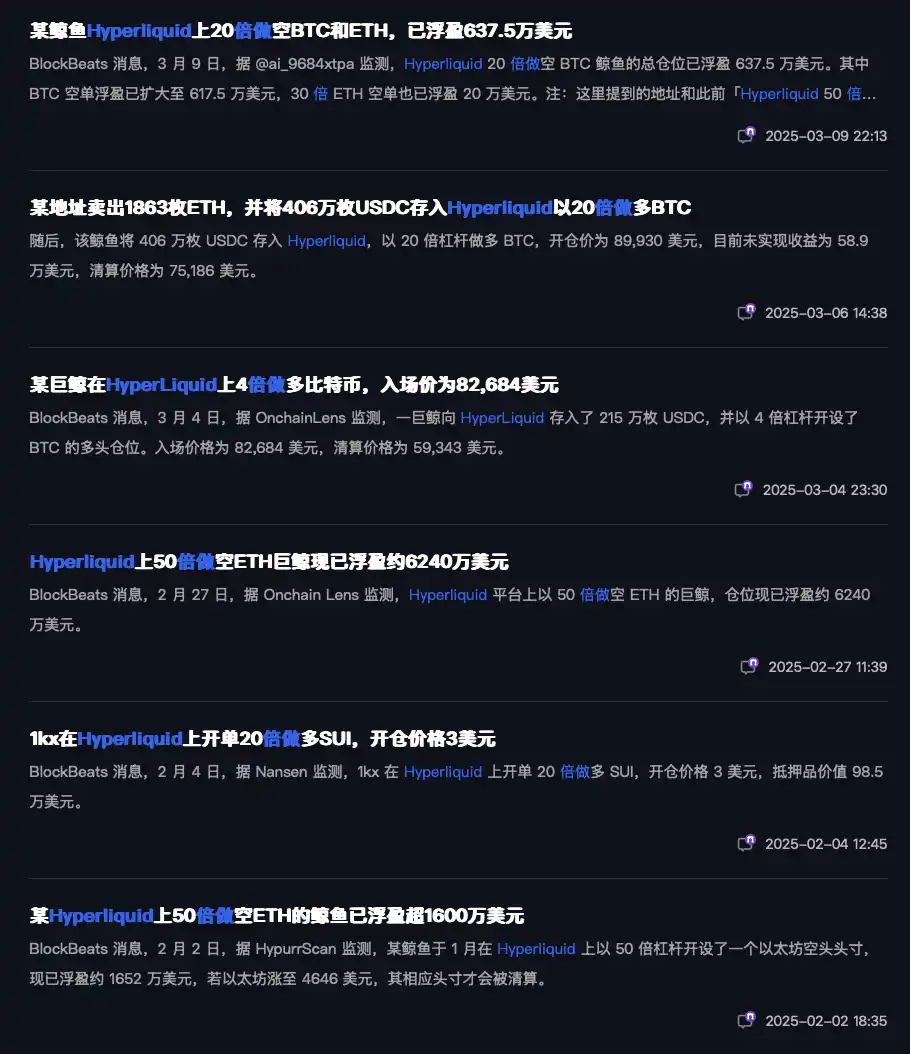
The following is the original content (the content has been edited for easier reading and understanding):
In the history of DeFi derivatives, few protocols have occupied more than half of the on-chain perpetual contracts market, but Hyperliquid has done it. What is its secret?
Data shows that within 24 hours, the total trading volume of on-chain perpetual contracts was $14.37 billion, while @HyperliquidX accounted for an astonishing $9.3 billion, a staggering 64.71% share, demonstrating Hyperliquid's absolute dominance in the market.
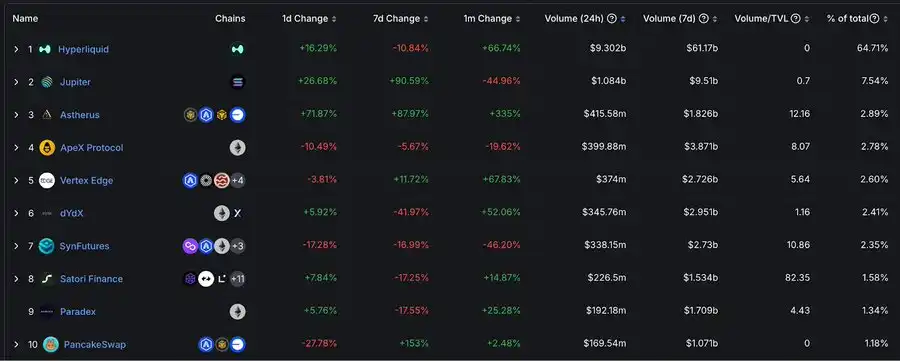
However, most DEXs have struggled to match these aspects, often relying on:
· AMM design (leading to excessive slippage for large orders, such as GMX);
· Partial off-chain solutions (such as dYdX v3), which affect transparency or increase the complexity of user usage.
Hyperliquid recognized this issue: if the user experience is poor or liquidity is insufficient, users will not migrate to the chain in large numbers. Therefore, the team has been committed to providing "CEX-level speed and liquidity, but completely on-chain."
Hyperliquid's success proves the possibility of DEXs facing giants like Binance. Binance's 24-hour perpetual contract trading volume is $97.22 billion, while the total DEX trading volume is only $14.637 billion, with Hyperliquid contributing $9.532 billion.
With Hyperliquid, DEX trading volume can reach 15% of Binance's; without it, this proportion would drop to 5%, amounting to only $5.105 billion. This proves Hyperliquid's role in promoting DeFi trading.
This performance fulfills Hyperliquid's core commitment - providing a CeFi-level trading experience on a fully decentralized Layer-1.
Background and Founding Story
Origins and Team Composition
Hyperliquid was founded by @chameleon_jeff (a Harvard graduate and former quant trader at Hudson River Trading) and a small team of engineers from top institutions such as MIT and Caltech.
They engaged in high-frequency trading (HFT) between 2020 and 2022, and after the FTX collapse, they shifted towards trustless solutions. Seeing billions disappear due to centralized custody, their goal became clear: to build a self-custodial alternative that does not sacrifice performance, and they chose a "no VC, self-funded" approach to ensure long-term alignment with users and traders, rather than catering to short-term investor interests.
Why CEXs Still Dominate?
Despite the collapse of major CEXs like FTX, user trading habits did not immediately shift to DeFi. Many traders still use centralized platforms like Binance, not because they ignore custody risks, but because CEXs always offer:
· Fast and familiar interfaces
· Deep liquidity
· Advanced trading features (stop-loss orders, professional K-lines, etc.)
· No Gas fees, cross-chain accessibility
· Low barriers, convenient trading experience
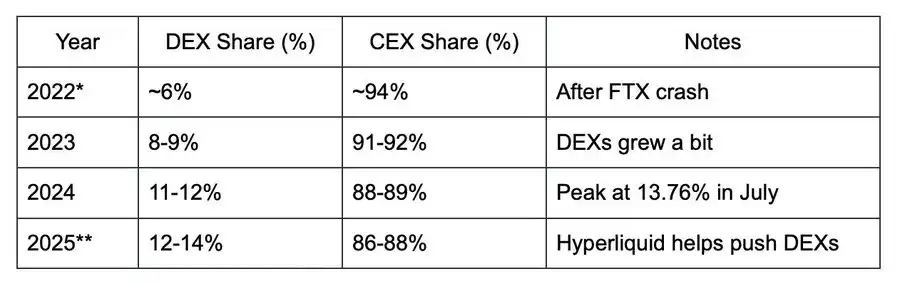
After the FTX collapse in November to December 2022. 2025 data is a projection as of March 6. Hyperliquid recognized this shortcoming: if the user experience is poor or liquidity is insufficient, users will not migrate to the chain in large numbers. Therefore, the team is committed to building "CEX-level speed and liquidity, but completely on-chain."
User Experience-Centric Product Development from Day One
Let's look at Hyperliquid's product matrix:
1. Perpetual Contract DEX
Hyperliquid's core product is its perpetual contract DEX, using a fully on-chain central limit order book (CLOB), supporting:
· BTC, ETH up to 50x leverage
· SOL, SUI, kPEPE, XRP up to 20x leverage
· Small-cap tokens up to 3x leverage
Hyperliquid built from scratch, offering higher openness than competitors' off-chain solutions, and specifically designed for high-frequency trading (HFT) needs. Its features include:
· Sub-second trade confirmation
· Processing 100,000 orders per second
· No Gas fees or near-zero Gas fee for placing and canceling orders
These key factors make its user experience comparable to CEXs.
Advanced Trading Mechanisms
· Atomic operations: support atomic liquidation based on the latest oracle price, and distribute atomic funding rates hourly
· Asset security checks: the platform performs asset security verification at the end of each block
· Order priority: prioritize canceling and limit orders, protecting market makers from malicious liquidity impact
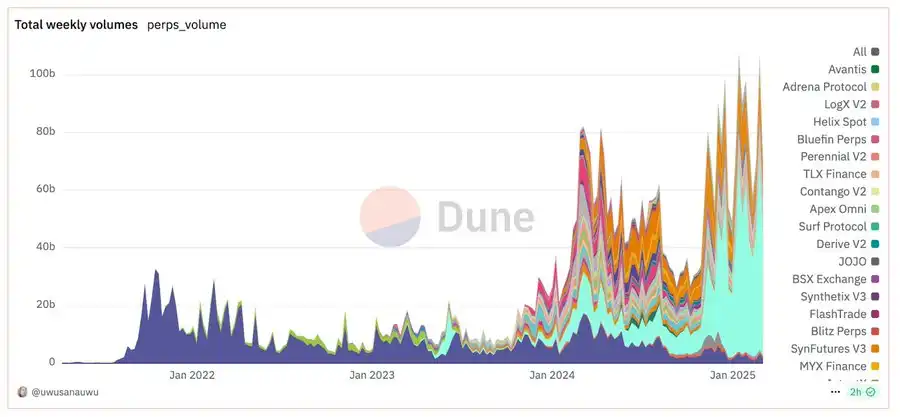
As of last week, Hyperliquid Perps had a trading volume of $66.5 billion, nearly seven times that of Jupiter (9.7 billion), and more than the sum of its 14 competitors (33.6 billion). Hyperliquid accounts for 66% of the total trading volume of the top 15 perpetual exchanges.
2. Spot Exchange
Hyperliquid's spot exchange launched in mid-2024, initially supporting over 20 native assets such as HYPE and memecoins.
Compared to Hyperliquid's massive $106 billion perpetual contract market, spot trading started smaller but grew rapidly. As of early 2025, with key updates (especially the launch of BTC), Hyperliquid is gradually becoming a strong competitor in on-chain spot trading.
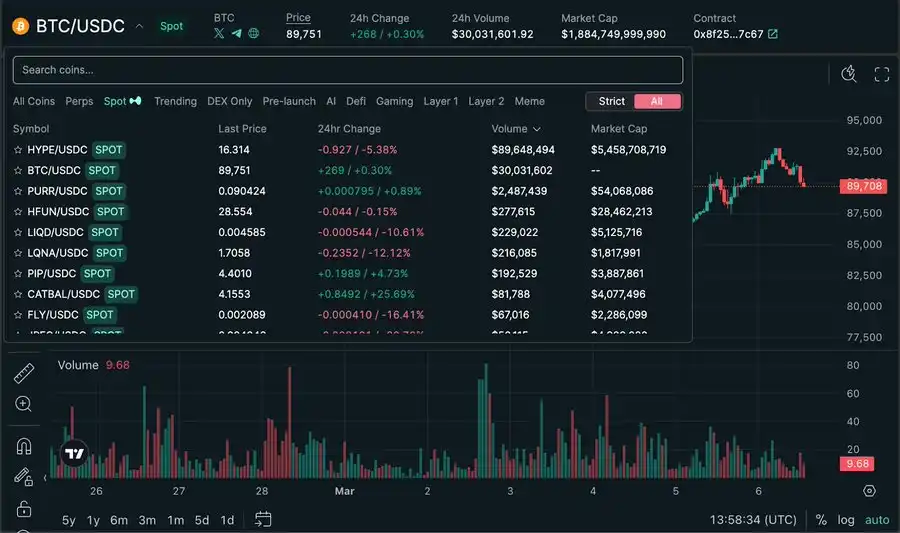
Back in mid-2024, Hyperliquid's spot trading was limited to its own token and a few other assets (such as RAGE). This limited asset range made many professional traders reluctant, who favored mainstream assets like BTC rather than speculative tokens.
Messari analyst MONK predicted in his report that adding BTC would change the game, making Hyperliquid a one-stop platform covering both spot and derivative trading, challenging centralized exchanges. This prediction was quickly validated on February 15, 2025, when the Unit team launched the function of directly trading BTC spot on Hyperliquid's order book.
What does this mean?
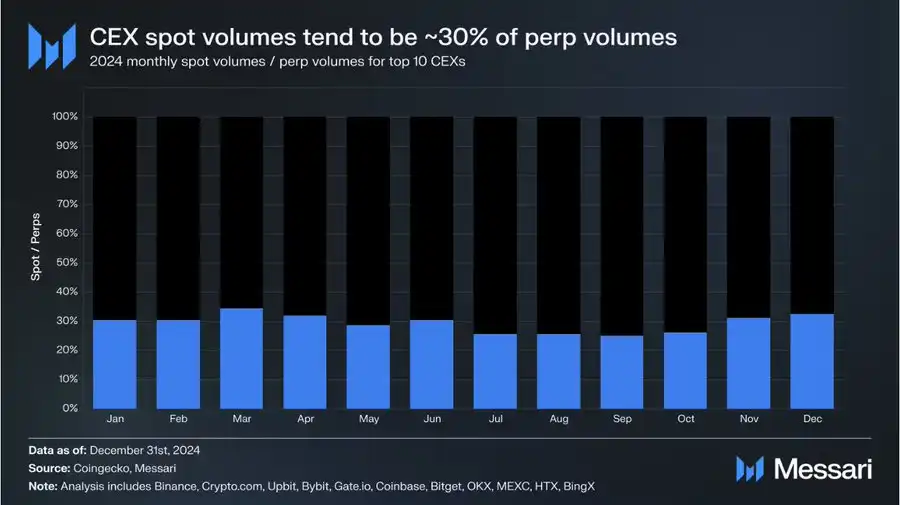
· Surge in trading volume: before the launch of BTC, Hyperliquid's spot trading volume was just a fraction of the monthly $63 billion BTC perpetual contract trading volume. Messari estimated that if appropriate assets were introduced, spot trading volume could reach 20%-30% of the perpetual contract trading volume, with potential incremental value of billions of dollars. With the launch of BTC spot, other DEXs already have $33 billion BTC trading volume per month, and Hyperliquid is rapidly capturing this market share.
· More assets are coming: the Unit solution not only supports BTC, but also lays the foundation for introducing ETH, SOL, and even real-world assets in the future. This may make Hyperliquid the core market for cryptocurrency spot trading.
3. Hyperliquid HLP (Liquidity Vault)
HLP is a liquidity vault where users can deposit funds (mainly USDC), acting as counterparties for derivative exchange traders and earning shares from trading profits.
· Purpose: To provide passive income opportunities for users who do not want to actively trade, following the "the house always wins" model, allowing depositors to benefit from trading activities.
· Core Features:
The funds deposited by users are lent to traders for leveraged trading.
The returns fluctuate, but the annualized return reached as high as 54% by the end of 2024.
4. Vaults (Copy Trading)
Hyperliquid offers a copy trading (Vaults) feature, allowing users to allocate funds to professional traders' strategies for automated trading.
· Purpose: To allow ordinary users to profit from the expertise of top traders without direct operation themselves.
· Core Features:
Anyone can create a Vault and manage funds, with managers needing to hold at least 5% of the position and receiving a 10% profit share.
Users can browse different Vault performances and choose to invest, achieving profit sharing.
5. HIP-1 and HIP-2 Token Standards
Hyperliquid introduced two innovative token standards to enhance its ecosystem:
· HIP-1: Native token protocol, allowing users to issue custom tokens on Hyperliquid L1 (such as PURR, a meme coin launched as a concept proof).
· HIP-2: Liquidity solution, providing market-making strategies for HIP-1 issued tokens, ensuring liquidity without relying on external platforms like Raydium (unlike Pump.FUN).
Core Features:
· HIP-1 tokens can be directly used for spot and perpetual contract trading on Hyperliquid.
· HIP-2 is customized by the Hyperliquid team, utilizing its quantitative trading capabilities to provide liquidity support.
Example: PURR has a native ledger, spot order book, built-in oracle, and perpetual contract trading, demonstrating how these standards build a composable trading ecosystem.
Technical Core of Hyperliquid
All of Hyperliquid's products, from perpetual contracts to spot trading, are built on its custom blockchain - Hyperliquid Layer1. On February 18, 2025, HyperEVM officially went live on the mainnet.
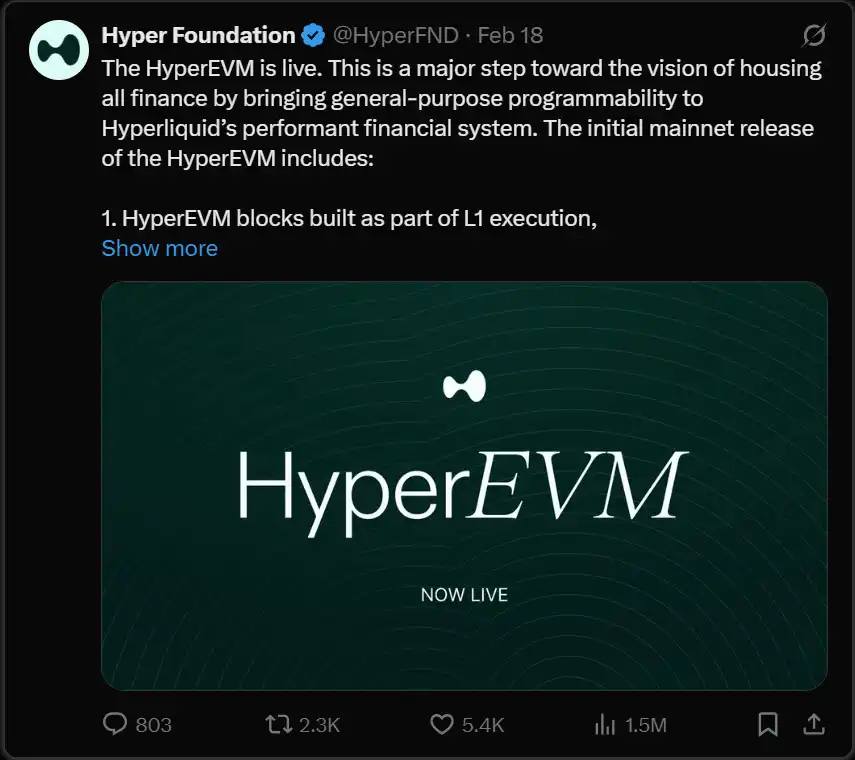
Hyperliquid's blockchain currently processes over 20,000 transactions per second (TPS), supporting a robust ecosystem including perpetual contract trading and BTC spot markets. Based on HyperBFT consensus, its L1 has evolved from a specialized trading platform to a general blockchain.
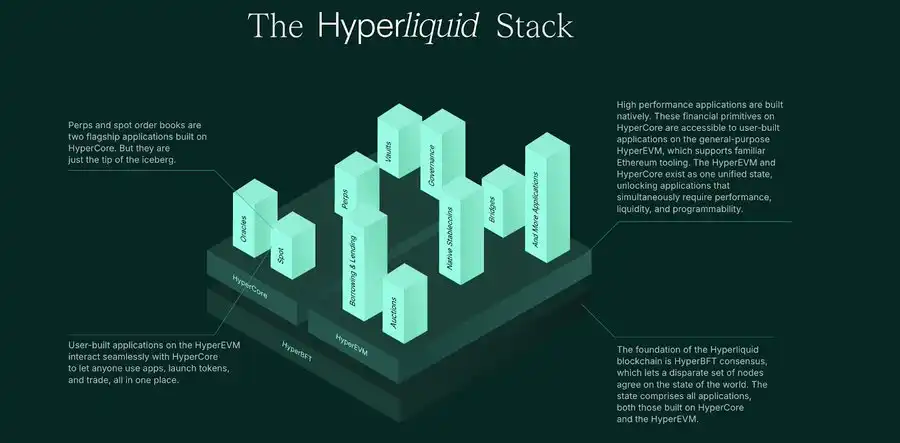
HyperBFT Key Optimizations
Significantly increased TPS: Previously limited by Tendermint, it supported 20,000 transactions per second, and after the upgrade, it can process 200,000 transactions per second.
Faster processing speed: The consensus process does not get blocked by execution, transactions can be continuously sorted without waiting for the current block to complete execution.
Lower latency: Confirmation time is faster and more stable, only affected by network latency.
Optimistic response: Block generation speed depends on validator communication efficiency.
HyperEVM: Full Layer-1 Capabilities
HyperEVM integrates a general EVM network into Hyperliquid blockchain state, forming a dual VM architecture:
Native VM: Optimized for high-performance trading.
EVM layer: Supports permissionless third-party development.
The HyperBFT upgrade, along with the introduction of BTC spot trading, has gradually made Hyperliquid a more powerful and versatile trading platform.
How Does Hyperliquid Compare to...?
Hyperliquid vs. Other DEXs
Full on-chain vs. Partial off-chain
Hyperliquid uses a fully on-chain central limit order book (CLOB), whereas many DEX competitors (such as dYdX v4) still rely on partial off-chain order books. Hyperliquid's solution ensures verifiability and transparent matching engine, avoiding dark box operations and front-running issues.
Domination in the perpetual contract market
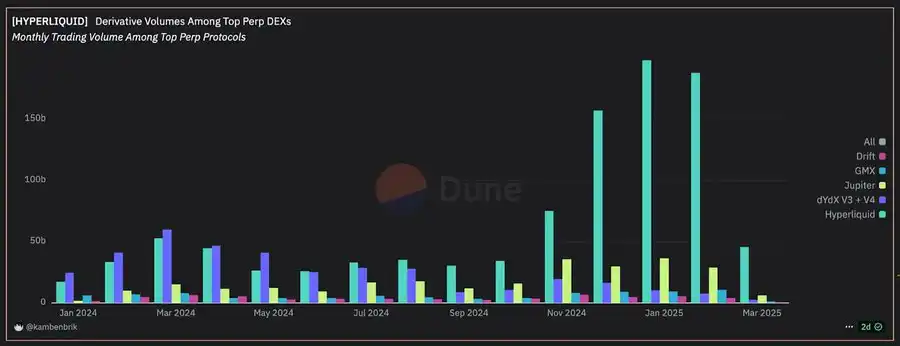
As of February 2024, Hyperliquid had captured 56% of the on-chain derivative DEX trading volume. Since July 2024, its monthly perpetual contract trading volume has surpassed its main competitors. In January 2025, Hyperliquid's single-month perpetual trading volume reached $196 billion, while the total of the other four protocols was only $60 billion.
Performance and Market Maker Priority
Hyperliquid's custom Layer-1 and consensus mechanism (HyperBFT) enable it to process sub-second latency and about 100,000 transactions per second. This is specifically tailored for high-frequency trading. Other DEXs based on general blockchains need to share block space with many other transactions, making it more difficult to maintain high throughput.
Comparison with CEXs
Trading Volume Gap and Growth Trajectory
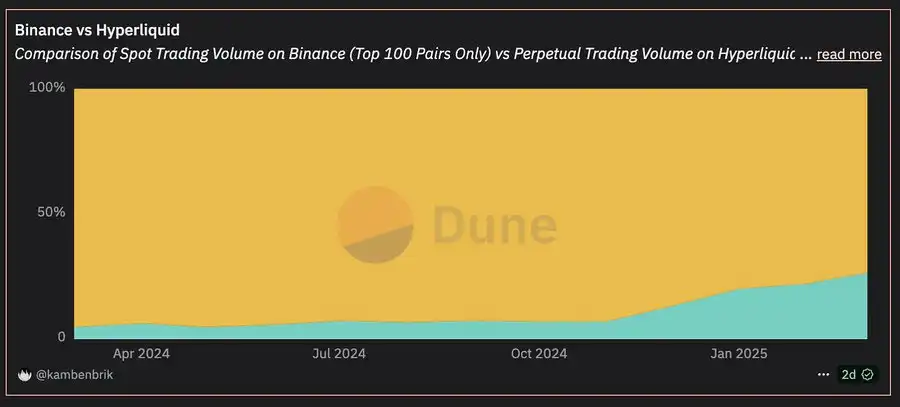
· Although Hyperliquid is still smaller than top CEXs like Binance, it has narrowed the gap in some months. By March 2025, its trading volume accounted for over 26% of the total trading volume shown (compared to Binance's top 100 spot trading pairs). This comparison highlights how a high-performance on-chain perpetual contract exchange can effectively challenge and even dominate the centralized spot market.
On-chain Transparency vs. Centralized Control
CEXs usually have proprietary off-chain engines, which may have opacity in order routing, fees, or front-running. Hyperliquid's fully on-chain design allows anyone to verify transactions in real-time.
Future Goal: "On-chain Binance"
Analysts describe Hyperliquid's bullish scenario as developing into an on-chain equivalent of Binance. It has already provided perpetual contracts and an expanding spot market, recently launching spot BTC, and HyperEVM is now running on the mainnet, starting to attract a broader DeFi application.
After becoming a product leader in the DeFi derivatives field, Hyperliquid's rapid success is not only dependent on its performance; it also demonstrates its community-first philosophy.
Hyperliquid's Community: A Platform Built for Traders
Community-First Token Allocation
· No risk investors holding: Hyperliquid's team developed through self-funding, avoiding the allocation of private investors. This ensures that tokens are not diluted by large venture capital shares, contrasting sharply with competitors like dYdX (over 50% to investors) or GMX (30% to internal personnel).
· Generous airdrops:
Genesis airdrop (31% of supply): distributed to 94,000 early users, averaging about $45,000 each. This rewards genuine users, not speculators.
Point system: opaque reward mechanisms suppress Sybil attacks, favoring loyal users over bots.
76% community allocation: Over three-quarters of $HYPE tokens are allocated to the community (airdrops + incentives), ensuring alignment with long-term growth.
Listening to Users
Direct feedback builds a community with shared interests. The team contacted traders like @HsakaTrades (with over 500k followers) and @burstingbagel via private messages, establishing Vaults (e.g., Delta-neutral strategies with 20%+ annualized returns) and HLP. Since 2024, over 50% of feature updates have come from user requests, making traders co-creators rather than just users.
· Building Trust Through Reliability
A reliable product retains users in a skeptical market. Traders initially came for airdrops but stayed because Hyperliquid offers 1-second deposit speed, HLP deep liquidity, and 99.9% uptime, unlike competitors that frequently go down.
Hyperliquid is not the first DEX to launch perpetual contracts, but by optimizing transaction speed (sub-second order execution), liquidity (HLP pools exceeding $540 million), and user experience (addressing withdrawal delays neglected by competitors), it achieved daily 100,000 transactions, successfully refuting the notion that "dYdX or GMX had already ended the derivatives market."
Aid Fund
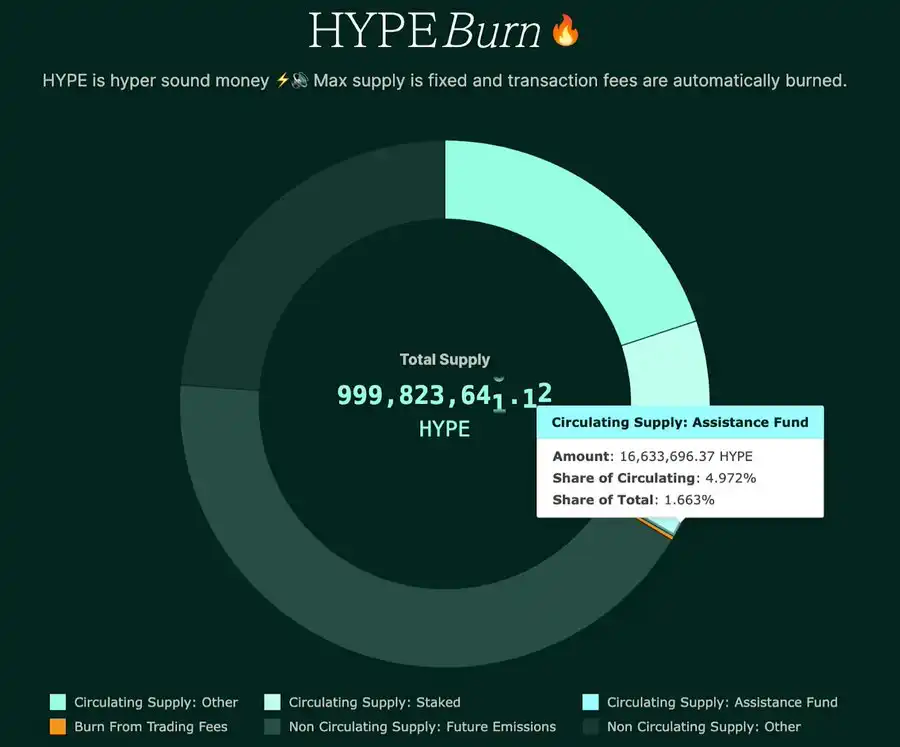
When traders use the Hyperliquid platform, they pay transaction fees, part of which is allocated to the Aid Fund (AF).
This fund continuously buys HYPE tokens from the market, creating sustained buying pressure. As trading volume increases, more fees flow into AF, further driving demand for HYPE. As of now, AF has accumulated 16.63 million HYPE tokens, accounting for 4.97% of the circulating supply, valued at approximately $267.24 million. The rapid growth of Hyperliquid is evident, with perpetual trading volume reaching $196 billion in January 2025 alone.
What does this mean for end users
For HYPE holders and traders, this system creates a self-reinforcing value loop. As Hyperliquid trading activity grows (as shown in the chart below), the purchasing power of the aid fund also increases, ultimately benefiting long-term token holders.
Self-reinforcing cycle: More trading → More fees → More buybacks → Increased token value.
User-Centric Product Design
· Gas-free trading: Gas fees are only generated when transaction activity increases (e.g., listing of spot or transferring to a new wallet).
· No KYC: Register via email or crypto wallet (e.g., MetaMask).
· Intuitive interface: Designed to cater to both beginners and advanced traders, with a user interface similar to centralized exchanges (e.g., Binance).
· Near-instant settlement: Sub-second block time supports real-time trading.
· High throughput: Processes over 200,000 transactions per second, without delays even during peak activity.
· Easy fund deposits: Deposit USDC via Arbitrum (future plans to support native multi-chain).
· Gamified design: Leaderboards and competitive rewards (e.g., airdrops for top traders), creating a sticky, active community.
Decentralization Path
Although Hyperliquid's L1 was initially operated by the team's validators (to optimize performance and fast iteration), it is gradually moving towards a multi-validator network and a distributed node framework:
· Expanding the validator set (from 16 to over 100 nodes).
· Read-only nodes: Third parties can run nodes to validate the chain's state and block production.
· Long-term deployment plan: As the ecosystem develops, the team plans to introduce stronger staking and validator onboarding mechanisms, moving towards a trustless model, similar to leading proof-of-stake networks.
· Team incentive alignment: Since fees currently flow to the protocol treasury and LP providers (not the founding team), the team's future compensation is tied to the upcoming token, aligning with long-term chain performance and decentralization goals.
Looking ahead, Hyperliquid is evolving from a focused perpetual contract DEX into a full-fledged exchange ecosystem, with the addition of BTC spot trading, the launch of HyperEVM on the mainnet, and the expansion of the validator set. Its ambition is clear, aiming to become the "on-chain Binance."
Its combination of CeFi performance and DeFi transparency has captured 64.71% of on-chain perpetual contract trading volume, proving that a successful community-driven approach can drive DEXs to challenge even the largest centralized platforms.
What Is the Secret to Hyperliquid's Success?
1. No VC, self-funded model: Ensures users own tokens, reduces private sale pressure, prioritizes genuine trader interests, not short-term investors.
2. User-centric token distribution: Generous airdrops (31% of supply allocated to early users, overall about 76% allocated to the community), dynamic point system to prevent Sybil attacks, and an aid fund that repurchases tokens to benefit holders.
3. High-performance Layer-1 (HyperBFT + HyperEVM): Sub-second confirmation, over 100,000 orders per second, and EVM compatibility, combining speed and future DeFi scalability.
4. Fully on-chain CLOB: Transparent order matching and minimal slippage, bridging the liquidity gap that typically binds traders to CeFi.
5. One-stop service for spot and perpetual contracts: Seamless access to core markets: newly launched BTC spot and strong perpetual products. Users can manage spot and leveraged positions on a single platform.
6. Community-driven feature development: Direct feedback loops (requests for Vaults, HLP enhancements, cross-chain bridges) let traders participate and shape continuous improvements.
7. Long-term decentralization vision: Gradually expanding the validator set, opening read-only nodes, and a fee structure without team profits, ensuring aligned incentives and gradual trustlessness.
By combining technical excellence, community-first incentives, and uncompromising user experience, Hyperliquid has already outlined a blueprint for DeFi success.
Its "secret" is essentially a perfect combination of institutional-grade performance and grassroots user engagement - a combination that redefines on-chain trading and paves the way for a broader future for decentralized finance.
Disclaimer: Contains third-party opinions, does not constitute financial advice


AI Practical Guide
This column focuses on the real progress of Agents: technological evolution, application implementat

Crypto Weekly
Tracking on-chain movements of the smart money and institutions

Frontier Insights
Spotlight on Frontier, trending projects, and breaking events

Blowup Alert
As the 2026 crypto bear market deepens, exit scams and project blowups are becoming increasingly fre

Regulatory Watch
American Crypto Act – timely interpretations of policies worldwide

Popular Airdrop Tutorial
Selected potential airdrop opportunities to gain big with small investments

FusnChain
FusnChain