
ChainThink
Stay ahead, master crypto insights
Binance Alpha Gold Mining Guide: How to Score Efficiently at Low Cost
Binance Alpha Gold Mining Guide: How to Score Efficiently at Low Cost

2025-05-05 20:19
Original Title: "Binance Alpha Mining Guide: How to Efficiently Accumulate Points at Low Cost"
Original Author: Luke, Mars Finance
The Binance Alpha Points System is a mechanism designed to assess user activity, with point levels directly determining eligibility for participation in Web3 token generation events (TGEs) and airdrops. Points are derived from both asset balance and trading volume, while double-point campaigns significantly enhance point accumulation efficiency. By optimizing trading strategies, selecting low-cost blockchains and high-potential tokens, participants can efficiently build points at minimal cost, positioning themselves to capture early Web3 opportunities.

Opening: The New Arena of the Points Race
The Binance Alpha Points System resembles a high-stakes “points battlefield” within the crypto world. Since the rule update in May 2025, competition has intensified dramatically. The qualification threshold for the $BOOP airdrop has surged to 137 points, with some players achieving 150 points in just 15 days—averaging 10–12 points per day, embodying the essence of a true “point chaser.” These points are far more than mere numbers; they determine whether you secure your “golden ticket” into the Web3 ecosystem—whether participating in TGEs or claiming free airdrops. High points mean more opportunities.
Today, we dive deep into the mechanics of the Binance Alpha Points System, leveraging on-chain data to outline a low-cost, high-efficiency strategy that will help you stand out in this points race and firmly seize the upcoming Web3 upside.
Chapter One: Decoding the Points Rules – Know Your Enemy
1.1 What Are Binance Alpha Points?
The Binance Alpha Points System is a dedicated metric assessing user engagement, primarily measuring activity across the Binance Alpha section and the Binance Wallet ecosystem. Point levels directly influence eligibility for token generation events (TGEs) and Alpha token airdrops. In short, points serve as your “entry pass”—the higher your score, the greater your chances.
1.2 What Are Binance Alpha Tokens?
Binance Alpha Tokens refer to a category of special tokens featured on the Binance Alpha platform. Launched officially on December 17, 2024, Binance Alpha is committed to identifying early-stage projects with strong growth potential within the Web3 ecosystem. These tokens are typically those of emerging projects, with some having future listing prospects on Binance’s spot market. However, not all tokens succeed in listing—investors must proceed with caution.
1.3 How Are Points Calculated?
Binance Alpha Points consist of two components: Balance Points and Trading Volume Points. The final score is the average sum over the past 15 days. Daily points are calculated via snapshots based on your asset balance and trading behavior, with snapshots conducted in UTC time to ensure fair global participation.
· Balance Points: Based on your total asset balance across Binance CEX (main account) and non-custodial wallets, including Alpha tokens and tokens previously showcased on the Alpha section now listed on spot markets. Sub-account balances are consolidated into the main account for calculation—splitting funds across accounts does not enable manipulation.
· Trading Volume Points: Based on the total purchase amount of Alpha tokens on the Binance Alpha platform and non-custodial wallets (only buys count, sales are excluded). Trading Volume Points are calculated solely on the buying amount, unaffected by subsequent sales. For example, if you buy $600 worth of tokens and later sell $500, your points remain based on $600. Token value is assessed using USD-equivalent market prices at the time of transaction, ensuring fairness.
Even more appealing is the Double Points Campaign launched by Binance on May 1. Purchasing Alpha tokens via Binance Smart Chain (BSC), or using limit orders (Limit Order) to buy any Alpha token, doubles the trading volume calculation. For instance, a $10 transaction on BSC counts as $20, earning you 10 points directly. This “buy one, get one free” benefit is nothing short of a blessing for point hunters.
To better visualize the rules, we’ve compiled the following table illustrating the exact calculation methods for Balance Points and Trading Volume Points:
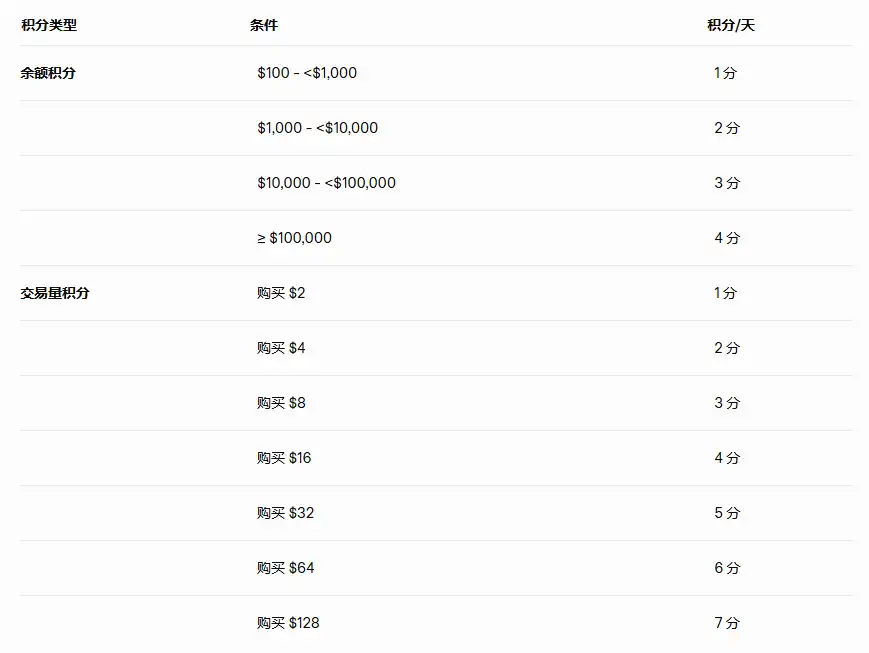
Note: Each doubling of trading volume grants an additional 1 point. Balance snapshots are recorded in UTC time.
This table clearly shows that Balance Points grow slowly, while the doubling mechanism of Trading Volume Points makes it the primary driver of efficient point accumulation.
Chapter Two: The Value of Points – Rewards Are Substantial
You might wonder: Why go through all this effort to earn points? The answer is simple: the rewards are significant. Alpha Points directly determine eligibility for TGEs and airdrops. TGEs offer early access to high-potential projects, often delivering returns of several times or even tens of times. Airdrops, meanwhile, are synonymous with “free gains”—for example, the recent $BOOP airdrop allows eligible users to receive tokens for free, potentially worth hundreds of dollars upon conversion.
Consider April’s case studies: some players leveraged precise understanding of the points system, accumulated sufficient points, and earned over $2,000 in profit. Such returns are hard to resist. Especially with the launch of the Double Points Campaign, entry barriers have dropped significantly, effectively offering everyone a prime opportunity to “get on the train.” Missing this wave means facing even stiffer competition in the future.
Chapter Three: Strategy Upgrade – Low Cost Is King
Now we arrive at the core question: How to accumulate points efficiently without draining your wallet? The goal is to achieve 10–12 points per day, aiming for 150–180 points within 30 days, while keeping trading costs (fees and slippage) under control. Below are three optimized strategies, informed by the latest rules and on-chain trends, to help you maximize results with minimal effort.
3.1 Leveraging Double Points: BSC and Limit Orders
The Double Points Campaign is currently the biggest advantage, especially when utilizing BSC. BSC boasts extremely low gas fees—typically just $0.01 to $0.03 per transaction—offering exceptional cost efficiency. On-chain data reveals that tokens like $B2 account for up to 13% of trading volume, with strong liquidity and minimal price volatility, making them ideal for high-frequency trading.
How to execute? Suppose you trade $10 daily on BSC during the campaign. This will be counted as $20 due to doubling, earning you 10 points effortlessly—meeting your daily target. Using limit orders enhances effectiveness further. A limit order involves setting a specific buy price (slightly below market price) and sell price (slightly above). For example, buy at $5, sell at $5.02, repeating the cycle. This approach accumulates trading volume while keeping slippage within 0.1% to 0.2%. Over 30 days, you could accumulate 300 points with total transaction costs ranging between $30 and $60—remarkably cost-effective.
3.2 High-Value, Low-Gas Chains: Solana and Sonic in Parallel
If cost control is your priority, Solana and Sonic chains are worth exploring. Solana’s gas fees are usually under $0.01 per transaction. Popular on-chain tokens like $KMNO account for over 30% of trading volume, with exceptional liquidity—perfect for small, frequent trades. Sonic’s fees are even lower, and recent promotional activities offer added incentives. $Anon is a solid choice.
A viable strategy: trade $100–$200 daily on the Sonic chain. Execute 50–100 transactions of $2–$5 each. Base points alone would yield 50–100 points. With double-point bonuses, this could reach 100–200 points. Slippage kept under 0.1%, daily cost around $2, totaling $60 over 30 days—achieving 3,000 points. Solana operates similarly but features more mature tokens, making it suitable for beginners.
3.3 Dual-Purpose Strategy: Points + Investment in High-Potential Tokens
If you possess market insight, consider combining point accumulation with investment. Select high-growth potential tokens such as $gork, which recently entered the top three by trading volume and enjoys strong market momentum. Trade $5–$10 per round, accumulate holdings, and wait for appreciation. Again, use limit orders with low buy-high sell setups to minimize costs.
The brilliance lies in earning points while potentially profiting from token appreciation. For instance, investing $300 in $gork, accumulating 300 points over 30 days, and achieving a 50% token increase yields an extra $150—easily covering the $60 in trading costs. However, avoid chasing high-priced spikes; instead, choose tokens with stable K-line patterns to prevent sudden losses.
To assist in choosing the right strategy, we’ve compared the three approaches:
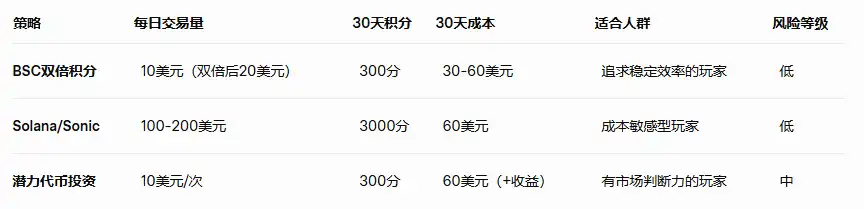
As shown in the table, the BSC strategy suits those seeking stable, efficient performance. The Solana/Sonic approach offers lower costs and higher points. The high-potential token strategy may generate additional returns but carries slightly higher risk. Choose the approach best aligned with your goals.
Chapter Four: Breaking Through the Ceiling – Targeting Higher Goals
The points race is never smooth sailing. Many players are already approaching 150 points, maintaining a steady 10–12 points per day. Yet pushing beyond 180 points—or even higher—feels like hitting an invisible wall. Don’t worry—here are proven tactics to break through the bottleneck and advance toward greater targets.
Increase Trading Volume for Single-Day High Scores
Current daily averages of 10–12 points stem from $20–$24 daily trading volume (doubled post-campaign). To break through, try increasing daily volume to $200. With the double-point bonus, this equates to $400 in effective volume—earning 200 points in a single day. Sustaining this pace for a few days creates a significant lead. However, note that increased volume raises costs. We recommend batching transactions—each $5–$10—to avoid large slippage risks from single large trades.
Multichain Synergy for Doubled Efficiency
Operating on a single chain may create inefficiency bottlenecks. Consider multichain coordination. For example, simultaneously trade on BSC, Solana, and Sonic. Allocating $50–$70 daily per chain totals $150–$210 daily—easily reaching 200 points per day. BSC excels in high-frequency trading, Solana offers ultra-low fees, and Sonic may feature bonus incentives. Combined, these chains diversify risk and boost overall efficiency. Sonic, in particular, may introduce additional point rewards through ongoing promotions—worth dedicating extra attention.
Optimize Trading Timing – Capture Low-Volatility Windows
Market volatility significantly impacts point efficiency. Trading during sharp price swings increases slippage, undermining cost control. Instead, opt for periods of relative calm—avoiding post-news event volatility or targeting Asian trading hours (8 AM to 2 PM Beijing Time), when liquidity remains stable and slippage typically stays under 0.1%. Strategic timing elevates your point accumulation efficiency.
Leverage Tools – Boost Operational Efficiency
Manual daily execution can be exhausting. Consider automation tools: use Binance API to set up automated trading scripts, predefine buy/sell prices via limit orders, and let the program handle repetitive tasks. Ideal for technically inclined users, this approach saves time and ensures consistent execution. However, thoroughly test your strategy before deployment—incorrect settings can lead to capital loss.
Chapter Five: Risk Management – Success Through Stability
While point accumulation is thrilling, avoid depleting your wallet. In the points arena, long-term success comes from stability. Here are key risk mitigation measures to ensure your journey is both efficient and secure.
· Cost Control: Minimize Wear-and-Tear: The core of point farming lies in cost management. Ideally, daily fees and slippage should stay under $2, with total monthly costs capped at $60. How? First, choose high-liquidity tokens like $KMNO or $B2—trading $1,024 may incur only $2 in slippage, offering excellent value. Second, use limit orders with tight spreads (0.1%–0.2%) to avoid losses from market orders. Third, prioritize low-gas chains like Solana and Sonic—avoid Ethereum, where gas fees are prohibitively high.
· Market Risk: Prevent Volatility from Stealing Profits: Market fluctuations are the nemesis of point farming. Buying at peaks and facing sudden drops can erase gains in minutes. Mitigation strategies: Avoid FOMO-driven trades; focus on tokens with stable K-lines, like $KMNO, known for high volume and low volatility. Monitor market sentiment via on-chain dashboards (e.g., Dune) to track volume and price trends—avoiding abnormal volatility. Beginners should start small, gradually building familiarity.
· Fund Safety: Diversification Brings Peace of Mind: Concentrating on one token simplifies operations but magnifies risk. If that token crashes or suffers a black swan event, your capital could be severely impacted. Better practice: diversify. Allocate funds across multiple tokens—e.g., $B2, $KMNO, and $gork—each receiving 30%–40% of your capital. This way, if one token falters, others act as a buffer, reducing overall exposure.
· Compliance & Efficiency: Rule-Following and Tool Integration: Always adhere to platform rules to avoid account restrictions. Excessive transaction frequency may trigger anti-fraud systems—limit to no more than 5 trades per minute. If time is limited, consider using Binance API for automated trading—pre-set strategies save time and improve efficiency. But always review platform terms before use; improper actions can backfire.
Chapter Six: Future Trends – Seize the Window
Competition for Alpha Points will only intensify. Future trends warrant proactive preparation. Current rules and campaigns may represent your last chance to “overtake on the curve.” Below are key trends and recommendations to watch.
Points Threshold: Likely to Exceed 200
With growing player numbers, qualification thresholds will inevitably rise. The $BOOP airdrop already requires 137 points; some TGEs may demand even higher scores. Expect thresholds to surpass 180–200 points within the next month. If your current points hover around 150, the next 30 days are critical. Maintain a 10–12 points/day pace and leverage the Double Points Campaign to surge ahead before the bar rises.
Event Window: Don’t Miss the Double Points Campaign
The Double Points Campaign, starting May 1, is the most valuable window today. But it won’t last forever—likely ending within weeks. Once gone, point efficiency plummets, widening the gap between competitors. Now is the perfect time to accelerate. Prioritize BSC and limit orders to fully exploit the doubling effect and lay a strong foundation for future competition.
New Chain Opportunities: Sonic’s Untapped Potential
Sonic, as a rising ecosystem, has drawn many participants through recent promotions. On-chain data shows $Anon’s trading volume on Sonic is growing rapidly, with potential future incentives—including extra point multipliers or new token airdrops. If you want additional upside beyond points, consider increasing your Sonic chain activity and monitor official announcements to join new campaigns immediately.
Strategy Adaptation: Stay Agile Amid Changes
The points landscape evolves quickly. Rules and market conditions may shift at any time—Binance could launch new token support or adjust the double-point formula. Regularly check official announcements and track real-time trends via on-chain dashboards like Dune. Adjust your strategy dynamically: when trading volume declines on a popular token, pivot to other chains or tokens promptly, maintaining optimal efficiency.
Conclusion: Win Through Wisdom, Not Just Speed
The Binance Alpha Points System opens a gateway to Web3 opportunities. Whether leveraging BSC’s double-point bonus, exploiting low-cost trading on Solana and Sonic, or combining point farming with high-potential investments, success hinges on low cost and consistent action. There are no shortcuts in this race—but with smart strategy and disciplined execution, you can outlast the competition. May your points climb steadily, and may you unlock your full Web3 reward in due time!
Disclaimer: Contains third-party opinions, does not constitute financial advice


AI Practical Guide
This column focuses on the real progress of Agents: technological evolution, application implementat

Crypto Weekly
Tracking on-chain movements of the smart money and institutions

Frontier Insights
Spotlight on Frontier, trending projects, and breaking events

Blowup Alert
As the 2026 crypto bear market deepens, exit scams and project blowups are becoming increasingly fre

Regulatory Watch
American Crypto Act – timely interpretations of policies worldwide

Popular Airdrop Tutorial
Selected potential airdrop opportunities to gain big with small investments

FusnChain
FusnChain