36 Years, 4 Wars, 1 Script: How Capital Prices the World in Conflict?
36 Years, 4 Wars, 1 Script: How Capital Prices the World in Conflict?


War reveals ruins to the world, but capital only watches prices.
As artillery reignites across the Middle East, colleagues in Dubai report bombings and air raid sirens. The sky torn by missiles bears the uncertain fate of humanity awaiting the unknown.
Meanwhile, on another invisible timeline, global financial markets have already begun recalibrating: How high will oil prices rise? Will gold continue its ascent? When will equities bottom out and rebound?
Capital shows no sympathy, nor does it rage. It simply performs one cold, rational act—pricing uncertainty. To most, it is invisible, incomprehensible, logically ruthless and rhythmically merciless.
Yet in turbulent times, understanding capital’s mechanisms and risk pricing logic may be the last line of defense between ordinary people and the tides of history. Looking back at human geopolitical conflicts and financial history, you’ll discover an almost unchanging pattern: in the face of war, capital markets always repeat the same script—and over the past 36 years, this script has been fully played out four times.
The Capital Fear Most Is Not Conflict, But "Waiting"
From the Gulf War in 1991, the Iraq War in 2003, to the Russia-Ukraine conflict in 2022, the script unfolds identically each time. These three globally impactful geopolitical crises illustrate the pricing dynamics of capital markets through their phases: “Preparation Phase — Crisis Phase — Clarity Phase.”
Financial markets are fundamentally a machine for discounting expectations. During the preparation phase, fear of supply disruption drives crude oil and gold to astronomical levels, while global equities plunge off a cliff. Yet Wall Street holds a bloody iron law: “Buy to the sound of cannons.”
Once the first cannon shot rings out (or the situation becomes clear), the greatest uncertainty is resolved. Safe-haven assets often peak and reverse swiftly, while equities complete a deep V-shaped reversal at the point of despair. War may still rage—but capital’s panic has ended.
Below is a deep analysis of capital market shifts during these three historical events:
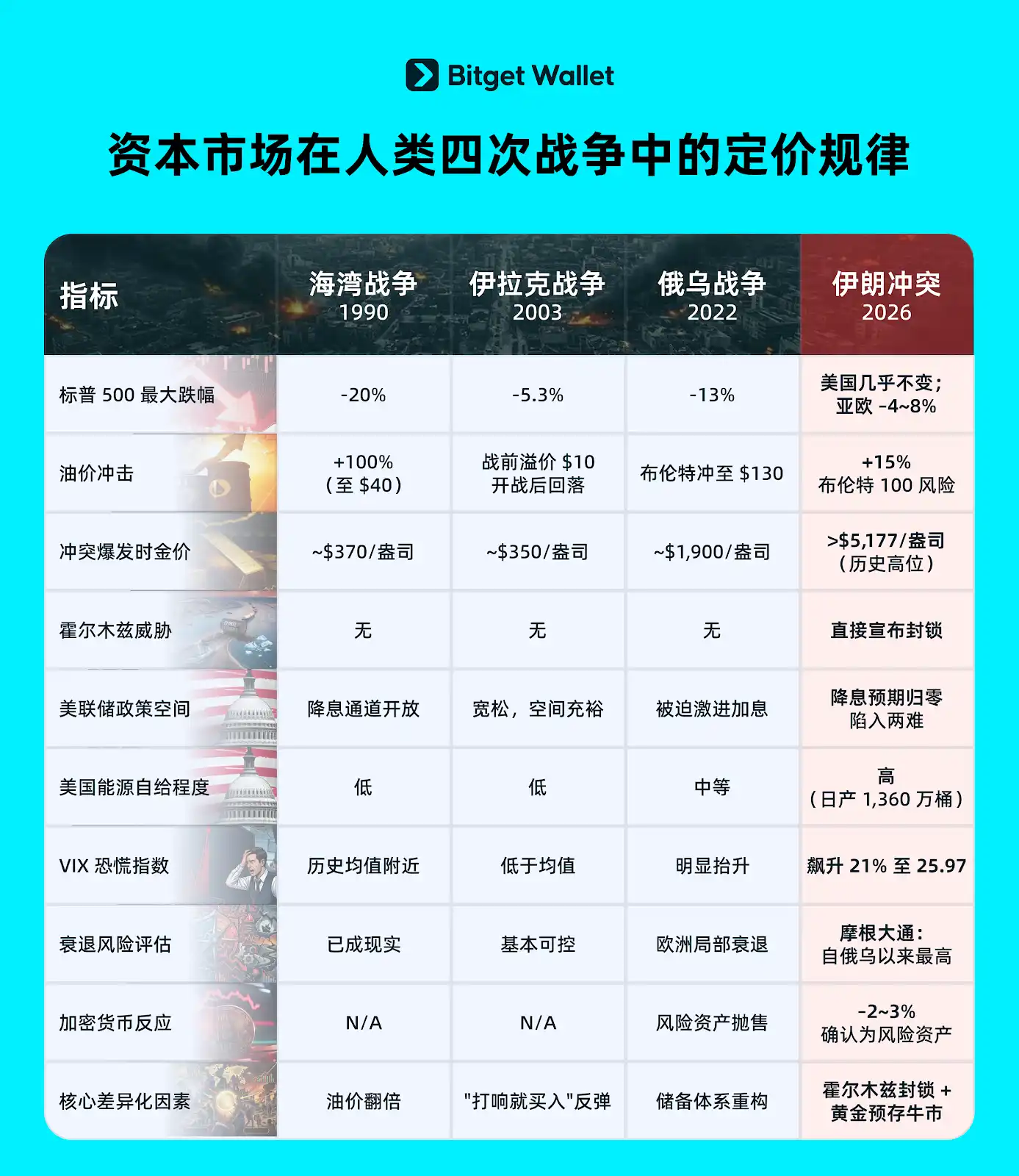
1. 1990–1991 Gulf War: The Classic “V-Shaped Reversal” and Oil Shock
This war remains a textbook case in modern financial history for studying geopolitical shocks, perfectly embodying the principle of “buy the rumor, sell the news.”
· Preparation Phase (August 1990 – January 1991): Panic and Flight to Safety
Oil Surge: After Iraq’s invasion of Kuwait, markets panicked over potential Middle Eastern oil supply disruption. Within two months, international oil prices soared from around $20 per barrel to over $40, surging more than 100%.
Stock Market Collapse: Affected by soaring oil prices and looming war clouds, the S&P 500 plunged nearly 20% between July and October 1990.
· Event Resolution (January 17, 1991): Market Turnaround That Defies Intuition
On the first day of Operation Desert Storm led by U.S. forces, the market delivered an extremely counterintuitive move: With the war unfolding overwhelmingly in favor of coalition forces, “uncertainty” vanished instantly.
Oil Plunge: Crude prices recorded one of the largest single-day drops in history (plunging over 30%) on the opening day of hostilities.
Equity Rally: The S&P 500 surged that day, triggering a sharp V-shaped recovery. Within half a year, the index not only reclaimed all losses but also hit new record highs.
2. 2003 Iraq War: A Long Drawn-Out Decline Followed by Relief
The 2003 Iraq War compounded lingering aftermath from the dot-com bubble burst and security anxiety following 9/11, leading market reactions to reflect a sense of “better a short pain than long suffering.”
· Preparation Phase (Late 2002 – March 2003): Slow Bleeding
Over months of diplomatic brinkmanship and military buildup, capital markets behaved like startled birds. The S&P 500 steadily declined, as global capital fled into safe havens such as gold and U.S. Treasuries due to heightened risk aversion.
Crude oil prices, driven by war expectations and strikes in Venezuela, slowly rose from $25 to nearly $40.
· Event Resolution (March 20, 2003): The Worst Is Over, So It’s a Buy
Remarkably, the absolute market bottom occurred just one week before the war began (around March 11, 2003).
When missiles finally struck Baghdad, the market interpreted it as “bad news priced in.” Equities then surged rapidly, launching a four-year bull run. Safe-haven assets like gold cooled quickly as the war progressed smoothly.
3. 2022 Russia-Ukraine Conflict: Supply Chain Disruption Triggering “Super Stagflation”
Differing from previous Middle Eastern wars—where the U.S. achieved overwhelming victories with minimal lasting damage to global supply chains—the Russia-Ukraine conflict had deeper, heavier impacts and altered the macroeconomic foundation.
· Crisis Onset (February 2022): Epic Commodity Storm
Russia is a global energy and industrial metal giant; Ukraine is the “breadbasket of Europe.” After the conflict erupted, Brent crude briefly breached $130 per barrel; European natural gas prices surged severalfold; wheat and nickel reached historic highs.
· Sustained Impact: The “Double Kill” of Inflation Surge and Monetary Tightening
Stocks and Bonds Fall Together: The most devastating market impact of the Russia-Ukraine conflict was shattering the fragile post-pandemic global supply chain, directly igniting the worst inflation in decades in the U.S. and Europe.
To combat this “imported inflation” triggered by geopolitics, the Federal Reserve was forced into the most aggressive rate hiking cycle in history. This resulted in the rare “equity-bond double whammy” (stocks down, bonds down) in 2022, with the Nasdaq Index plunging over 30%.
Deadly Illusion: Never Try to “Profit from War”
Let us bring the timeline back to reality.
The sudden escalation in the Middle East has once again pushed global capital markets into a high-stress “pressure test” phase filled with uncertainty.
From a macroeconomic transmission perspective, the core threat of Middle East conflict to capital markets lies in: “Physical supply chain disruption → Energy price surge → Global inflation rebound → Central banks forced to maintain tight policy → Risk asset collapse.”
Chain Reaction Analysis in Capital Markets
1. International Crude Oil: The Absolute Epicenter of the Storm
Chain Reaction: The Middle East controls the lifeblood of global crude (especially key straits like the Strait of Hormuz). Any expansion of conflict or risk to major oil producers triggers immediate market pricing of “geopolitical risk premium.” This causes Brent and WTI crude to spike sharply in pulses within days.
Deeper Impact: Oil is the mother of industries. Price spikes raise costs across aviation, logistics, and chemical sectors—and transmit directly into “imported inflation,” threatening global price indices (CPI) that were only recently stabilizing.
2. Precious Metals (Gold/Silver): The Traditional Ultimate Safe Haven
Chain Reaction: In times of war, geopolitical turmoil, and potential hyperinflation, capital instinctively flows into gold. Gold prices typically gap up at the onset of conflict, reaching new highs or even record-breaking levels. Silver, due to its industrial use, exhibits higher volatility than gold.
Deeper Impact: Note that gold’s rally is often driven by emotion. Once the situation clarifies (even if conflict continues), risk-off sentiment fades, and gold prices are prone to rapid retracement, reverting to pricing logic dominated by real U.S. interest rates.
3. U.S. Equity Market: The Inflation Ghost and “Valuation Kill”
Chain Reaction: War is generally bearish for U.S. equities. The VIX volatility index surges quickly, prompting capital to flee high-growth tech stocks (e.g., AI, semiconductors) and shift toward defensive sectors like defense, traditional energy, and utilities.
Deeper Impact: What U.S. equities fear most isn’t Middle Eastern artillery—it’s inflation rebound triggered by war. If oil spikes push CPI persistently high, the Fed must delay rate cuts or even hike again. This tightening of macro liquidity inflicts severe valuation pressure on tech stocks, especially those in the Nasdaq.
4. Crypto Market: Liquidity Drain for High-Risk Assets
Chain Reaction: Despite Bitcoin’s “digital gold” narrative, during actual geopolitical crises (e.g., early stages of the Russia-Ukraine war, Middle East escalation), crypto markets behave more like a “high-volatility Nasdaq index.”
Deeper Impact: Facing war-related panic, Wall Street institutions prioritize selling the most liquid and risky assets first to raise cash. Cryptocurrencies are often hit first, experiencing sharp declines. Altcoins face liquidity drought. However, when local fiat collapses or traditional banking systems are disrupted regionally, the “censorship-resistant and borderless transfer” features of crypto attract some risk-averse capital.
Comparing these three historical geopolitical conflicts, we can distill a core rule for ordinary people facing geopolitical crises:
1. “Uncertainty” Is the Greatest Killer: The sharpest stock market declines almost always occur during the preparation and negotiation phase before war breaks out. Once war actually begins (especially when the situation becomes predictable), equities often bottom and rebound. This validates the Wall Street adage: “Buy when cannons roar.”
2. The “Pump-and-Dump” Trap in Commodities: Before and at the start of war, crude oil and gold often surge to absurd highs due to panic. But if the war doesn’t cause a long-term physical supply cutoff (as in the Gulf and Iraq Wars), prices plummet after hostilities begin—often halving. Chasing commodities blindly risks becoming the victim of institutional “dumping.”
3. Distinguish Between “Emotional Shock” and “Fundamental Damage”: If war is merely emotional shock (e.g., localized, lopsided conflict), equities fall and recover quickly. But if war disrupts core supply chains (e.g., energy and food crises from Russia-Ukraine), it reshapes the global pricing anchor via inflation and interest rate hikes. In such cases, the market’s painful adjustment period is prolonged.
History does not repeat itself exactly—but it rhymes. When observing current capital movements, we must remain calm and assess: Is the current conflict merely temporary panic, or will it truly reshape the black swan of global inflation and interest rate cycles?
Geopolitical maneuvering defies any rules. A single late-night ceasefire announcement can vaporize leveraged positions overnight. In crisis, the first rule is always preserving principal.
Defensive Position in Turbulent Times: How Ordinary People Should Play
Under the dual shadows of war and inflation, the ordinary investor’s primary goal must shift from “seeking high returns” to “preserving capital, hedging inflation, and insulating against tail risks.” We recommend restructuring your portfolio using the following “defend-and-counterattack” framework:
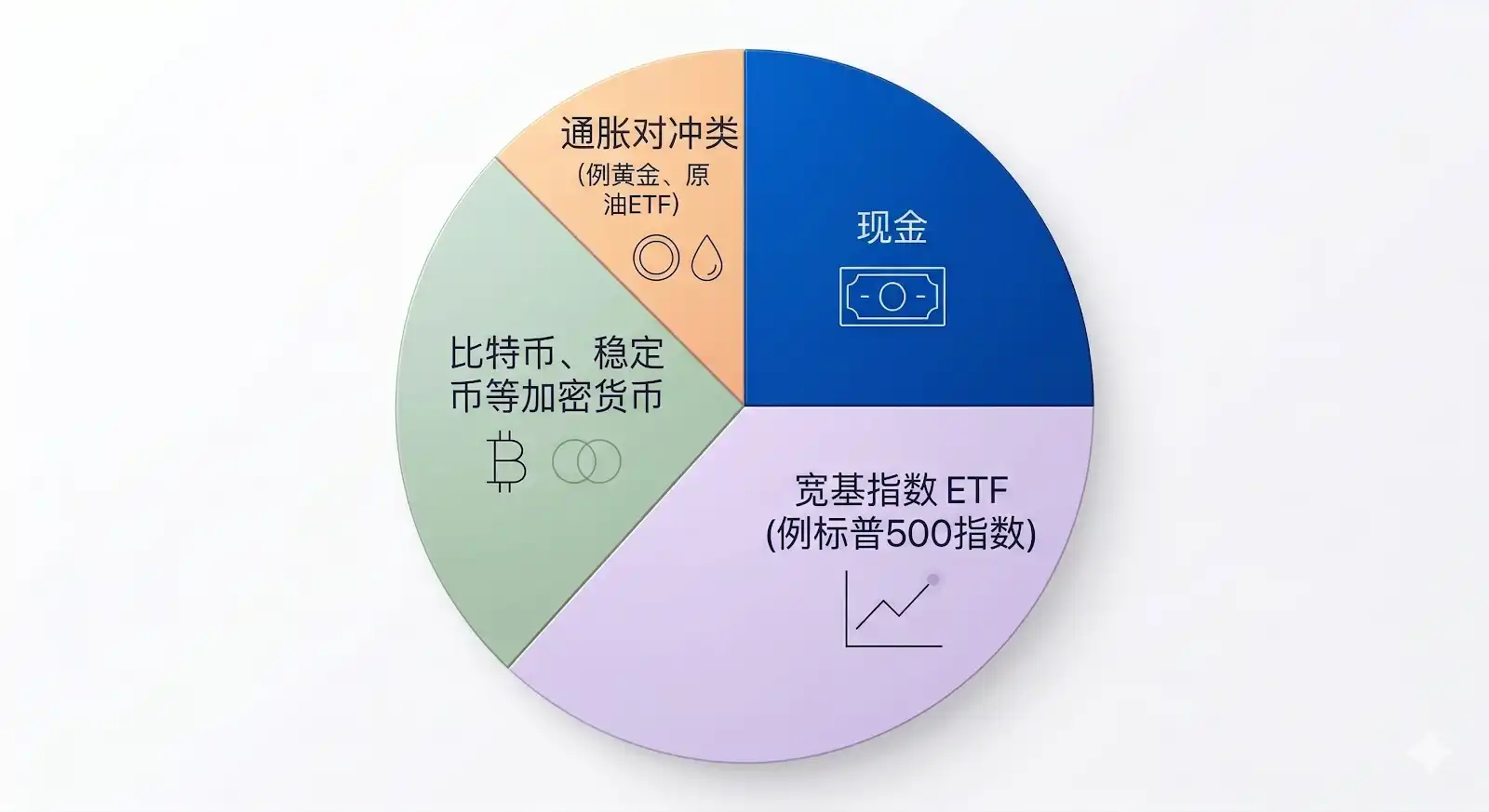
Strategy 1: Build a Cash Moat (20%-30% allocation)
· Action: Increase holdings in cash and cash equivalents (e.g., high-yield USD deposits, short-term treasuries, money market funds).
· Logic: In crises, liquidity is life. Holding ample cash ensures your household maintains quality of life amid soaring prices and gives you the firepower to “buy the dip” when markets crash.
Strategy 2: Buy Inflation “Insurance” (10%-15% allocation)
· Action: Allocate modest amounts to gold ETFs, physical gold, or select energy-focused broad-based ETFs.
· Logic: This portion isn’t for profit—it’s for protection. If war causes oil supply cuts and prices skyrocket, increased living costs can be offset by gains in gold and energy sectors. Remember: never go all-in chasing headlines.
Strategy 3: Conserve Resources, Hold Core Equity Positions (30%-40% allocation)
· Action: Sell high-leverage, unprofitable marginal stocks; concentrate capital into broad-based index ETFs (e.g., S&P 500) or companies with strong cash flow.
· Logic: Individual stocks face massive black swan risks during war (e.g., sudden supply chain collapse leading to bankruptcy). Embracing broad indexes leverages national resilience and systemic economic strength to hedge corporate fragility. As long as you stick to dollar-cost averaging and ignore short-term paper losses, crises often create long-term “golden pits” for accumulation.
Strategy 4: De-risk Crypto (For Web3 Users)
· Action: Reduce exposure to high-volatility altcoins and meme coins; consolidate funds into Bitcoin (BTC) as a long-term base position, or convert to USD stablecoins (USDC/USDT) and park them in top-tier compliant platforms to earn spot yields. Once geopolitical risk is deemed manageable and market liquidity returns, allocate 10%-30% of capital to meme coins based on your risk profile to capture alpha opportunities.
· Logic: Liquidity crises disproportionately affect small-cap cryptos. Stablecoins serve dual roles: safe haven and more flexible liquidity reserve than traditional banks.
Non-Negotiable Red Lines
1. No Leverage Allowed: Geopolitical developments shift in seconds. One ceasefire statement can trigger a 10% oil drop. In leveraged trading, you may not survive the short-term volatility before seeing long-term gains.
2. Abandon the “War Profiteering” Mentality: Information asymmetry in capital markets is brutal. By the time you decide to go long on an asset due to escalating conflict, Wall Street quant desks have likely already positioned to “take profits, sell the news.”
Against macro tremors, the ordinary person’s strongest weapon is not precise prediction, but common sense, patience, and a healthy balance sheet.
Wars will end, and order will be rebuilt upon ruins.
At the peak of extreme panic, the most anti-human action is staying rational; the most dangerous move is panic-selling. Remember the oldest investment maxim: Never bet on the apocalypse—because even if you win, no one will pay out.
And our deepest wish remains: peace restored, families reunited after forced separation, a world at peace.
Disclaimer: Contains third-party opinions, does not constitute financial advice
Coinbase Perpetual Contract Trading for Non-U.S. Regions Will Be Suspended for Approximately 1 Hour Starting at 17:00 on October 1
2 days ago
SpaceXAI to Tidy Up Subscription Chaos, Grok and Cursor to Unify Plans Within Weeks
18 days ago
JPMorgan: Oracle's Backlog Orders Up by $26 Billion, Funding Trail Raises Questions
18 days agoThe Nasdaq-100 Index futures decline widens to 1.5%
18 days agoJefferies: Expecting Fed rate hike this week, Wunsch's comments to be pivotal
18 days agoData: Bitcoin's current holding volume has decreased by 13.5% compared to September 3rd, suggesting the market may have already begun deleveraging ahead of time
18 days ago
The UK's Financial Conduct Authority is exploring regulatory exemptions for tokenized gold
18 days ago

