Predictive Markets Strike Again: Kalshi Launches $1 Billion Challenge
Predictive Markets Strike Again: Kalshi Launches $1 Billion Challenge


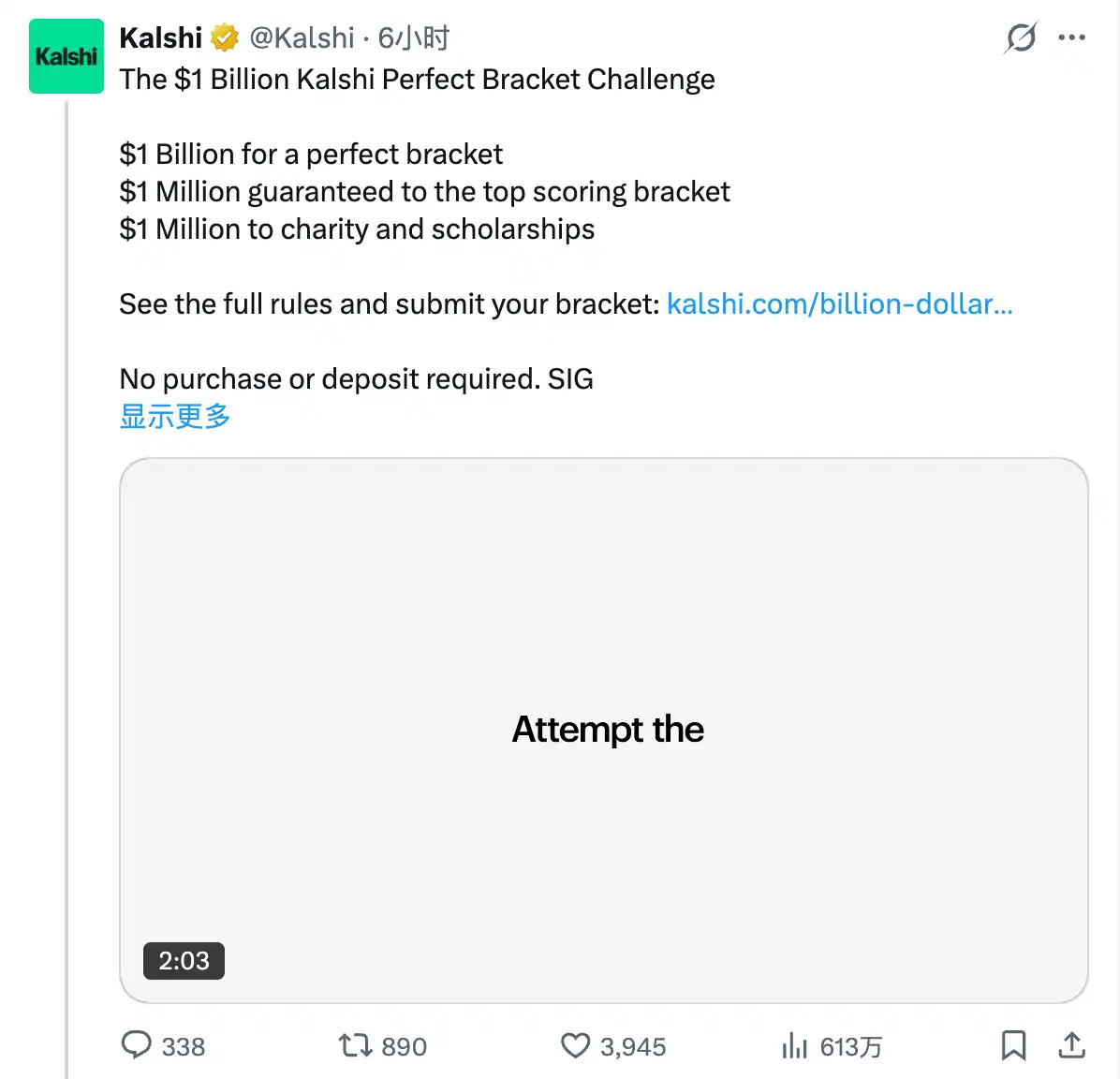
At 3:00 AM on March 17, prediction market Kalshi announced on X that it would follow in the footsteps of Warren Buffett by launching the "Perfect Bracket Challenge" for the upcoming NCAA "March Madness" tournament — a super prize of $1 billion awaits users who perfectly forecast all matchup outcomes.
"March Madness": The Nation's Most Exciting College Basketball Spectacle
Known as "March Madness," the NCAA Men’s Basketball Tournament is an annual event hosted by the National Collegiate Athletic Association (NCAA) every March. Named for its intense, single-elimination format and packed schedule, the tournament typically begins in March, drawing massive national attention.
Based on yesterday’s official draw, the 2026 "March Madness" tournament will officially commence at 8:00 PM Beijing Time on March 18 (tomorrow).
68 college teams that earned their spots through months of regular-season competition will now battle for the championship. The tournament kicks off with the First Four play-in games, where four teams will be eliminated directly. The remaining 64 teams will then proceed through five rounds of single-elimination matches (64 to 32 → Sweet 16 → Elite Eight → Final Four → Championship Game → National Champion) to determine the ultimate winner.
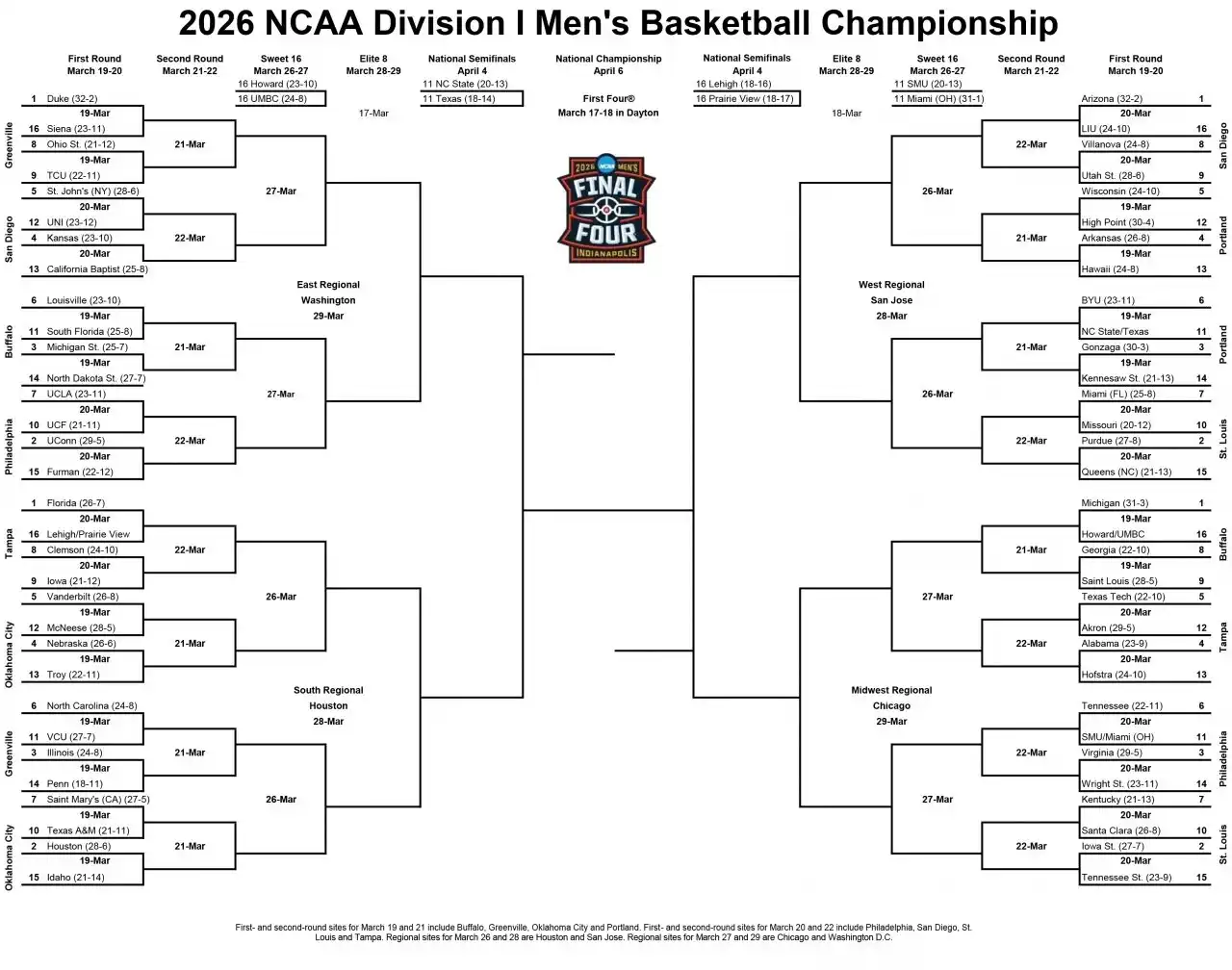
As the most-watched college basketball event in the U.S., NCAA tournaments foster a stronger sense of "team loyalty" among the public than NBA club-based competitions. During "March Madness," students, alumni, and local communities alike rally behind their alma maters. This grassroots enthusiasm often surpasses even the popularity of the NBA Finals.
From a competitive standpoint, while college players generally lack the overall skill level of professional athletes, the unique aspect of "March Madness" lies in the limited window each player has — typically just one to four years — before elite prospects enter the NBA draft. This fleeting opportunity heightens the stakes: once on the court, nearly every athlete plays with everything on the line.
Additionally, 2026 is widely regarded as a major NBA draft year, further amplifying interest in this year’s tournament. Players such as Darrin Peterson from Kansas University, AJ Dibanza from Brigham Young University, and Cameron Buser (son of former NBA star Carlos Buser, known as Yao Ming’s rival) are considered rare talents who could contend for the No. 1 overall pick in next year’s NBA Draft. The direct matchups between these future stars add a strategic forward-looking dimension to the tournament beyond pure entertainment value.
Unmissable Attention: Prediction Markets Can’t Afford to Miss Out
Drafting bracket predictions via sports betting platforms during "March Madness" has long been a cultural staple in the U.S. Can specialized prediction markets afford to miss this golden opportunity?
Currently, prediction markets such as Polymarket and Kalshi have already launched events tied to the "March Madness" tournament. Polymarket even classified this as one of its first pilot paid sports events, signaling strong intent to capitalize on the impending surge in activity.
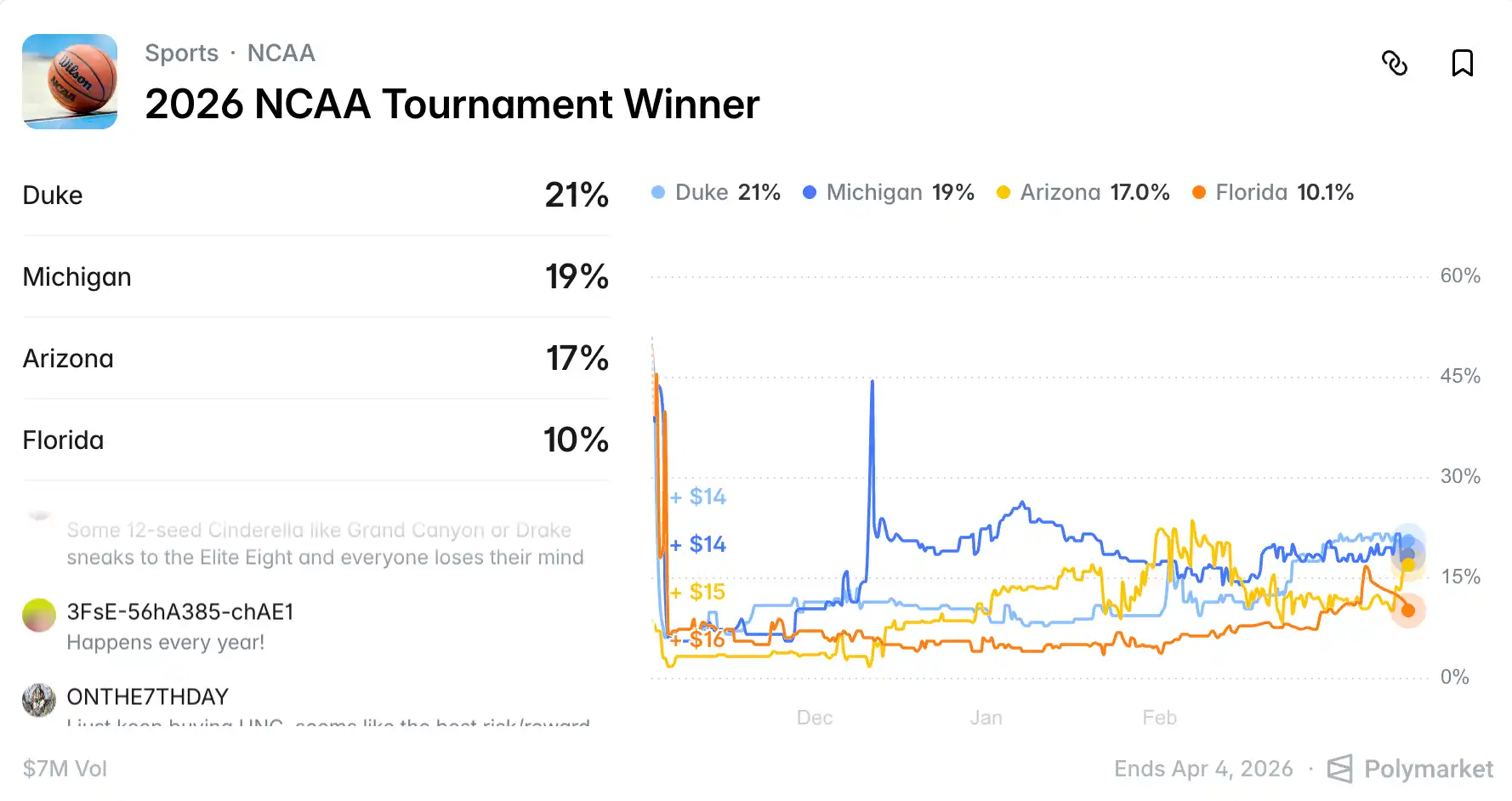
Polymarket’s real-time odds currently rank the top four championship contenders based on their respective regional seeds:
· Duke University, home to the projected #1 NBA draft pick Cameron Buser, leads with a 21% chance;
· University of Michigan ranks second at 19%, followed by University of Arizona at 17%;
· Defending champion Florida Gators rank fourth at 11%.
Meanwhile, Kalshi launched a nuclear-level $1 billion prize this morning, echoing Buffett’s legacy. All users can submit a free bracket on Kalshi; anyone who perfectly predicts all game outcomes wins the $1 billion jackpot. If no one succeeds, Kalshi will award $1 million to the best-performing participant and allocate an additional $1 million to support charitable causes.
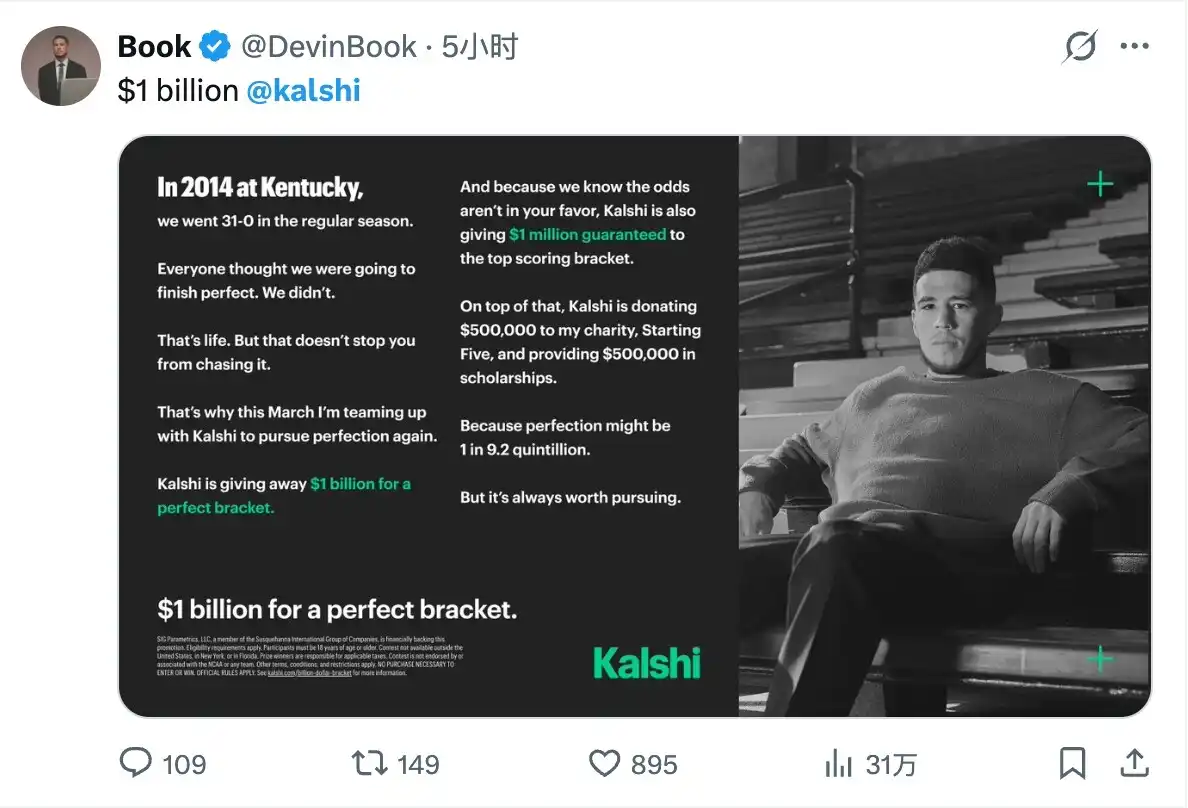
Notably, Kalshi enlisted NBA star Devin Booker to help promote the campaign. In 2014, Booker’s Kentucky Wildcats posted a perfect 31–0 regular season record and were heavily favored to win the national title — but fell 64–71 to Wisconsin in the semifinals. Booker entered the NBA the following year, leaving his collegiate dream unfulfilled.
Buffett Has Offered the Prize for 12 Years — Yet No One Has Claimed It
The reason Kalshi’s prize echoes Buffett is because Buffett established the same $1 billion reward back in 2014: employees of Berkshire Hathaway could win $1 billion if they correctly predicted every game result, paid out over 40 years (or a lump sum of $500 million).
However, due to the astronomical difficulty of perfect prediction, the prize has never been claimed. Buffett has since reduced the challenge’s difficulty (and correspondingly lowered the reward), until last year when an anonymous employee from FlightSafety International, a Berkshire Hathaway subsidiary, won a reduced $1 million prize after correctly forecasting 31 out of 32 first-round games.
How improbable is perfect prediction? The industry’s most famous statistic is “1 in 9.2 quintillion” — one in 9.2 × 10¹⁸. This figure stems from a mathematical model assuming each game is a 50/50 toss-up with no consideration of seed strength, odds, or historical trends. With 63 total games (excluding the First Four play-ins), there are 2⁶³ possible outcome combinations — a number equal to 9,223,372,036,854,775,808. If each combination were printed on paper, the stack would weigh 180 trillion tons — equivalent to the mass of 500 million Empire State Buildings...
Does that sound impossible? Don’t worry — I’ll help you dramatically improve your odds!
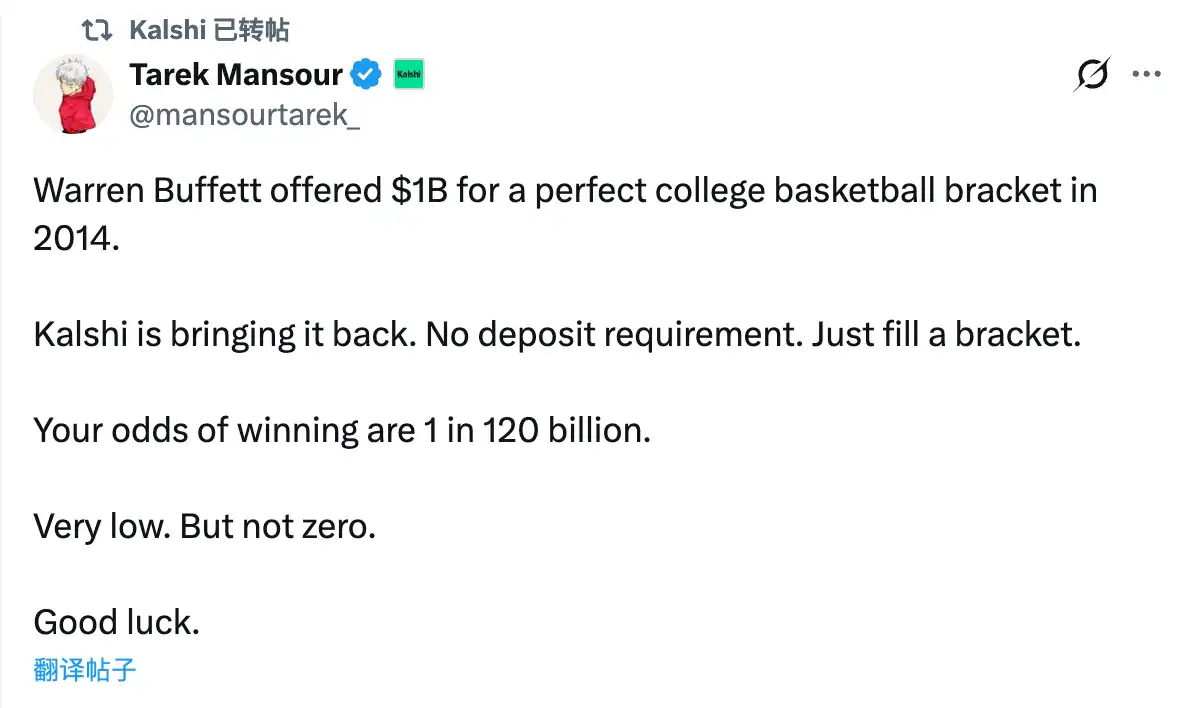
Kalshi CEO Tarek Mansour stated this morning that the probability of a perfect bracket is approximately “1 in 120 billion” — one in 120 billion.
The dramatic difference in probabilities arises because this estimate is derived from more realistic models: sports outcomes aren’t 50/50. Stronger teams statistically win more often. After applying weighted calculations based on historical win rates and betting odds, academic and statistical consensus places the probability of a perfect bracket between “1 / 10¹¹” and “1 / 10¹³.” Thus, “1 in 120 billion” falls squarely within this range.
Even at “1 in 120 billion,” the odds remain effectively zero. Evidently, Kalshi is playing the same probabilistic game as Buffett, betting that no one will ever claim the $1 billion prize.
Community Ready to Engage — AI May Be the Game-Changer
Immediately after Kalshi’s announcement, the event sparked widespread discussion across social media — after all, predicting is free, and what if you’re the lucky one?
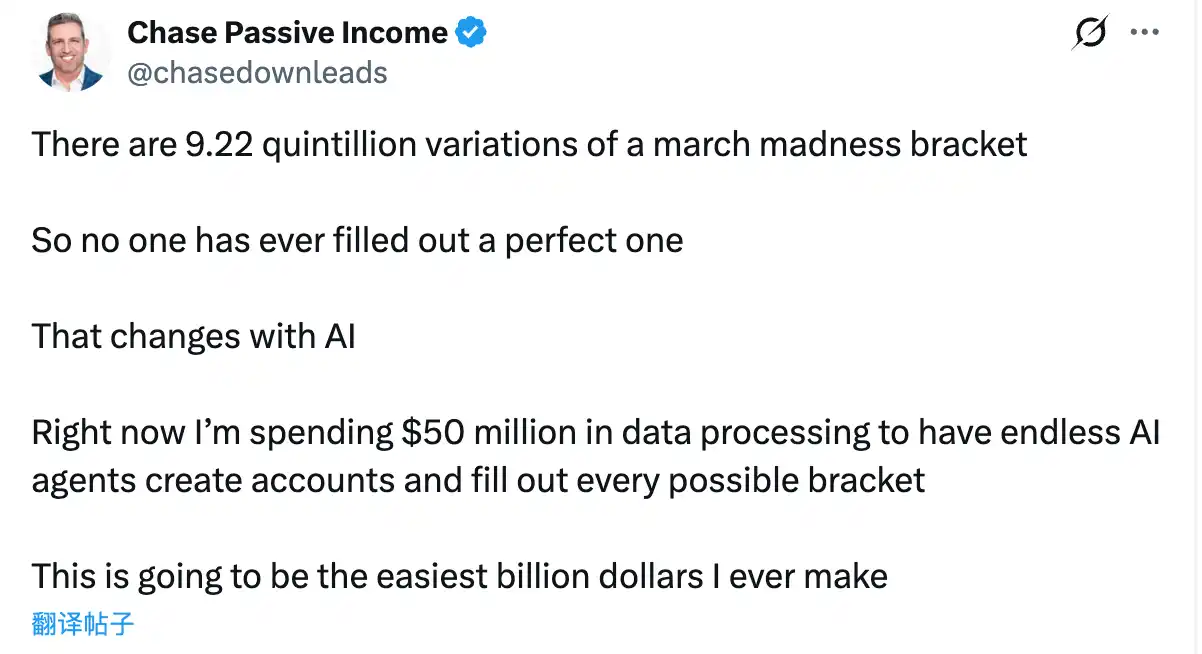
This time, many users are placing their hopes on AI as the breakthrough technology capable of cracking the code. Overseas influencer Chase Passive Income posted on X stating he would invest $50 million in data processing to deploy countless AI agents to create accounts and fill out every possible bracket configuration — calling it “the easiest $1 billion to ever make.”
Will this unsolvable probability puzzle persist? Can AI truly create a miracle? Until the national champion is crowned in "March Madness," no one knows the answer.
As spectators, besides watching the games and enjoying the drama, don’t forget to submit your dream bracket on Kalshi.
Disclaimer: Contains third-party opinions, does not constitute financial advice
Polymarket will launch the "Taker Fee Rebate Program" next week, with up to 50% of taker fees refunded.
24 days ago
Indonesia Convicts Crypto-Financed Terrorism Case Using Blockchain Evidence
04-07Kalshi: Whoever controls the traffic, controls the market
03-26
If U.S. Treasury yields surge past 5%, will Bitcoin fall below $50,000?
03-25
Shadow stocks of OpenAI and SpaceX, pumped up to 16 times
03-25
5 smart money accounts have collectively invested $65,400, betting that U.S. military forces will enter Iran before May
03-25
Bitcoin breaks through $71,000, with a 24-hour increase of 1.47%
03-25


