Where Do Stablecoin Yields Clash with U.S. Legislation?
Where Do Stablecoin Yields Clash with U.S. Legislation?


The legislative effort, backed by the President and aimed at establishing a more comprehensive regulatory framework for the U.S. cryptocurrency market, is approaching a critical political deadline in Congress. Meanwhile, the banking sector is pressuring lawmakers and regulators to prohibit stablecoin issuers from offering yield similar to bank deposit interest.
This standoff has become one of the most pivotal unresolved issues on Washington’s crypto agenda. The core debate centers on whether dollar-pegged stablecoins should be confined to payment and settlement functions—or whether they can also develop financial product attributes that compete with bank accounts and money market funds.
The Senate’s market structure bill, known as the CLARITY Act, has stalled due to the collapse of negotiations over so-called “stablecoin yield” provisions.
Industry insiders and lobbyists say the window for advancing the bill realistically lies between late April and early May, if passage is to remain feasible before the tightening election-year schedule.
Congressional Research Service Sharpens Legal Disputes
The Congressional Research Service (CRS) has framed the issue more narrowly than public discourse suggests.
In a report dated March 6, the CRS noted that the GENIUS Act prohibits stablecoin issuers from directly paying yields to users—but remains ambiguous about the so-called “three-party model,” where intermediaries such as exchanges sit between issuers and end-users.
The CRS pointed out that the legislation lacks a clear definition of “holder,” leaving room for dispute over whether intermediaries may still pass on economic benefits to their clients. This gray area is precisely why banks are urging Congress to clarify the issue within a broader market structure framework.
Banks argue that even limited yield incentives could enable stablecoins to become formidable competitors to bank deposits—particularly threatening to regional and community banks.
Conversely, crypto firms maintain that incentive mechanisms tied to payments, wallet usage, or network activity can help digital dollars compete with traditional payment rails and enhance their mainstream financial relevance.
This divide reflects fundamentally different visions for the future role of stablecoins.
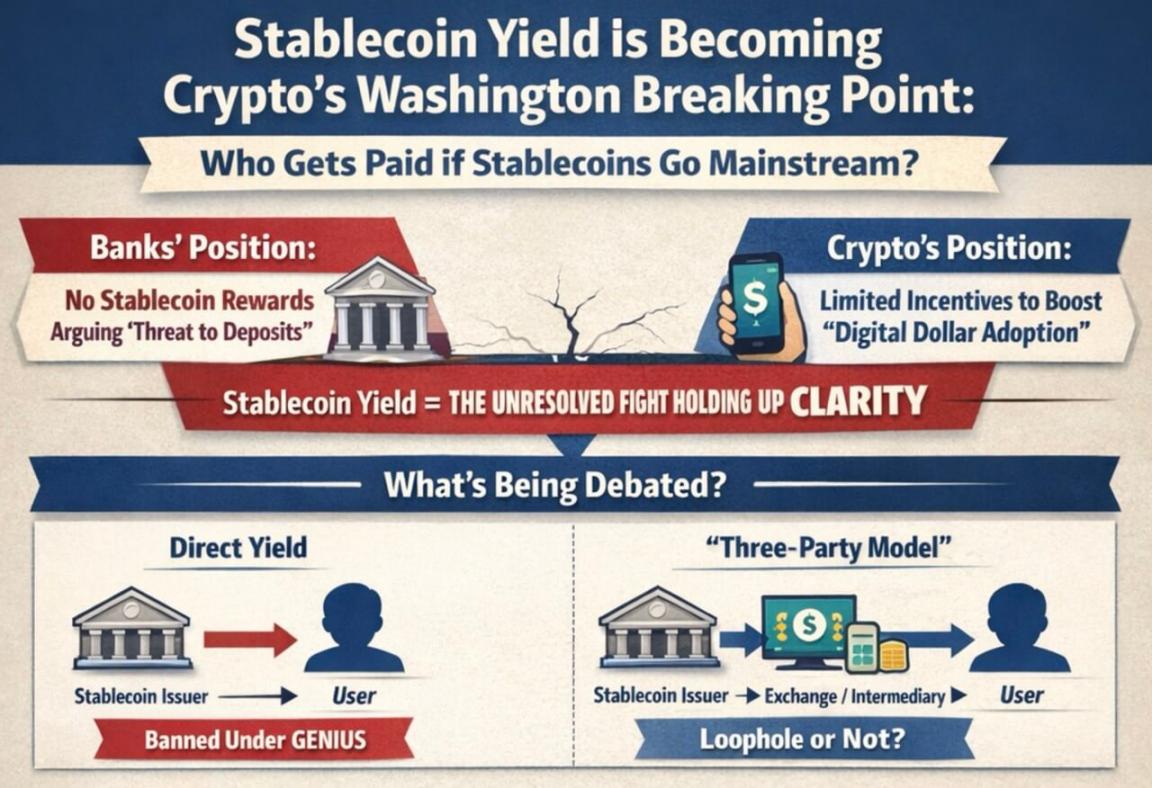
Infographic illustrates the deep divergence between banks and crypto firms over who should benefit from stablecoin yields as digital dollar adoption expands.
If legislators view stablecoins primarily as payment instruments, arguments for stricter limitations on rewards become stronger. Conversely, if stablecoins are seen as part of a transformative shift in digital value circulation, support for limited incentives gains traction.
The American Bankers Association has urged lawmakers to close what it calls a “regulatory loophole” before these reward mechanisms proliferate. Banks warn that allowing yield on idle balances could trigger capital flight from banks, undermining their core funding base for lending to households and businesses.
Standard Chartered estimated in January that by the end of 2028, stablecoins could siphon off approximately $500 billion in U.S. bank deposits, placing the greatest strain on smaller institutions.
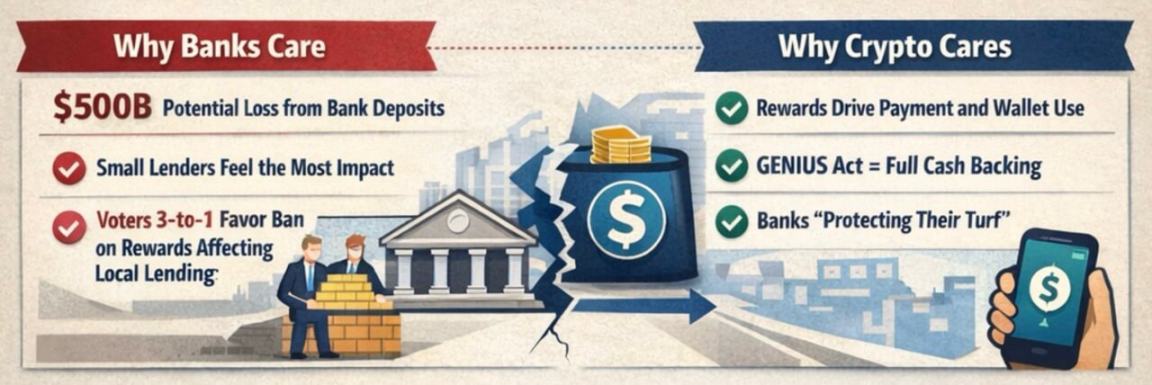
Infographic contrasts the stakes for banks and crypto firms in the stablecoin legislation, highlighting deposit loss, impact on lenders, cash-back rewards, and bank protectionism.
The banking sector has also sought to demonstrate public support. The American Bankers Association recently released polling results showing:
- When asked about potential reduction in bank lending capacity due to stablecoin yields, respondents supported banning such yields by a 3:1 margin;
- By a 6:1 ratio, respondents believed stablecoin legislation should proceed cautiously to avoid destabilizing the existing financial system—especially community banks.
Crypto advocates counter that banks are merely seeking to limit competition from digital dollars to protect their own business models.
Industry figures including Coinbase CEO Brian Armstrong argue that under the GENIUS Act, stablecoin issuers face stricter reserve requirements than banks—requiring full backing by cash or cash equivalents for issued stablecoins.
Trading Volume Elevates the Stakes in Washington
Market scale has rendered this yield debate no longer a niche issue.
Boston Consulting Group estimates that total stablecoin transaction volume reached around $62 trillion last year, but after excluding bot-driven trades and internal exchange movements, only about $4.2 trillion represented real-world economic activity.
The vast gap between surface volume and actual economic utility explains why the “yield” debate has become so consequential.
If stablecoins remain primarily tools for trading and settlement, lawmakers find it easier to classify them strictly as payment instruments. But if yield mechanisms transform stablecoins into widely used digital cash storage solutions within user apps, pressure on banks will escalate rapidly.
To address this, the White House earlier this year proposed a compromise: permitting limited yield in specific use cases like peer-to-peer payments, but banning returns on idle balances. Crypto firms accepted this framework, but banks rejected it—leading to a complete deadlock in Senate negotiations.
Even without congressional action, regulators may step in to tighten yield models.
The Office of the Comptroller of the Currency (OCC) has proposed rules implementing the GENIUS Act, stating that if a stablecoin issuer provides funds to affiliated parties or third parties, who then distribute yield to stablecoin holders, such arrangements would constitute an impermissible indirect yield distribution.
This means that if Congress fails to legislate, the executive branch may unilaterally define boundaries through regulatory rulemaking.
Time Running Out in Congress
The current standoff unfolds along two tracks:
- Congress debating whether to resolve the issue via statutory law;
- Regulators interpreting legal boundaries under existing statutes.
For the Senate bill, time itself is the greatest constraint.
Galaxy Digital’s research head Alex Thorn wrote on social media:
“If the CLARITY Act isn’t advanced through committee by late April, its chances of passing in 2026 will be extremely low. The bill must reach the full Senate floor for vote by early May. Legislative time is running out—each passing day diminishes its odds.”
He also cautioned that even resolving the yield dispute won’t guarantee progress:
“While many assume the stablecoin yield dispute is blocking the CLARITY Act, even if a compromise emerges on yield, the bill still faces other significant hurdles.”
These obstacles may include DeFi regulation, regulatory jurisdictional authority, and even ethical considerations.
With the November midterms approaching, crypto regulation is likely to become an even larger political battleground. This intensifies the urgency of the current impasse—any delay risks facing a more congested political calendar and a more challenging legislative environment.
Market predictions reflect shifting sentiment. In early January, Polymarket assigned an 80% probability of passage; following recent setbacks—including Armstrong declaring the current version unworkable—the odds have dropped to near 50%.
Kalshi data shows a 7% chance of passage before May, and 65% by year-end.
Failure Would Shift Power to Regulators and Markets
The consequences of failure extend far beyond the yield debate. The CLARITY Act’s primary objective is to define whether crypto tokens qualify as securities, commodities, or another category—establishing a clear legal framework for market oversight.
If the bill stalls, the entire industry will rely increasingly on regulatory guidance, interim rules, and future political shifts.
This is one reason the market closely watches the bill’s fate. Bitwise Chief Investment Officer Matt Hougan said earlier this year that the CLARITY Act would codify the current favorable regulatory environment for crypto; otherwise, future administrations could reverse existing policies.
He wrote that if the bill fails, the crypto industry will enter a period of “proving its value”—requiring three years to demonstrate its indispensability to ordinary citizens and traditional finance.
Under this logic, future growth will depend less on expectations of legislative enactment and more on whether products like stablecoins and asset tokenization achieve mass adoption.
This creates two divergent paths for the market:
- Bill passes → investors price in stablecoin and tokenization growth ahead of time;
- Bill fails → future growth depends on real-world adoption, while facing uncertainty from potential shifts in Washington’s policy direction.
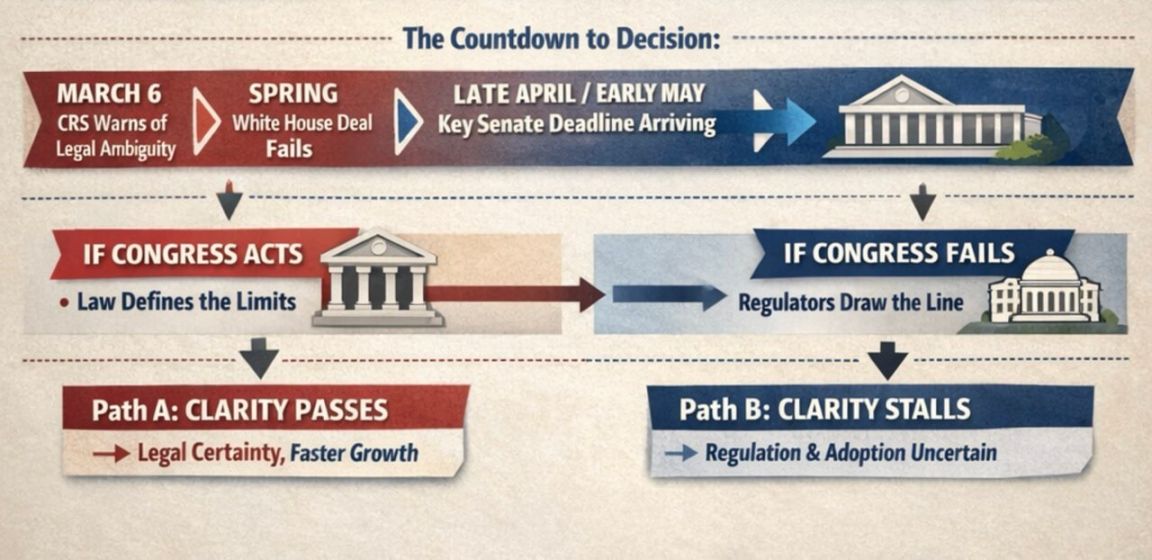
Flowchart depicts the countdown for Senate stablecoin decision-making, with March 6 and late April/early May deadlines leading to two outcomes: congressional action brings regulatory clarity and faster growth; inaction leads to uncertainty.
At present, the next move rests in Washington. If senators revive this market structure bill this spring, they still hold the power to define how much value stablecoins can return to users—and how much of the crypto regulatory framework can be written into law. If not, regulators are clearly prepared to establish at least part of the rules themselves.
Regardless of outcome, the debate has long since transcended whether stablecoins belong in the financial system—it now probes how they will operate within it, and who stands to benefit from their development.
Disclaimer: Contains third-party opinions, does not constitute financial advice
CoinGecko Report: RWA Sector Size Reaches $19.3 Billion, with Gold and U.S. Treasuries Leading the Way
04-30
Aave sees $10.1B in outflows, total deposits drop to $3.57B
04-20Circle's founder confirms Arc Network will launch a token, with further details to be disclosed later
04-14SEC Chair: Crypto Safe Harbor Proposal Submitted to White House for Review, Permitting Cryptocurrency Projects to Raise Funds Without Immediate Registration
04-07Ark Invest increased its holdings of CRCL by 116,000 shares yesterday, valued at approximately $11.6 million.
03-25Sources: Tether's First Comprehensive Financial Audit May Be Driven by Fundraising Needs
03-25Crypto Finance CEO: Traditional banks are at least 5 years behind crypto-native platforms in DeFi innovation
03-25