
ChainThink
Stay ahead, master crypto insights
Web3 Lawyer Analysis: How Can Mainland Enterprises Successfully Issue RWA Products in Hong Kong?
Web3 Lawyer Analysis: How Can Mainland Enterprises Successfully Issue RWA Products in Hong Kong?

2025-05-27 15:00
Original Title: "In-Depth Analysis by Web3 Lawyers: How Can Mainland Chinese Enterprises Successfully Issue RWA Products in Hong Kong?"
Original Author: Guiruo Fei, Sha Jun, ChainLaw
The global tokenization of real-world assets (RWA) is accelerating. According to data from the RWA.xyz platform, as of April 2025, the total value of on-chain RWA assets worldwide has exceeded $22 billion. At the same time, Deloitte also predicts that the market size for tokenized real estate will reach $4 trillion by 2035.
In this wave of financial innovation, Hong Kong has rapidly become a pioneer in the compliance development of RWA, thanks to its unique institutional advantages. From the charging pile asset tokenization project launched by Langxin Group to the first compliant tokenized fund in Asia launched by Huaxia Fund, multiple landmark cases have successfully been implemented, demonstrating the application potential of this innovative financing method in the field of physical assets.
· What exactly is RWA?
· Why choose RWA? What are its advantages?
· How does Hong Kong regulate RWA?
· What compliance points should mainland enterprises pay attention to when conducting RWA in Hong Kong?
ChainLaw team has been deeply involved in the cryptocurrency industry for many years and has extensive experience in designing RWA project architectures and handling complex cross-border compliance issues. In this article, we will combine our latest RWA project experiences and industry research findings to systematically analyze and answer the above questions from a professional legal perspective.
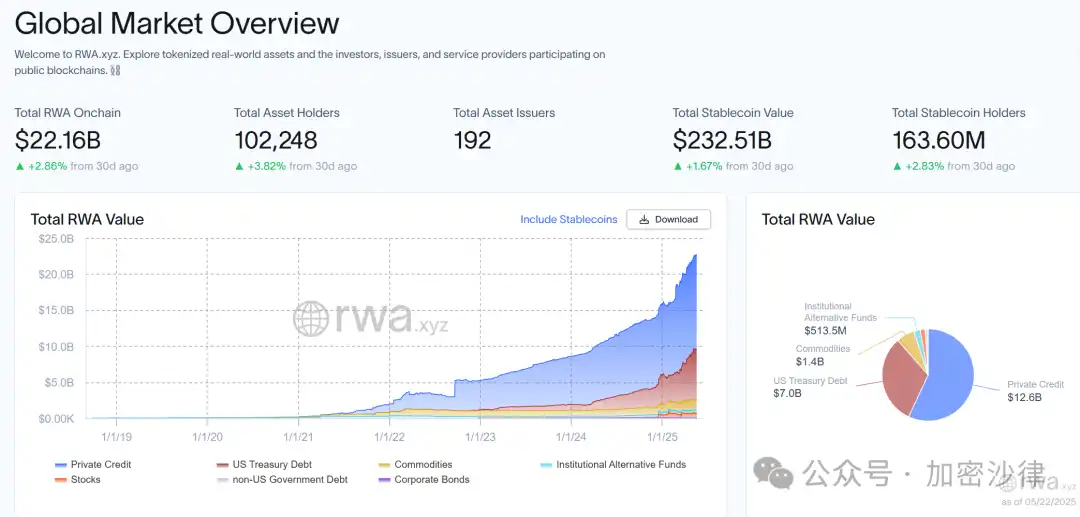
(The above figure is a dashboard of global on-chain RWA assets compiled by RWA.xyz)
One: What is RWA Exactly?
RWA, short for "Real World Assets," refers to the tokenization (or "tokenization") of real-world assets, an innovative financial model based on blockchain technology. It maps physical or financial assets onto the blockchain, transforming them into digital tokens with high liquidity and divisibility. This transformation not only realizes the digital representation of assets but also provides these real-world assets with unprecedented transparency and traceability through blockchain technology.
Although we can elaborate on the connotation and extension of the concept of RWA at a theoretical level, it is difficult for all parties to reach a consensus in practical project implementation.
"What is the true RWA? Which projects should be recognized as RWA projects?" – professionals, regulatory authorities, and project parties have their own perspectives and views on these questions. Based on project experience and research findings, ChainLaw team gives its view from a legal compliance perspective: "RWA is actually a broad concept without a so-called standard answer. All processes of asset tokenization through blockchain technology can be called RWA." For an in-depth analysis of the concept of RWA, see: "Web3 Lawyers Decrypted: What Kind of RWA Do People Understand?"
Two: Why Choose RWA, What Are Its Advantages?
(1) Activating Heavy Asset Financing Scenarios That Traditional Finance Cannot Reach
First, take assets such as real estate, infrastructure revenue rights, and commodities as examples. These types of assets are difficult to complete financing through traditional financial tools due to their heavy asset nature, liquidity restrictions, and complex compliance regulations. The RWA model, combined with blockchain technology, segments the ownership of these physical or equity assets into highly liquid digital tokens and raises investor funds through the issuance of digital tokens. RWA opens up new financing methods for these assets, enabling these previously "sleeping" assets to be revitalized. This means that in the current situation where financing channels are limited, financing is difficult, and financing costs are high, RWA can provide companies with a new "blood-making" method.
For investors, the divisibility of tokens lowers the investment threshold for specific assets. For example, in traditional finance, investors who want to invest in real estate often need to spend hundreds of thousands of yuan to purchase the entire property's title. The high capital threshold excludes many small and medium-sized investors. However, relying on the RWA model, investors may only need to spend $50 to purchase a token representing part of the property's ownership. By holding this token, investors can enjoy investment returns from property appreciation and rental income.
(2) Lowering Financing Costs and Improving Financing Efficiency
In the traditional securities issuance process, enterprises and projects must go through strict and lengthy review procedures. The qualifications, scale, and operating methods of the issuing entity must meet high requirements. For example, in the issuance of asset-backed securities (ABS), the regulatory and approval standards are extremely strict, which largely limits the financing needs of some enterprises.
However, in the RWA model, apart from complying with local compliance requirements, the access requirements and restrictions are relatively fewer, but the underlying assets still need to be compliantly processed. Therefore, this financing method partially avoids the long review process and complicated issuance procedures in traditional financing, effectively reducing financing costs.
(3) Customized Transaction Structures
RWA financing provides enterprises with unprecedented flexibility, allowing them to design financing structures tailored to market demand and their own development goals. Enterprises can independently design key terms such as profit distribution models, redemption mechanisms, and token unlocking mechanisms, and adjust the issuance conditions in real-time according to market dynamics. This high degree of flexibility enables enterprises to precisely match investors' expectations and risk preferences, thereby improving the targeting and success rate of financing.
At the root of it, besides introducing blockchain technology to improve financing efficiency and transparency, RWA has also changed the financing logic under the traditional financial framework. Whether it is debt financing or equity financing, traditional financing models mostly rely on corporate credit as a foundation. In contrast, RWA uses blockchain technology to achieve effective isolation between "corporate credit" and "asset credit." This way, even if the credit status of the issuing entity is average, as long as the underlying assets are of sufficient quality, they can finance based on the credit of the assets themselves.
This characteristic is similar to the ABS model mentioned earlier. However, although the financing logic is similar, there is a fundamental difference between the two in terms of the investor groups they cover and the ecological effects they generate. The ABS market is mainly dominated by traditional financial institutions, with a limited number of participants and most transaction entities being institutional investors. This characteristic makes the overall trading depth of the ABS market insufficient and the market coverage relatively narrow, lacking widespread influence.
In contrast, the participation in the RWA market is more diverse. In addition to traditional financial institutions, the RWA financial market will also attract many crypto investors and industry ecosystem partners. Therefore, in the RWA market, from professional institutions to ordinary retail investors and partners, everyone can freely buy and use the tokens and become an important part of the token ecosystem.
A large and active ecosystem and community have formed around RWA tokens. The strong community cohesion and ecological stickiness generated by this will provide strong support for the long-term value growth of RWA tokens, thus promoting the healthy development of the market. The prosperity of the on-chain ecosystem can also feed back to the offline business of the project party, significantly enhancing the brand awareness of the project party.
This positive feedback development model of on-chain and off-chain synergy is the true subtlety of the RWA model compared to traditional financing methods, which the ABS model cannot achieve. Currently, the market is continuously cultivating and expanding the RWA investor group. Among the current RWA sectors, the leading ones are various financial asset tokenization products. Because financial assets themselves have high compliance, high standardization, and low data acquisition difficulty, they have a significant advantage and demonstration effect in the RWA sector.
The wave of financial asset tokenization started with the lowest-risk underlying assets such as U.S. Treasury bonds and money market funds. A typical case is the BUIDL tokenized investment fund launched by the world's top asset management group BlackRock. As of now, the total market cap of BUIDL has reached $2.89 billion. In addition to low-risk financial assets, high-risk stocks, ETFs, and other financial assets have recently also entered the fast track of tokenization. On May 22 and 23, Kraken exchange and Ondo finance announced that they would proceed with the tokenization and on-chain trading of stocks, ETFs, and other financial assets.
With the rapid development and implementation of various tokenized financial assets and stablecoins, the scale of RWA investors and liquidity will reach a new height. In the future, more different types of RWA products will come into the sight of investors, attracting more Web2 users and traditional financial investors to enter the RWA ecosystem. The flywheel of the entire RWA ecosystem will quickly cycle and develop, bringing new wealth effects and industry opportunities.
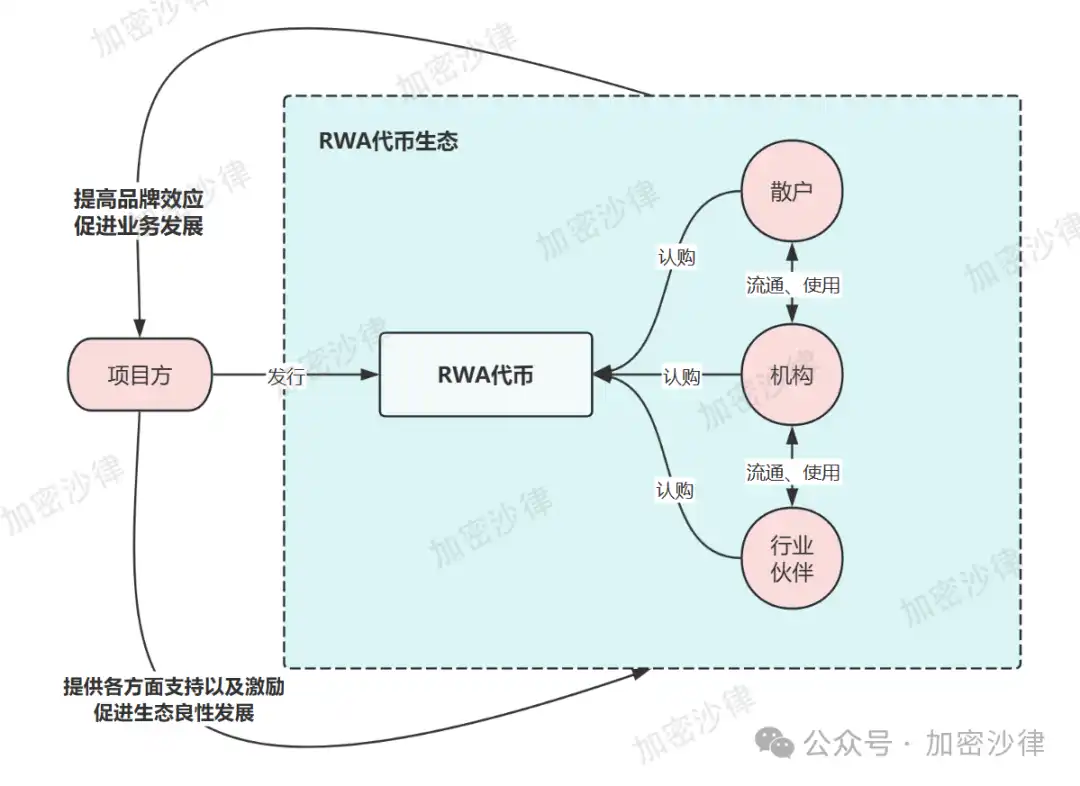
(The above figure is a schematic diagram of the RWA ecosystem development model, for reference only)
Three: How Does Hong Kong Regulate RWA?
(1) Regulatory Principles
The Hong Kong Securities and Futures Commission (SFC), as a central force in Hong Kong's market regulation, adopts a "see-through approach" when regulating RWA products. The core of this principle lies in focusing on the financial attributes of the real-world assets corresponding to the tokens, rather than whether the product adopts a "token" form. In short, Hong Kong's regulation of RWA aims to return to the essence of the underlying assets, without being bound by the form of the tokens. This regulatory principle is a concrete manifestation of the concept of "same business, same risk, same rules."
(2) Specific Regulatory Documents
1. In November 2023, the Hong Kong SFC issued a circular titled "Circular on Tokenized SFC Recognized Investment Products," which clearly outlined the layered regulatory concept for the issuance of security tokens. According to the relevant regulations, security tokens (Tokenised Securities) are subject to the Securities and Futures Ordinance and must meet the relevant requirements proposed by the SFC in the aforementioned circular, including token issuance qualifications, information disclosure, and investor suitability. Non-security tokens are included in the regulatory scope of the Anti-Money Laundering Ordinance.
2. In November 2023, the Hong Kong SFC issued a circular titled "Circular on Intermediaries Engaging in Activities Related to Tokenized Securities." This circular re-emphasizes that although tokenized securities are issued using blockchain technology, their essence remains traditional securities and must comply with existing securities regulations. At the same time, intermediaries must conduct due diligence, ensure product appropriateness, and notify the SFC in advance when distributing, trading, or managing these assets.
3. In March 2024, the Hong Kong Monetary Authority launched the "Ensemble Project." Ensemble Sandbox focuses on exploring the application scenarios of tokenization technology, and several RWA projects have already been successfully implemented, covering industries such as green bonds, carbon credits, real estate, and supply chain finance.
Overall, from 2023 to 2024, the Hong Kong SFC has issued multiple circulars and guidance documents related to tokenized investment products, further clarifying the specific regulatory standards for RWA products (especially tokenized securities), thereby providing clear normative guidance for the steady development of the RWA market.
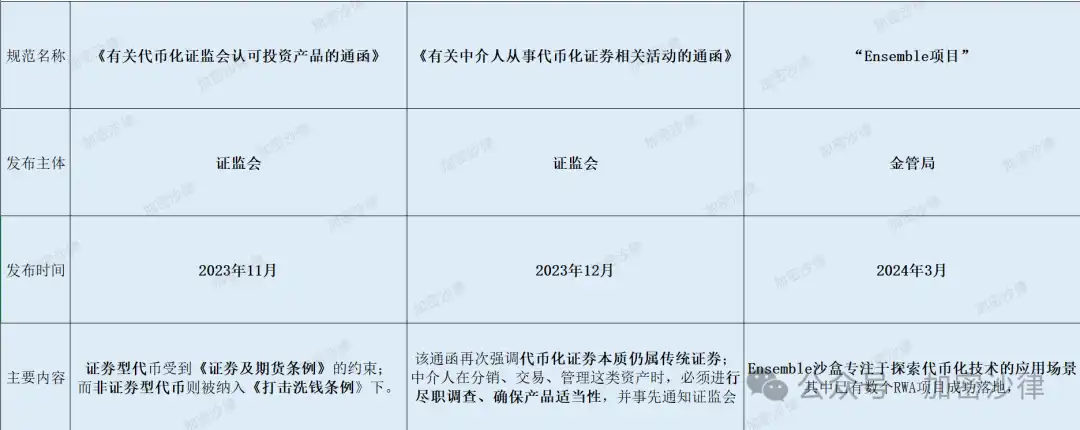
(The above figure is a summary of the RWA-related regulatory framework)
The above text specifically analyzes Hong Kong's regulatory framework for RWA. For a comprehensive systematization of Hong Kong's virtual asset regulatory policies, please refer to the following: "A Comprehensive Guide to Hong Kong's Virtual Asset Regulatory Policy Framework."
Four: What Compliance Points Should Mainland Chinese Enterprises Pay Attention to When Conducting RWA in Hong Kong?
The reason why RWA must be structured across borders is because token issuance is an un-crossable regulatory red line within mainland China. On September 4, 2017, the People's Bank of China and seven other departments issued the "Notice on Preventing Risks of Token Issuance Financing," clearly stating that no organization or individual may engage in illegal token issuance financing activities, and all token issuance financing activities should be immediately stopped.
Therefore, the token issuance behavior of RWA projects in mainland China must take place overseas. Among them, Hong Kong, due to its sound regulatory framework, friendly policy attitude, and rich industry ecosystem, has become one of the optimal choices for Chinese enterprises to implement RWA projects. The following text will analyze the key compliance points and framework design ideas for conducting RWA projects in Hong Kong from three levels: underlying assets, data on-chain, and fund circulation.
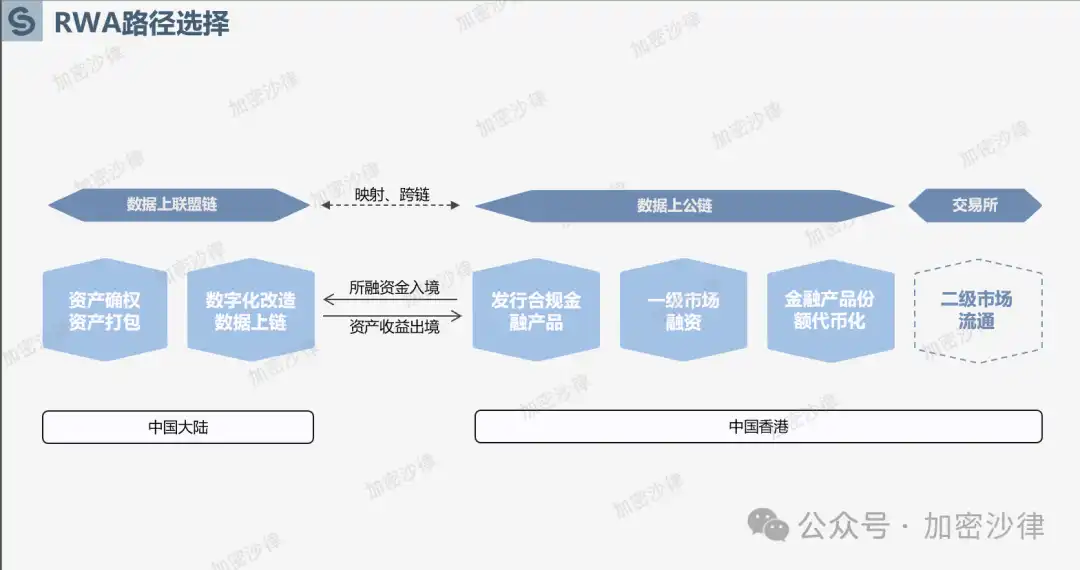
(The above figure is a schematic diagram of the overall framework for issuing RWA in Hong Kong)
(1) Compliance of Underlying Assets
1. Asset Ownership Confirmation
Since the essence of RWA is the tokenization of real-world assets, the holders of the tokens will directly or indirectly own specific rights to the real-world assets. Therefore, to ensure that the RWA tokens can be legally issued, circulated, and redeemed later, the owner of the underlying assets, i.e., the RWA project party, must ensure that they have a legitimate and clear ownership of the asset. The compliance team of the RWA project needs to conduct detailed due diligence on the underlying assets during the project implementation to ensure the legality of the ownership. Specifically, the compliance team will conduct disputes over ownership, collect and verify the ownership documents, public registration information, litigation situations, pledges, mortgages, or judicial freezes related to the underlying assets during the due diligence process.
2. Asset Audit
After completing the asset ownership confirmation, the project party also needs to hire a professional audit institution to audit the underlying assets. The audit report will provide reference data for subsequent asset pricing and issuance, including but not limited to the following elements:
· Asset Market Value — assessed by professional appraisers or valuation experts, referring to historical transaction data, market trends, and similar asset prices.
· Asset Depreciation and Impairment — for fixed assets, consider depreciation methods, asset useful life, and possible impairment situations to ensure that the assessment value reasonably reflects the actual value.
· Asset Risk Identification — identify risks related to the assets, such as market risk, legal risk, liquidity risk, and operational risk.
3. Asset Divestiture
As mentioned earlier, the core value of RWA lies in financing directly based on the credit of high-quality assets, thus separating from the traditional financing model based on corporate credit. Therefore, when launching an RWA project, it is necessary to separate the underlying assets from the actual operating entity of the project party, thereby achieving risk isolation between the operating entity and the underlying assets. The following text will illustrate one type of asset divestiture architecture design by combining a practical case currently being advanced by the ChainLaw team:
· First, the project compliance team assists the project party in establishing a Special Purpose Vehicle (SPV) domestically.
· Second, the actual operating entity transfers the underlying assets to the SPV through a purchase and sale transaction.
· Finally, the SPV signs an operation service agreement with the project party, whereby the project party is responsible for managing and operating the underlying assets, and the SPV pays the project party regular service fees.
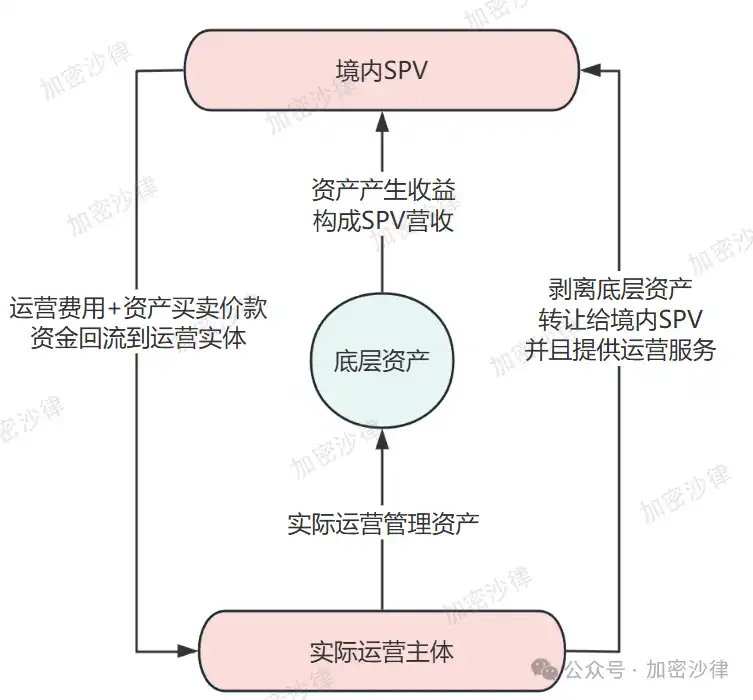
(The above figure is a schematic diagram of the asset divestiture framework design, for reference only)
In summary, through this asset divestiture framework, the project party can transfer the asset ownership to the SPV company, achieving risk isolation while facilitating subsequent asset packaging and issuance. At the same time, the actual operating entity, although no longer owning the asset's ownership, can continue to manage and operate the underlying asset through the service agreement.
(2) Data On-Chain Compliance
Due to the strict regulation of cross-border data transmission and data exchange in China, most RWA projects do not choose to transmit related data overseas and circulate and disclose it on public blockchains. After researching, the ChainLaw team found that, under the premise of meeting the compliance requirements of China's "Data Security Law" and "Personal Information Protection Law," the project party tends to adopt the "two chains and one bridge" model to achieve data on-chain.
Specifically, RWA asset data is stored and recorded on a domestic consortium chain, while the corresponding RWA tokens are deployed on a high-performance public chain overseas. The RWA tokens circulating overseas and the data stored on the domestic chain are mapped and bound via a cross-chain bridge. This architectural design solves the issue of on-chain storage of RWA underlying asset data, ensuring the transparency and traceability of asset data, while avoiding the compliance red line of cross-border data transmission.
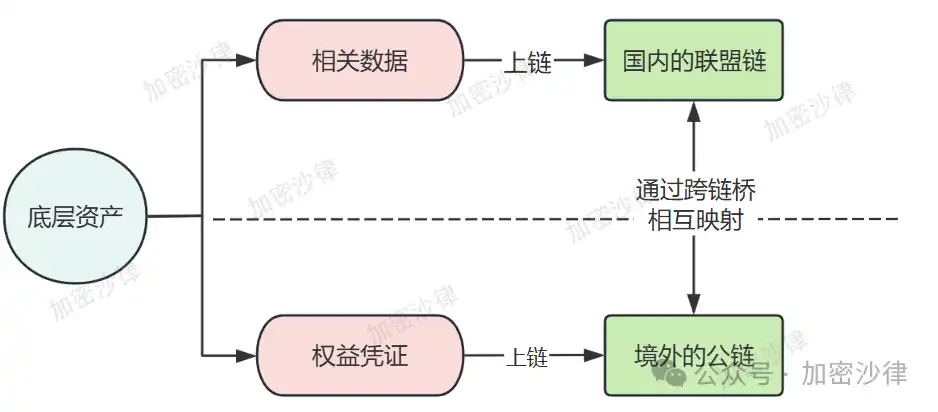
(The above figure is a schematic diagram of the "two chains and one bridge" model, for reference only)
Other than the "two chains and one bridge" model, RWA projects can also complete cross-border data on-chain and circulation through the Hainan Free Trade Port Cross-Border Data Flow Pilot Zone (hereinafter referred to as the "Hainan Free Trade Data Port"). According to the disclosed information, the ChainLaw team summarized the core framework of the data export solution in the Hainan Free Trade Port as follows:
1. The regulatory authority actively classifies and grades the data;
2. Establish a data whitelist; if the data is listed on the whitelist, it can be exported directly without approval;
3. If the data is not listed on the whitelist, the regulatory authority will apply the corresponding regulatory procedures based on the type of data: personal information protection certification, data export security assessment, personal information export standard contract filing, etc.
During the actual project advancement, the ChainLaw team found that in addition to the compliance requirements in the data circulation link, there are also certain key compliance points and administrative regulatory requirements in the data collection, storage, de-identification, and packaging of the underlying assets of RWA. Due to the length of this article, these details are not discussed here.
(3) Fund Circulation Compliance
Due to China's strict foreign exchange control, funds raised from RWA issued overseas cannot be directly transferred to the actual operating entity in mainland China. A special framework and path for the collection and circulation of overseas funds must be designed by the compliance team. According to the project experience of the ChainLaw team, after RWA projects issue tokens overseas, the funds in the overseas SPV are usually collected through a fund channel and finally transferred to the actual operating entity. There are three options for the fund channel in this framework:
1. QFLP (Qualified Foreign Limited Partner, Qualified Foreign Limited Partner)
2. FDI (Foreign Direct Investment, Foreign Direct Investment Enterprise)
3. QFII (Qualified Foreign Institutional Investor, Qualified Foreign Institutional Investor)
When designing the fund circulation framework, the compliance team generally needs to comprehensively consider factors such as tax burden, entry barriers, procedural requirements, and compliance costs. In the actual implementation of the project, the project team must pay attention to compliance first. The preparation of application materials for different fund channel entities, responses to window opinions, and adjustments and improvements to the corresponding frameworks all require the full support of a professional legal team.
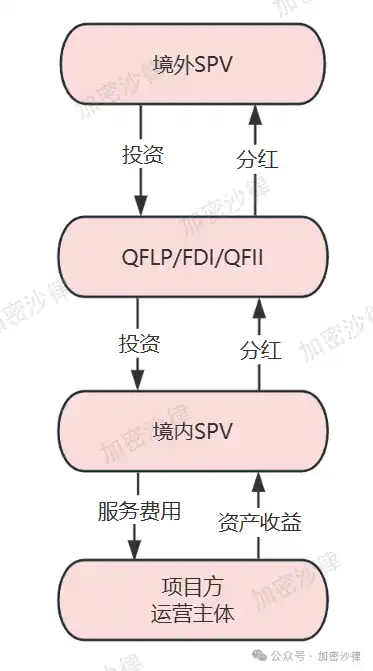
(The above figure is a schematic diagram of the RWA project fund channel, for reference only)
Disclaimer: Contains third-party opinions, does not constitute financial advice


AI Practical Guide
This column focuses on the real progress of Agents: technological evolution, application implementat

Crypto Weekly
Tracking on-chain movements of the smart money and institutions

Frontier Insights
Spotlight on Frontier, trending projects, and breaking events

Blowup Alert
As the 2026 crypto bear market deepens, exit scams and project blowups are becoming increasingly fre

Regulatory Watch
American Crypto Act – timely interpretations of policies worldwide

Popular Airdrop Tutorial
Selected potential airdrop opportunities to gain big with small investments

FusnChain
FusnChain