
ChainThink
Stay ahead, master crypto insights
Interplanetary Great Navigation: Musk's Private Capital Writing a New Script for Martian Civilization
Interplanetary Great Navigation: Musk's Private Capital Writing a New Script for Martian Civilization

2026-04-08 22:19
Every escape of human civilization begins exactly like this.
In September 1620, 102 people squeezed aboard a wooden ship named the Mayflower, setting sail from Plymouth, England into the treacherous North Atlantic. The cramped hold carried not only luggage but an entire political blueprint—they aimed to build a "city upon a hill" in the New World, a new world free from the constraints of the Church of England and distant from the exploitation of corrupt aristocracy.
They came neither for exploration nor commerce; they were simply a group of people fleeing fate.
168 years later, in 1788, the first batch of British convicts was exiled to Australia. At the time, Europeans viewed that continent as the edge of the world—a natural dumping ground for unwanted souls, left to fend for themselves. Ironically, those discarded convicts rooted themselves there, built cities, and forged a nation.
Later still, came the California Gold Rush of 1848, Siberia’s great development of the 1880s, and Brazil’s rubber boom at the dawn of the 20th century… Each attempt by human civilization to “reset” has followed the same script: find terra nullius, declare a new order, then witness capital, population, and technology flood in, forging a new survival logic from extreme adversity.
Now it’s Mars’s turn.
But the difference is clear: the Mayflower had Britain’s tacit approval; Australia was already a British Crown colony; the California Gold Rush was underwritten by U.S. federal land policy. This time, no nation-state drives the process—instead, it’s private capital: venture capitalists, Silicon Valley entrepreneurs, former NASA engineers, and Elon Musk himself.
Colonization driven by state will carries the DNA of taxation, military force, and sovereignty; colonization fueled by private capital bears the imprint of ROI, exit strategies, and narrative premium. Civilizations born from these two fundamentally different logics are destined to diverge from the very beginning.
So what exactly are these men wielding private capital like a club betting on?
On a typical workday in 2025, Tom Mueller pitched his new company to a room full of investors.
Mueller isn’t an ordinary founder. He spent nearly 20 years at SpaceX, personally designing the Merlin engine of the Falcon 9—the thundering power that launched humans to the International Space Station, placed satellites into orbit, and lifted SpaceX from the brink of bankruptcy into a trillion-dollar commercial empire.
At the end of 2020, Mueller departed SpaceX and founded Impulse Space. The company’s core mission can be summed up in one sentence: deliver cargo to Martian orbit.
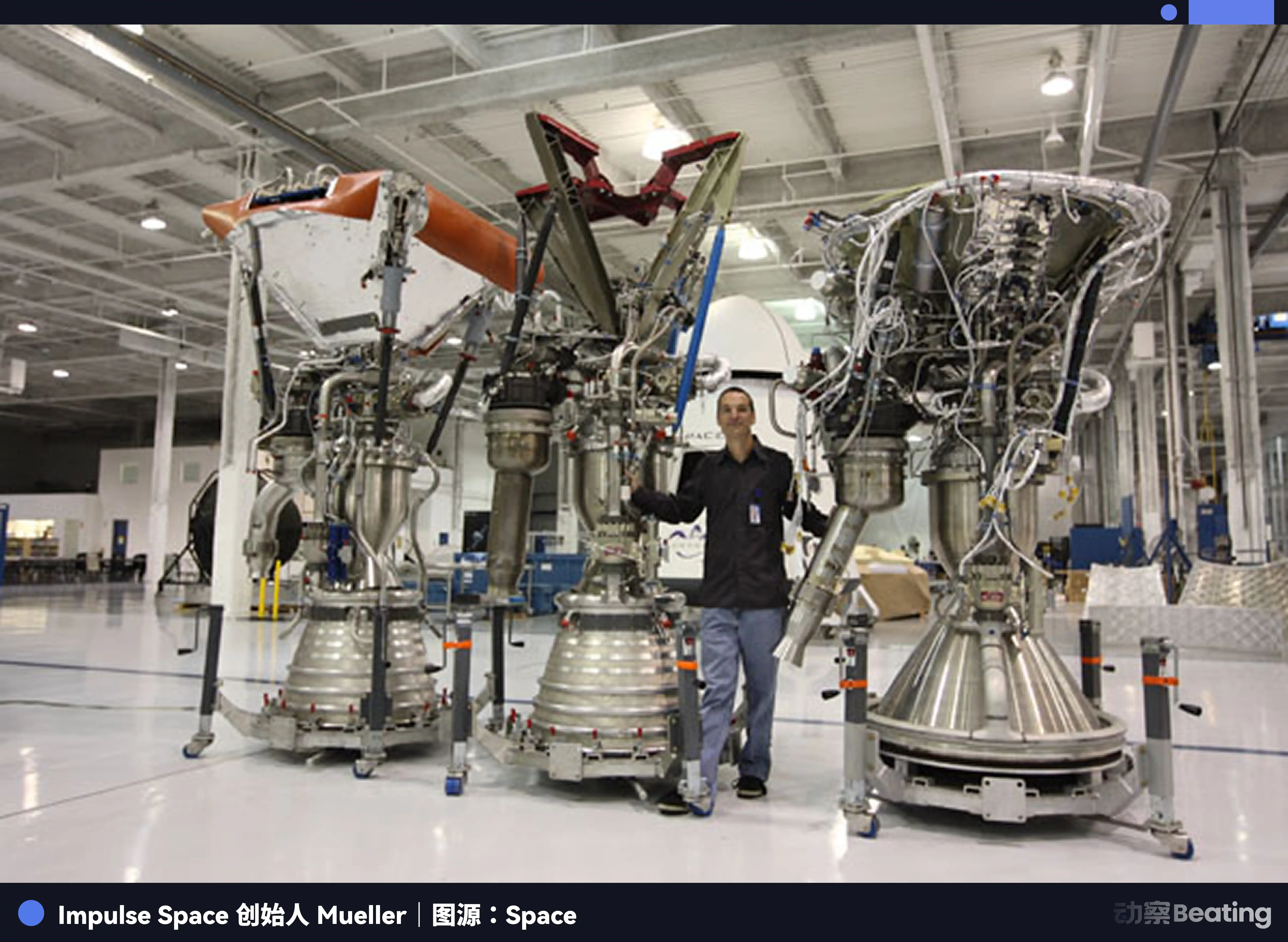
Yes—targeting Martian orbit, not low Earth orbit, not the Moon.
His clients are institutions and enterprises urgently needing to deploy satellites, probes, and supply modules in Martian orbit. His logic is crystal clear: infrastructure for Mars missions must begin now. By the time Musk’s Starship finally soars into space, someone must already be waiting along that corridor.
In June 2025, Impulse Space closed a $300 million Series C round, bringing its total funding to $525 million. The investor roster is formidable: Linse Capital led, with Founders Fund, Lux Capital, DCVC, and Valor Equity Partners participating. Founders Fund is Peter Thiel’s fund; Valor Equity Partners is an early backer of Musk-affiliated companies. These are not wild-eyed dreamers intoxicated by Mars fantasies, but the most seasoned capital in Silicon Valley.
Zooming back to today, the hottest topic in our social circles is “Will AI make me unemployed?”
On the same planet, along the same timeline, some people agonize over their current livelihoods while others are negotiating ownership rights to Martian mineral claims. This is the most authentic cognitive time gap—different people folded into different temporal dimensions: some live in 2025, some in 2035, some in 2050.
This cognitive time gap is nothing new. In the early 1990s, while most Chinese were debating whether to buy a color TV, a small vanguard was already tinkering with the internet. By the early 2010s, while most people were typing on Nokia keypads, others had already begun developing mobile apps.
Each technological wave inevitably creates such gaps. Those who open their eyes first aren’t necessarily smarter—they’re simply immersed in information and capital vortexes that force them to seek answers further into the future.
But this time, the gap is wider than ever before.
Anxiety about AI is real—but it remains confined to the present. Mars industry, however, is a high-stakes bet on the future, not just five years ahead, but twenty or fifty.
When people hear “Mars industry,” many instinctively dismiss it as science fiction, Musk’s idle daydream, or a Silicon Valley tycoon’s money-burning toy.
This view held water in 2015, and remained largely valid in 2020—but in 2025, it no longer stands.
The current state of the Mars industry closely resembles the internet in 1998. Infrastructure wasn’t fully built, most companies were burning cash, business models weren’t clear—but enough real capital, real technology, and real talent were already at work. You might say it’s still early, but you cannot deny its existence.
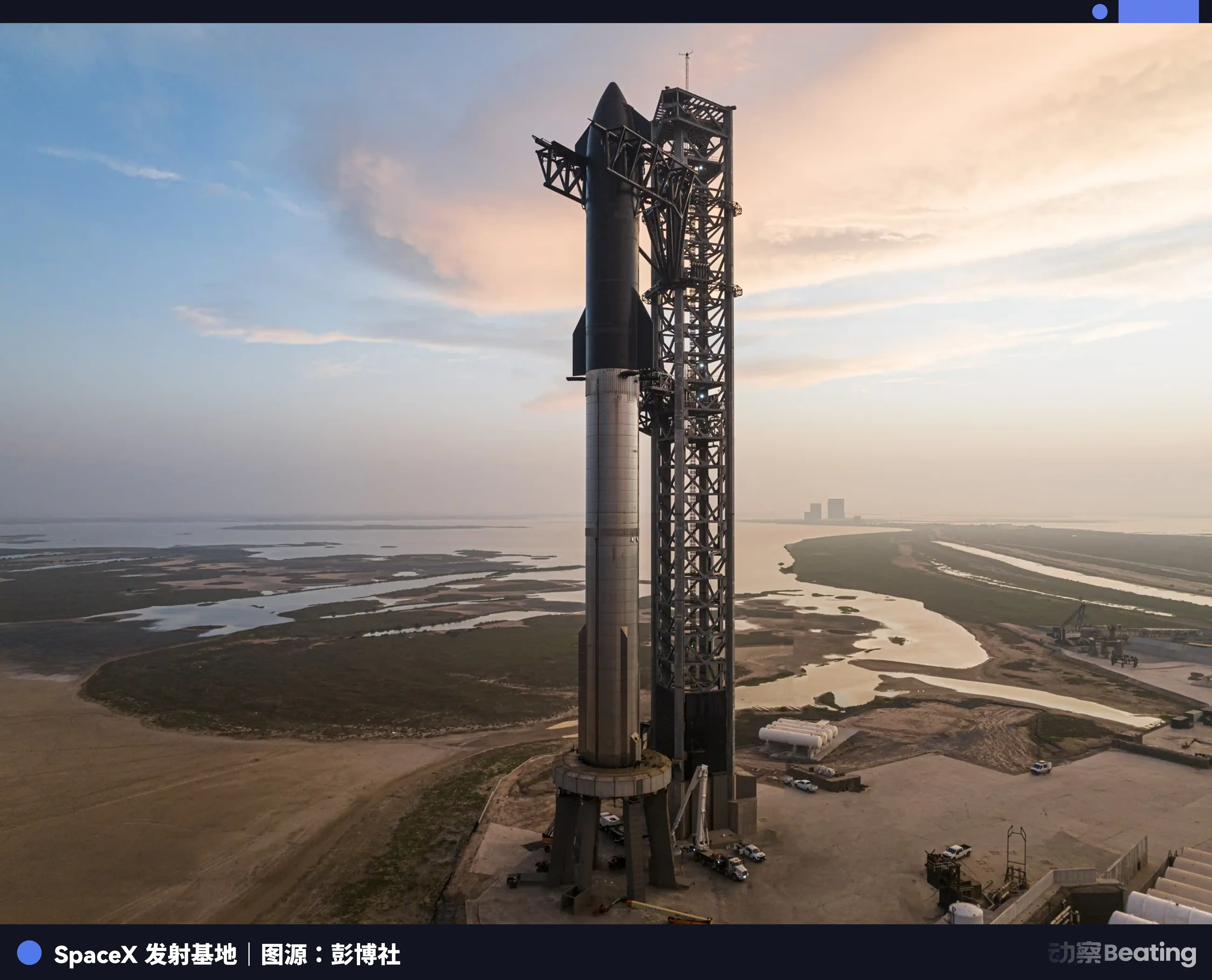
This interstellar industrial chain, from bottom to top, can roughly be broken down into five layers.
First layer: Launch.
To transport anything from Earth to Mars, you need rockets. Here, SpaceX’s Starship remains the dominant player—but another company, Relativity Space, is equally impossible to ignore.
Relativity Space builds entire rockets using robots to 3D print them. Their Terran R rocket sees 95% of its components printed—from engine to stage. So far, Relativity holds $2.9 billion in launch contracts. Their logic: traditional rocket supply chains are too long and fragile; once mass launches ramp up, parts shortages become fatal bottlenecks. 3D printing compresses supply chains to their absolute limit—you only need raw materials and a printer.
Second layer: Orbital transfer.
Transporting cargo from low Earth orbit to Martian orbit presents entirely different engineering challenges, requiring dedicated propulsion systems and orbital planning. This is precisely where Mueller’s Impulse Space is making breakthroughs. Their developed propulsion system enables precise micro-maneuvers in deep space—infrastructure indispensable for future Mars expeditions, much like logistics networks are vital to today’s massive e-commerce empires.
Third layer: Construction.
Once humans land on Mars, where do they live? The most intriguing company here is ICON, a 3D-printed construction firm. They’ve already successfully printed residential homes and military bases on Earth. Now, they hold a $57.2 million contract with NASA, focused on in-situ resource utilization—printing human habitats directly from Martian regolith (basalt, perchlorates, sulfur). This project is called Project Olympus.
Beyond that, ICON is building CHAPEA, a simulated Martian habitat for NASA in Houston, Texas. This 158-square-meter fully 3D-printed module welcomed four volunteers in June 2023. They weren’t actors or influencers—these were scientists and engineers handpicked by NASA. Over 378 days of simulated Mars life, they grew their own food, walked outside only in spacesuits, and communicated with Earth with a 22-minute one-way delay—mirroring the actual communication lag between Mars and Earth.
The grueling, solitary interplanetary simulation concluded officially on July 6, 2024.
Fourth layer: Mining.
What resources exist on Mars? Iron, aluminum, silicon, magnesium—and vast quantities of carbon dioxide and water ice. But even more commercially compelling are near-Mars asteroids. These rocks contain platinum-group metals—platinum, palladium, rhodium—extremely scarce on Earth but critical to today’s EV, semiconductor, and hydrogen energy supply chains.
A company called AstroForge is actively mining these metals from asteroids. In February 2025, they successfully launched their first prospecting satellite, Odin, en route to asteroid 2022 OB5. With $55 million raised, the funding isn’t massive in aerospace terms—but they are the world’s first private company to actually send a mining satellite into deep space.
Fifth layer: Energy and Resources.
Mars is barren—no fossil fuels, solar efficiency only 43% of Earth’s. Nuclear power thus becomes the only viable option. But even more epochal is the energy potential on the Moon: abundant helium-3, an isotope extremely rare on Earth but plentiful on the lunar surface, considered the theoretically perfect fuel for nuclear fusion.
A company named Interlune is pioneering helium-3 extraction from the Moon. In May 2025, they signed a formal purchase agreement with the U.S. Department of Energy. This isn’t just a transaction—it’s humanity’s first government procurement contract for extraterrestrial resources.
Each of these five layers hosts real operating companies, real capital investments, and hard-earned technological breakthroughs. In 2025, global space startup fundraising neared $9 billion, up 37% year-on-year. This isn’t speculative science fiction—it’s a real, roaring industry taking shape.
But here’s a pressing, practical question: Do these heavy-investing backers truly believe they’ll see tangible returns in their lifetimes?
Few of these investors genuinely expect to live to see a finished Martian city.
Lux Capital partner Josh Wolfe once said in an interview: They invest heavily in space ventures not because they’re betting on specific delivery timelines, but because every challenge conquered in interstellar space produces valuable spin-off technologies—even if the primary mission fails.

Even if lunar mining never becomes self-sustaining, Interlune’s advances in cryogenic separation and vacuum operations have direct applications in Earth-based semiconductors and medical devices. ICON’s relentless pursuit of printing houses from Martian soil may be decades away from colonization—but their 3D printing tech is already proving profitable in Earth’s affordable housing market.
This is essentially a “win both ways” investment framework. Capital isn’t gambling on Mars—it’s hedging against uncertainty in Earth’s systems.
But this is only the first layer of logic. The second layer is even more intriguing.
On April 1, 2026, SpaceX secretly filed for IPO. Target valuation: $1.75 trillion, aiming to raise $75 billion. If realized, this would be history’s largest IPO—surpassing Saudi Aramco’s $256 billion in 2019, Alibaba’s $250 billion in 2014, and all expectations.
The IPO filing listed three uses for proceeds: first, push Starship launch frequency to “insane limits”; second, deploy AI data centers in space; third, fully drive both unmanned and manned Mars expeditions.
Note the order. Mars comes last—but it’s the ceiling of the entire valuation narrative.
Remove Mars from SpaceX’s story, and what remains? Just a run-of-the-mill rocket manufacturer, plus Starlink—the satellite internet business.
Rocket company valuations cap out around Boeing or Lockheed Martin levels—hundreds of billions. Starlink is a good business, but in a saturated satellite internet market, it can’t justify a $1.75 trillion valuation.
Only Mars—the ultimate narrative lever—can catapult a valuation from “hundred-billion” to “trillion-dollar” territory.
This is the most extreme play of “expectation economics.” Narrative leverages capital, capital funds technological breakthroughs, technology validates the narrative, which then attracts even larger capital. This flywheel loop is now fully operational under Musk’s leadership.
When SpaceX launched in 2002, the market didn’t believe a private company could send humans to the ISS. In 2012, when Dragon first docked with the ISS, skeptics began to change their tune. In 2020, SpaceX delivered astronauts to space and fulfilled NASA contracts with Crew Dragon. Each technological milestone turned narrative into reality, and reality birthed new narratives.
In this closed loop, belief itself becomes a form of productivity. Belief drives investment; capital powers technology; technology confirms faith; and faith ignites even greater following and surging capital.
But this logic rests on one precondition: Musk must believe in it himself.
In June 2025, Peter Thiel told columnist Ross Douthat in an interview: “2024 was the year Musk stopped believing in Mars.”
Thiel is one of Musk’s oldest friends and earliest investors. They co-founded PayPal and survived the brutal early days of Silicon Valley together. What he says carries weight beyond mere speculation.
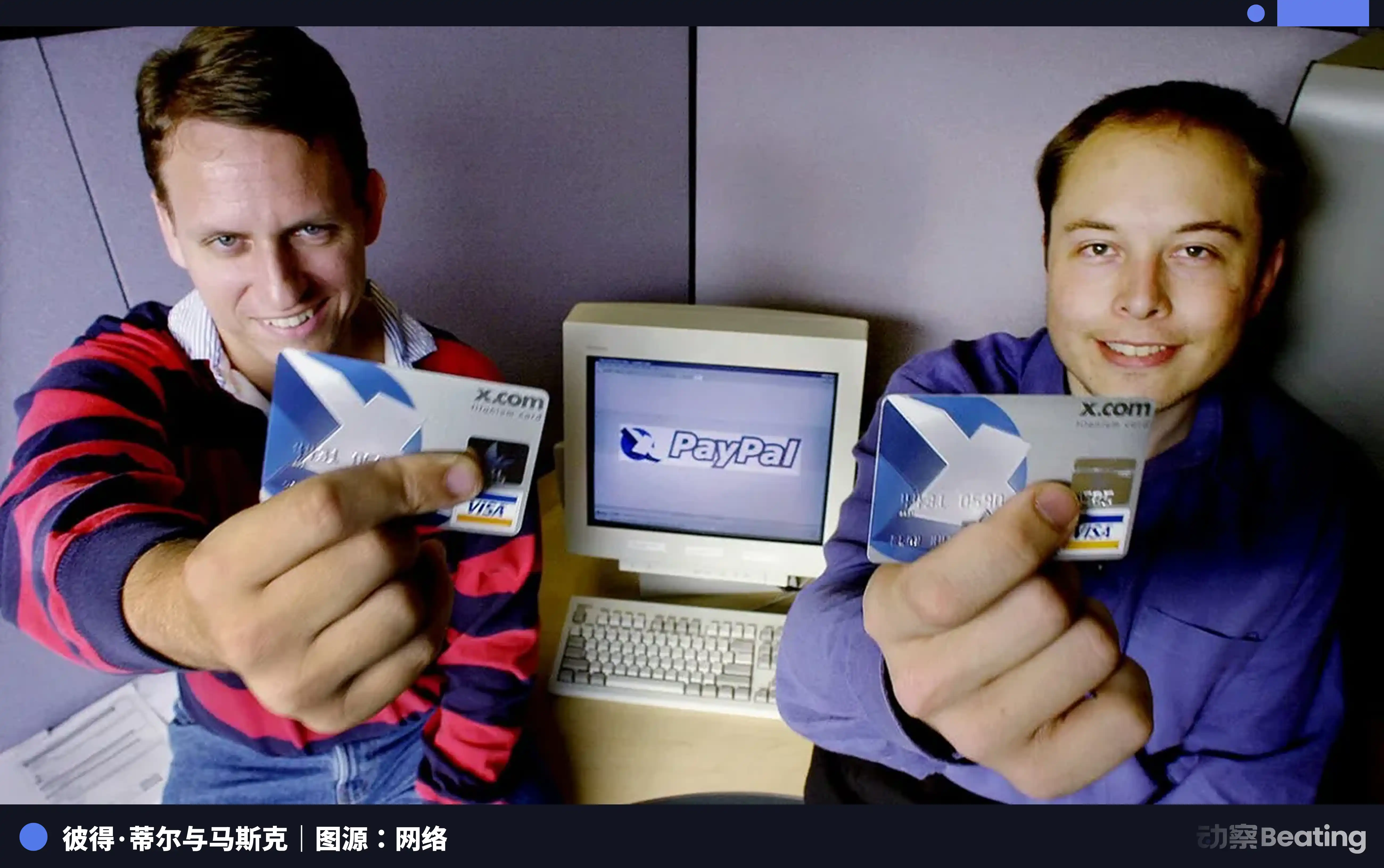
According to Thiel, Musk’s original vision was to turn Mars into a purist libertarian utopia. That idea had a clear cultural anchor: Robert Heinlein’s classic novel *The Moon Is a Harsh Mistress*.
The book depicts a group of lunar exiles who, after breaking free from Earth’s regime, establish spontaneous order and ignite revolution to declare independence. Musk read the book obsessively—he wanted to replicate that story on Mars: a special economic zone with no U.S. taxes, no EU regulation, no tolerance for “woke culture,” where the harshest rules of free markets reign—winner takes all, losers eliminated.
Musk never stated this openly, but it was the foundational driver behind the entire Mars plan. Going to Mars was never just a technical expedition—it was a grand political escape.
Until one day, Musk chatted with Demis Hassabis, CEO of DeepMind. Hassabis casually remarked: “You know, my AI will follow you to Mars.”
The implication: you can’t escape. When you migrate humanity to Mars, you also transplant human values, biases, power structures, and ideologies. AI is the concentrated amplifier of these civilizational flaws. Whatever AI you grow on Earth, the same will emerge on Mars. Mars is never a blank slate—it’s just a costly copy of Earth, with harsher survival conditions.
Musk fell silent for a long time. Then he whispered: “There’s nowhere to run. Really, nowhere to run.”
To Thiel, this conversation forced Musk onto the political stage in 2024. Rather than build a utopia on Mars, better to transform power structures right here on Earth. This explains Musk’s full support for Trump and deep involvement in DOGE (Department of Government Efficiency)—because if you can’t flee, you might as well remake the place you’re trying to escape from.
The Pilgrims on the Mayflower crossed the Atlantic, yet carried with them Britain’s rigid class hierarchy, racial prejudice, and power logic. Their “city upon a hill” ultimately became a mirror of the old world—slavery, entrenched class stratification, religious persecution resurfaced, just under new rhetoric.
Australia’s penal colony was no different—it perfectly replicated the British imperial class structure, merely transferring the title of “nobility” to “free settlers.” Every time humanity attempts rebirth on a new continent, it inevitably embeds the genetic code of the old civilization.
People carry their ideologies with them. Ideologies travel with them.
The very struggle to escape becomes proof that escape is impossible.
If so, does this trillion-dollar interstellar gambit still matter? Under the shadow of a civilization with nowhere to run, is anyone still embarking on this Sisyphean expedition?
After saying “nowhere to run,” Musk did not stop moving forward.
By late 2026, Starship will fly—carrying Tesla Optimus robots to Mars’s red soil, blazing the trail for future crewed missions. In 2029, the countdown for manned expedition begins. To build a Martian city of a million people requires pouring one million tons of supplies, assembling a thousand Starships, and completing ten thousand launches. The sheer cost of this launch campaign alone is estimated at a staggering $1 trillion. Even today, Musk remains in the spotlight, stubbornly repeating these mind-boggling figures.
But this isn’t just his story.
In March 2025, AstroForge’s prospecting satellite Odin vanished completely in deep space.
Launched on February 26, 2025, aboard a SpaceX Falcon 9 as a secondary payload for the IM-2 mission, Odin was headed toward asteroid 2022 OB5. Its mission: photograph the rock’s surface to confirm whether it harbored platinum-group metals.
Initial launch went smoothly. But soon, ground stations lost contact. The main Australian station crashed, backup station misconfigured, another site’s power amplifier mysteriously failed just before launch, and even a newly built cell tower interfered, completely disrupting the reception band. Odin sank into silence, drifting in the dark void 270,000 miles from Earth—its fate unknown.
Facing this failure, AstroForge CEO Matt Gialich wrote in his post-mortem report: “At the end of the day, you’ve got to step into the ring and go all in. You’ve got to try.”
With black humor, they dubbed the failed mission “Odin't” (Odin + didn’t). Immediately afterward, they announced the ambitious DeepSpace-2 plan: a 200-kilogram behemoth equipped with electric propulsion and landing legs—this time, they’d actually land on an asteroid.
This is the true nature of the space industry. It’s not Silicon Valley’s lightweight game of “fail fast, iterate quickly”—it’s something heavier, more somber, more fated. When you hurl your life’s work into deep space, and signal vanishes, it becomes just another nameless speck in the cosmos. You don’t know its fate, can’t recover its fragments. All you can do is swallow the silence and go back to build another.
July 6, 2024, Houston, Texas. As the 3D-printed hatch slowly opened, four volunteers emerged from their 378-day “Mars exile” into the real world.
Microbiologist Anca Selariu told the camera: “Why go to Mars? Because it’s genuinely possible. Deep space brings humanity closer together, igniting the brightest sparks within our souls. This tiny step by Earthlings can illuminate centuries to come.”
Structural engineer Ross Brockwell admitted: During those isolated years, his deepest insight was this—facing the infinite cosmos, imagination and awe for the unknown are humanity’s most precious qualities.
Medical officer Nathan Jones found his most inward revelation during this long isolation. He summarized: “I learned to appreciate each season as it comes, and to calmly await the next. For over 300 days, I learned to draw.”
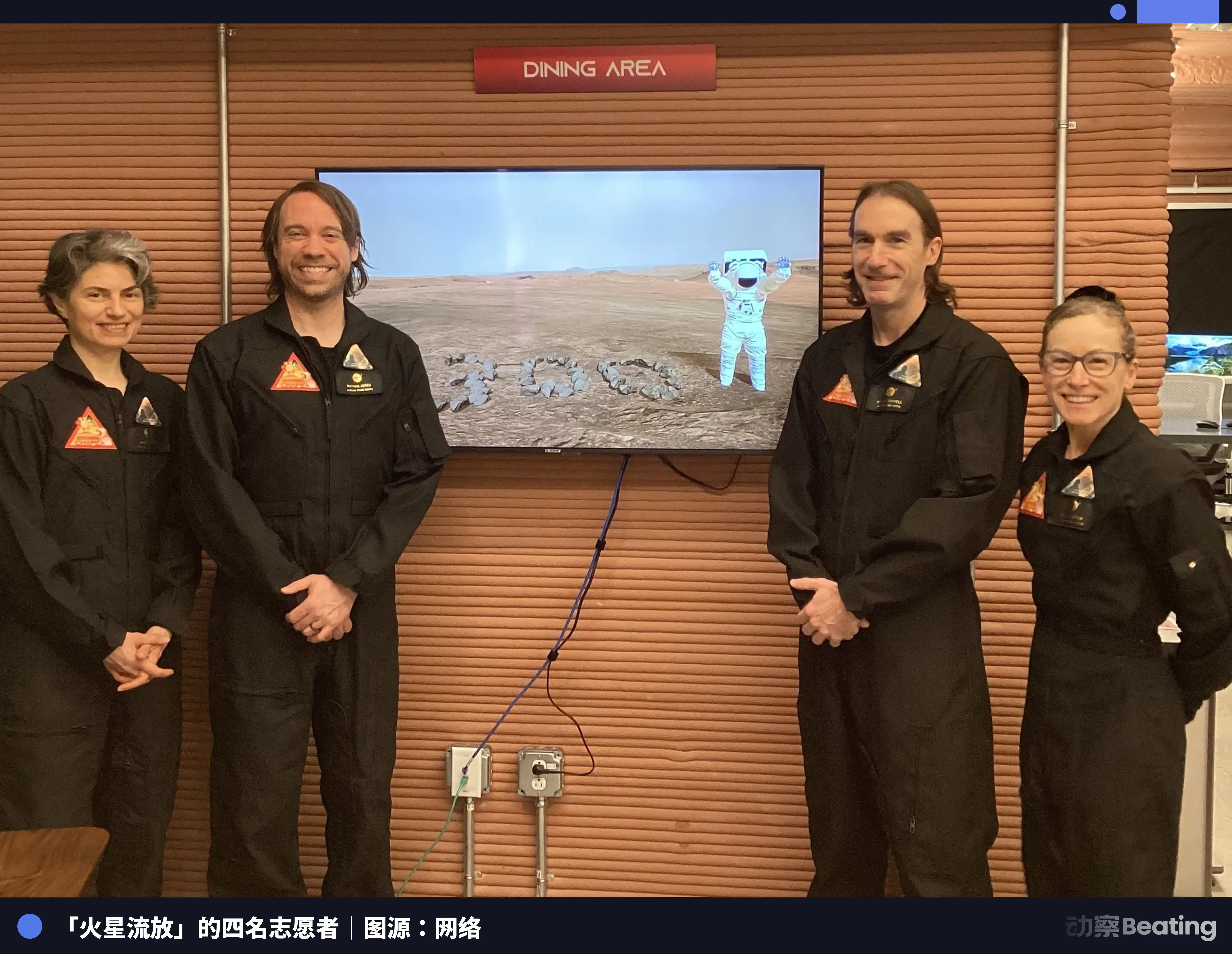
These four people are not Musk. They carry no $1.75 trillion capital myth, and no one cares about their social media snippets. They entered the chamber because someone had to try. Gialich launched that satellite because someone had to try. Mueller left SpaceX and founded Impulse Space because someone had to try.
Faced with Musk’s pessimistic “nowhere to run,” they didn’t flee or give up—they went to test how it felt.
After exiting the module, Selariu said: “I’m truly glad I can access information anytime again—but I’ll miss the luxury of being disconnected. After all, in this world, a person’s worth is defined by their digital presence.”
She lived in a Mars-simulated room for 378 days. When she returned to Earth’s noise, what she missed most was the silence.
You're anxious about AI, they're already discussing Martian mining rights
Mars Industry Chain
The bigger the dream, the easier the funding
“Nowhere to Run”
But Starship still flies
Disclaimer: Contains third-party opinions, does not constitute financial advice


AI Practical Guide
This column focuses on the real progress of Agents: technological evolution, application implementat

Crypto Weekly
Tracking on-chain movements of the smart money and institutions

Frontier Insights
Spotlight on Frontier, trending projects, and breaking events

Blowup Alert
As the 2026 crypto bear market deepens, exit scams and project blowups are becoming increasingly fre

Regulatory Watch
American Crypto Act – timely interpretations of policies worldwide

Popular Airdrop Tutorial
Selected potential airdrop opportunities to gain big with small investments

FusnChain
FusnChain