The TAO token favored by Huang Renxun crashed today following a letter
The TAO token favored by Huang Renxun crashed today following a letter


As long as the people are here, the story remains; when they leave, you might not even find a counterpart to trade against.
TAO suddenly plummeted 15% today, now trading around $277, with downward momentum still in play.
The sudden price drop may have been triggered by an open letter.
The letter was authored by Sam Dare, founder of Covenant AI. Bittensor is currently the highest-valued project in the AI+Crypto space, while Covenant AI is the most pivotal subnet team within its ecosystem.
Last month, this team accomplished a major milestone: running a 72B-parameter large model, Covenant-72B, using just over 70 contributors’ consumer-grade hardware—boasting the largest decentralized AI training effort in history.
A month ago, this event made TAO the brightest narrative across the entire crypto sphere, evoking the image of “AI’s beacon.”
NVIDIA CEO Jensen Huang publicly praised it; prominent Silicon Valley investor Chamath dedicated a segment on his podcast to it; and $TAO surged as much as 90% in one month—a striking performance amid the current bear market.
But today, Sam Dare announced he and his team are leaving Bittensor, effectively dismantling the very foundation of that narrative.
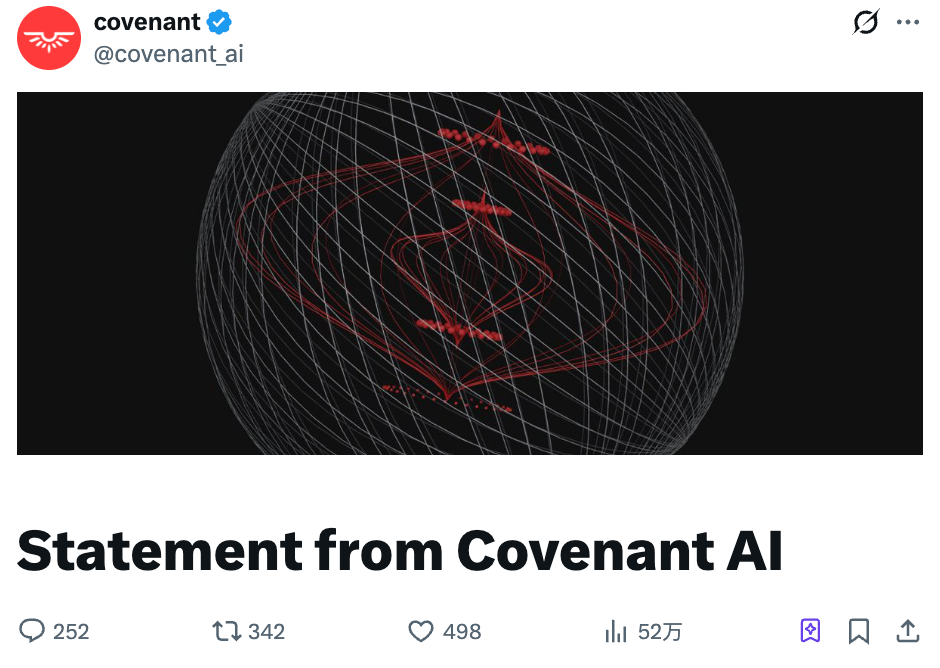
Sam Dare’s open letter is lengthy, but its core accusation boils down to one point:
Bittensor’s founder, Jacob Steeves (widely known in the community as Const), single-handedly controls the entire network—the so-called decentralization is merely a façade.
In the letter, he outlines a series of actions, the most severe being: first, directly halting the emission of rewards for the Covenant subnet, effectively zeroing out the team’s revenue; second, conducting large-scale token sell-offs during the conflict to pressure opponents through market mechanisms.
The parallel launch of the whistleblower website Tao Papers provides harder evidence. According to on-chain data disclosed by the site, between 2023 and 2026, Bittensor conducted 41 network upgrades—of which 38 were proposed, signed, and deployed entirely via infrastructure controlled by Const; the other two signers each added their signatures within minutes, with no public discussion or transparency whatsoever.
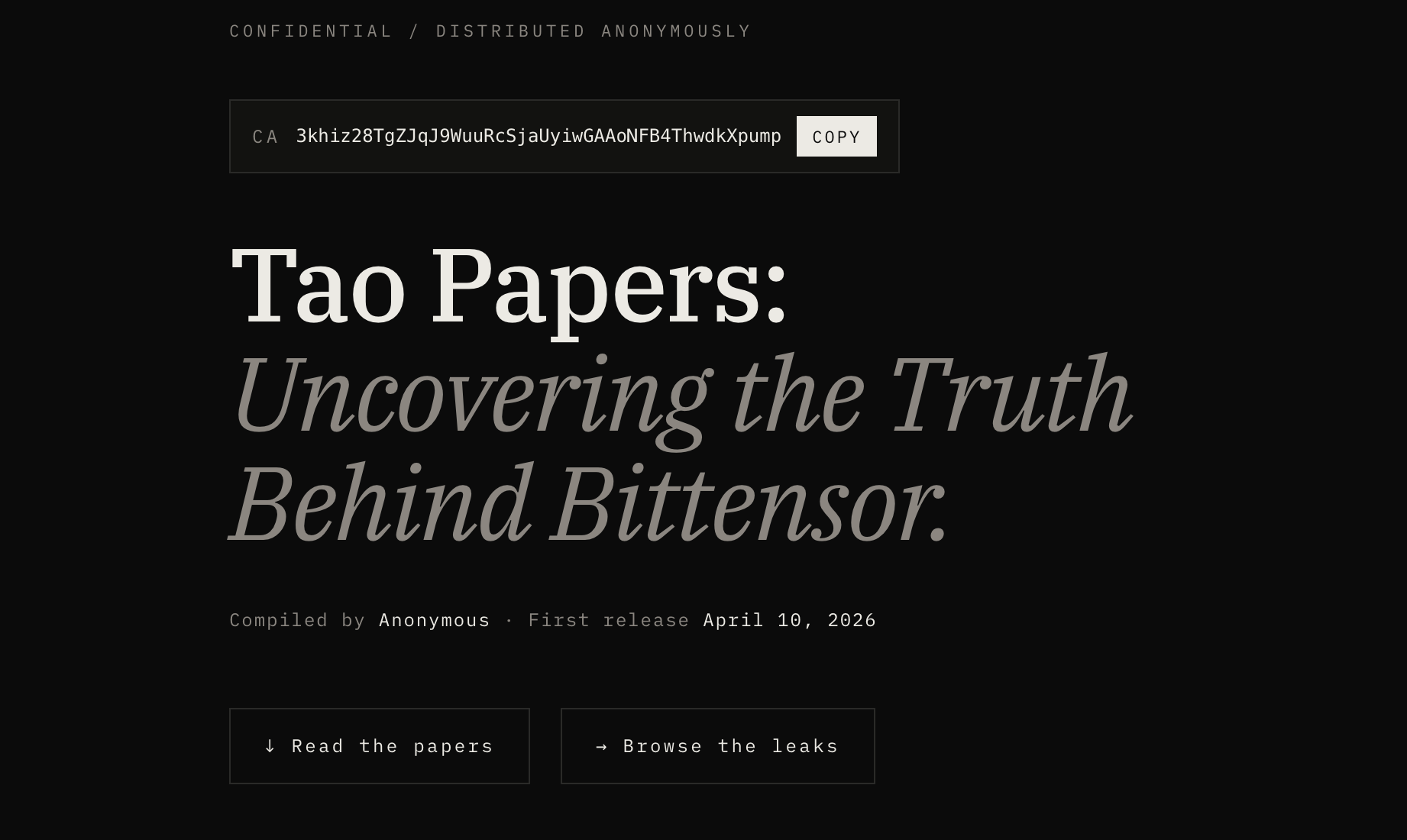
The so-called "governance committee" of three is, in reality, a single decision-maker with two rubber stamps.
The simultaneous release of the open letter and the whistleblower site clearly indicates this was not a spur-of-the-moment move by Sam.
Correspondingly, just two months ago, Bittensor’s founder Const had announced his resignation from the CEO role at Opentensor Foundation (the development foundation behind Bittensor), citing a commitment to further decentralization.
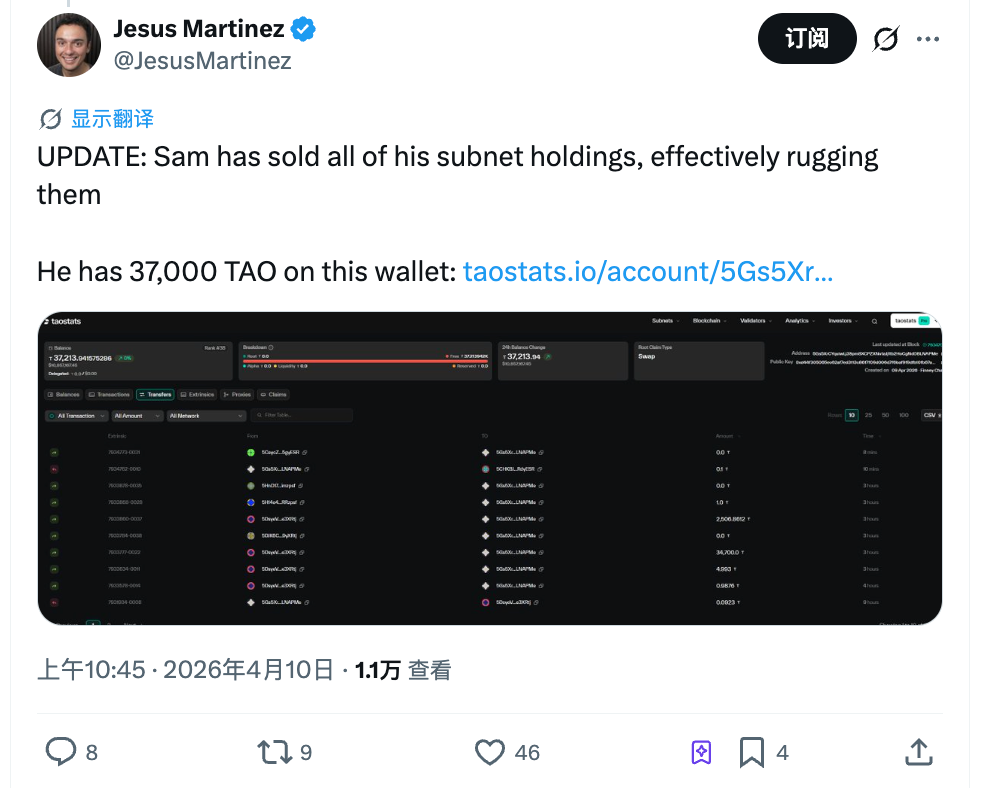
Meanwhile, after Sam’s announcement of departure, on-chain data reveals he sold all 37,000 TAO tokens held by his team—triggering additional FUD in the market.
To date, Const’s only response has been a single statement: essentially, that Covenant’s exit is actually beneficial, as it will catalyze the emergence of subnets that operate autonomously without reliance on any single team.
He has not addressed a single one of Sam Dare’s allegations. Whether the dispute is justified or not, the market has already priced it in.
In March, $TAO rose from approximately $170 to $337—a near doubling. According to The Block, following the release of Covenant-72B, TAO surged over 50% within two weeks—the single biggest catalyst behind the total 90% rally.
Covenant AI is linked to templar, basilica, and grail (subnets sn3, sn39, and sn81). These subnet tokens are tied to TAO via staking mechanisms. When news of Covenant-72B broke, subnet tokens spiked up to 400%, dragging TAO along with them.
Thus, buyers of TAO ostensibly purchased access to a decentralized AI network comprising over a hundred subnets—but the price structure tells another story: nearly half of the price appreciation was anchored to a single team.
Success was built on Covenant; failure now stems from Covenant too. This phrase is being echoed widely today, yet most people grasp only the surface meaning.
More worth pondering is why a network claiming 125 subnets relied on just a few to drive the bull run—and now, when the downturn hits, collapses due to drama from those same few. In both cycles, the vast majority of subnets remained virtually invisible.
Bittensor’s decentralization narrative has been sold for three years, yet its price structure has consistently reflected centralization. As for who is right or wrong in this conflict, the author believes that is beside the point.
Every ecosystem has star teams. Every star team can leave.
The real challenge lies in how you respond to such events.
Team feuds in crypto projects during bear markets are nothing new. When the market lacks narratives, a project’s rise hinges entirely on whether a compelling story can be spun. Covenant-72B was one of the best narratives of the year—Huang’s endorsement, TAO’s doubling, the community collectively believing decentralized AI had finally produced a viable contender.
But price rallies driven by narratives carry an inherent flaw: those who create the narrative can also destroy it. In the ascent, it was crypto’s beacon; in the descent, it becomes a tale of team exodus. For TAO holders, the 90% gain and today’s 15% loss stem from the same source.
This may represent the most authentic investment dilemma in today’s crypto landscape: prices perpetually chase unpredictable narratives, and these narratives remain tethered to key individuals.
People are here, the story persists; when people leave, you may not even find a counterparty to trade with.
Disclaimer: Contains third-party opinions, does not constitute financial advice
NVIDIA attracts $85 billion in investor demand during massive bond issuance
17 days ago
Ethereum surges over 10% in 24 hours, currently priced at $1,841.31
17 days agoAmazon announces a multi-billion dollar investment in Missouri to build a data center campus, expected to create over 400 long-term positions
17 days agoBinance Platform's SpaceX Perpetual Contract Trading Volume Surpasses $9 Billion, Capturing Over 60% Market Share
17 days agoBinance platform XLM/USDT short-term spike down to $0.17, now recovered to $0.225
17 days ago
Trump: The Strait of Hormuz has been fully reopened as of Friday, and all agreements have been signed
17 days agoSlowMist: Aztec Connect Contract Hacked for $2.19 Million Due to ZK-Rollup L1/L2 State Boundary Vulnerability
17 days ago
