
ChainThink
Stay ahead, master crypto insights
Last night, Trump announced an indefinite ceasefire—what's next for Bitcoin's price outlook?
Last night, Trump announced an indefinite ceasefire—what's next for Bitcoin's price outlook?

2026-04-22 09:51
On the morning of April 22, Trump said during a phone interview on CNBC’s Squawk Box: “I don’t want to extend the ceasefire. We don’t have much time left. I expect bombing to resume because I believe this is a better opening posture.”
Several hours after making this statement, he posted on Truth Social announcing an indefinite extension of the ceasefire—until Iran submits a proposal and negotiations conclude in some form.
The "off-ramp" this time was facilitated by intervention from Pakistan’s Chief of Army Staff and Prime Minister. He also added that the decision was influenced by the "severe fragmentation within the Iranian government."
Those familiar with Trump know this is his classic TACO maneuver.
Far from a proactive diplomatic victory, this appears to be a reactive decision made out of necessity as the deadline approached with no better alternatives.
This story begins with the Islamabad talks on April 11.
At that time, Vice President Vance led a U.S. delegation to Pakistan, where negotiations with Iran lasted 21 consecutive hours—the highest-level direct talks between the U.S. and Iran since the 1979 Islamic Revolution. Upon departing, Vance declared that Iran had “rejected U.S. terms.” The American core demand was singular: Iran must make a clear commitment not to pursue nuclear weapons—not only refraining from building a bomb, but also renouncing any technological capabilities enabling rapid nuclear breakout. Iran refused. Iran’s chief negotiator and Parliament Speaker, Khalilbaf, countered that the U.S. must first determine whether it can earn “our trust.”

After the breakdown, the U.S. immediately announced a maritime blockade of the Strait of Hormuz.
A two-week ceasefire framework was established on April 8, with an expiration date set for April 22. In the final night before expiry, the situation deteriorated rapidly: Iran had yet to confirm attendance at the second round of talks, and Pakistan’s Information Minister publicly stated, “formal response has not arrived yet.” In anticipation, Pakistan preemptively heightened security in Islamabad, with security personnel visible around the Serena Hotel—an indicator that Islamabad was still awaiting confirmation from Tehran.
Vance had originally planned to return to Islamabad, but after a series of internal White House meetings, the trip was indefinitely postponed. A report by The Wall Street Journal was more direct: Trump privately discussed canceling the entire mission altogether, citing Iran’s unwillingness to compromise on uranium enrichment. Subsequently, the Iranian negotiating team relayed through Pakistani intermediaries that participating under these conditions would be a waste of time, as the U.S. was actively blocking any substantive agreement.
Meanwhile, Trump faced mounting pressure from within the U.S. political landscape.
Deutsche Bank constructed a “pressure index” combining inflation expectations and U.S. Treasury yields to forecast turning points in White House policy shifts. According to this model, when crude oil prices approach $95–$100 per barrel, the administration’s rhetoric tends to soften noticeably; actual policy adjustment pressure truly emerges only when the 10-year U.S. Treasury yield nears 4.5%.
WTI crude has already broken above $90. If the ceasefire lapses and tensions escalate again, crossing $100 per barrel is entirely plausible. Gasoline prices exceeding $4 per gallon historically inflict severe damage on public opinion toward sitting U.S. leaders.
Moreover, Trump plans a visit to China in mid-May, and he aims to appear as a “victor” rather than a “wartime president.” This timing gives Iran additional leverage in negotiations and increases Washington’s incentive to show flexibility on deadlines.
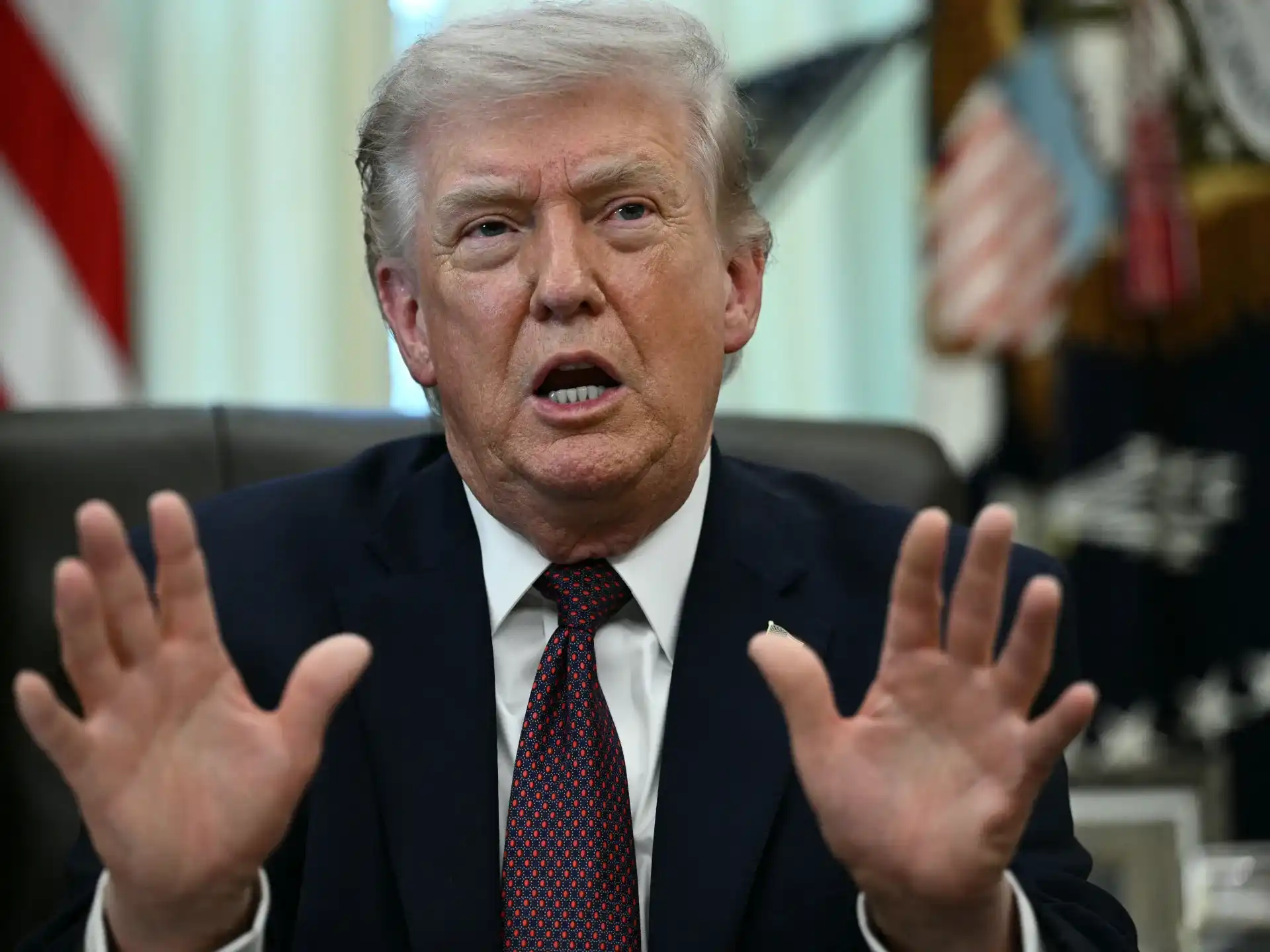
From this perspective, the phrase “indefinite extension” functions more as a domestic political signal than a diplomatic concession to Iran. It grants Trump space to delay without formally admitting defeat.
It was against this backdrop that Trump announced the extension.
Axios’ analysis cuts to the core: while this extension avoided war resumption and regional escalation, it simultaneously weakened Trump’s own negotiating leverage. A credible threat of force relies precisely on the authenticity of the countdown. Each TACO moment erodes the credibility of the next threat.
Iran’s response has been divided, with clear tension between moderate and hardline factions.
Iran’s national television adopted a narrative of victory: Iran is the “winner on the battlefield,” controlling the Strait of Hormuz being the most valuable asset of this conflict. Iran agrees to suspend military operations, but insists “the war is not over.” Simultaneously, the state media warned that negotiations must not touch any issue perceived as infringing on Iran’s sovereignty or dignity—primarily including defense and missile capabilities, nuclear capacity, and technology.
The hardliners were more direct. Iran’s Parliament Speaker’s advisor stated, “Trump’s ceasefire extension is meaningless; the loser cannot dictate terms,” and cautioned this extension was merely “buying time for surprise attacks.”
Yet moderate voices emerged too. Iran’s UN Ambassador Ebravi stated that the government had received “some signals” that the U.S. was preparing to lift the blockade. Once lifted, “the next round of talks will take place in Islamabad.” He emphasized that the U.S. maritime blockade itself violated the ceasefire agreement, and lifting it was a precondition for new negotiations. When asked about confidence in the negotiation outlook, his reply was: “We should give it a chance—we remain hopeful.”
The core impasse remains unchanged: the U.S. demands complete denuclearization, while Iran insists on lifting the blockade first. Both sides are using delay to gain strategic space.
Evidently, over the past two weeks, Bitcoin’s price has been driven almost exclusively by Middle East geopolitical narratives, not macroeconomic fundamentals.
Last Friday, Bitcoin surged to $78,300—the highest level since early February. Then, upon Iran’s announcement closing the Strait of Hormuz, the price retreated to the $75,000–$76,000 range. On April 19, when U.S. forces seized the cargo vessel TOUSKA, Bitcoin briefly dipped below $74,000. After news broke of the ceasefire extension on April 21, the price rebounded above $76,000 the same day, driving a broader crypto market rally of over 1%, pushing total market cap to $2.55 trillion.
Each price milestone corresponds directly to a specific event on the ground.
At the institutional level, demand hasn’t disappeared. Bitcoin spot ETFs recorded approximately $1.29 billion in net inflows from April 14 to 17, with even higher figures—around $1.1 billion—for the week preceding April 10, closely aligning with the timing of ceasefire expectations before and after the Islamabad talks.
Rachel Lucas, analyst at BTC Markets, observed: “The current resilience of Bitcoin stems less from narrative momentum and more from market mechanics. Institutional buyers—especially corporate capital—are aggressively accumulating during every pullback.” She also noted that this recovery coincides with heightened market focus on the Federal Reserve Chair nominee’s upcoming hearing—investors are betting on future monetary policy direction.
Yet internal structural data signals are less optimistic.
Since Bitcoin reclaimed $75,000, perpetual contract funding rates have remained persistently negative. Negative funding rates indicate that short positions still dominate the derivatives market. In other words: while spot prices rise, the structural long-side momentum has not caught up—this rebound is largely driven by short-covering, not fresh long-entry activity.
Deribit’s data confirms this view: approximately $1.5 billion in Bitcoin put options cluster around $60,000, while $1.3 billion in call options concentrate near $75,000. The overlay creates an ambiguous options structure with unclear directional bias.
Thielen, Research Director at 10x Research, concurs with this signal. He pointed out that this rally has not yet been accompanied by significant call option buying—market dynamics are fundamentally driven by short-covering, not a sustained upward trend.
Hughes from Tokenize Capital suggests the rally may weaken next month, with further downside risk looming by August.
Even more pessimistic is CryptoQuant’s on-chain data model, which indicates downward pressure on Bitcoin’s current price, with a potential test of the ~$70,000 support level in the medium term. If on-chain momentum continues to weaken, deeper corrections could reach the $56,000 range. Morgan Stanley strategist Denny Galindo stated that Bitcoin is currently in the “autumn” phase of its four-year cycle—winter is coming.
Should the ceasefire continue and tangible signs emerge of the Strait of Hormuz reopening, some analysts believe Bitcoin could target $80,000 before the end of April. But this scenario hinges on a long chain of prerequisites: no ceasefire breach, blockade lifted, negotiations advancing, global energy supply expectations stabilizing—only then can market risk appetite truly open.
Tariffs, threats to allies, pressure on the Fed—every single TACO moment arrives predictably, and those who bet on reversals have profited.
But TACO is not a natural law—it’s a predictive model based on past behavior. The nature of an Iran war differs fundamentally from trade negotiations. It involves military casualties, national sovereignty, domestic political red lines. Each TACO cycle consumes the dwindling mutual trust in negotiations and shrinks the market’s operational space for TACO. This implies that one day, TACO may simply fail completely.
Disclaimer: Contains third-party opinions, does not constitute financial advice


AI Practical Guide
This column focuses on the real progress of Agents: technological evolution, application implementat

Crypto Weekly
Tracking on-chain movements of the smart money and institutions

Frontier Insights
Spotlight on Frontier, trending projects, and breaking events

Blowup Alert
As the 2026 crypto bear market deepens, exit scams and project blowups are becoming increasingly fre

Regulatory Watch
American Crypto Act – timely interpretations of policies worldwide

FusnChain
FusnChain