Crypto professionals accelerating exodus—what’s left to do in this industry?
Crypto professionals accelerating exodus—what’s left to do in this industry?


Many of my friends have already left or are considering leaving the crypto industry, so I want to share some broader market reflections on what remains possible for cryptocurrencies.
The core issue lies in three critical challenges facing crypto: (i) a lack of innovation—nothing new has emerged over the past 2-3 years; (ii) advances in quantum technology threaten Bitcoin’s survival by 2029; and (iii) large language models like Claude Mythos have increased attack vectors, making DeFi’s risk/reward profile unattractive.
This raises the central question: What remains possible for crypto?
VCs and Liquidity Token Investors
Due to this innovation drought, the VC space has been notably quiet, especially in token trading. Every crypto VC will tell you how dull it is—unless they’re executing larger Series B+ rounds or funding stablecoin payment startups.
The few high-quality VCs I’ve engaged with are investing in reverse verticals—such as quantum startups (e.g., Project Eleven, Oratomic) or novel concepts (e.g., Shift Foundation, PostFiat, Ambient).
This feels natural: we’ve largely figured out what works and what infrastructure is needed, so fewer exciting new developments remain. We’re now in the adoption phase for payments and remittances. The endgame and institutionalization have arrived.
Similarly, for those working in crypto, meaningful roles exist only at stablecoin fintech firms (e.g., Circle, OpenFX, Tempo, Arc, Plasma), exchanges (e.g., Polymarket, Kalshi, Hyperliquid), or innovative reverse startups (as above). Working at an L1 foundation is a well-paid dead-end job with no long-term benefit for you.
The absence of "cool new things" in VC means fewer high-quality tokens hitting the market, and less VC capital flowing into liquid markets.
Thus, long-term liquidity token investors evaluating projects based on growth, fundamentals, and value accrual may now have fewer than 10 quality opportunities—and this number seems unlikely to increase significantly in the near term.
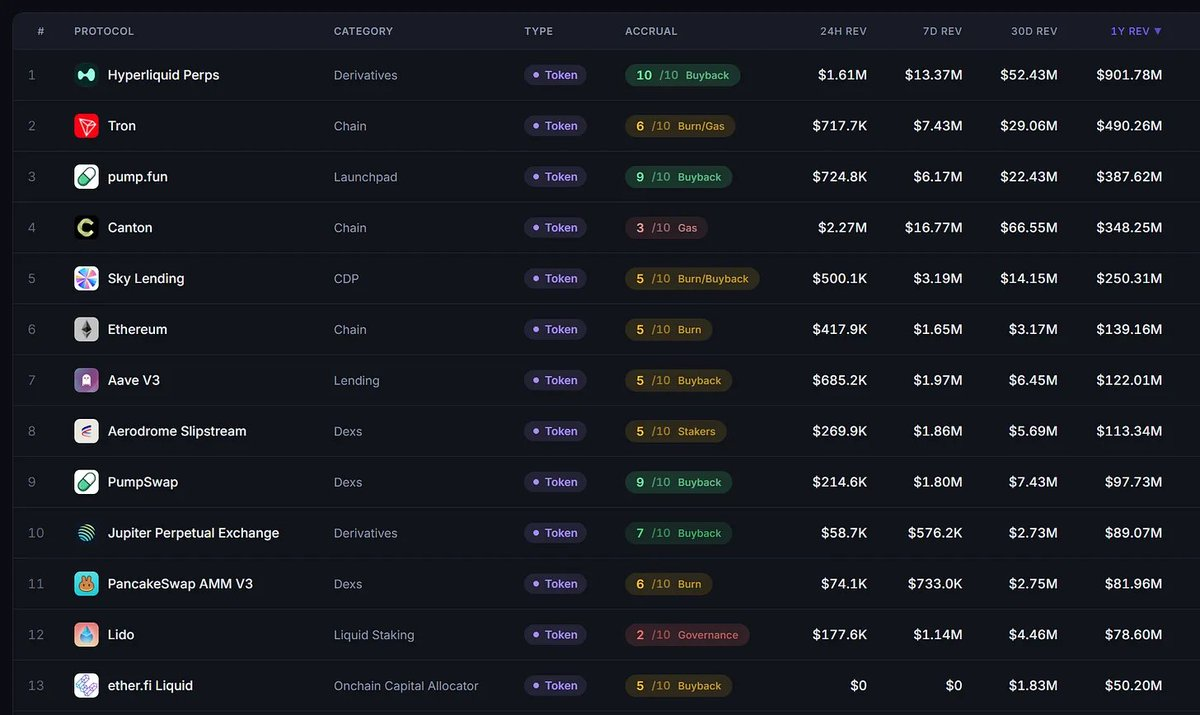
Only 12 token projects generate annual revenue exceeding $50 million. Of these, only three have value accrual scores >=7 (HYPE, PUMP, JUP). Even if you assess based on "growth" and teams improving token value accrual, you might add another 5–10 tokens to the list below (e.g., MORPHO, SYRUP).
OTHERS’ market cap has fallen from ~$450B to ~$180B, while equities are experiencing speculative mania in high-bandwidth memory, photonics, quantum, and polypeptide sectors.
Subjective and Systematic Traders
You might argue that crypto is primarily narrative-driven and momentum-based, making it ideal for long/short, narrative, or catalyst/news-focused subjective traders. This is my domain, and the one I know best.
During deep bear markets, trading catalysts have been particularly profitable—even though many require sharp mental clarity and rapid reaction. There remain significant advantages and solid trading opportunities here.
Still, the past three months have seen considerable event-driven trading, such as...
Selling short TAO upon Templar subnet exit, dropping from $330 to $260 in 5 hours (April 9)... Going long TAO when Chamath and Jason Cal called (success varied)
No trade here, but interestingly, WLD didn’t rally on Tinder and Zoom partnership announcement (fell 8% in two days)
Selling short AAVE during KelpDAO hack—attack occurred around 1730 UTC, first Twitter report at ~1830 UTC (April 19)
Selling short AAVE upon Marc Zeller’s departure from ACI (March 3)
Selling short TRUMP after Trump dinner announcement (March 12)
Selling short ACX after token-to-equity conversion surge (March 11)
Selling short DRIFT during exploit—down 40% in 1 hour (April 1)
Selling short RESOLV during exploit—down ~10% (March 22)
Going long ALGO after Google’s quantum breakthrough (March 31)
Going long LDO after buyback announcement—up ~17% over ~5 days (March 27)
Long/shorting pump-and-dump schemes like RAVE, SIREN, STO, PIPPIN, POWER (I prefer not to participate)
Nevertheless, open interest has declined ~60% since October 10th, and reactions to news are often minimal. You must be selective about which news to trade and whether others care—retail interest is rare (often the slowest responders), so you’re mostly competing against other news traders in PvP.
I increasingly see subjective traders spending more time on prediction markets and trading stocks/commodities—Hyperliquid has made this transition much easier.
For systematic traders and basis traders: declining volume and funding rates make traditional strategies increasingly unprofitable. To stay engaged, they now pursue HIP-3 markets, arbitrage prediction markets, trade Pendle PT/Boros, or arbitrage new perpetual DEXs (with limited liquidity).
Yield Farmers
Increasingly frequent DeFi exploits have pushed yield farmers—or TVL traders in institutional contexts—into dormancy or full exit this year, as the last few viable trades were Plasma and USDai. FlyingTulip might work in bull cycles, but its launch attracted little attention.
“Yield plays” usually make sense because you can sell governance tokens you earn (as emphasized here)—but this assumes someone buys them from you. If liquidity investors or subjective traders aren’t adding fuel, it’s hard to justify the risk/reward.
This applies to past (OHM), present (XPL, ENA), and future (USDai’s CHIP) scenarios. The historical threshold for on-chain DeFi yields was 15–25% annualized, factoring in ~0% treasury yields and ~10–15% exploit probability.
OHM was worth it not because risk was lower, but because returns were far higher.
Today’s threshold may approach 50–60% annualized, due to rising exploit frequency (DeFi hacks totaling $795M in first four months of 2026) and potential increases in quantum threats from Claude Mythos. With no buyers for released tokens, achieving reasonable risk/reward is difficult.
Most rational farmers have fully shifted off-chain, as even STRC’s 11.5% traditional finance fixed-income note offers better risk-adjusted returns (15–20%).
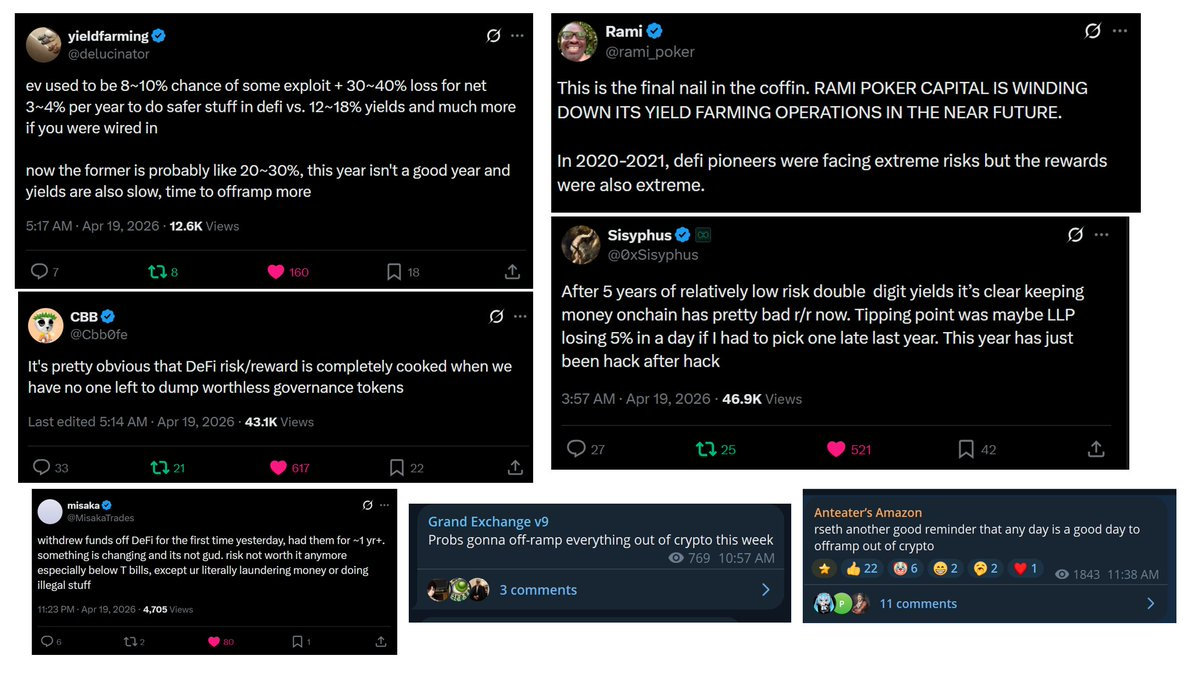
See: Rami poker, CBB, Sisyphus, delucinator, misaka
On-Chain Miners
Finally, and equally important: the infamous on-chain miners—those who buy at $1M market cap and sell at $100M. I believe they’ll persist because trenches remain the only place where 100x gains are still possible.
On-chain miners also feel like World War II soldiers trapped in a cave, unaware the gold rush has essentially ended.

Needless to say, meme coins peaked when our beloved president and first lady launched their tokens. We’re nearing the tail end of the euthanasia rollercoaster—assets no longer rise like before, with excessive value extractors everywhere (“FNF crew,” “LA vape group,” consecutive rug pulls, and extractive fee mechanisms).
That said, I still believe this niche won’t vanish entirely—a sliver of hope keeps people in the trenches. Over recent months, we’ve seen…
$GAS: GasTown rose from $100K to $60M market cap in 3 days, then fell back to $100K in 3 days, now trading at $50K (Jan 15)
$RALPH: RalphWiggum surged from $500K to $55M in 2 weeks, then dropped to $3M (-93%) within 12 hours after dev abandonment, now trading at $50K (Jan 21)
$PENGUIN: Nietzchean Penguin hit $170M in 3 days (Jan 24), now trading at $3M
$MOLT reached $120M in a day (Jan 31), now trading at $1M
$WHITEWHALE hit $200M (Jan 10), now trading at $7M
$ASTEROID reached $200M yesterday (April 19) after Musk tweeted it might become a SpaceX mascot. It may soon trend toward zero.
While these show occasional surges, your odds of catching them are likely <10%, and absolute upside is capped at net 10x (e.g., $10M → $100M), as assets no longer scale beyond $100M. You now have only hours post-peak to exit, as prices drop >90% within hours.
So... What am I doing?
I’m maintaining my arbitrage strategy on Polymarket, generating ~15% annualized return, with max capacity ~$250K. Fully deployed, monthly profit is only ~$3,500. Since Polymarket introduced trading fees, arbitrage opportunities have diminished, and with the recent npm package poisoning incident, I increasingly feel the risk/reward isn’t there anymore (especially post-airdrop). Current plan: shut it down post-airdrop.
I continue trading crypto, but not as actively as before. I’ve entertained the idea of launching an AI hedge fund, but my exploration leads me to conclude that AI isn’t yet creative enough for subjective trading (e.g., idea generation), though if given a task or methodology you’ve used before and requiring some logical reasoning, it excels.
Thus, I’m spending time automating certain “hedge fund analyst” tasks—like automating on-chain due diligence I previously performed manually for internal wallets on Polymarket. This is highly procedural but requires a bit of logic thinking—perfect for Claude.
I’m also increasingly diving into AI model fine-tuning, especially from crypto and financial data perspectives. I’ve been reading beyond crypto and find topics like AI stacks (social impact and entire stack equity), physical AI (world action models, vision-language models, data issues), and “AI integration” (PE integration but with AI) intellectually stimulating—but haven’t yet found a problem compelling enough to dedicate my life to solving.
Disclaimer: Contains third-party opinions, does not constitute financial advice
Hedge funds collectively liquidating, possibly one of the main drivers behind the accelerated market crash
4 mins ago
Floating profit of $3.76 million, a major whale shorting $50.34 million worth of Anthropic
28 mins agoQuarterly Net Profit of Hyperliquid Strategies Reaches $621 Million
2 hours agoBlock time reduced to 200 milliseconds, Base Mainnet Denim upgrade goes live
4 hours agoChainalysis Plans to Restore KYT and Address Screening Services via Trusted IP Whitelist Starting November 5
4 hours agoUnupgraded nodes will be forked off the network; Anza recommends Solana validators upgrade to Agave 4.4.1
5 hours agoThe Federal Reserve and OCC contact banks to assess the impact of the Binance hack, with approximately $6.34 billion in assets affected
5 hours ago