
ChainThink
Stay ahead, master crypto insights
Sun Yuchao Sues the Trump Family After Being Rug Pulled—Can He Win?
Sun Yuchao Sues the Trump Family After Being Rug Pulled—Can He Win?

2026-04-23 16:04
Sun Yuchao invested $75 million, receiving in return a consulting title, a pile of frozen tokens, and a federal court complaint.
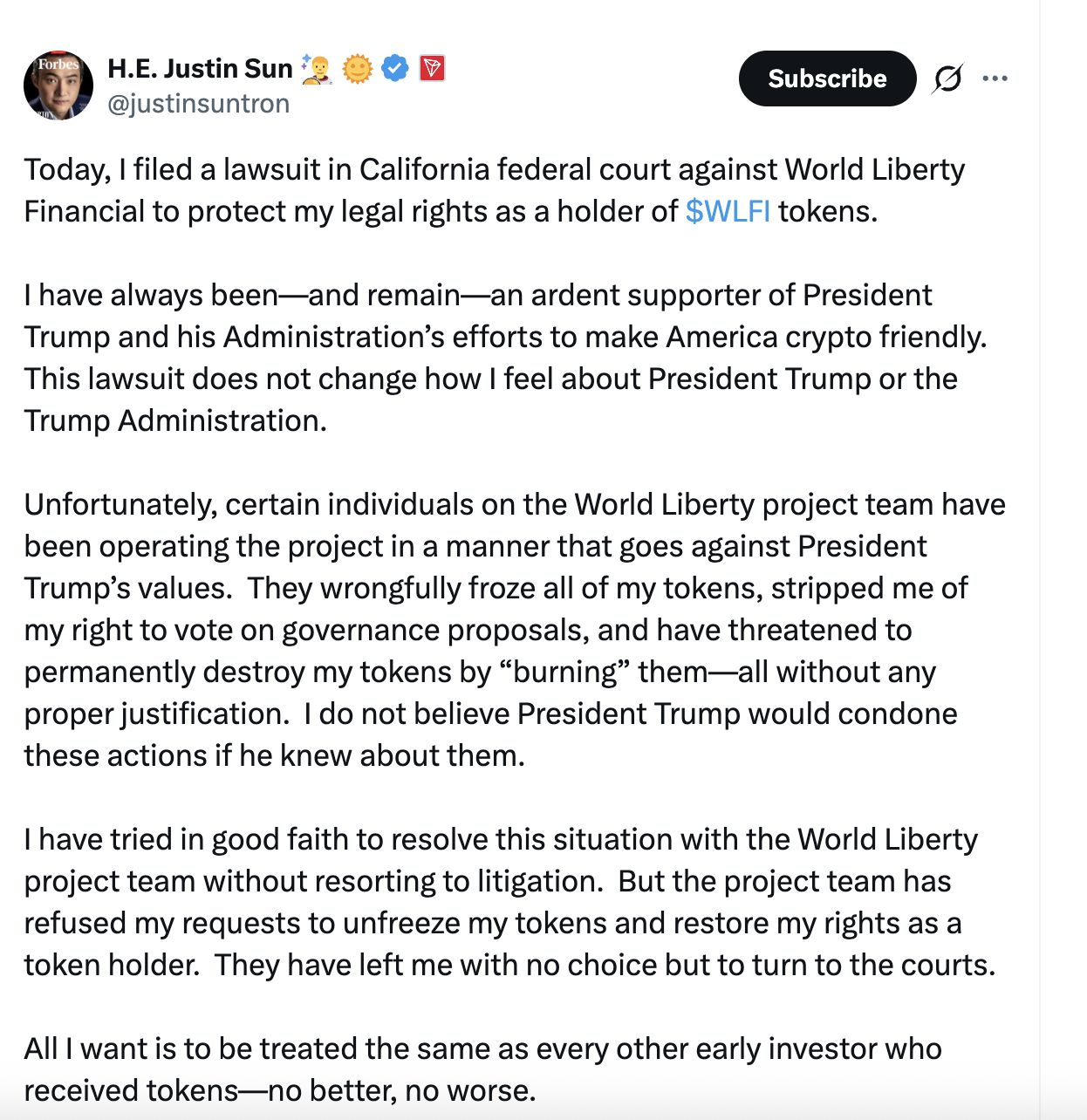
On April 22, the Tron founder formally sued World Liberty Financial (WLF) at the U.S. District Court for the Northern District of California, accusing it of making him “the primary target of its fraud scheme,” resulting in “hundreds of millions of dollars in losses” to him and his company. He further alleged that WLF is currently “on the brink of collapse” and “severely insolvent,” with plans to allocate “95% of token sale proceeds to insiders.”
The most financially astute figure in the crypto world has been outmaneuvered.
The $75 Million “Letter of Allegiance”
Fast forward to late 2024.
When World Liberty Financial first launched its WLFI token, the market reception was dismal—just $22 million in sales during its first month.
Sun Yuchao stepped in. He initially invested $30 million, later increasing his stake to $45 million, plus an additional 1 billion WLFI tokens granted as compensation for advisory services. His total investment amounted to approximately $75 million, making him WLF’s largest publicly disclosed investor.
After Sun’s entry, other investors followed suit, ultimately raising around $550 million. WLF later publicly acknowledged that Sun had “resurrected” the project.
At the time, the SEC was prosecuting Sun for market manipulation, unregistered securities sales, and paying celebrities for promotion without disclosure. However, following Donald Trump’s inauguration in January 2025, the SEC voluntarily suspended proceedings against Sun. In March 2026, both parties settled for $10 million, with Sun admitting no wrongdoing.
For $30 million, Sun avoided a potentially catastrophic legal battle. The numbers were clear—he knew exactly what he was trading.
Refusing Bailout, Immediate Blacklisting
The honeymoon was short-lived.
According to the complaint, WLF repeatedly pressured Sun to increase his investment in 2025, including demanding he mint WLF’s USD1 stablecoin on the Tron network. Sun refused.
By July 2025, relations had completely collapsed.
What followed wasn’t merely a business dispute—it was a blockchain-led reckoning.
In August 2025, WLF modified the WLFI token’s smart contract to include a “blacklist” function. Project administrators could freeze any holder’s tokens unilaterally, without notice, justification, or governance vote.
A month later, when Sun attempted to transfer his WLFI tokens, his wallet was blacklisted. Approximately $107 million worth of governance tokens were frozen, and his voting rights revoked.
Subsequently, WLF threatened to “burn” (permanently destroy) his tokens. In blockchain terms, burning means irreversible asset deletion—extinction from existence.
Sun claimed he had attempted to resolve the matter “in good faith,” but WLF refused to unfreeze his tokens or restore his rights.
“They left me no choice but to go to court,” he wrote on X.
Zach Witkoff, CEO of World Liberty Financial, responded by calling Sun’s allegations “baseless” and asserting that Sun had engaged in “improper conduct,” necessitating action “to protect the platform and its users.”
No explanation was given as to what this “improper conduct” entailed.
The President’s ATM
To understand why Sun was frozen, one must first examine what World Liberty Financial truly is.
On the surface, it presents itself as a “decentralized finance” project promising small investors control over their own funds. It features a governance token (WLFI), a stablecoin (USD1), and DeFi lending products.
But beneath the facade lies a profit pipeline.
The Trump family receives 75% of net proceeds from WLFI token sales. By December 2025, they had already profited $1 billion, while holding $3 billion worth of unsold tokens. USD1 stablecoin reserves are invested in U.S. Treasuries, with interest income flowing directly to family entities. Based on a $4.2 billion valuation and current Treasury yields, the stablecoin alone generates approximately $160 million annually.
That’s not even the largest slice.
In January 2025, just four days before Trump’s inauguration, a sovereign wealth entity linked to Sheikh Tahnoon bin Zayed of Abu Dhabi acquired 49% of World Liberty Financial for $500 million. The agreement was signed by Eric Trump. Of this, $187 million flowed directly into Trump-controlled entities, and at least $31 million went to entities tied to the Witkoff family.
Zach Witkoff, CEO and co-founder of World Liberty Financial, is the son of Steve Witkoff, the U.S. Special Envoy for the Middle East.
Senator Elizabeth Warren labeled it “outright corruption.” The House subsequently launched an investigation. Trump himself stated he was “unaware” of the transaction.
Dolomite: Borrowing Your Own Money
Early 2026 saw on-chain data revealing that World Liberty Financial deposited 5 billion of its own WLFI tokens into the DeFi lending platform Dolomite as collateral, borrowing approximately $75 million in stablecoins. Over $40 million of this was transferred to Coinbase Prime—typically indicating conversion into fiat currency.
Corey Caplan, co-founder of Dolomite, also serves as an advisor to World Liberty Financial.
Using its own tokens to collateralize loans on a platform run by its own advisor, borrowing its own issued stablecoins, then converting them into cash.
This move pushed Dolomite’s USD1 lending pool utilization to 100%. Ordinary depositors were locked out, unable to withdraw their funds. Meanwhile, WLF’s collateral accounted for 55% of Dolomite’s total locked value.
WLF’s response: “We act as anchor borrowers, creating attractive returns for the platform.”
In essence, they used self-issued tokens to secure loans on a platform managed by their own advisor, borrowed self-issued stablecoins, and converted them into cash. In traditional finance, this would be considered a conflict of interest requiring separate audits and disclosures. In DeFi, there was not even a public announcement.
Sun publicly challenged WLF on April 12, accusing its team of treating users like “personal ATMs,” with himself being “the first and largest victim.” Three days later, WLF unveiled a governance proposal.
Last Chance
The April 15 governance proposal, ostensibly titled “governance restructuring,” actually stipulated that 6.228 billion WLFI tokens (62% of total supply) would be subject to a new unlock schedule. Tokens held by founders, team members, and advisors—totaling 45.2 billion—would face a 10% burn (approximately 4.5 billion), followed by a two-year lock-up and three-year linear release.
Holders refusing the new terms would have their tokens indefinitely frozen.
Sun called the proposal “one of the most absurd governance scams I’ve ever seen.” Yet he couldn’t vote against it—his tokens were already frozen.
Examining voting power distribution: In January 2026, a USD1 governance proposal passed, with the top nine wallets controlling nearly 60% of voting power.
The price trajectory of WLFI tells the full story. It hit a historical high of $0.46 in September 2025, then declined steadily. On April 11, it reached a historic low of $0.0767—a drop of 84% from its peak.
Early buyers who purchased at $0.015 still hold paper gains. But if you’re Sun Yuchao, having invested $75 million for tokens once valued at over $1 billion, now frozen—and potentially permanently destroyed—the stakes are existential.
Same Mirror, Different Reflection
Sun Yuchao was never an innocent victim.
He was previously accused by the SEC of market manipulation and fraud—coinciding precisely with his legal troubles.
It’s precisely because he isn’t blameless that this case matters.
A man who built his empire on “squeezing retail investors” is now being subjected to the same tactics by a larger power structure. The irony speaks louder than any whitepaper.
World Liberty Financial promised “decentralized finance”—users in control of their assets, no intermediaries, no censorship.
Yet behind the scenes, backdoors exist in smart contracts; project teams can freeze your tokens at will; governance votes are controlled by nine wallets; founders lend out your deposits to themselves.
Sun’s original words on X: “Unfortunately, certain individuals within the World Liberty Financial team have operated in ways contrary to President Trump’s values.”
Even at the moment of filing the lawsuit, he still maintained a veneer of respect for Trump. A man who spent $75 million, whose entire assets were frozen, still carefully distinguished between “President Trump” and “certain individuals within the project team” in his complaint.
The most intriguing aspect of this case isn’t whether Sun will recover his tokens. It’s how the courts will classify WLFI. If deemed a security, WLF’s unilateral modification of the contract and freezing of holders’ assets may constitute fraud under federal securities law.
WLFI’s current price is $0.078, down roughly 84% from its peak. The adequacy of USD1’s reserve backing is under scrutiny. Risks at Dolomite’s lending pool remain unresolved. The House investigation continues. Yet the Trump family has already cashed out over $1 billion.
Sun’s convertible bonds have their earliest maturity window in 2027. Court scheduling may take over a year. During this period, WLFI tokens will continue unlocking, and more users will face the ultimatum: “accept the new terms or be frozen forever.”
Disclaimer: Contains third-party opinions, does not constitute financial advice


AI Practical Guide
This column focuses on the real progress of Agents: technological evolution, application implementat

Crypto Weekly
Tracking on-chain movements of the smart money and institutions

Frontier Insights
Spotlight on Frontier, trending projects, and breaking events

Blowup Alert
As the 2026 crypto bear market deepens, exit scams and project blowups are becoming increasingly fre

Regulatory Watch
American Crypto Act – timely interpretations of policies worldwide

FusnChain
FusnChain