Tether Collaborates with U.S. Sanctions to Freeze $344 Million in Involuntary USDT, Sparking Further Controversy Over Stablecoin's "One-Click Freeze" Authority
Tether Collaborates with U.S. Sanctions to Freeze $344 Million in Involuntary USDT, Sparking Further Controversy Over Stablecoin's "One-Click Freeze" Authority


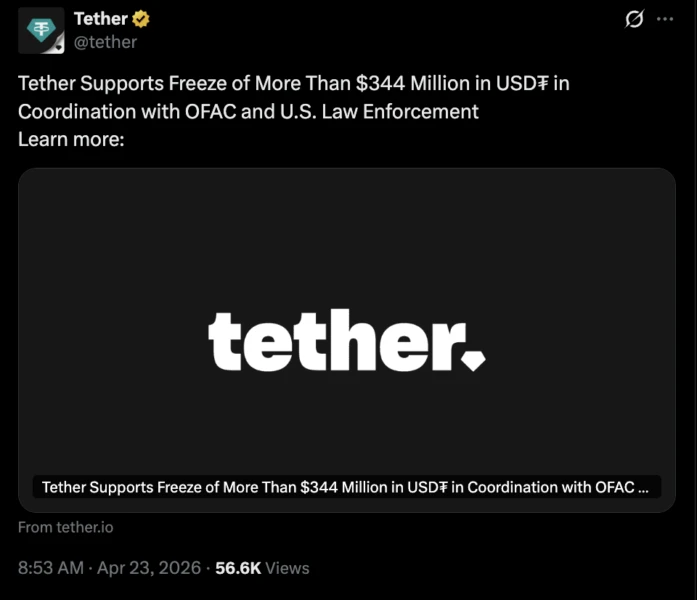
The largest single compliance freeze in stablecoin history has been executed.
On April 23, Tether issued a statement confirming that it had cooperated with the U.S. Department of the Treasury’s Office of Foreign Assets Control (OFAC) and multiple law enforcement agencies to freeze two USDT wallets on the Tron blockchain, totaling over $344 million. Blockchain security firm PeckShield was the first to identify the blocked addresses on-chain: TNiq9…QZH81 holds approximately $212.9 million, and TTiDL…pjSr9 holds around $131.3 million.
Tether stated that the freeze action was based on intelligence shared by U.S. authorities regarding sanction evasion, criminal networks, or other illicit activities, though specific investigation targets or nature of the alleged misconduct were not disclosed. Blockchain analytics firm AMLbot noted that both addresses previously appeared in documents linked to fraud—one associated with a forged $7.5 billion contract, the other involved a Bitcoin-to-USDT scam promising 10% instant returns.
Historic Largest Single Freeze, Nearly Twice Previous Record
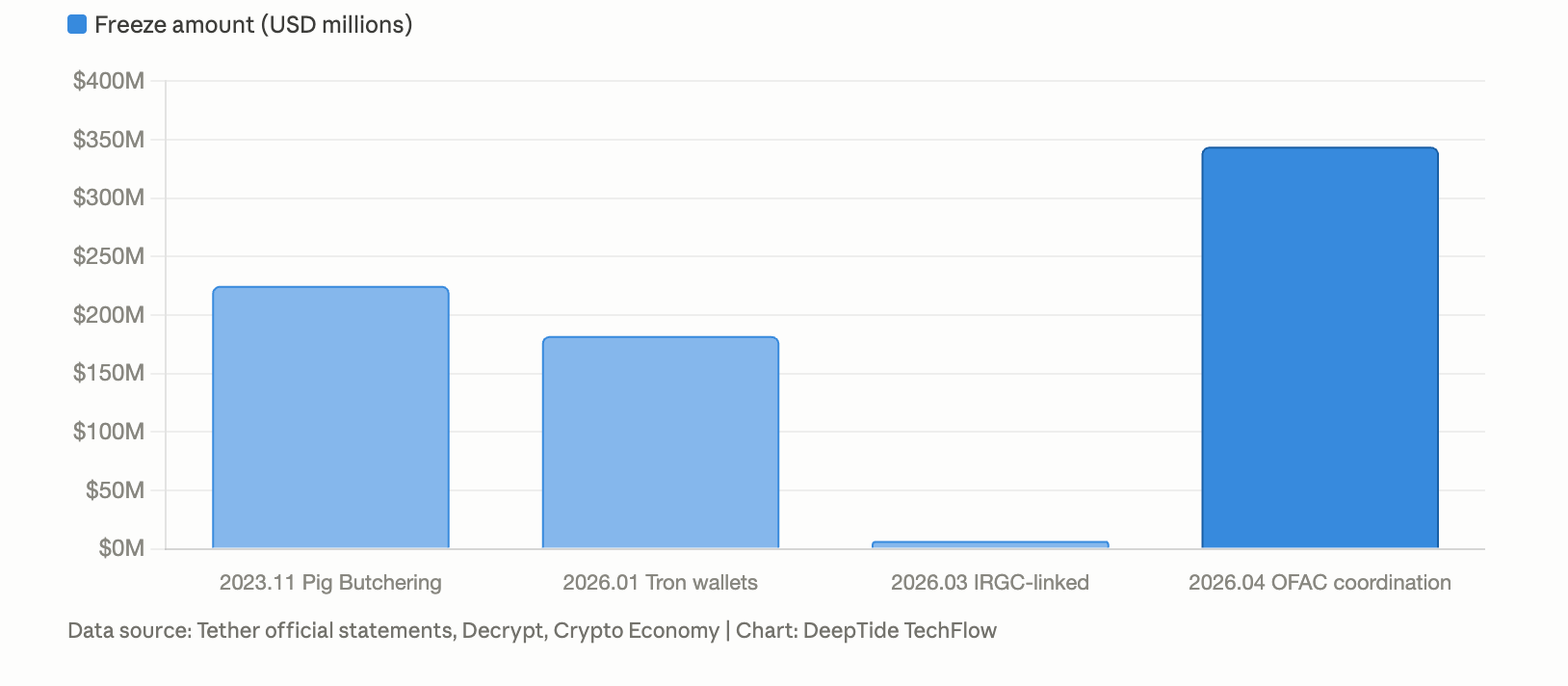
This marks the largest single freeze in Tether’s recorded history, nearly doubling the $182 million freeze earlier this year in January.
Tether CEO Paolo Ardoino stated in the announcement that USDT is not a safe haven for illicit activity, and that the company takes immediate action when credible links to sanctioned entities or criminal networks are identified. He subtly criticized Circle’s delayed response during the Drift Protocol incident, remarking, “Recent events have shown that when platforms fail to act swiftly, enforcement breaks down, users are exposed, and trust erodes.”
According to data disclosed by Tether, the company currently collaborates with over 340 law enforcement agencies across 65 countries, having assisted in more than 2,300 cases and frozen assets exceeding $4.4 billion cumulatively, with $2.1 billion directly tied to U.S. enforcement actions. Notable prior large-scale freezes include: November 2023 freeze of approximately $225 million (related to human trafficking and pig-butchering investigations in Southeast Asia), and January 2026 freeze of about $182 million (five Tron wallets).
Sanctions Context: Iran, Drug Networks & OFAC Enforcement Escalation
As reported by The CC Press, this freeze was carried out under OFAC’s Iran-related sanctions framework—a timing of significant strategic importance.
On the same day (April 23), the U.S. Department of the Treasury announced sanctions against 23 individuals and entities linked to the Sinaloa drug cartel, involving a complex supply chain network sourcing fentanyl and methamphetamine precursor chemicals from Asia. While this enforcement action is unrelated to Tether’s freeze, both underscore a unified policy direction: the United States is intensifying its enforcement posture against cryptocurrency as a channel for sanctions evasion.
Regarding Iran, the scale of using USDT to circumvent sanctions has surged dramatically in recent years. According to a TRM Labs report cited by The Block in January, two exchanges registered in the UK—Zedcex and Zedxion—actually serve as financial conduits for IRGC (Islamic Revolutionary Guard Corps), processing approximately $1 billion in transactions between 2023 and 2025, with 56% of those transactions linked to IRGC, almost entirely settled via USDT on the Tron blockchain. IRGC-linked transaction volume skyrocketed from $24 million in 2023 to $619 million in 2024.
U.S. Senator Richard Blumenthal has publicly labeled Tether as a “key money laundering tool” for IRGC, sanctioned Iranian banks, and Iranian arms manufacturers. In March this year, Tether also froze $6.76 million in USDT linked to networks connected to IRGC and the Houthi movement.
Community Skepticism: Your Coins Were Never Yours
However, debate persists over the precise attribution behind this $344 million freeze.
According to on-chain analysis published by @asvanevik (Alex Svanevik, CEO of Nansen) on X, the network associated with the frozen addresses has been operational since 2021, with fund flows linked to the Turkish exchange Paribu, but only about $1.5 million in transactions with known IRGC wallets—representing just 0.4% of the total frozen amount. Svanevik assessed the credibility of linking this network to IRGC at 40%-50%.
Meanwhile, reactions within the crypto community are sharply divided.
Crypto media TFTC bluntly stated: “Tether instantly froze $344 million. Your stablecoin was never really yours.” The outlet framed this event as a textbook counterexample to Bitcoin’s censorship resistance, emphasizing that Bitcoin has no issuer, no compliance desk, and no intermediary capable of freezing balances.
On-chain data substantiates this concern. The USDT smart contract embeds a blacklist function on every supported chain. Once an address is blacklisted, the associated tokens remain visible on-chain but cannot be transferred, exchanged, or redeemed. To date, Tether has frozen over $3.3 billion in USDT across more than 7,000 wallets.
On the other hand, regulatory advocates argue this very capability demonstrates that stablecoins can serve as effective compliance infrastructure. Unlike cash, every transaction on public blockchains is traceable, and the issuer’s ability to freeze provides law enforcement with speed and precision unattainable in traditional finance.
In the tension between regulatory compliance and decentralization ideals, stablecoins are increasingly converging toward a clearer hybrid model:
Decentralized infrastructure running centralized control.
Author: Claude, DeepChaos TechFlow
Source: DeepChaos TechFlow
Disclaimer: Contains third-party opinions, does not constitute financial advice
NVIDIA attracts $85 billion in investor demand during massive bond issuance
06-16
Ethereum surges over 10% in 24 hours, currently priced at $1,841.31
06-16Amazon announces a multi-billion dollar investment in Missouri to build a data center campus, expected to create over 400 long-term positions
06-16Binance Platform's SpaceX Perpetual Contract Trading Volume Surpasses $9 Billion, Capturing Over 60% Market Share
06-16Binance platform XLM/USDT short-term spike down to $0.17, now recovered to $0.225
06-16
Trump: The Strait of Hormuz has been fully reopened as of Friday, and all agreements have been signed
06-16SlowMist: Aztec Connect Contract Hacked for $2.19 Million Due to ZK-Rollup L1/L2 State Boundary Vulnerability
06-15
