Prompts Cannot Salvage Mediocre AI Writing
Prompts Cannot Salvage Mediocre AI Writing


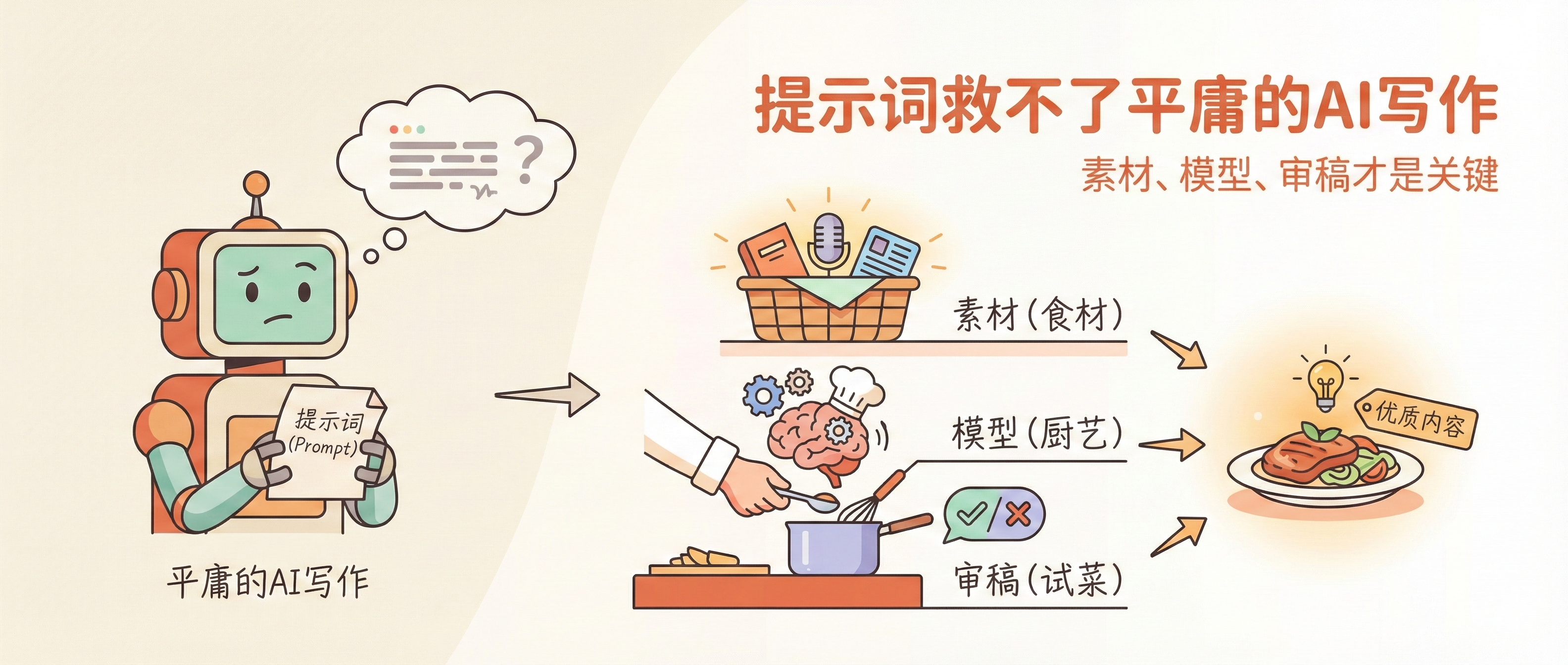
Many people believe the quality of AI-generated content hinges primarily on prompt engineering. Having used AI-assisted writing for some time, my experience shows that prompts have surprisingly limited influence—they only control surface-level aspects like format and tone.
What truly determines content quality are three other factors.
If we compare AI writing to cooking a dish, these three elements are: ingredients, culinary skill, and taste.
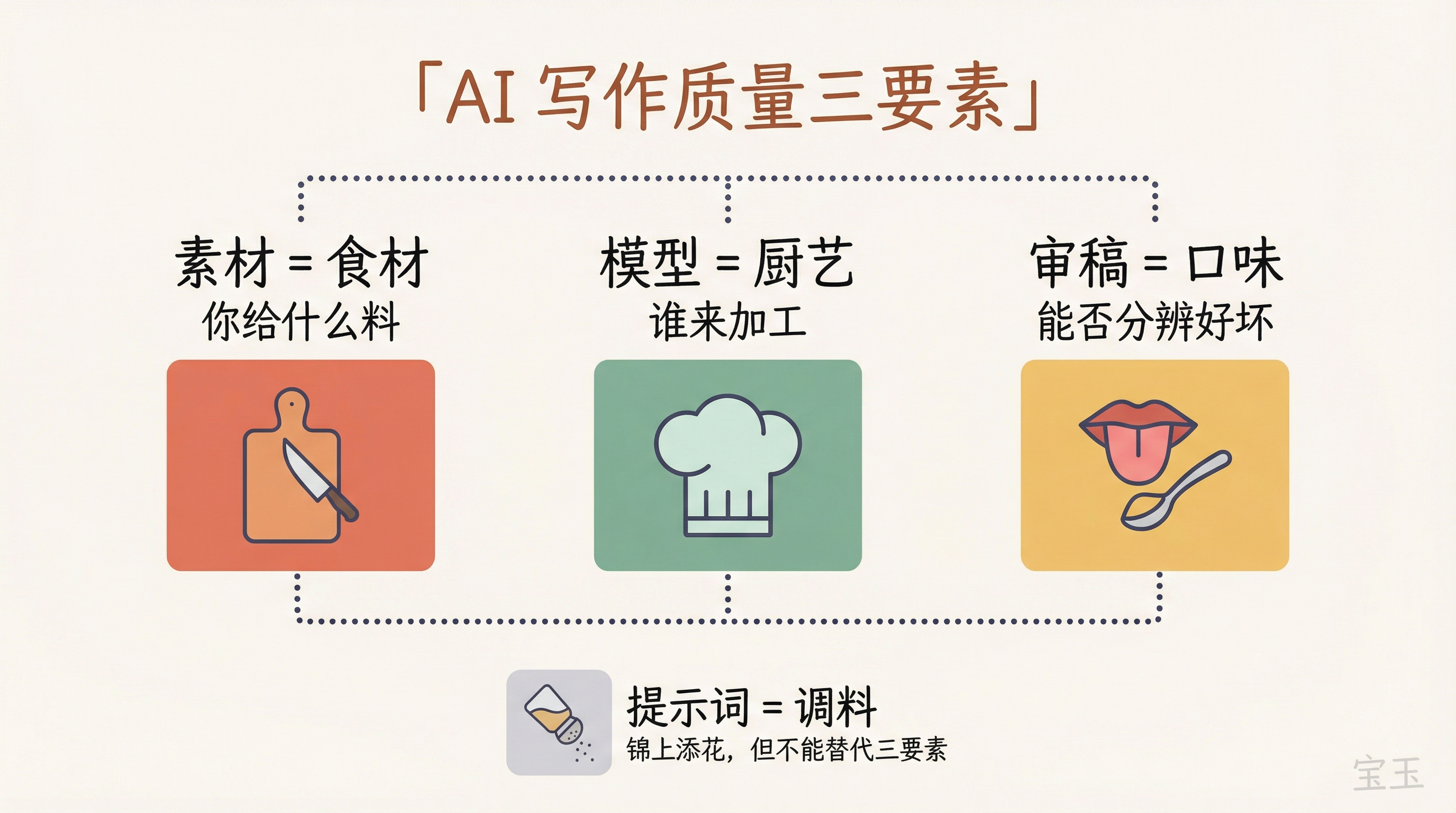
Ingredients Are the Raw Materials: You Feed It What You Want, It Can Only Produce Based on That
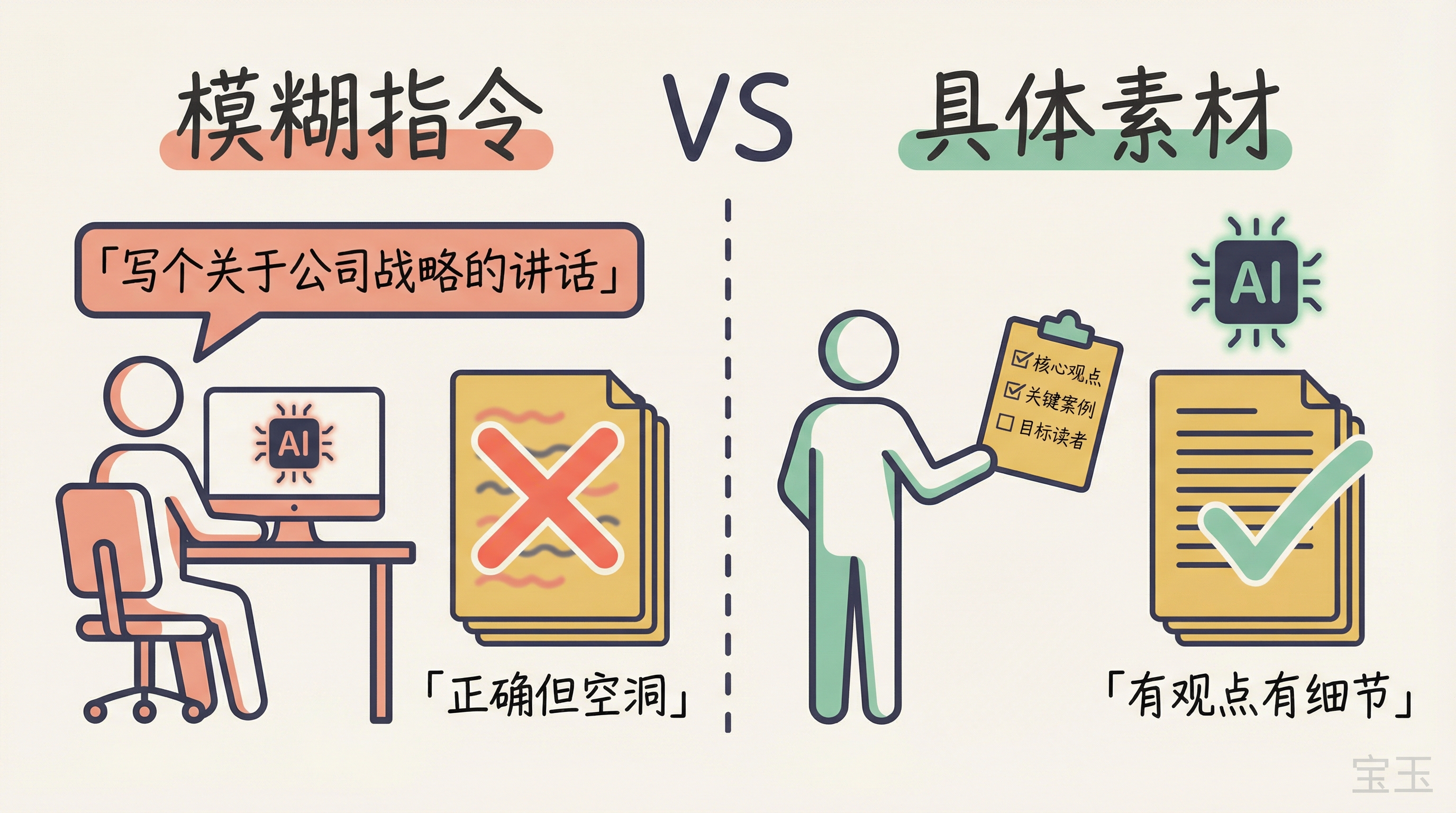
Many users approach AI writing by simply tossing a topic at it and letting it run freely. The result? A technically correct but hollow piece—filled with generic platitudes that apply universally but mean nothing.
If you give it nothing, it cannot produce anything meaningful.
For example, if you ask your assistant to draft a speech but only say “write something about our company’s strategic direction” without any context, the output will likely be a string of polished emptiness.
But if you clarify: “Our core focus is abandoning overseas markets to concentrate fully on domestic growth; the reason is that customer acquisition costs abroad have tripled. I want to open with a failed case from Southeast Asia last quarter.” The resulting piece will be dramatically different in quality.
AI writing works the same way. You don’t need to hand it a full draft, but you must provide the core narrative and key points. What’s your main argument? Which examples support it? What should readers remember after reading? Once you’ve clarified these, even just a few sentences fed into AI will yield far better results than vague background information.
The value of ingredients lies not in volume, but in your curation and judgment. Your decisions about what to include and exclude, which examples to use and which to discard—these choices form the foundation of content quality. AI excels at filling in details, organizing structure, and polishing language once the direction is set. But the direction must come from you.
For me, the most effortless applications are translation and transcribing video interviews—where both input and format are fixed. The output is consistently good because the raw material itself is strong, so the result rarely fails.
But for pieces requiring original viewpoints—like this one—I can’t just say “write an article on improving AI writing quality.” I must break down each key point clearly, explaining how the entire piece revolves around ingredients, culinary skill, and taste—so the AI knows exactly how to proceed.
With ingredients prepared, the next step is who does the cooking.
Model Is Culinary Skill: Same Ingredients, Vastly Different Results
The differences between models in writing tasks are far greater than most people realize.
Same ingredients, yet a Michelin-starred chef produces something entirely different from a street vendor. You can’t take premium ingredients and hand them to an average cook, then expect a masterpiece.
Currently, I believe Claude Opus 4.6 delivers the highest-quality writing. Its sense of language, contextual understanding, and nuanced tonal control are clearly superior. However, models evolve rapidly—the rankings shift constantly. I once favored GPT-4.5, but GPT-5 series underperformed; Gemini 3.0 Pro felt too repetitive—after reading several, they all tasted the same.
Smaller models generally perform poorly; larger parameter models tend to be better. For instance, while many praise Sonnet, it still falls short compared to Opus.
Naturally, this is subjective.
Editing Is Tasting: If You Can’t Taste Quality, You Can’t Serve Good Food
Initially, I wanted to write “author’s skill.” But increasingly, the author may not be human—it could be an AI Agent. Regardless of whether the editor is human or an agent, the principle remains: you must be able to discern what works and what doesn’t in a draft.
This is a hidden barrier often overlooked—and also the current bottleneck limiting my own writing quality.
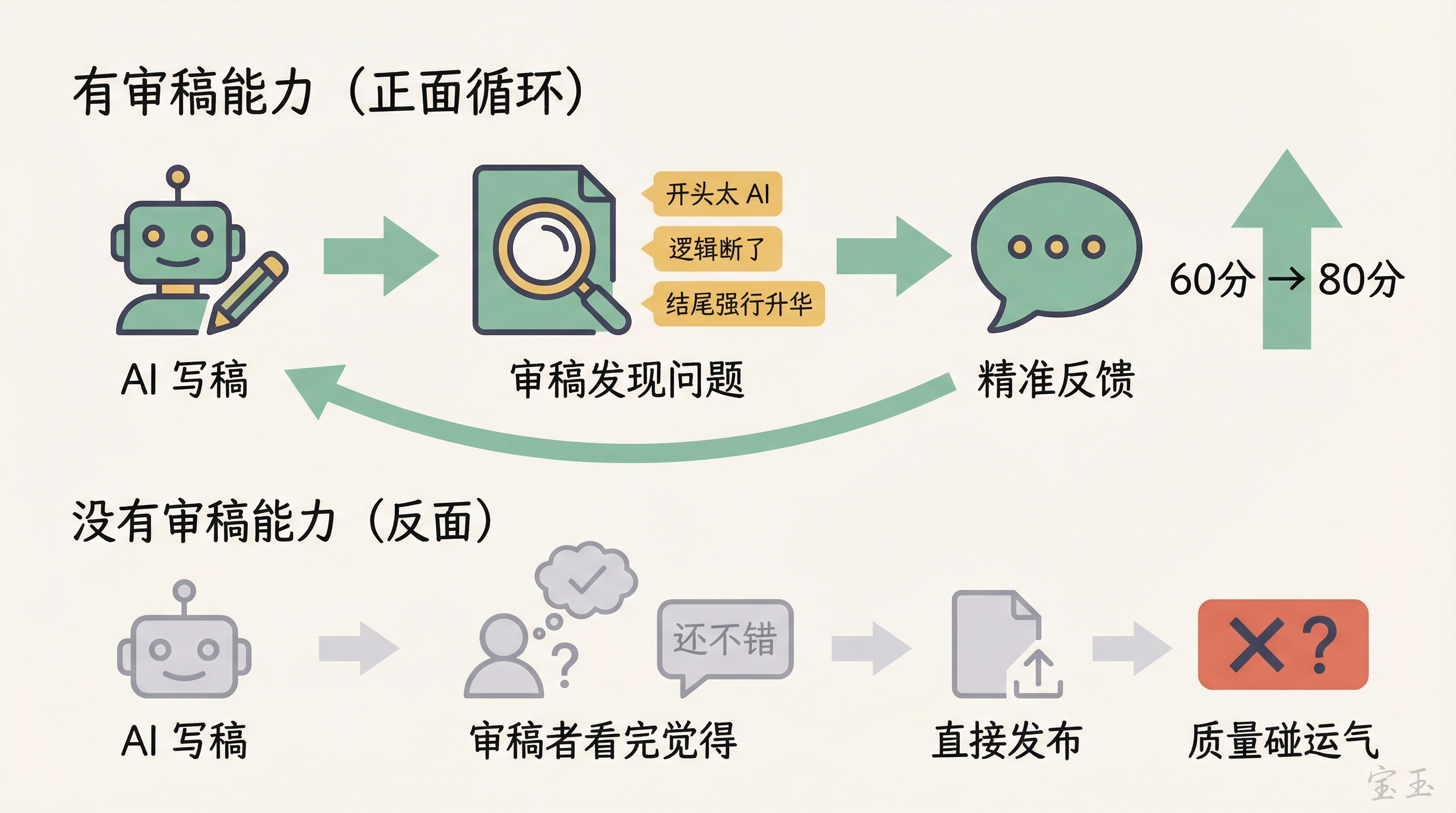
After AI generates an article, you think “it’s decent” and publish immediately. But **“decent” is a dangerous judgment**. You might miss that the opening uses a typical AI hook, a section has broken logic, or the conclusion artificially inflates meaning. If you can’t spot these flaws, you can’t provide feedback for revision—and the final quality becomes a gamble.
When lucky, AI gets it right on the first try. When unlucky, the published content is bland or even flawed.
Conversely, if you possess strong editing ability, you can instantly identify filler that should be cut, metaphors that don’t fit, or transitions that feel abrupt. Feed those corrections back to the AI, ask it to rewrite that section, and after a few rounds, the piece elevates from 60 to 80 points.
This is like a skilled chef who can taste every dish and precisely adjust salt, spice, or missing flavor notes. A chef without taste might say “it’s okay,” then serve the dish on pure chance.
This issue is even more pronounced in Agent-driven writing. An Agent acts like a chef with no sense of taste—cooks a dish and declares it done. Even if asked to self-reflect, its evaluation stays superficial: “the dish is well-balanced in color, aroma, and flavor”—empty praise. It lacks true sensory perception to judge whether a sentence flows naturally or whether an example is persuasive.
Editing ability comes from extensive reading and writing experience, from an intuitive grasp of high-quality content. This skill cannot be replicated by AI in the short term—this is why I never automate content generation. I’d rather publish less, but spend time carefully reviewing and refining every piece.
Ingredients, Culinary Skill, and Taste—None Can Be Missing
Good ingredients but poor cooking ruin the potential. Excellent cooking but poor ingredients—no matter how skilled the chef, there’s nothing to work with. Even when both ingredients and skill are strong, poor taste leads to inconsistent results. One weak link, and the outcome fails.
What about prompts? Prompts are seasonings—salt, pepper, spices. When all else is solid, good seasoning enhances the dish. But you can’t rely solely on seasoning to transform a dish lacking ingredients, cooking skill, or tasting expertise into something great.
Author: Baoyu
Disclaimer: Contains third-party opinions, does not constitute financial advice
Which One Is Right for You: OpenClaw or Hermes?
04-26
Xchat is officially live—after the review, words fail to express.
04-25
GPT Images 2.0 Comprehensive Guide: From Prompts to Full Workflow
04-24
AI "Middleman" Earns Millions Monthly? Five Questions Reveal the Truth Behind Token Arbitrage
04-23
Lobster Is History? Sorting Through Hermes Agent Tools That Can Scale Your Output 100x
04-13
10 Survival Rules for Ordinary People in the AI Era
04-08
The Golden Window for AI Entrepreneurship Has Only 12 Months Left
04-03


