VCs Accelerate Exit from Crypto — Why Is A16Z Betting Big with $2.2 Billion Raised?
VCs Accelerate Exit from Crypto — Why Is A16Z Betting Big with $2.2 Billion Raised?


On May 5, a16z crypto, the cryptocurrency-focused venture capital arm of Andreessen Horowitz (a16z), announced the closing of its fifth fund with a size of $2.2 billion. Concurrently, CTO Eddie Lazzarin was promoted to General Partner, joining Chris Dixon, Ali Yahya, and Guy Wuollet as the fund’s fourth GP.
Most English-language media focused on the narrative that this marks the largest fundraising during the current crypto winter, emphasizing the absolute figure of $2.2 billion. However, this number was previously seen in 2021 when a16z crypto closed its third fund also at $2.2 billion. Spanning five years, a bull market peak, and two crypto winters, a16z has now placed another bet on this same figure.
The story behind this number isn’t about scale—it’s about relentless commitment.
a16z crypto’s previous dedicated crypto fund, Fund 4, was raised in May 2022 with $4.5 billion, making it the largest single crypto VC fund in history, a record that still stands today. From $4.5 billion to $2.2 billion, the size is indeed halved. But in this current winter, only a16z remains capable of assembling another $2.2 billion to continue betting on crypto.
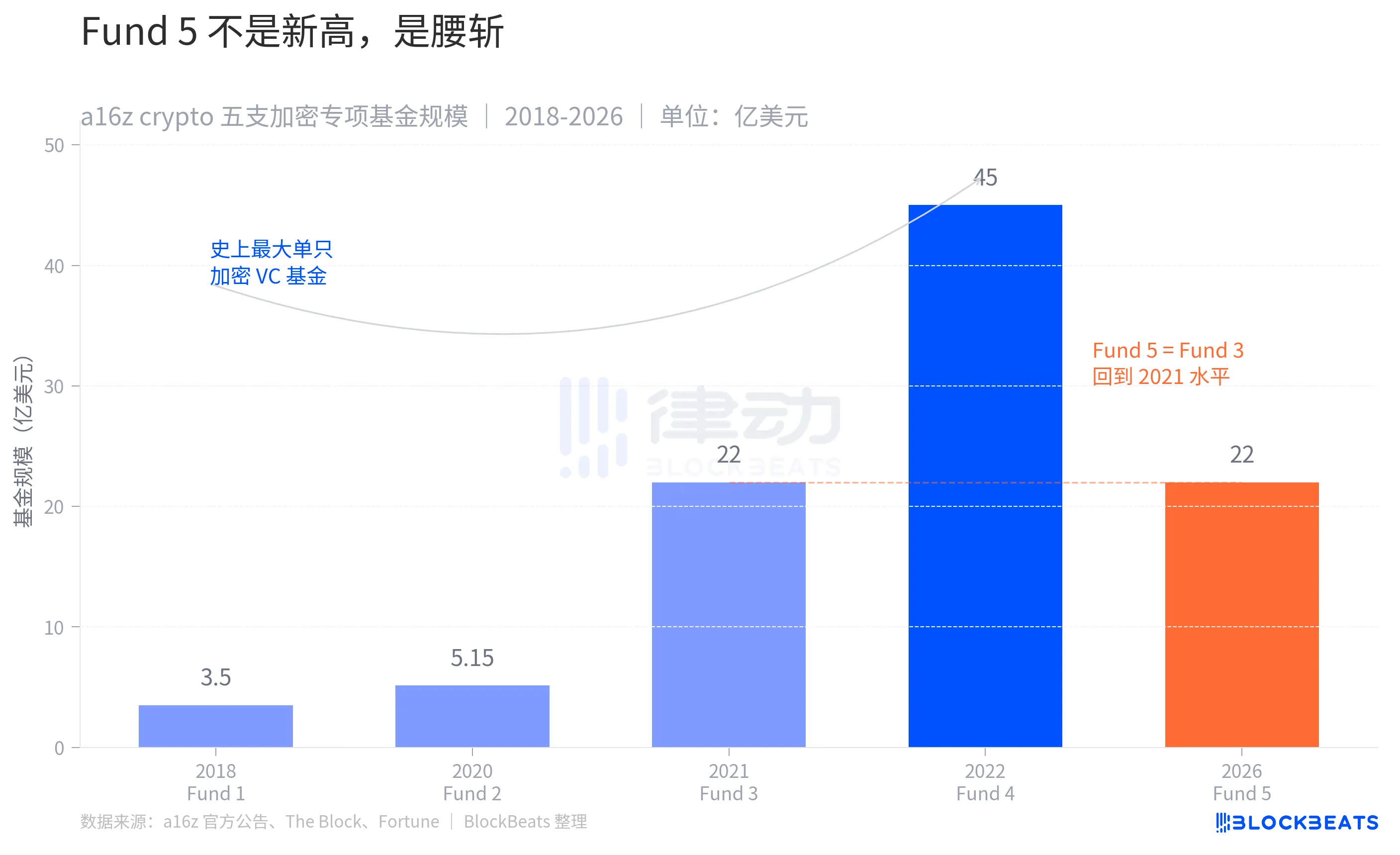
When viewed together, the sizes of a16z crypto’s five crypto funds over eight years reveal a clearer rhythm. Fund 1 (2018, $350 million) and Fund 2 (2020, $515 million) were early exploratory bets. Fund 3 (2021, $2.2 billion) marked the first phase of industry-wide bullish expansion, quadrupling the prior size. Fund 4 (2022, $4.5 billion) reached the peak—doubling again in scale. Now, Fund 5 returns to $2.2 billion after five years, precisely matching Fund 3.
Drawing a dashed line connecting the peaks of Fund 3 and Fund 5 reveals a full circle: a16z crypto has returned to the dimensions of 2021 within the crypto narrative. Since its founding in 2018, the firm has committed $9.8 billion in total capital, nearly half ($4.5 billion) allocated to Fund 4—which remains largely unspent. Fund 5 is not a new wave of aggressive deployment but rather a continuation of ammunition for crypto, extending the dedicated fund pipeline even while Fund 4 is still active and the industry cools once more.
Another way to read this chart: the interval between Fund 1 through Fund 4 shortened consistently—two years, then one, then one—with scale expanding each time. This reflects the typical rhythm of the crypto industry from 2018 to 2022. After Fund 4, the gap suddenly stretched to four years.
During those four years, FTX collapsed, DeFi surged and retreated, Bitcoin ETFs passed in 2024, a new bull cycle emerged and faded. Rather than continuing the pace of Fund 1–4, a16z crypto chose to first deploy part of Fund 4’s capital before raising the next. On the day Fund 5 closed, exactly 48 months had passed since Fund 4.
But viewing a16z crypto’s own curve alone is incomplete. Whether $2.2 billion represents stubborn resolve or mere follow-through depends on placing it within the broader industry context.
In reality, the industry’s collapse was steeper than a16z crypto’s own trajectory. According to Galaxy Digital, global crypto venture capital investment reached approximately $32.8 billion in 2021 and $30.4 billion in 2022. Combined, these two years represent over $63.2 billion in risk capital—the largest injection in crypto history. After FTX’s collapse, the figure dropped to $10.1 billion in 2023—a nearly 70% contraction. In 2024, it rebounded slightly to $11.5 billion, and by 2025, according to PitchBook, it recovered to around $18 billion, returning to the 2020 level.
Placing a16z crypto’s two major fundraisings into this curve highlights their relative significance. The $4.5 billion of Fund 4 accounted for roughly 15% of the 2022 industry pool—meaning one out of every seven dollars in crypto VC was managed by a16z crypto alone. The $2.2 billion of Fund 5 represents about 12% of the $18 billion industry pool in 2025. While the absolute amount has halved, in a pool reduced to one-third of its former size, a16z crypto maintains nearly the same share.
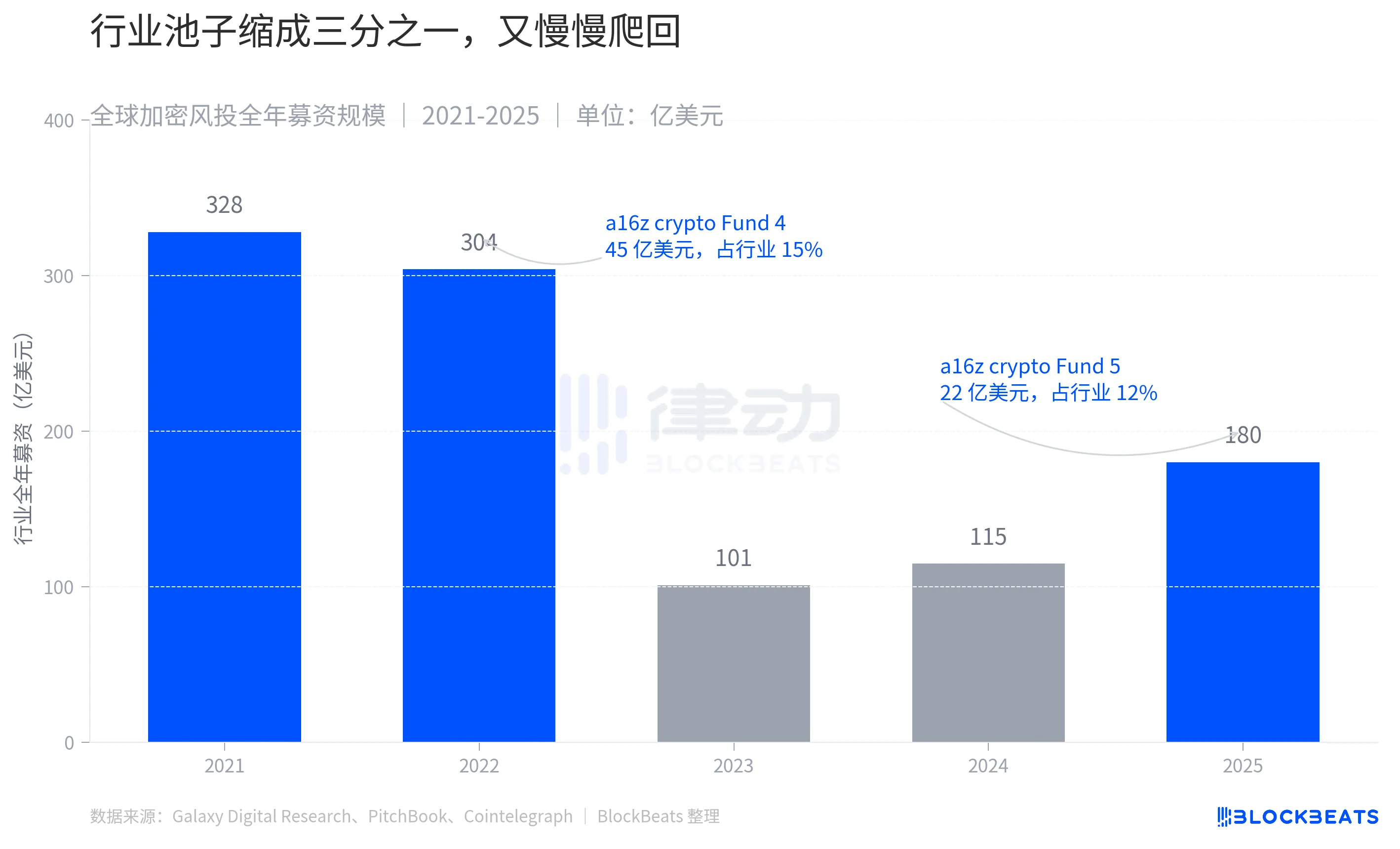
Understanding this layer reveals Fund 5’s true positioning: despite halving in size, a16z crypto secures nearly unchanged market share in a pool reduced to one-third. Achieving this requires LPs not to have fully exited crypto exposure over the past three years, and a16z partners to convince themselves that “continuing to deploy capital in crypto” remains viable.
Another set of details deserves separate attention. Between 2024 and 2025, Multicoin’s AUM rose from around $600 million to $6 billion, then halved to $2.7 billion following Bitcoin’s drop after October. During the same period, a16z crypto’s portfolio valuation declined by approximately 40%. Haun Ventures saw a similar rise of around 30%.
Pantera generated profits for LPs via exits from five portfolio companies—including Circle and BitGo—in 2025, enabling the firm to begin fundraising for its fifth fund. In the current winter, peers’ actions broadly fall into three categories: raising new capital, returning capital to LPs, and expanding investment scope beyond crypto. a16z crypto chose only the first—raising new capital—and nothing else. No capital return, no diversification—just continued investment in crypto.
A third lens is peer comparison. The contrast between $2.2 billion and $4.5 billion is internal to a16z crypto; the contrast between $18 billion and $32.8 billion is industry-wide. The final comparison lies among peers.
Looking at the most recent funds from top crypto VCs between 2024 and 2026: Polychain ($400 million), Dragonfly ($650 million), Haun Ventures ($1 billion), Paradigm’s new fund ($1.5 billion, still fundraising), and a16z crypto’s Fund 5 ($2.2 billion). a16z crypto leads as the largest fund in this cycle—but the key detail lies between it and Paradigm.
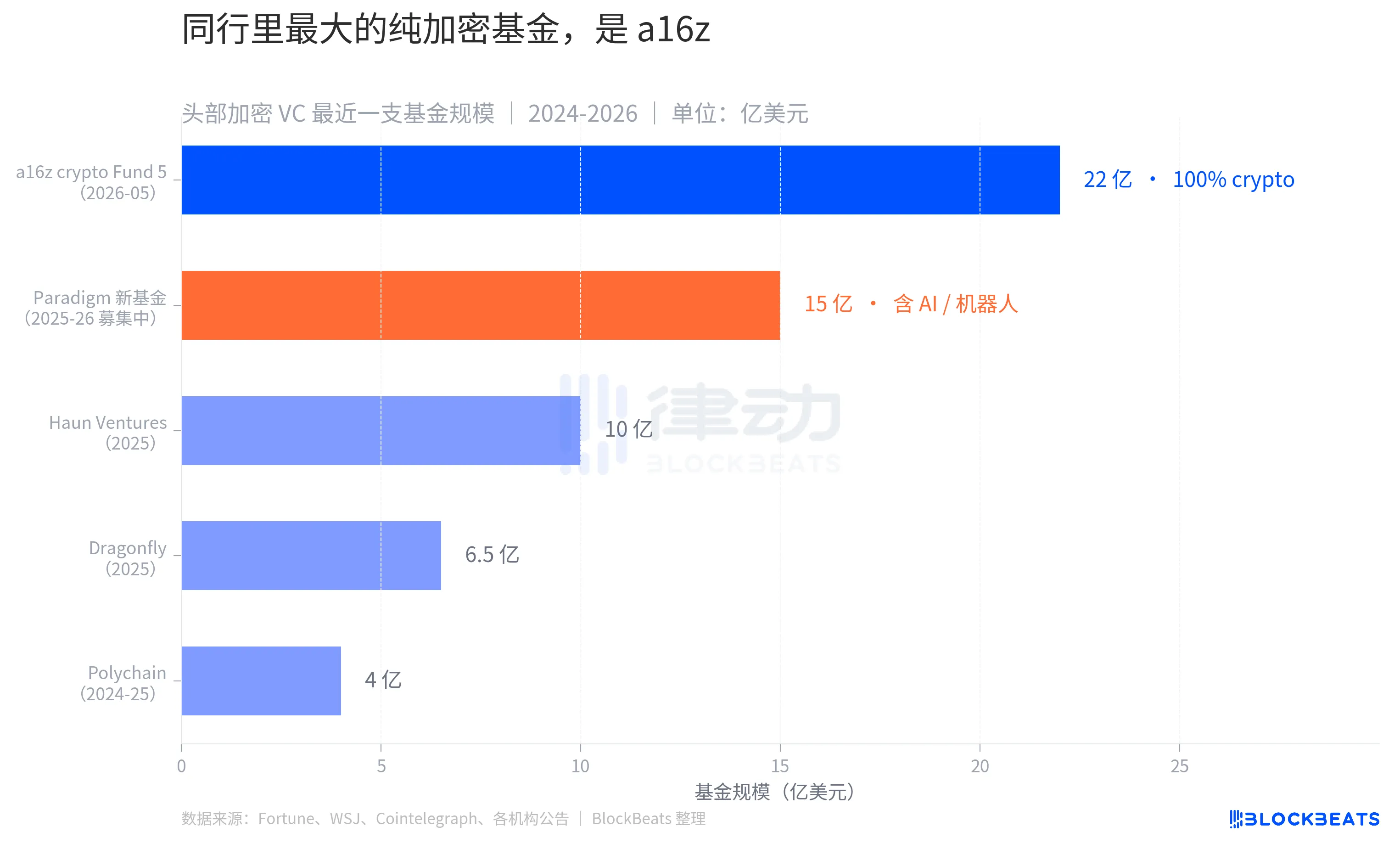
Paradigm was founded in 2018 by a former Sequoia partner and a Coinbase co-founder, long regarded as a16z crypto’s most direct competitor in crypto. Paradigm closed its $850 million early-stage fund “Paradigm Three” in 2024, followed by an announcement of a new fund targeting $1.5 billion. According to The Wall Street Journal, this new fund has expanded beyond pure crypto into AI, robotics, and other frontier computing sectors. In essence, Paradigm’s partners concluded that “investing solely in crypto would mean missing too many opportunities.”
a16z crypto’s direction is the opposite. On the day of fund announcement, a spokesperson told Fortune with a single sentence: “Fund 5 is 100% dedicated to crypto founders.” In the VC context of 2026, this statement is a declaration of unwavering commitment.
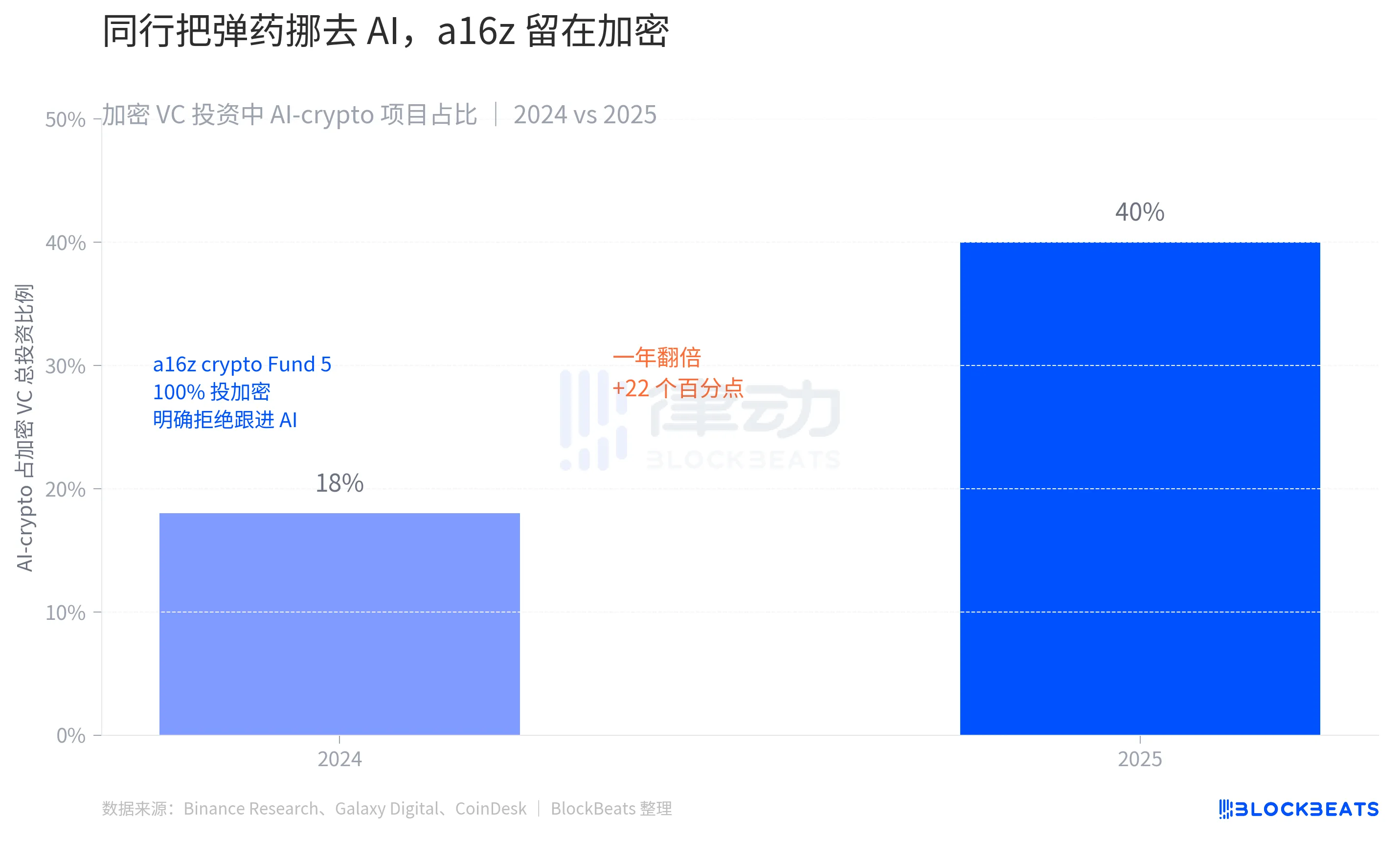
In 2024, for every dollar invested in crypto VC, 18 cents flowed into projects combining “AI + crypto.” By 2025, this figure more than doubled to 40 cents.
The 40% figure reflects a complete shift in capital allocation. According to a16z’s January “Why Did We Raise $15B” announcement, the parent company completed a $15 billion new fundraising round in January 2026, distributed across: Apps ($1.7 billion, AI applications), Infrastructure ($1.7 billion, AI infrastructure), Growth ($6.75 billion), American Dynamism ($1.176 billion), Bio ($700 million), and Other ($3 billion, including crypto, fintech, and enterprise software). Notably, there is no standalone category labeled “Crypto” in the public breakdown. Fund 5 was raised separately four months later.
a16z’s overall capital base grew from $42 billion in May 2024 to over $90 billion by March 2026. Meanwhile, the crypto division’s share fell from 11% during Fund 4 to just 2.4% in Fund 5. Internally, crypto has transitioned from being a standalone vertical to merely one type of bet within the “Other” pool. The parent company’s strategic center has shifted away—only a16z crypto continues to concentrate firepower on crypto.
This is Fund 5’s true position: a concentrated bet on crypto within the a16z ecosystem. Though scaled down to half the size of the previous round, it remains the sole dedicated crypto fund amid a parent company where crypto now accounts for just 2.4%. According to Fortune, investments already made toward the end of Fund 4—such as Babylon (a protocol allowing BTC holders to use BTC as collateral), cross-platform prediction market tool Kairos, and a $50 million stake in Solana’s Jito staking protocol—are indicative of Fund 5’s deployment focus. As Dixon and partners stated in the announcement, the goal is to “target the overlooked segment of the cycle and turn new infrastructure into products used daily by ordinary people.”
Those who remain steadfastly committed to crypto are, quite simply, a16z itself.
Disclaimer: Contains third-party opinions, does not constitute financial advice
Hyperliquid perpetual contract open interest market share reaches 8.2%, setting a new all-time high
4 mins ago
Bitdeer sold 194.4 BTC this week, maintaining zero holdings
32 mins agoPakistan's Prime Minister: U.S.-Iran Peace Agreement Could Be Finalized Within Next 24 Hours
48 mins agoIran's Foreign Minister: Iran and Oman to Issue Joint Statement on the Strait of Hormuz
57 mins agoU.S. Capital Competes for Venezuela’s Oil Fields, Aims to Launch Nasdaq’s First Venezuelan Oil Company
1 hour ago"White-Haired Stock Guru": Critical Gas Supply Shortage for Chip Manufacturing—Tungsten Hexafluoride—May Benefit South Korea's Foosung
1 hour agoSPCX issued by Backpack leads in liquidity and trading volume among SpaceX-related assets on Solana
1 hour ago