Are NFTs Making a Comeback? A Simple Guide to Slonks' 60x Surge in 6 Days
Are NFTs Making a Comeback? A Simple Guide to Slonks' 60x Surge in 6 Days


The recent crypto market appears to be rebounding, with some prominent figures in the blockchain space beginning to introduce innovative mechanics—such as the long-dormant NFTs.
On May 1st, a new NFT collection called Slonks launched on Ethereum, with a mint price under 0.004 ETH, equivalent to less than 70 RMB.
Six days later, the floor price has surged to 0.123 ETH—approximately 60 times its initial value. On OpenSea, the 7-day trading volume reached 586 ETH, with over 23,000 transactions. The total supply is 10,000, of which 1,348 have been permanently burned, leaving 8,642 in circulation.
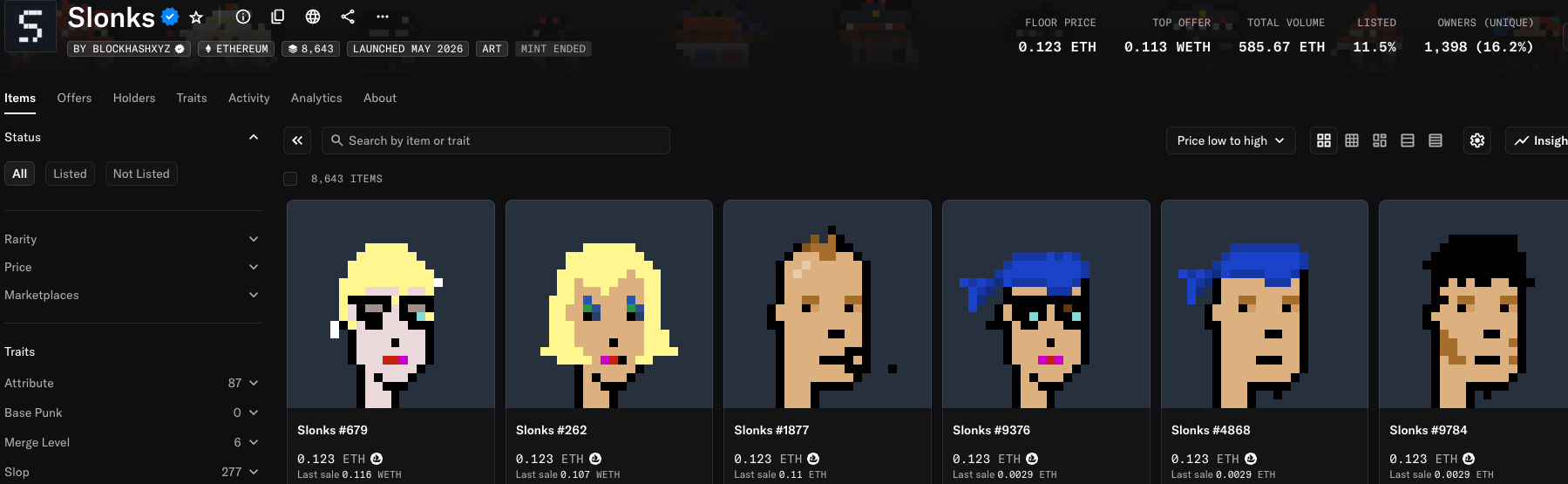
How does this performance stack up against the NFT market in 2026? In the same week, the eight-year veteran blue-chip project CryptoPunks recorded only 20 trades, while Slonks achieved over 23,000.
This evening at 9 PM, the project will launch its official token: $SLOP.
If you search “Slonks” on Twitter, you’ll notice an intriguing phenomenon: nearly everyone praises the project’s “sophisticated mechanism” and “coherent design,” but when asked to explain how it actually works, most people stall after saying “images can be exchanged for tokens, tokens for images.”
Some describe it as GameFi, an on-chain AI art experiment, or even an evolutionary upgrade of CryptoPunks; others claim it’s essentially a “Dream of the Westward Journey Baby Collection” game.
After a quick investigation, I believe all these descriptions are somewhat relevant—but none quite hits the core.
The truly fascinating aspect of Slonks may lie in turning a counterintuitive idea into a viable business model. That idea is:
AI-generated errors are worth more than perfect outputs.
Why Are AI-Generated Pixel Errors Worth Money?
What sets this project apart from previous NFTs is that its NFTs aren’t static image files.
Traditional NFTs typically store a pre-rendered image off-chain and reference it via a URL within the contract. Slonks is different—it embeds an AI image generation model directly into the Ethereum smart contract, totaling just 214KB, roughly the size of a low-resolution smartphone wallpaper.
Every time someone views a Slonk, the contract runs the model inference in real time to generate the image.
No image stored—only the ability to draw. This represents a micro-innovation in NFT mechanics.
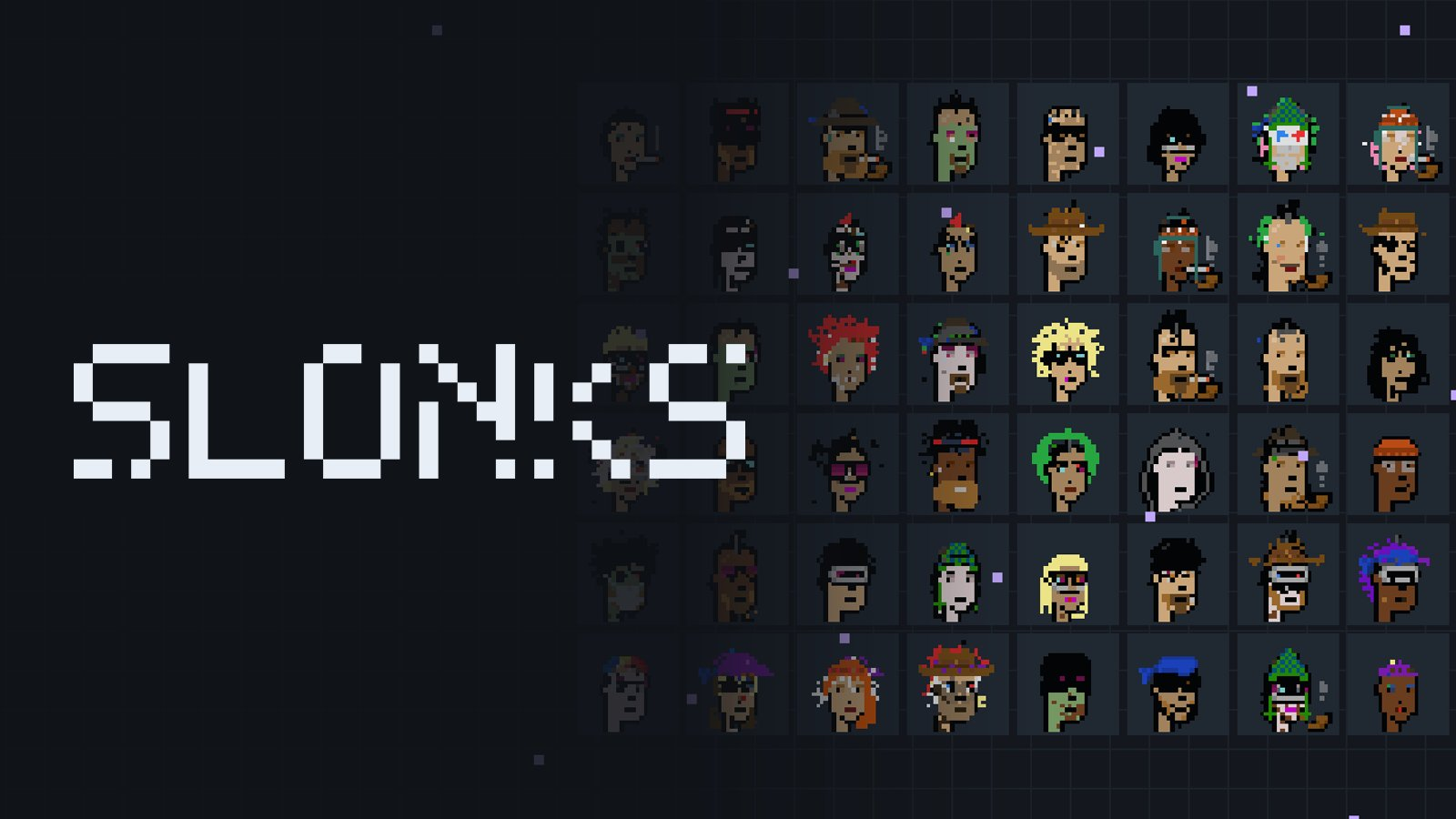
But what exactly is the model drawing?
It’s copying… The model’s task is to render a duplicate of each of the 10,000 original CryptoPunk images. Each CryptoPunk corresponds to one Slonk—the model studies the original and attempts to redraw it using the same palette.
However, compressing 10,000 faces into a mere 214KB model is inherently challenging.
Each image consists of 576 pixels; on average, the model misrenders about 24 pixels per image—around 4% deviation from the original. Out of 10,000, only 32 were perfectly replicated; the rest all bear varying degrees of distortion.
The project refers to these erroneous, distorted pixels as "slop."
Zero errors → slop = 0; complete failure → slop = 576. The project’s developer, Hirsch, succinctly captured the philosophy in a single tweet:
The slop is not a bug. It is the medium. (The imperfection is not a flaw—it is the medium.)
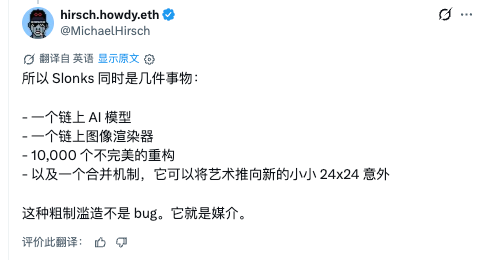
This means the project uses an AI model to re-illustrate the original NFT OG project, but due to inherent inaccuracies, each version differs subtly—creating unique scarcity and speculative value.
Thus, the entire economic model rests on this logic: the more errors, the higher the value.
Slonk holders can perform an action called Merge: take two Slonks of the same tier, select one to keep, and burn the other. The contract then mixes features from both images and reruns the model to generate a new one.
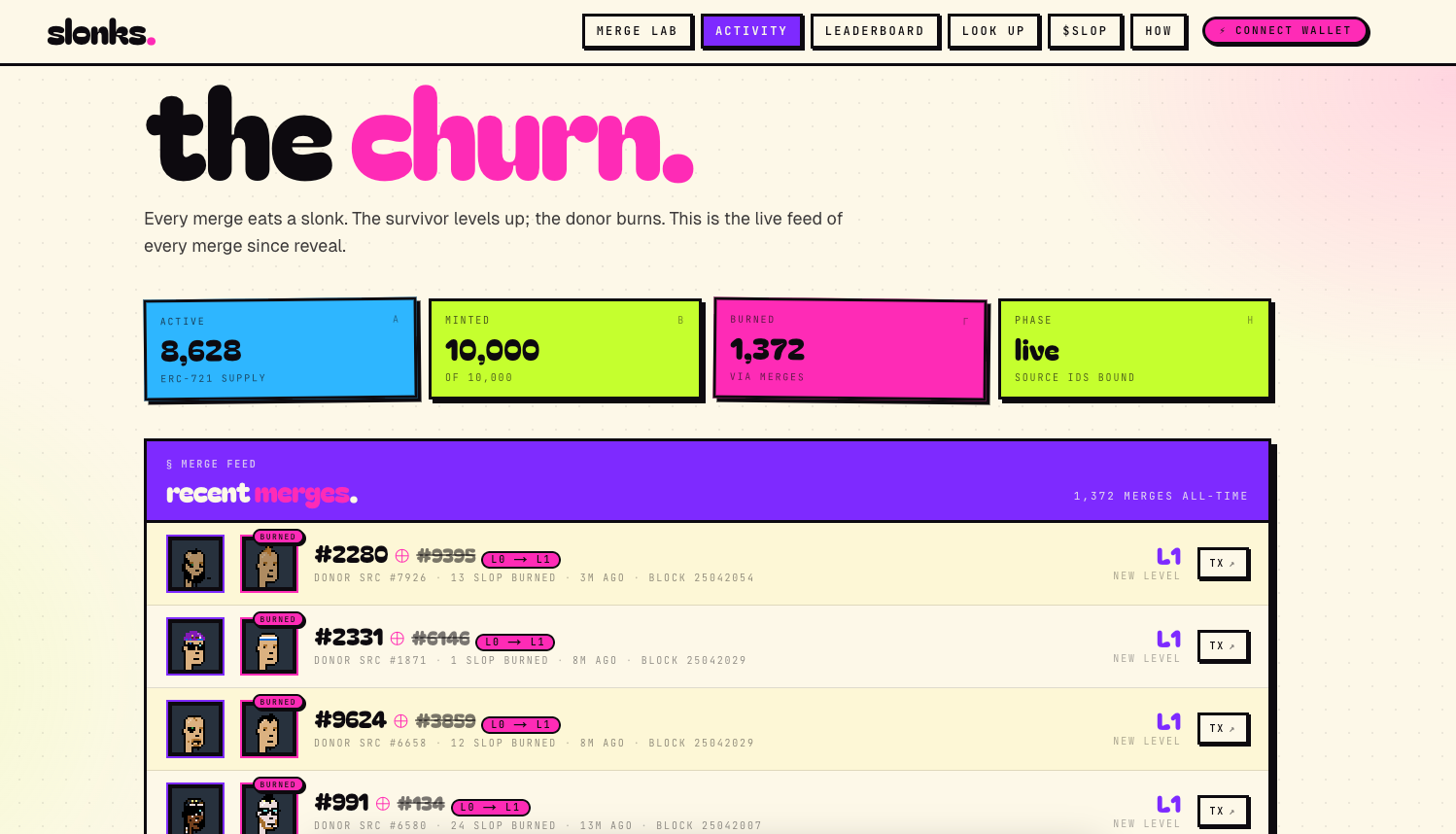
Because two distinct images are blended together, the resulting output diverges further from the original CryptoPunk—never closer.
Each Merge increases the slop level, never decreases it. And the burned NFT is gone forever—total supply shrinks by one.
This explains why, within six days, over 1,300 of the 10,000 Slonks have already been burned. Players continuously merge, creating higher-slop versions while systematically reducing circulating supply.
At this point, Slonks has evolved into a compelling on-chain art experiment—using AI algorithms to artificially generate scarcity.
$SLOP: Pricing Every Misdrawn Pixel
What transforms this project into a true business is the upcoming official token: $SLOP.
Its purpose is to turn the “number of misrendered pixels” on each image into a tradable asset.
How? Through an operation called Void (the Void).
Holders can send their Slonk “into the void”—removing it from circulation. The contract then mints an amount of $SLOP d-token equal to the image’s slop value, sending it directly to the user.
For example, if your image has a slop of 287, you receive 287 $SLOP. If slop is 450, you get 450.
But this isn’t arbitrary. The contract requires users to first generate a ZK proof verifying that the on-chain model’s rendering result matches the claimed slop. Only after validation is the token minted.
In plain terms: you must “verify the goods”—prove your image genuinely contains that many errors—for the contract to acknowledge it.
The Slonk sent to the void isn’t destroyed—it remains in the contract. This leads to the second operation: Revival.
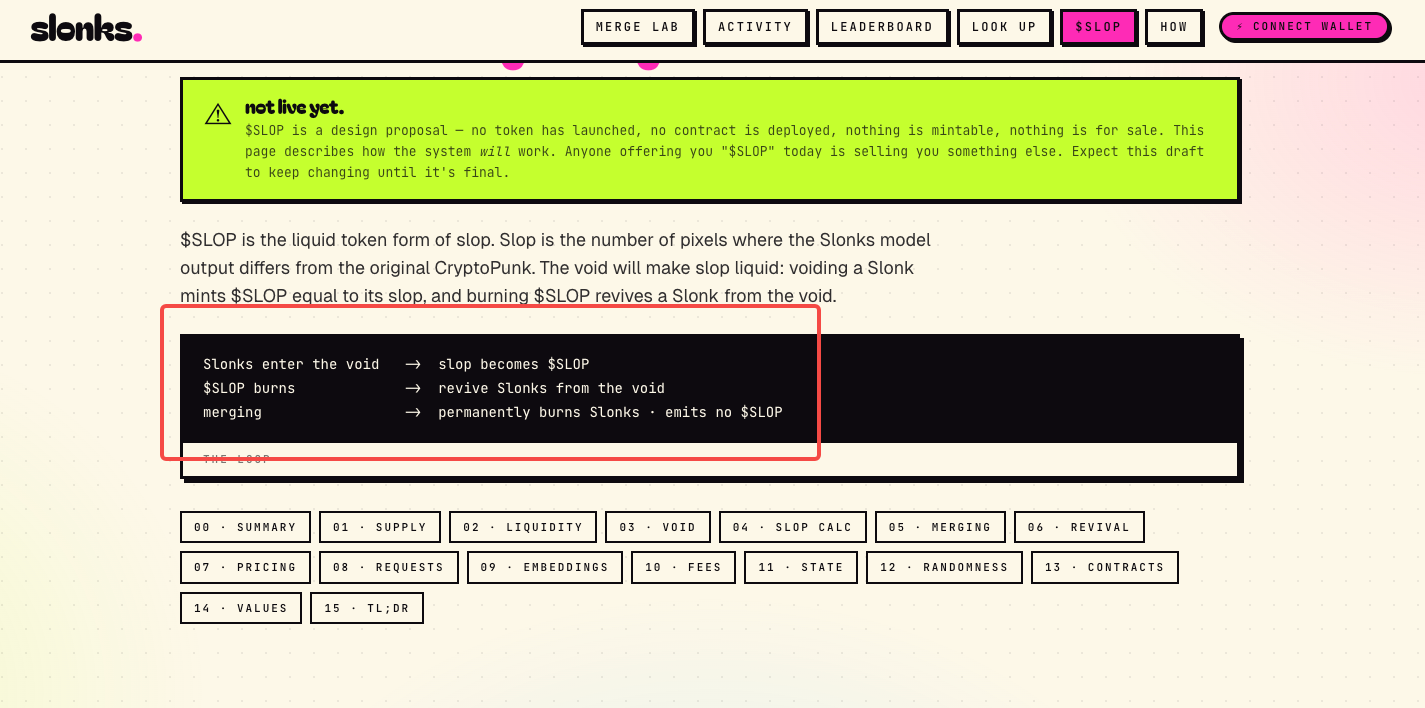
By spending a certain amount of $SLOP, you can randomly draw a Slonk back from the void. You can’t choose which one, and upon return, the model regenerates it—making it highly likely to look different from before.
Revival pricing follows a Dutch auction: starting at 576 $SLOP per draw, decreasing by 1 per block until reaching a minimum of 100. But as soon as someone buys, the price resets to 576 and begins declining again. To get a cheap draw, you must wait—but someone might snatch it before you do.
Most revived images will resemble the original CryptoPunk closely, with moderate slop values. However, there’s a 1% chance the model “goes completely insane,” producing an extreme version with slop exceeding 400. That 1% is the lottery.
At this point, you’ve likely realized that Void and Revival form a closed-loop economy between NFTs and tokens:
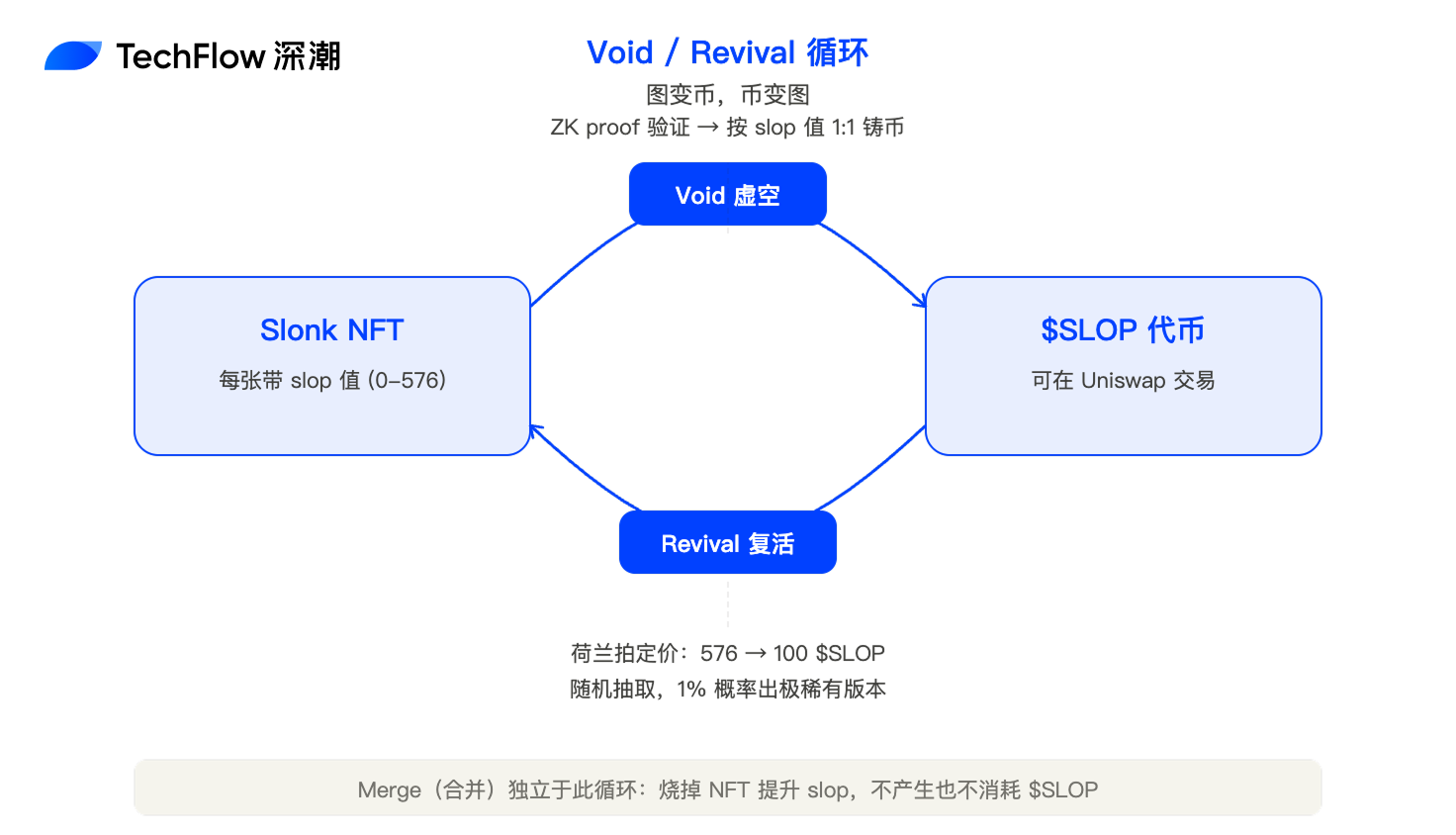
The project also includes an automated flywheel: the $SLOP trading pool charges a 2% fee, half of which is automatically used to buy floor-priced Slonks on OpenSea and send them into the void as future revival inventory.
The more active the trading, the larger the void inventory—and the more compelling the revival experience becomes.
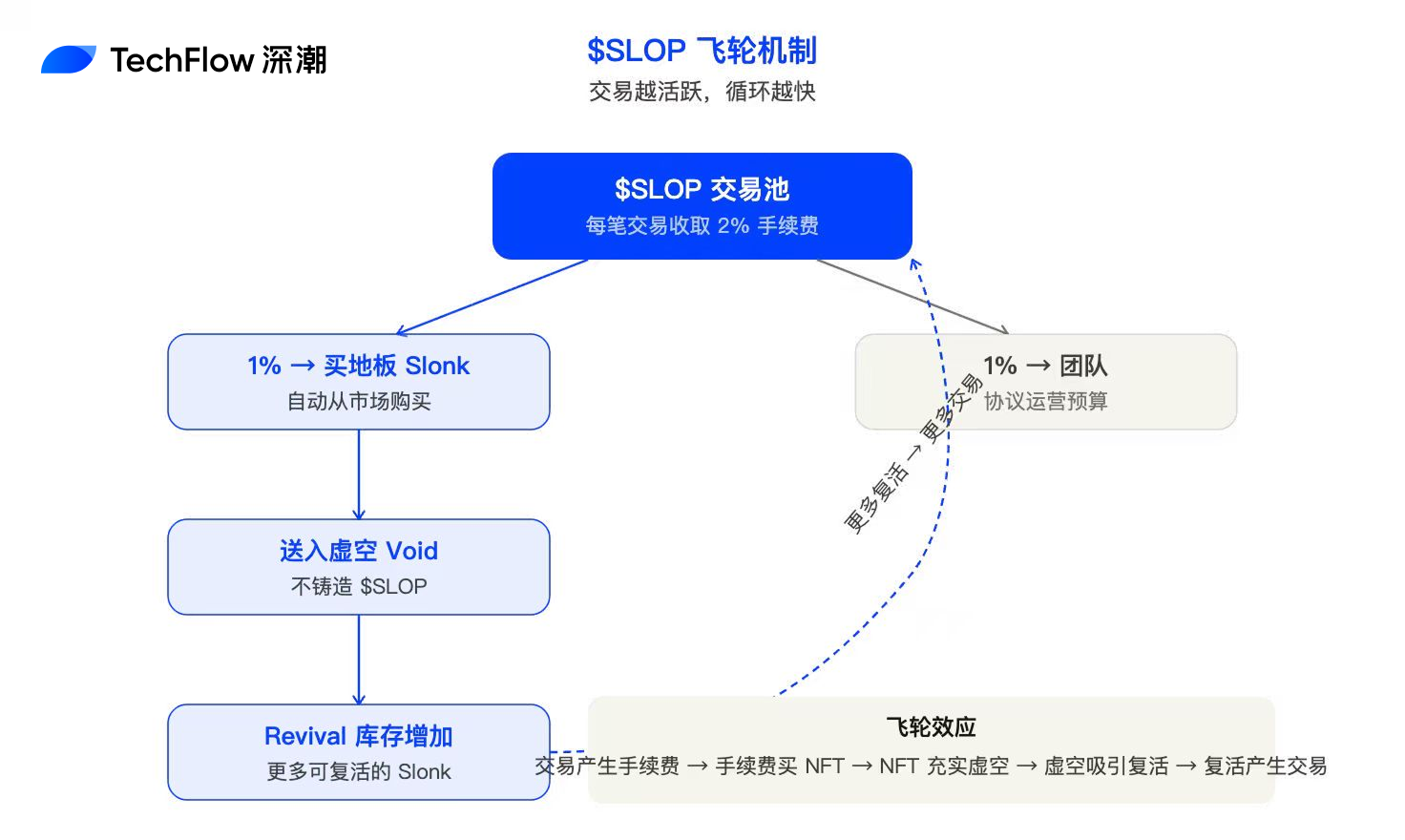
Regarding tonight’s token launch, Hirsch revealed the exact process earlier today. 576,000 $SLOP will be placed into a single-sided liquidity pool, with an initial valuation of approximately $50,000.
Buyers must bring their own ETH. For the first 6 hours post-launch, only token trading will be allowed—Void operations will be disabled. This 6-hour window is purely a price discovery phase, allowing the market to set $SLOP’s value before enabling Void and unlocking the bidirectional conversion between NFTs and tokens.
The hard cap for $SLOP is 5,760,000 tokens—exactly 10,000 images × 576 pixels each. But this number will never be fully minted, as merged NFTs (burned) generate no tokens. The over 1,300 already burned Slonks have locked their slop values permanently.
I believe the most brilliant part of this design is that it binds speculation and creation into the same action.
When you Merge two Slonks, you’re speculating—higher slop means greater potential token yield. But you’re also creating: the model generates a brand-new, never-before-seen 24×24 pixel image. Earning profit and making on-chain art use the same button—and they reinforce each other in a positive feedback loop.
Thus, this entire mechanic can be seen as a micro-innovative Ponzi-like economic structure in NFTs—on scarcity generation, token-NFT exchangeability, and deflationary design.
Old-School Inscription Veteran, New Tricks Old Play
About the creator of Slonks, Michael Hirsch, few in the community recognize him—but he’s far from a novice.
Recall the inscription mania on Ethereum, where ETHS was one of the standout projects? At its peak, the project had a market cap of around $420 million—and Hirsch was its founder.
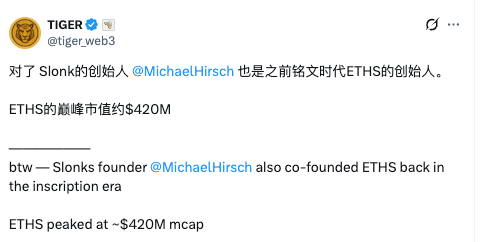
After the inscription wave cooled down, he pivoted to Blockhash—a boutique studio focused on on-chain products—building DEXs, NFT marketplaces, token-gated chat tools, and various “weird crypto experiments” he describes himself.
Slonks is the latest product from this studio.
A veteran who’s weathered multiple cycles of the inscription boom-and-bust now launching a project with an extremely high entry barrier—this itself is a notable signal. Is on-chain liquidity returning? Are micro-innovations beginning to spark speculation again?
I think we should observe closely.
As noted above, $SLOP will launch tonight at 9 PM. For the first six hours, only token trading will be permitted—no Void operations. This six-hour period is pure price discovery, with no new supply, as buyers compete to establish $SLOP’s valuation.
After six hours, the Void channel opens, and bidirectional conversion between NFTs and tokens officially begins.
A $50,000 initial market cap implies extremely thin liquidity—early price volatility will be severe. The whitepaper still reads “v1 · draft.”
This project boasts technical ingenuity, a proven founder, and a logically consistent economic loop—but fundamentally, it’s still a micro-innovation centered on economic modeling and artificial scarcity.
Seasoned participants familiar with past cycles will likely nod in recognition. Regardless, the fact that new ideas emerge even in current conditions suggests a positive trend.
DYOR.
Author: Ku Li, DeepFlow TechFlow
Disclaimer: Contains third-party opinions, does not constitute financial advice
Why the NFT Market Will Grow from $2 Billion to $60 Billion
05-11
Market cap surpasses $12 million, attracting attention from OpenSea and Uniswap—what’s the magic behind the new image-based meme coin, Unipeg?
04-27
NVIDIA attracts $85 billion in investor demand during massive bond issuance
06-16
Ethereum surges over 10% in 24 hours, currently priced at $1,841.31
06-16Amazon announces a multi-billion dollar investment in Missouri to build a data center campus, expected to create over 400 long-term positions
06-16Binance Platform's SpaceX Perpetual Contract Trading Volume Surpasses $9 Billion, Capturing Over 60% Market Share
06-16Binance platform XLM/USDT short-term spike down to $0.17, now recovered to $0.225
06-16


