Ray Dalio's Latest Interview: Massive Changes in the U.S. Over the Next Five Years, After Which the World Will Be Unrecognizable
Ray Dalio's Latest Interview: Massive Changes in the U.S. Over the Next Five Years, After Which the World Will Be Unrecognizable


Introduction: Against the backdrop of soaring U.S. fiscal deficits, escalating geopolitical tensions, and renewed scrutiny of dollar credibility, discussions about America are shifting from "Is it still the world’s strongest economy?" to "Are the institutional, debt, and international order foundations underpinning American hegemony still stable?"
But when both "America remains powerful" and "America is in disorder" hold true simultaneously, a more critical question emerges: Is America facing a typical cyclical adjustment—or the unraveling of an enduring global order?
This article is a translation of a podcast interview with Ray Dalio from The New York Times’ “Interesting Times.” Dalio, founder of Bridgewater Associates, has long studied macroeconomic shifts through the lenses of debt cycles, reserve currencies, and imperial decline.
In this conversation, Dalio breaks down the U.S. predicament into a set of deeper structural variables: how debt accumulates, how politics fractures, how international order fails, and whether technology can still deliver new productivity gains.
First, the debt cycle is fundamentally altering national capacity. In the past, the U.S. leveraged its strong fiscal credit and the dollar’s status as a reserve currency to finance for extended periods at low cost, sustaining military spending, social welfare, and global commitments. Now, persistent spending exceeding revenue has led to rising debt and interest burdens, continuously compressing fiscal space. This means debt is no longer just a number on a balance sheet—it increasingly constrains state action: the ability to protect allies, maintain welfare, or bear war costs will be limited by fiscal reality.
Second, domestic political polarization is now entangled with wealth distribution. Previously, political divides could be partially absorbed through growth, tax expansion, and welfare increases; while different groups had conflicting interests, they still shared trust in core institutions. Today, widening inequality, value conflicts, and left-right antagonism intersect, making any deficit reduction plan touch on the contentious issue of "who pays more taxes, who receives fewer benefits." Thus, fiscal adjustment is no longer a technical matter but a test of political legitimacy—reforms become harder precisely because they are needed most.
Third, the international order is reverting from rules to power. After 1945, the U.S. established a global system centered on multilateral institutions, rule-based frameworks, and dollar credibility. Even during the Cold War, the U.S. maintained overwhelming financial and institutional advantages. But today, geopolitical conflict, bloc realignment, and supply chain security concerns are undermining the stability of that order. Comparisons to Iran, the Strait of Hormuz, or even the Suez crisis all point to one central problem: when rules cannot be enforced, markets will reevaluate the relationship between power, credibility, and security.
Fourth, pressure on the dollar does not mean the renminbi will directly replace it. Dalio’s assessment is more nuanced: the renminbi may become a more common medium of exchange in trade, but this does not imply Chinese debt will become the world’s premier store of wealth. The real issue is, under broad fiat currency depreciation pressures, what kind of safe assets will capital seek? The resurgence of gold in central bank reserves reflects exactly this uncertainty.
Fifth, AI may alleviate or exacerbate the crisis. Historically, technological progress has been seen as a key outlet for the U.S. to address debt and growth challenges; if AI significantly boosts productivity, it could indeed improve income, growth, and debt-servicing capacity. Yet today, AI also drives new wealth concentration, job displacement, and security risks. It may serve as a buffer against fiscal stress—but equally, it could amplify social fragmentation and geopolitical competition.
If we compress this dialogue into a single judgment: America’s problem is not a singular crisis, but rather a simultaneous revaluation across debt, politics, international order, and technology variables.
In this sense, the subject of discussion is no longer merely whether America is declining, but a broader structural question: When old orders still function, yet their underlying conditions are fraying, how should markets, states, and individuals redefine “safety” and “credit”?
Below is the original content (slightly restructured for readability):
· Dalio’s core thesis: America is not temporarily weak, but entering a downward phase of a long-term cycle.
· America’s real risk isn’t lack of money, but excessive debt that gradually erodes state capacity.
· Deficits are hardest to resolve because they inevitably become political conflicts over “who pays, who sacrifices.”
· The root cause of U.S. political polarization lies not only in values but in distorted wealth and benefit distribution.
· Postwar U.S.-led rule-based order is failing—the world is returning to power politics.
· The dollar won’t be immediately replaced by the renminbi, but global attention will shift toward safe-haven assets like gold.
· AI may rescue growth, but could also further fracture employment, wealth, and security structures.
· Whether America can recover depends less on markets than on education, social cohesion, and avoiding war.
I feel we might be at a moment when the American Empire is ending.
Partly due to the Iran conflict stalling; partly due to Donald Trump pressuring U.S. alliances; and partly due to a growing sense—increasingly palpable—that China, America’s greatest competitor, is watching coldly, waiting for its collapse.
This week’s guest has long focused on this question. He holds a grand historical theory predicting America’s decline. To some extent, he’s an atypical Cassandra—one who issues warnings but rarely gets taken seriously.
Ray Dalio founded one of the world’s largest hedge funds, Bridgewater Associates, from scratch. But today, what he most wants to discuss isn’t markets or investments—it’s the decline of the American empire and whether we can still pull the “American Empire” back from the brink.
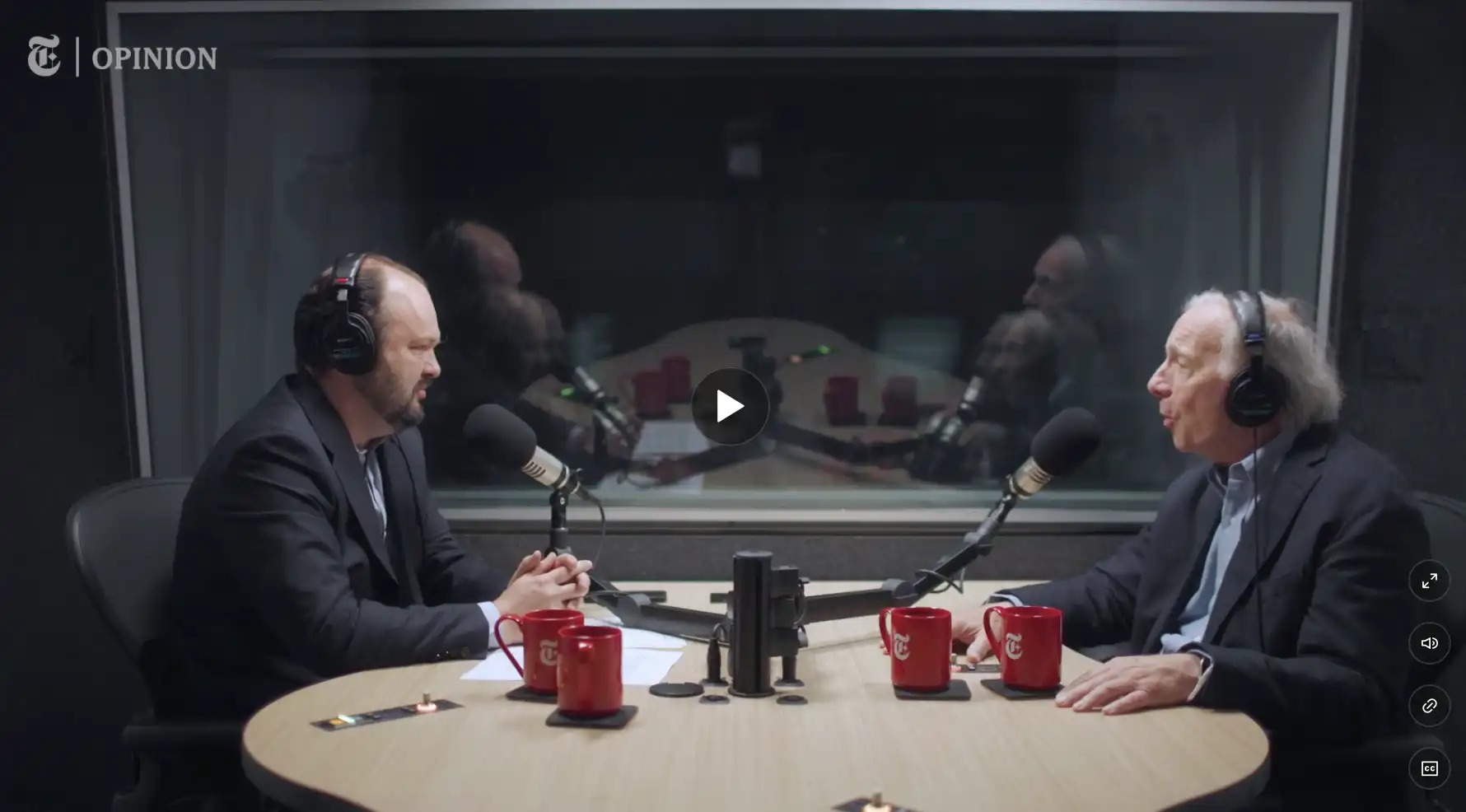
Below is the edited transcript of an episode from “Interesting Times.” For full impact, we recommend listening to the original audio. You can access it via the player above, or through The New York Times App, Apple, Spotify, Amazon Music, YouTube, iHeartRadio, and other podcast platforms.
The Cyclical Logic of America’s Crisis
Ross Douthat (host): Ray Dalio, welcome to “Interesting Times.”
Ray Dalio (founder of Bridgewater Associates): Thank you. It’s quite fitting to be here on “Interesting Times.”
Douthat: Everyone says so. You’ve spent your career betting on outcomes, and over the past decades, many of your predictions have paid off. Recently, you’ve said that the United States today might not be a particularly good bet.
So, if someone is currently observing America and trying to decide whether to bet on “the American Empire” remaining dominant in the 21st century, what key forces or factors should they focus on?
How Debt Undermines National Capacity
Dalio: Let me first clarify something. I’m not saying the U.S. is a bad bet or a good one—I’m simply describing what’s happening.
Over my roughly 50 years in investing, I’ve learned that many events crucial to me have never occurred in my lifetime, yet they’ve happened repeatedly throughout history.
So I began studying 500 years of history to identify why reserve currencies and their underlying empires rise and fall. You see the same pattern again and again. There truly is a “big cycle,” and each big cycle begins with the formation of a new order.
There are three types of order: monetary order, domestic political order, and international world order—three powerful forces constantly evolving.
Let’s start with the first force: monetary order. Here exists a debt cycle. When debt relative to income keeps rising, and debt servicing costs relative to income keep increasing—whether for nations or individuals—
Douthat: Or empires.
Dalio: Any entity! Exactly!
Douthat: Yes.
Political Fragmentation Rooted in Wealth Distribution
Dalio: —this squeezes other expenditures. That’s the crux. For example, the U.S. now spends about $7 trillion annually, earns about $5 trillion, meaning expenditure exceeds income by roughly 40%. This deficit has persisted for years, so the U.S. has accumulated debt equivalent to about six times its annual income—where income refers to actual government receipts.
Exactly. But the result is currency devaluation. That’s how it works. Hence, long-term debt cycles, short-term debt cycles, monetary cycles, and economic cycles—all drive the economy from one recession to overheating, then to another downturn.
Connected to this is the domestic political and social cycle, which closely ties to monetary issues. When a society experiences massive wealth gaps and value divisions—
Douthat: You mean the gap between rich and poor?
Dalio: Between rich and poor, and between people with differing values. When these differences become irreconcilable, political conflict arises—and such conflict becomes severe enough to endanger the entire system.
So I believe the first cycle is already underway. And I believe the second cycle—the irreconcilable divide between left and right—is also unfolding. We’ll expand on this later.
The World Order Reverting to Power Politics
Douthat: How do international factors play out?
Dalio: The same logic applies internationally. After a war, a dominant power emerges and establishes a new world order. By “order,” I mean a system. This order began in 1945.
Douthat: For us, yes. The U.S. was the driving force behind building this system.
Dalio: Exactly. The U.S. created a system largely modeled on its own institutions, intended to be representative. For instance, the United Nations represents a multilateral world order—different countries operate within it, and theoretically, a rule-based system should exist.
But the problem is: without enforcement mechanisms, such a system isn’t truly effective. It’s an idealistic framework that was once beautiful while it lasted. Today, we no longer have a genuine multilateral rule-based system.
We’re returning to the state that existed before 1945—and for much of history: persistent geopolitical rifts, such as those around Iran today.
How are such disputes resolved? You don’t submit them to an international court and wait for a verdict to be enforced. Ultimately, power prevails.
Douthat: Exactly. But even during the peak of the “rules-based international order,” for most of that period, the U.S. was locked in conflict with the Soviet Union.
Dalio: Correct.
Douthat: So the Cold War persisted. The window of pure system-driven governance—free from great power conflict—was actually quite brief. And even then, U.S. power remained decisive, right?
Dalio: Absolutely. Because the Soviet Union lacked real strength. It had military power, but after WWII, the U.S. held about 80% of global monetary wealth, half of global GDP, and was the dominant military power. Thus, we could provide funding externally, and recipients valued those funds highly. In contrast, the Soviet system was just a small part of the picture. Financially, it was nearly bankrupt and certainly not a major player.
Douthat: So military balance was real, but financial dominance was clearly American.
Dalio: Precisely. Fortunately, the “mutual assured destruction” framework prevented actual use of that military power. Still, I remember the Cuban Missile Crisis—I was a child watching developments unfold, unsure if nuclear exchange would occur. But it didn’t go that far, and eventually, the Soviet Union collapsed.
Douthat: In your cyclical historical view, what role do random events play?
Dalio: All events happen in sequence. The key question is: do they trigger conflict? And in a world without a court system to resolve disputes—whether domestically or internationally—how are such conflicts settled?
Take current events in the Middle East, especially involving Iran. Conflict exists, and it escalates into war because no alternative resolution mechanism exists. The global focus now is: Can the U.S. win this war, or will it lose?
We tend to judge this in binary terms: Who controls the Strait of Hormuz? Who controls nuclear materials? Can the U.S. prevail?
We should also note the alignment of blocs. Russia and Iran often support each other, just as there are opposing support networks on the other side.
Douthat: Again, what makes this moment unique compared to the past few decades? Is it that the opposing bloc is now stronger?
Dalio: It’s relative power shifts and the breakdown of the existing order. Also, vast creditor-debtor relationships are involved. For example, when the U.S. runs large deficits over long periods, it must borrow. During conflicts, this becomes extremely dangerous. Mutual dependency is also at play.
In short, in a higher-risk world, self-sufficiency becomes essential. History shows we can be cut off at any time. Any party can be severed.
Douthat: Yes. I’m deeply concerned about how these factors interlock. Suppose the final outcome of the Iran issue is that people conclude the U.S. lost the war—or at least failed to achieve its goals. Maybe the Strait of Hormuz remains open, but the Iranian regime stays in power, and a perception forms: the U.S. tried something but failed. Do you think such a perception would feed back into doubts about U.S. debt repayment credibility?
Dalio: I recently spent about a month in Asia meeting leaders and other figures. The impact is profound—very much like when Britain lost control of the Suez Canal. Egypt took over the canal, and that was seen as the symbol of the end of the British Empire. In other words, it was a massive event.
Douthat: Yes, that was in the 1950s.
Dalio: Exactly. And that’s precisely when people stopped wanting to hold British debt and other assets. Now, different countries are asking: Will the U.S. still protect us? Or has the U.S. lost the ability to do so? Because American citizens don’t want prolonged wars, so wars must end quickly, be low-cost, and—
Douthat: —and popular, right?
Dalio: Popular.
Douthat: And our current wars are generally unpopular. But let me linger on the Suez analogy, which I find fascinating. Many people are using it. In the Suez Crisis, Britain, France, and Israel essentially tried to reclaim control of the canal after Egypt nationalized it.
Clearly, this parallels Iran: a critical chokepoint in global trade, where Western powers clash with a regional power. But what struck me about the Suez event was that Dwight Eisenhower and the U.S. basically told Britain: No, you can’t do that.
Thus, the confidence crisis in the British Empire, the pound, and everything else stemmed partly from the realization that this was post-WWII order—and the U.S. was the dominant force.
Now, does China need to play a similar role? Must there be a comparable moment before people truly lose faith in the U.S.? Does one have to see a new hegemon emerge before abandoning the old one?
Dalio: Incidentally, I don’t believe China will ultimately become a traditional hegemonic power. We can explore that later.
Douthat: I’d love to hear more about that.
Dalio: But I want to say that it was the combination of Britain’s debt problems and its obvious loss of power that triggered the crisis. Britain’s decline had already begun before the Suez Crisis, as people realized the U.S. was not only a world power but also fiscally stronger.
Douthat: So if this analogy holds, what corresponds to it today? If people conclude the U.S. is no longer trustworthy, that its ability to repay debt has diminished, etc.—perhaps relating to your earlier thoughts on China and whether it could become a new hegemon—will people turn to China? Will they abandon the dollar as a reserve currency? If confidence in the U.S. erodes, where will capital flow?
Dalio: Let me share my view. But I also want to emphasize this is a recurring phenomenon in every cycle. For example, when Britain replaced the Netherlands, the process was similar. Britain was stronger financially and overall. The Netherlands lost, leading to a transfer from the Dutch Empire to the British Empire—while the Dutch still had a reserve currency and debt. Similar transitions have repeated throughout history.
So you don’t necessarily need a specific figure like President Eisenhower—
Douthat: No, but you do need a successor power. That’s exactly what I’m asking.
Dalio: Then I believe what will follow is—answering your question about where capital and wealth will flow—a country can remain a dominant power while still facing serious financial issues.
For example, in 1971, when the monetary system collapsed, the U.S. was still the dominant power. In 1971, U.S. debt became too high to honor gold delivery promises, causing the system’s collapse. We then experienced stagflation in the 1970s. Such scenarios can still recur.
Dollar, Gold, and Safe-Haven Wealth
Douthat: So that’s one scenario: crisis occurs, but no successor power emerges. The Soviet Union didn’t replace the U.S. in the 1970s.
Dalio: Correct.
Douthat: The U.S. just endured about a decade of very tough times.
Dalio: Your fiscal situation remains dire. This means holding bonds is not a good way to preserve wealth. To answer your question, money has two functions: medium of exchange and store of value.
I believe we’re now seeing China’s currency becoming increasingly used as a medium of exchange for various reasons. But I’m highly skeptical that Chinese debt or similar assets will become serious stores of wealth, because historically, they haven’t excelled at protecting wealth.
Douthat: Right.
Dalio: And I don’t believe any fiat currency will be an effective store of value.
Douthat: For our listeners, explain: “fiat currency” refers to money issued by a nation-state but not backed by gold or other assets, correct?
Dalio: Exactly—money they can print themselves.
Douthat: They can print money.
Dalio: So when we look back historically, in every similar era, all fiat currencies depreciate, while gold appreciates. Now, gold is the second-largest reserve asset among central banks. In other words, the dollar ranks first, followed by gold, then euros, then yen.
So I believe the real question is: What kind of currency can serve as a store of value? Gold has become the primary candidate largely because of “no choice”—it has proven itself a winner over thousands of years.
Douthat: So alternatives to the dollar become more attractive, but that doesn’t mean people will directly rush to buy Chinese debt?
Dalio: From a transactional perspective, traditionally, when countries start using a particular currency for trade, they gradually build up reserves of that currency—like a cash account. When they need to pay for goods or services they’ve just purchased, they need sufficient cash on hand. So I expect such reserves to grow.
The challenge lies in storing wealth in such debt assets. Thus, we’re entering a new world where everyone is asking: What constitutes safe wealth storage?
Douthat: For ordinary Americans, if they observe the cycle you describe and think: “Okay, this has happened before, and it’s happening again. We’re living through a period of spending beyond our means, and adjustment is inevitable—what shape do you expect this adjustment to take?”
One possibility is the 1970s: high inflation, slow growth—stagflation. Another is the Great Depression model: financial market collapse triggering crisis, poverty, and deflation. Which should we be more worried about in today’s context?
Dalio: I think everyone should worry most about what they don’t understand about the future. Understand?
Douthat: I do. And I’m genuinely worried about that. That’s why I asked you.
Dalio: So my point is: we have no idea what the world will look like in three to five years. What we don’t know vastly outweighs what we do. I’m certain we’re entering an increasingly disordered era—and that’s the greater risk.
So what’s the answer? I believe it’s knowing how to construct a well-diversified portfolio that can broadly withstand such uncertainties.
In simple terms, if you ask: “What should my typical investment portfolio look like?” It should include stocks, bonds, and investments in other countries—diversification is beneficial. As for specific allocations, I can’t detail them here. But I believe any portfolio should include 5% to 15% in gold, because when other assets enter truly bad times, gold tends to perform best. Indeed, that’s one reason gold has been an excellent investment in recent years—because the market is moving in that direction.
So I’d say: stay balanced, learn to diversify your portfolio well to hedge against other risks.
Douthat: As an investor, I definitely want investment advice. But as a commentator, columnist—whatever I am—I’d rather describe or anticipate reality. Even acknowledging we can’t predict the future exactly, if history offers these lessons and if these cycles repeat, and we’re heading toward some bottoming or reset, perhaps even rebounding afterward—I just want to understand: in your view, what will life at the cycle’s bottom look like? Will it resemble prolonged stagnation and sustained discontent, or more like a crisis erupting into street violence? The 1970s and 1930s seem very different. That’s my question.
Dalio: I can tell you what I’m concerned about. I see several major issues now: monetary problems, domestic political and social fractures, and international geopolitical tensions. Looking ahead, we’re approaching midterm elections. I believe the Republicans will likely lose control of the House. After that, you’ll see political and social conflicts intensify—especially between that election and the 2028 presidential race.
I fear these divisions may become irreconcilable. I don’t know how things will develop. I don’t know whether respect for rules, laws, and order can be maintained to uphold law and order.
I worry—not predicting—about broader violence. Indeed, larger-scale violence could occur. The U.S. has more firearms than people.
Douthat: People—
Dalio: I’m not predicting—let me finish.
Douthat: Okay.
Dalio: I’m just seeing these possibilities. I believe everyone can observe their surroundings and judge for themselves. Overall, answering your question, my reaction is: we’re entering a more disordered era. I believe the risks are greater than ever, and they’re following that trajectory. We’re discussing this in words, but I usually visualize these patterns in charts—and these events are aligning with historical patterns.
You asked me this question, and I gave my answer. Precisely because of these reasons, I believe people should keep their portfolios well-diversified and stay alert to such developments.
Douthat: Talk to me about how the debt landscape interacts with political and social landscapes. Because if you ask people now what they’re divided over, they usually don’t cite national debt interest payments. They list a long list of conflicting issues.
I’m just curious: when interest payments rise and squeeze other investments, what economic forces lie beneath this interaction with social disorder?
Dalio: Their disagreements are fundamentally about “who owns how much money, and who gets it”—which is closely tied to fiscal deficits.
I recently wrote a book explaining this mechanism through 35 cases, titled “How Nations Go Bankrupt.” I’ve also been speaking with senior figures from both Democratic and Republican parties—everyone agrees on the mechanics themselves.
When I sit down and tell them they must reduce the fiscal deficit to 3% of GDP through a mix of tax increases, spending cuts, and interest rate control—because that’s the only way the mechanism works—
They respond: Ray, you don’t understand. To win elections, I must make at least one of two promises: “I won’t raise your taxes,” or “I won’t cut your benefits.”
The nation’s division manifests between billionaires and those struggling financially, between left and right, between populism, and so on—all rooted in monetary and financial factors. Thus, fiscal deficits and monetary issues are crucial parts of social conflict.
Douthat: So when you talk to politicians about this, and they say we can’t raise taxes or cut spending, I imagine they’ll add that people will see these actions as threats to opportunity or equality. Those relying on healthcare and social security view it as equality protection; those depending on low taxes for entrepreneurship see it as opportunity protection.
If you want to convince them to reduce the fiscal deficit to 3% of GDP, what would you tell them this is meant to shield them from?
Dalio: Shield them from a financial crisis.
Douthat: What would a U.S. financial crisis look like? What exactly would happen?
Dalio: A financial crisis means the government’s spending capacity would be severely limited. In other words, you couldn’t afford military expenses, social welfare, and so on—fiscal constraints would be immense. With demand failing to match supply, interest rates would rise, suppressing borrowing and damaging markets. This would force central banks to resort to printing money to stabilize the situation, resulting in currency devaluation and a stagflationary environment.
Douthat: I see. So the worst-case scenario sounds like a financial crisis akin to 2008, ultimately turning into a 1970s-style stagflation? Sorry, I’m not trying to pressure you—
Dalio: No, no, I’m happy to answer as fully as possible.
Douthat: I just wanted to provide context: I’m 46 this year, and my entire life has lived under the shadow of forecasts that “U.S. fiscal deficits are unsustainable.” My first vivid memory of a presidential election was Ross Perot’s campaign in 1992, which was largely built around these themes.
But like many Americans, I’ve tended to automatically dismiss arguments about fiscal deficits. Since the 1990s, I’ve felt for the first time that deficits and excessive spending are truly affecting ordinary people’s pockets—the inflation wave during Biden’s early years.
So I think it’s helpful for me and our listeners to understand: why will the 2030s, or late 2020s, differ from the past 20 years? After all, we’ve had these deficits for two decades.
Dalio: Thank you for your curiosity! And I feel compelled to answer. It’s like plaque building up in arteries. Like you said: “I don’t have a heart attack yet.”
Douthat: “I feel fine.”
Dalio: Then I can say: okay, I understand—you haven’t had a heart attack yet. But can I show you an MRI scan so you can see the plaque accumulating in your body? Can you grasp what these plaques mean—if they continue to grow, you’ll have a heart attack? Can you understand what these numbers mean, and where you currently stand? Listen, this is your life, your choice. Ask yourself: “Is this right or wrong?” This is what you must do for your own well-being.
Douthat: In your narrative, if you combine this diagnosis with your assessment of how America’s political system currently operates—which is also my view—it seems to suggest that America will experience at least a mild “heart attack” before real change happens.
You initially said, despite my framing as a podcast host, you’re not shorting America. So are you optimistically suggesting America might endure a so-called “minor heart attack” and then recover?
Can AI Alleviate America’s Dilemma?
Dalio: I believe we’re entering a more disordered era, as several forces converge: monetary issues; irreconcilable domestic social and political divides; international order challenges. I’ll add two more factors. One is the recurring natural forces in history—
Douthat: Like pandemics.
Dalio: Droughts, floods, pandemics. And if you look at most people’s assessments of climate change trends, it’s not improving but worsening. Then comes technology and AI.
We must incorporate technology and AI into this picture, because they will play a role. And they’ll do so in three ways. First, they may dramatically boost productivity, helping ease some debt issues—possibly. We can discuss this further. But I don’t think it will happen fast enough.
Douthat: I often hear this from AI experts. They say: in the best case, if AI just raises GDP growth by X percentage points and productivity growth by X percentage points, it would help alleviate the issues you mentioned earlier.
Dalio: Exactly, exactly.
Douthat: It would make debt more manageable.
Dalio: That’s precisely my point. Because it can generate income, which helps repay debt principal and interest, and so on. So this is one of AI’s three impacts.
AI’s second impact is creating massive wealth disparities. Those benefiting are nearing the question of “who will become the first trillionaire.” Wealth gaps have widened dramatically, and AI will replace large numbers of jobs. So this is the second factor. Regardless of how we handle it, these disparities will be problematic. They must be addressed, and this will likely become a political issue—but it is a problem.
Third, technology itself can be used to harm others—it carries immense power. It can be used by other nations, by those intent on causing harm, or by those seeking to steal funds. It can be weaponized.
Douthat: Yes. But in your model, your cycle theory, from this last point, technology could exacerbate geopolitical tension. It would reinforce Cold War dynamics and heighten domestic tensions.
Dalio: Exactly.
Douthat: But it could also relieve fiscal pressure.
Dalio: Yes, it could bring productivity gains.
Douthat: If it brings some negative effects, it probably brings some positive ones too.
Dalio: The key is how these impacts ultimately offset each other and reach equilibrium.
Douthat: Yes.
Dalio: And we don’t know what the future will look like, because human capability falls short of predicting what the world will be like in three to five years. Over the next five years, these five forces will converge, and the entire world will experience a temporal distortion. Massive changes will occur in the next five years, with all these forces colliding. Once we pass through this period, the world on the other side will be almost unrecognizable. It will be a period of extreme change and turbulence.
So what should one do? Knowing you can’t truly predict the future, my own approach—and my advice—is to learn how to balance your positions.
Douthat: But for politicians, hearing your analysis, they might think: okay, I know Ray Dalio wants us to cut the fiscal deficit to 3% of GDP, but he also believes we’re experiencing a five-year “temporal distortion” unlike anything in human history. Maybe we should just wait and see what the world looks like in five years before painfully restructuring Medicare and social safety nets.
Dalio: I don’t think they care much about what Ray Dalio thinks. (Laughter)
Douthat: Not that. But—
Dalio: I believe they care more about what the voting booth thinks.
Douthat: Yes, of course. I’ve spoken with people in Washington, D.C., who genuinely worry about fiscal deficits and are trying to act.
What truly interests me is: in your narrative of imperial rise and fall—Spain, Britain, the Dutch “little empire,” etc.—is there any case where a great power went through this cycle, hit the bottom you described, then rebounded, launching a new upward phase? Or are there such examples?
Because as Americans, that’s our goal. If someone accepts your narrative, they’ll say: okay, but history isn’t deterministic. We can choose, and we can enter another cycle, right?
Dalio: Yes, I believe it’s possible. But the issue is that some things must happen—and history hints at this. Plato once discussed such cycles—
Douthat: Yes.
Dalio: In “The Republic.” He spoke about democracy and its problems, because people don’t always vote for what truly benefits them or strengthens the nation. About 60% of Americans read below a sixth-grade level, and productivity issues persist. Yet they vote, and largely determine outcomes.
The problem is: how can change occur under a democratic system? In Plato’s view, ideally, a “benevolent despot” is needed—one capable of controlling the situation, sufficiently strong, and willing to sacrifice for the nation. In a sense, he could reunite people.
Whatever form it takes, you need a strong leader from the center. They must recognize that partisan conflict and strife are inherently problematic, yet possess enough power to get people and the entire system to function as needed. Only then can some form of debt restructuring occur, education systems improve, and structural reforms in efficiency advance.
Running a large company is hard enough. Imagine governing a nation and doing it well—how much harder is that? So you need an extraordinary individual with immense power; you need strong leadership that is followed, not continually undermined by any faction.
Douthat: So you’re looking for a Franklin Roosevelt or perhaps a Ronald Reagan-type figure in this specific crisis?
Dalio: Well, I believe it’s harder now than ever.
Douthat: Because we’ve gone further—
Dalio: Everyone has their views. Do you know how hard leadership is? (Light laugh) I mean, can you imagine leading people to the center, uniting them, and getting them to do difficult things?
Douthat: Yes. But in these discussions, I often think: we are indeed very wealthy. Today’s America is richer than in the 1980s, and vastly richer than during the Great Depression. Even though people feel inflation pressure or hardship when unemployment spikes suddenly, this wealth itself is a stabilizer.
You could also envision another scenario. For example, Japan. Japan is a country with long-standing massive debt—I wouldn’t say it handled it very successfully. Its economic vitality declined, and it became more stagnant, no longer the Japan of the 1980s or 1990s that seemed poised to “take over the world.” But it has maintained a stable, aging society. Could that be a possible scenario for the U.S.?
Dalio: I think you’re raising two questions, though related. Let me answer them separately. First, about higher living standards and America’s growing wealth. This has always been true historically. Throughout all prior periods before WWII, this was also the case. The real issue is how people relate to each other.
Douthat: You mean that empires often become richest precisely when debt peaks?
Dalio: Yes. If you look at per capita income, many indicators—life expectancy, any measure of well-being—then draw a line from the 15th century or from the medieval dark ages, you’ll see these indicators were relatively flat initially. Meaning, at every historical moment, from a global or societal perspective, we are wealthier than ever before. Your point stands.
But this didn’t prevent WWII, didn’t stop debt problems, or other such events. Because the crucial issue is how people relate to one another. Can they work together to solve problems? Realistically, if a 10% drop in living standards is part of a healthy adjustment, what’s the harm?
I’m nearly done, but I want to make this clear. So this is the first point. Wealth doesn’t alleviate debt problems or the struggle over “who controls what”—
Douthat: But maybe it eases it somewhat. Like in the 1930s—
Dalio: No, no, no. Wait. I didn’t interrupt you earlier. Please don’t—
Douthat: Okay, please continue. Sorry.
Dalio: Let me finish, then you respond. Regarding Japan—would you like me to answer that first, then move to Japan?
Douthat: Let’s pause on Japan. I just want to clarify one more thing: if you look at the 1930s, 1970s, and the aftermath of the 2008 financial crisis, they were all economic crises, but conditions seem to be improving. The 1930s were worse than the 1970s, which were worse than the 2010s. So maybe because we’re wealthier, things can stabilize to some degree, right?
Dalio: Yes. If you look at per capita income, life expectancy—any standard of living or similar metric—you’ll see a trend line—
Douthat: I’m just saying that even social conflict wasn’t as severe in the 1970s as in the 1930s. That’s all I’m expressing.
Dalio: Well, I won’t emphasize that too much.
Douthat: Okay.
Dalio: In other words, based on multiple metrics, I’d say today resembles the 1930s more. If you examine debt severity and internal conflict severity—I’ve lived through these eras. And I’d say—
Douthat: So you believe our current situation is worse than the 1970s?
Dalio: Our debt situation is worse.
Douthat: That’s true.
Dalio: America’s dominance in the global order and related conflicts are also worse than then.
Douthat: I see.
Dalio: So I believe this is an objective fact. I’m not deliberately painting a pessimistic picture—I’m just trying to analyze correctly, because my job is to make the right bets.
Douthat: Okay. Then what about our “Japanese future”? Could we face a Japanese-style future?
Dalio: Japan’s case has two very interesting aspects. First, Japan’s debt is primarily domestic. In that specific case, the solution was: the central bank printed massive amounts of money and bought debt. That’s what they did. Result: the yen depreciated. With currency and debt value falling, Japanese people’s wealth suffered huge losses.
So yes, we could see something similar. But ours is different: one-third of U.S. debt is held by foreigners. That’s a key difference. As a nation, we owe money to other countries.
Douthat: Here I’d like to—
Dalio: If you consider that a good outcome (light laughter)
Douthat: No, I don’t. Well, I think—
Dalio: It’s like the decline of the British Empire. You might experience something similar to that decline. Roughly that situation.
Douthat: No, I don’t see that as a good outcome. I’m interested in it because in Japan’s case, it’s more like sustainable stagnation, not crisis and collapse. But I agree with you on one point: for various reasons—reasons beyond this conversation’s scope—Japanese society seems more willing than American society to accept a decline in living standards. In that sense, it’s probably not a viable model for the U.S.
Let me end with a personal note of optimism, and then pose my final question for you to respond to. Earlier, I mentioned that my whole life has been shaped by people endlessly worrying about deficits and deficit spending. I agree with you: crisis hasn’t arrived yet doesn’t mean you won’t have a heart attack tomorrow. That’s entirely reasonable. So I fully expect the problems you describe will have significant negative impacts on the U.S.
Yet at the same time, I do feel this is a strange moment: if you look at certain metrics, America appears fragile; but from many perspectives, America remains incredibly strong. Over the past 10 or 15 years, U.S. GDP growth has clearly outpaced Western Europe, Canada, and other comparable economies. We still have the world’s most profitable, cutting-edge tech companies. We still have the most capable military. Socially, we do have serious problems, but are there other major powers better at absorbing immigrants, having higher birth rates, and being geographically distant from major wars and refugee flows? I’m uncertain if there’s a better bet than America.
If I look 50 years ahead, within the broader context of global order, isn’t America still a place where one could reasonably maintain some confidence? What’s your take?
Dalio: I believe we shouldn’t frame the issue the way I initially opposed—“Will America win or lose?”
I think we know what health looks like. Throughout history, any nation wishing to stay healthy needs to do three things. First, properly educate children, equipping them with capabilities, high-quality production skills, and civic literacy. Second, ensure they grow up in an orderly society where people can collaborate, create productivity, and thus achieve widespread prosperity. Third, avoid war. No civil war, no foreign war. That’s all you need.
Then you can assess these fundamentals. Have we educated our children well, giving them productive abilities and civility? Do we have a population with civic awareness? Do we have an environment that fosters productivity and harmonious coexistence?
I believe our current condition is very poor. I live in Connecticut, and my wife has been helping the poorest kids complete high school. The education gap, and the gap in civic literacy, are real issues. So I believe the ultimate problem really comes down to these basics.
These are fundamental matters. Is your income above your spending? What’s your income situation? What’s your balance sheet? These are basic questions. You know these fundamentals. So if we can establish these foundations—yes, I thank God I grew up in America, because wow, it was incredible. It was once a place where anyone from anywhere in the world could truly become a citizen, so it did have that genuine elite system. I came from a middle-lower class family. My father was a jazz musician. I could attend a good school and carve my own path, right? I think of that creativity, all those wonderful things—the broad education, a middle-class society—we once had a middle class and those things.
So I’ve seen the difference. I know what the fundamentals are. I look at various metrics, and they concern me.
Douthat: Okay. Ray Dalio, thank you for joining us.
Dalio: Thank you for having me.
Original text: BlockBeats
Disclaimer: Contains third-party opinions, does not constitute financial advice
NVIDIA attracts $85 billion in investor demand during massive bond issuance
06-16
Ethereum surges over 10% in 24 hours, currently priced at $1,841.31
06-16Amazon announces a multi-billion dollar investment in Missouri to build a data center campus, expected to create over 400 long-term positions
06-16Binance Platform's SpaceX Perpetual Contract Trading Volume Surpasses $9 Billion, Capturing Over 60% Market Share
06-16Binance platform XLM/USDT short-term spike down to $0.17, now recovered to $0.225
06-16
Trump: The Strait of Hormuz has been fully reopened as of Friday, and all agreements have been signed
06-16SlowMist: Aztec Connect Contract Hacked for $2.19 Million Due to ZK-Rollup L1/L2 State Boundary Vulnerability
06-15
