The company that makes glass for iPhones sees its stock price surge fivefold due to AI
The company that makes glass for iPhones sees its stock price surge fivefold due to AI


On the afternoon of May 6, NVIDIA announced an investment. The amount wasn’t particularly large—$500 million—but the contract stipulated that it could be increased to $3.2 billion in the future. Corning’s stock price surged 14% on the same day.
What’s more intriguing is the structure of this transaction. Among the 18 million equity warrants granted to NVIDIA by Corning, 3 million have a strike price of just $0.0001. This means these 3 million shares were virtually given away to Corning. Later that same afternoon, Corning raised its revenue growth target through 2030 to $4 billion at its investor conference in New York.
Yet none of this represents the most unusual aspect of Corning’s recent performance. In its Q1 earnings report, Corning disclosed that two unnamed companies had recently signed multi-year contracts worth $6 billion each—a “repeat” scenario, as Corning had just finalized a similar-sized agreement with Meta not long ago.
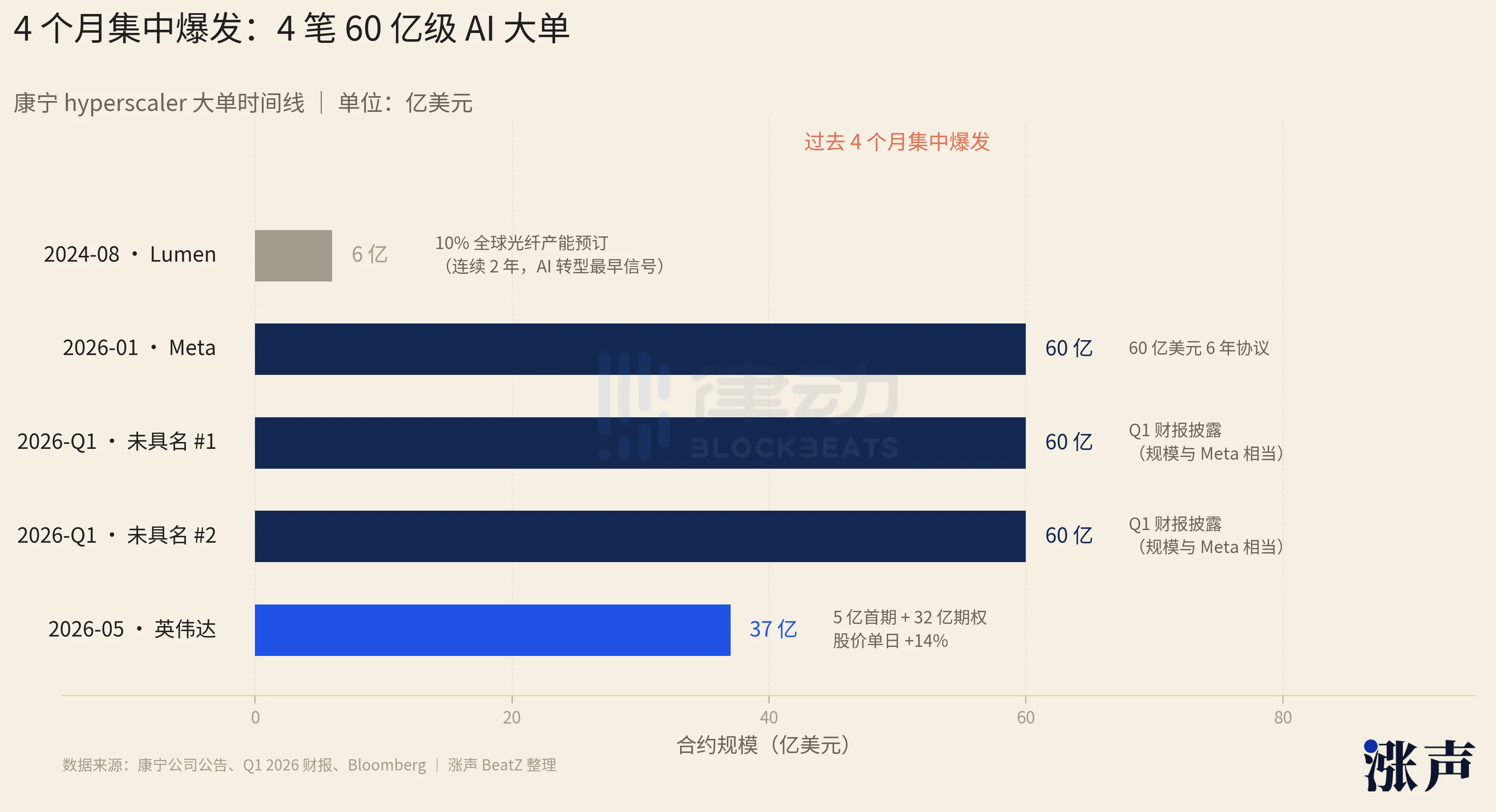
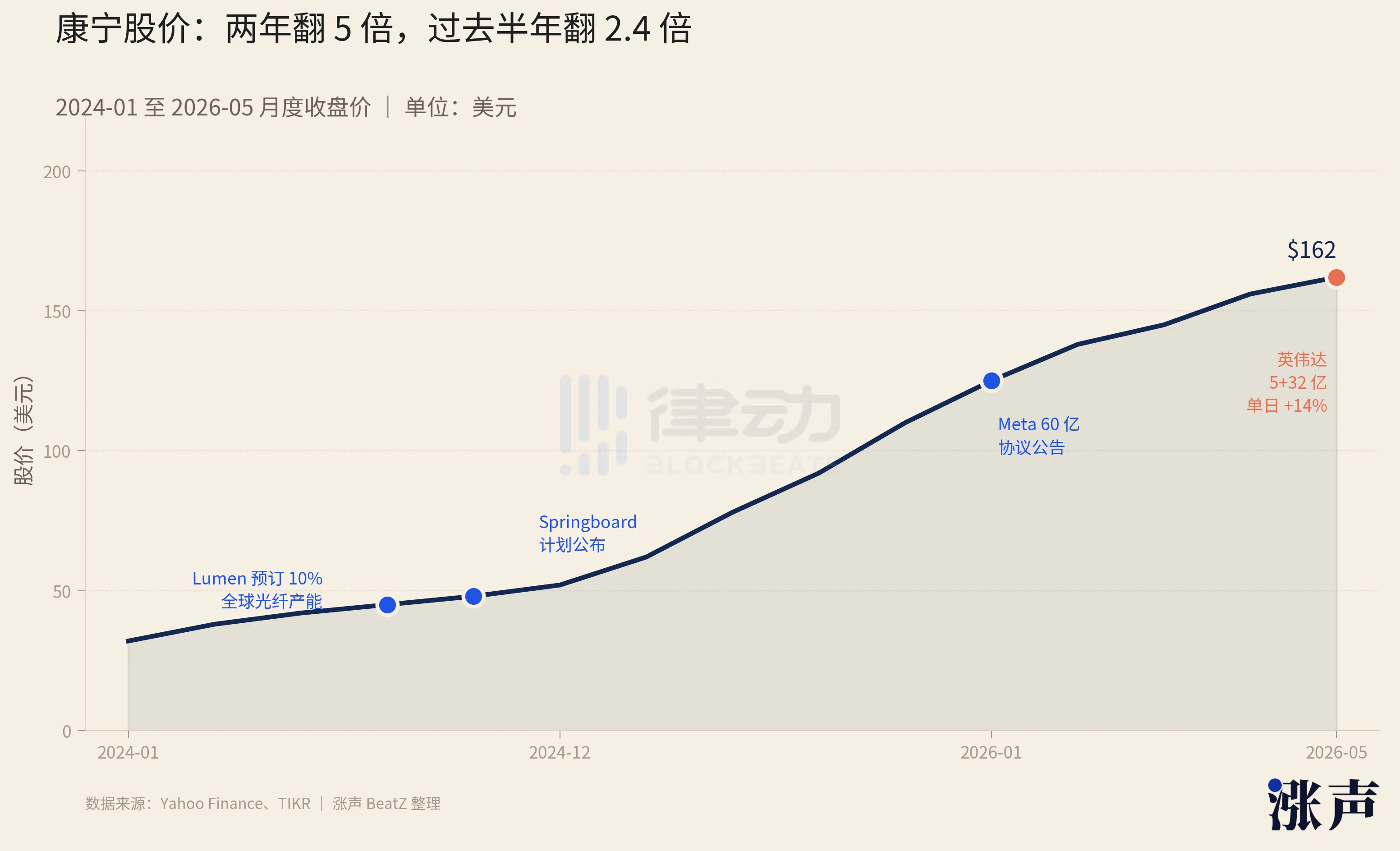
Count them: at least four AI-related deals worth several billion dollars each have been concentrated on this 174-year-old glass company within the past four months. Over the last six months, Corning’s stock has risen 140%, and compared to two years ago, it has multiplied fivefold.
From Selling Smartphone Glass to Becoming a Hot Commodity in AI Factories
If you’re reading this article on your smartphone, the screen covering your device is almost certainly made by Corning. Since Apple’s first-generation iPhone in 2007, Corning’s Gorilla Glass has become the default choice for high-end smartphone displays worldwide. But “smartphone glass supplier” is only one facet of Corning—and not even its most profitable segment.
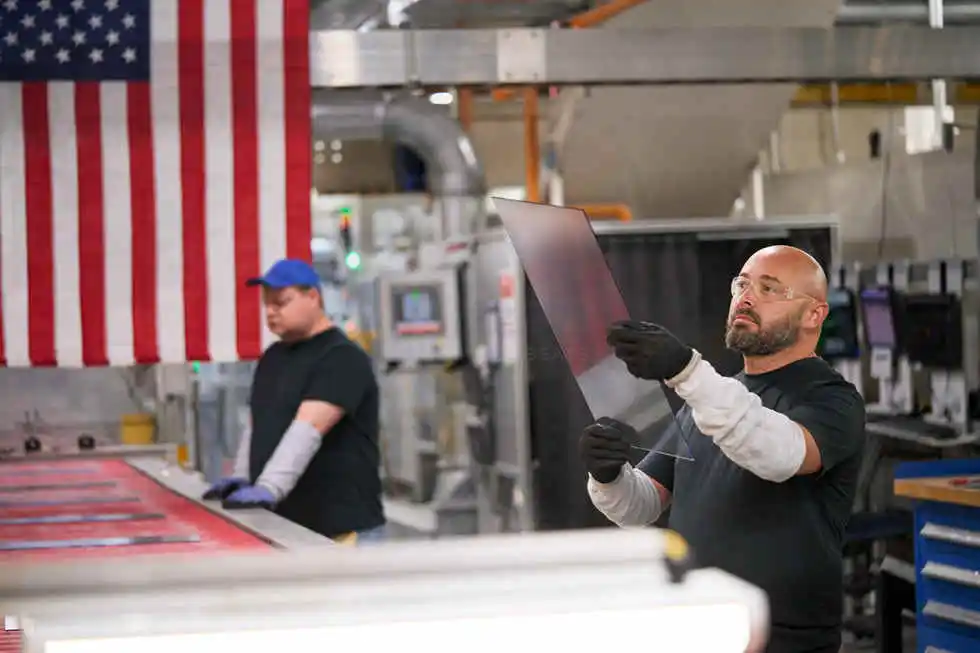
Founded in 1851, Corning manufactured the glass envelope for Edison’s first incandescent bulb. In the 1970s, it invented low-loss fiber optics from scratch, laying the foundation for the entire modern optical communications industry. The iPhone glass in 2007 marked its third major business transformation. Today, Corning is undergoing its fourth pivot, with optical communications now serving as the true engine of its business.
Corning’s optical communications business has over 50 years of history, but its customer base underwent a complete reversal in the past two years.
For a long time, Corning primarily sold fiber optics to telecom operators like AT&T and Verizon, who used them to deploy fiber-to-the-home networks and build 4G and 5G cell towers. In 2009, Corning launched its EDGE data center cabling solution, formally adding data center operators to its client roster. Over the past decade, driven by the explosion of mobile internet, widespread cloud services, and the surge in remote work during the pandemic, Corning’s optical communications business grew steadily—but remained a secondary revenue stream.
In November 2022, OpenAI brought ChatGPT into the public eye. From that moment onward, global data centers began redesigning their physical infrastructure to accommodate AI training, a new computational paradigm. The density of fiber required for AI training exceeds anything seen in any previous era.
The earliest signs emerged in August 2024. A U.S.-based telecom operator, Lumen, placed a single order for 10% of Corning’s global fiber production capacity for two consecutive years—this was the first public signal of Corning’s pivot toward AI infrastructure.
By early 2026, the four previously mentioned $6 billion contracts erupted simultaneously. While Corning had collaborated with data center operators for 15 years, it was only within the past 24 months that these “minor clients” became “absolute core customers.”
This shift in customer dynamics is clearly reflected in Corning’s financial statements. In 2023, Corning’s annual revenue declined 11% year-on-year, reflecting an industry downturn. But by 2025, total annual revenue surged to $1.56 billion, up 19%. In Q1 of this year, revenue rose another 18% year-on-year. The most impressive figure is in optical communications, which saw a full-year growth of 35%. The share of optical communications in total revenue climbed from 30% in 2020 to 37% in 2025. The absolute value change is even more striking: from $2 billion five years ago to $6.3 billion in 2025—an increase of over three times.
This leap from “secondary business” to “core driver” was no accident—it’s the result of a growth strategy led by CEO Wendell Weeks, internally codenamed “Springboard,” meaning “launchpad.”
Two years ago, Corning was still described by Wall Street analysts as a “boring glass manufacturer,” classified as a mature, low-growth dividend stock. But after three years of implementing Springboard, Corning’s stock price rose from around $30 at the beginning of 2024 to $162, a fivefold increase in two years, with a 140% surge in the past six months alone. A glass factory has transformed into the nervous system of the AI revolution.
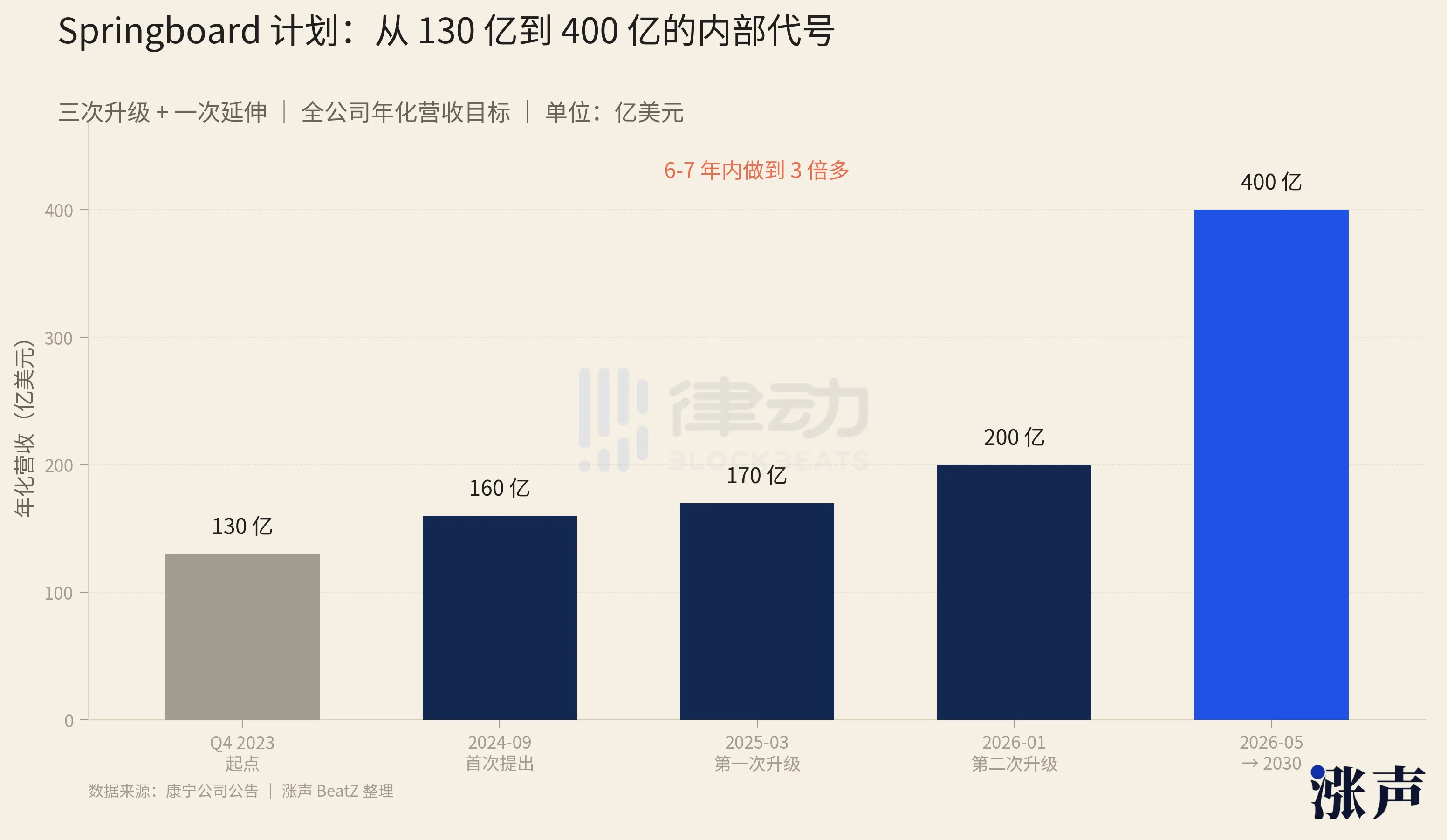
Springboard was first unveiled in September 2024. Its baseline was Corning’s annualized revenue level in Q4 2023, approximately $13 billion. The initial target was to increase annualized revenue by more than $3 billion by the end of 2026, achieving an overall operating margin of 20%.
However, over the next 18 months, this target was revised upward three times, ultimately reaching $6.5 billion—pushing Corning’s annualized revenue target for the end of 2026 to $20 billion. After NVIDIA’s investment on May 6, the company directly raised its internal revenue target for 2030 to $40 billion. Meanwhile, Corning achieved its 20% profit margin goal ahead of schedule in Q4 2025, one year earlier than planned.
The key to the Springboard plan lies in “premium pricing.” While sales grew by 18%, earnings per share surged by 46%—a profit growth rate 2.5 times higher than sales growth. On the operational level, Corning focused on three specific actions:
First, aggressively raising prices on legacy businesses. Corning’s display glass business is mature and stagnant. But by late 2024, Corning implemented a price increase of over 10% on this line, locking in exchange rates tied to the Japanese yen through 2030. As a result, even amid yen depreciation, this segment consistently contributes $900 million to $950 million in annual net profit, maintaining a 25% net profit margin.
Second, upgrading optical communications products. In 2025, optical communications sales grew 35%, while net profit jumped 71%. This means Corning isn’t just selling more—it’s earning significantly more per fiber optic cable.
Third, ramping up idle production capacity. Rather than building new factories, Corning reactivated underutilized capacity from past cyclical downturns, increasing the company’s overall gross margin from 33% in 2024 to 36% in 2025.
Naturally, price hikes are only sustainable because customers are willing to pay. Product upgrades generate higher margins because buyers are ready to pay premiums. The core reason Springboard enabled Corning’s profit growth to outpace revenue growth is that its customer base now includes a group of clients willing to pay premium prices.
The AGI race and surging order demand have made every data center operator acutely time-sensitive.
Cloud giants’ core business has traditionally been “renting IT infrastructure to enterprises.” Companies like Netflix, Airbnb, and Uber—born alongside the mobile internet—mainly experience “north-south” traffic: a user opens an app from outside, sends a request to a server in the cloud, and receives data back. Servers communicate occasionally among themselves, but the volume and frequency are low. This network architecture places minimal demands on underlying physical infrastructure: Ethernet works, copper cables suffice, standard fiber optics are adequate. Cloud giants operated this way for over a decade—stable, reliable, and profitable.
But all that changed after ChatGPT’s launch.
Over the next few years, nearly all major cloud providers began building AI training systems in-house. Microsoft is OpenAI’s largest compute provider; AWS is deeply integrated with Anthropic; Alibaba trains Tongyi. The core business of cloud giants shifted—from “renting IT to enterprises”—to “training AI for the world.”
Yet this transition triggered chain reactions in physical infrastructure that far exceeded the accumulated wisdom of the past 20 years.
AI training traffic patterns are “east-west” in nature. Training a large model may involve tens of thousands of GPUs communicating simultaneously, synchronizing gradients across all devices. Any delay in a single link stalls the entire training process—turning tens of thousands of GPUs into “cars stuck at a traffic jam.” Thus, east-west traffic demands latency and bandwidth requirements that are dozens of times greater than traditional north-south traffic.
Before this, most high-speed interconnects inside data centers relied on copper cables. Copper is cheap, easy to install, and stable—making it the default choice for decades. However, the geometric layout of AI training clusters is precisely what copper struggles with. With tens of thousands of GPUs distributed across dozens of racks, distances often exceed ten meters—far beyond copper’s reach. Fiber optics, by contrast, have no distance limitations.
Overnight, the old sparse network became inadequate. Cloud giants must now lay fiber denser than ever before.
This massive overhaul is already reflected in capital expenditures. In 2026, the combined capital spending of the world’s top six cloud providers is expected to exceed $600 billion. The number of operational hyperscale data centers globally reached 1,297, nearly three times the number in early 2018. In 2026 alone, over 150 new data centers are expected to be added, with corresponding AI infrastructure investments surpassing $400 billion.
Market research estimates that AI clusters require 10 to 100 times more fiber than traditional cloud services. This is the fundamental reason Corning can secure four $6 billion contracts.
Between data centers and between cabinets, every fiber must pass through a conduit—typically a plastic or metal tube with an inner diameter of 2 to 4 inches, buried underground or mounted on racks. These conduits have a key limitation: once installed, they are extremely difficult to expand. Adding a new conduit between cities requires reapplying for road rights and digging up streets—taking years. Adding a conduit inside an existing facility means shutting down operations—taking months.
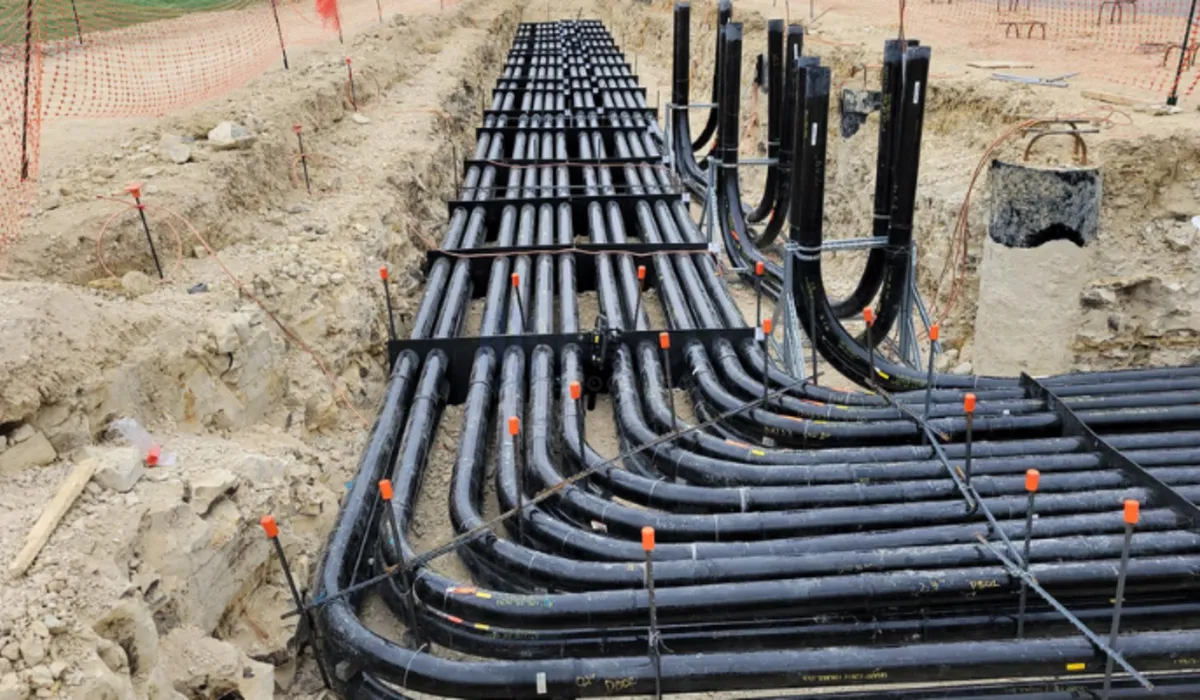
Over the past two years, Corning has specifically targeted AI data centers by maximizing fiber density without increasing conduit count.
Beyond making fibers thinner, Corning redesigned the fiber arrangement from loose “spaghetti-style” layouts to compact flat ribbons that can be rolled when not in use and unrolled when needed, then densely packed into cables. Where traditional 2-inch conduits could hold just over 1,000 fibers, Corning’s new design fits over 3,000—doubling capacity. In 4-inch conduits with six such cables laid side-by-side, over 20,000 fibers can fit—more than six times the capacity of traditional designs.
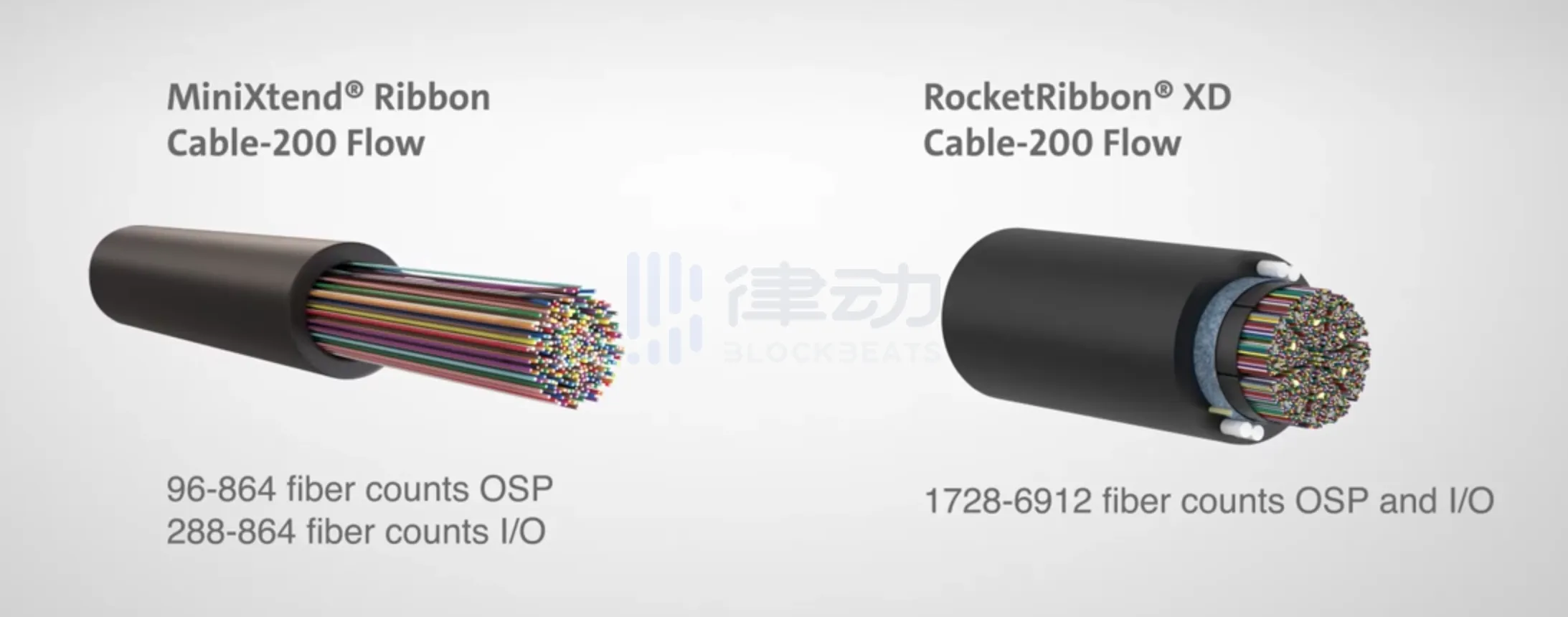
Not only does it carry more fibers, but termination is also dramatically more efficient. A 3,456-fiber cable traditionally requires over 200 labor hours to terminate individually. Corning’s ribbon design reduces this to under 40 hours, cutting cable preparation time by a third. Consider that the U.S. already faces a shortage of optical communications engineers.
In a large-scale AI factory construction project, delaying delivery by just one month results in massive GPU depreciation and delayed training tasks—costing hundreds of millions in losses. A product that saves months of time and millions in engineering costs is well worth paying 30% to 70% more for in fiber optics.
On May 8, NVIDIA CEO Jensen Huang reiterated during an interview that next-generation AI infrastructure demands vast amounts of optical connectivity—copper simply cannot meet the need. He also emphasized that NVIDIA plans to scale up optical technology applications at an unprecedented level.
Indeed, the investment details with Corning reveal this “unprecedented scale.” Of the 18 million equity warrants, 3 million are effectively “free”—a structure rare in NVIDIA’s ecosystem investments over the past year. This means NVIDIA secured significant equity exposure without using cash—more akin to a signing fee for a long-term partnership.
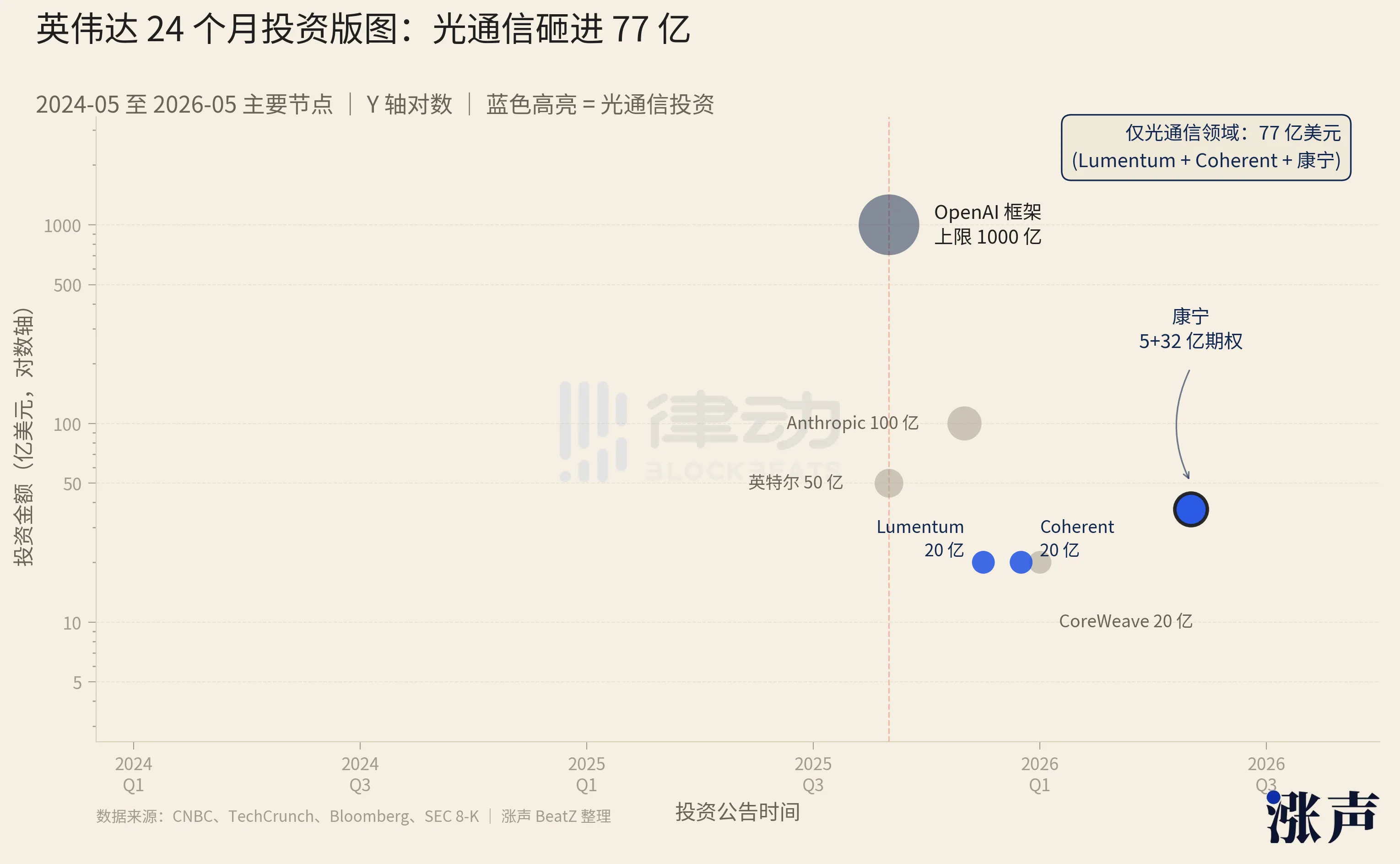
And Corning isn’t the only piece in NVIDIA’s chessboard. Since September of last year, NVIDIA has entered a new investment rhythm: larger deal sizes, and frequent use of financial instruments like “frameworks,” “options,” and “pre-funded warrants”—locking in commitments upfront and fulfilling them in tranches. Beyond its $100 billion investment framework for OpenAI, NVIDIA has made additional investments of tens to hundreds of billions in AI infrastructure players including Anthropic, Intel, and CoreWeave.
The most overlooked part is its investment in optical communications. In addition to Corning’s $500 million initial round plus $3.2 billion in options, NVIDIA also invested $200 million each in Lumentum and Coherent—two of the world’s largest optical component companies. Combined, NVIDIA has poured approximately $7.7 billion into the optical communications niche alone.
When viewed together, these investments form a complete AI factory construction blueprint: compute, network, optics, power, cooling, software, customers, models—all layers secured with at least one key supplier. At this year’s GTC conference, NVIDIA presented this full-stack integration publicly: launching the Vera Rubin DSX hardware reference architecture and the Omniverse DSX Blueprint digital twin solution. Together, these constitute essentially the “blueprint for an AI factory.”
A GW-scale (equivalent to electricity usage for 100,000 households) AI factory takes 18 to 24 months from planning to deployment, requiring coordination with over 100 suppliers. Previously, this task was handled independently by data center operators, each repeating interface validation. But NVIDIA’s Omniverse DSX systematizes this process: all partners’ products have already undergone validation within NVIDIA’s digital twin environment, parameters aligned, interfaces standardized—cloud giants can now simply buy based on NVIDIA’s blueprint.
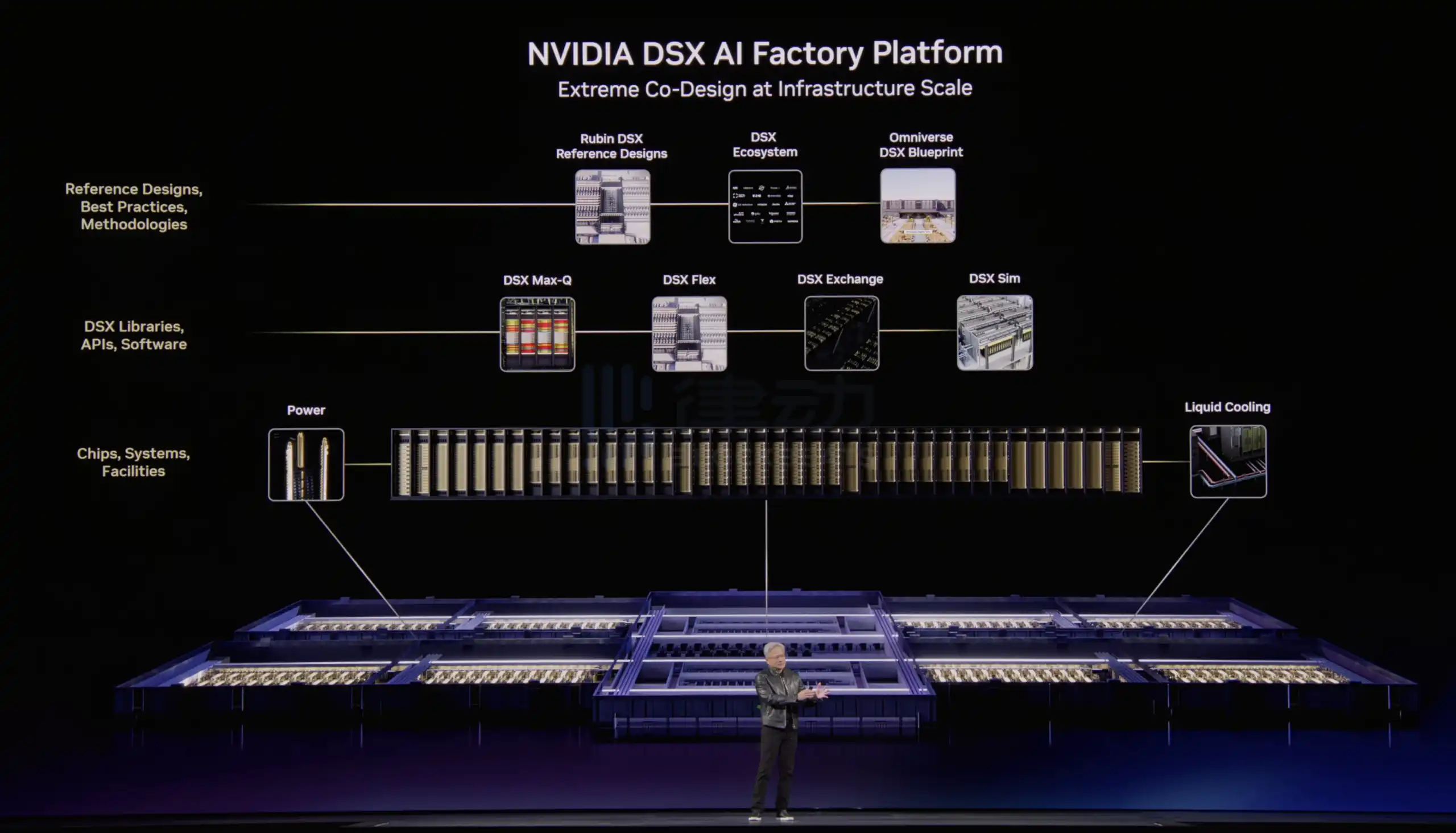
This marks NVIDIA’s critical step from a chip company to a “turnkey AI factory integrator.” Higher integration leads to expanded gross margins. Even if AMD or Broadcom launches a GPU with equivalent performance tomorrow, replicating NVIDIA’s supply chain coordination capability—from chips to fiber to grid—would take years.
Thus, NVIDIA’s $3.2 billion option granted to Corning truly signifies locking in a key player for “domestic optical communication capacity” within its AI factory blueprint. Of course, only NVIDIA today possesses the ability to draw such a blueprint.
Original Source: BlockBeats
Disclaimer: Contains third-party opinions, does not constitute financial advice
Anthropic Revenue Explodes—Why Is the AI Market Still Diving?
5 days ago
Deepseek Server Down for Nearly 4 Hours with No Recovery Yet
5 days ago
Vitalik: The zkEVM Speed Race Is Over, the Primary Focus Should Now Fully Shift to Security
5 days agoAnalyst: Market swing holders are gradually being cleared out, but panic has not yet been fully released.
5 days agoSouth Two Times Long Hynix Drops 22.04%, Two Times Samsung Drops 19.72%
5 days agoU.S. SEC Approves Cboe Listing of Binary Options Tied to Key Performance Indicators of Companies
5 days agoLITE longs suffer $7.35M liquidation, four other whales also wiped out on overnight US stock positions
5 days ago
