A Comprehensive Guide to $UORE: The V4 Hook Project That Combines Mining, Lottery, and NFT in a Single Transaction
A Comprehensive Guide to $UORE: The V4 Hook Project That Combines Mining, Lottery, and NFT in a Single Transaction


Still FOMOing yesterday's hot Ethereum on-chain project Slonk? Actually, a new narrative has arrived:
V4 Hook.
Over the past two weeks, Uniswap V4's Hook mechanism suddenly exploded in popularity. SATO leveraged Hooks to implement an on-chain bonding curve, rapidly scaling its market cap to $40M. uPEG rode the viral story of Uniswap’s scrapped name draft, achieving over $30M in value within two weeks. Slonks stuffed AI models into smart contracts to imitate CryptoPunks, generating 586 ETH in trading volume within just six days.
Although these three projects differ in gameplay, they all harness Uniswap’s V4 mechanism.
Now comes the fourth.
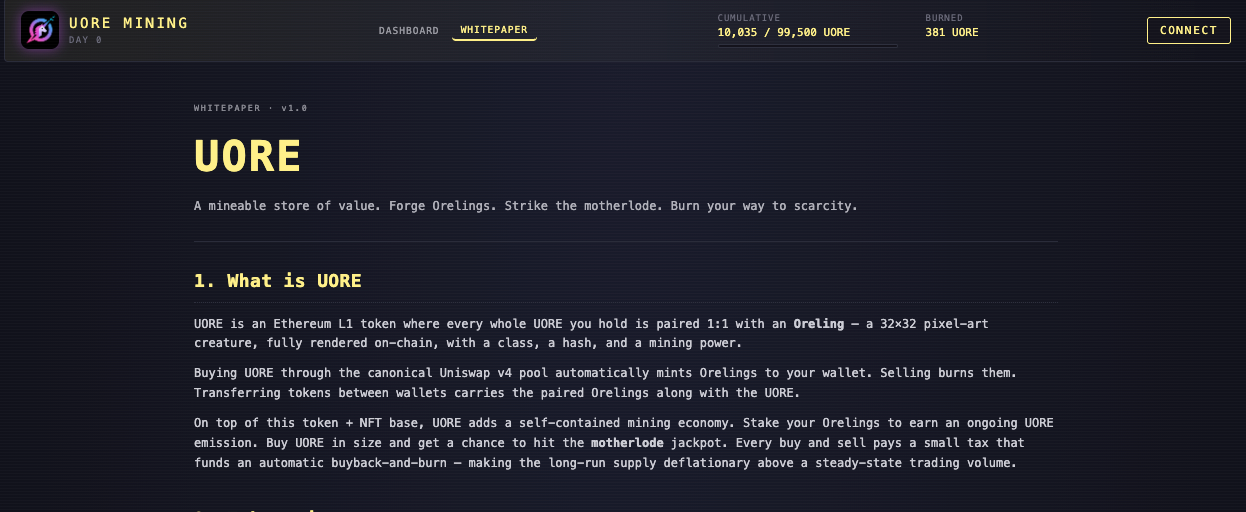
The new project is called $UORE, launched yesterday. Its core concept in one sentence: bundling on-chain mining, token purchase raffles, automatic pixel NFT generation, and deflationary burn mechanics—all into a single Uniswap V4 pool.
Because every transaction in this pool simultaneously executes all six actions behind the scenes, gas costs are two to three times higher than standard swaps...
Currently, opening CT reveals users complaining bitterly about the high gas fees.
On the token side, as of this writing, GMGN data shows $UORE surged past $1.2M in market cap within hours of launch, then quickly dropped to $440K. The pool’s liquidity sits at only $64K, yet 24-hour volume reached $1.2M—meaning funds have rotated nearly twenty times.
Yet there are only 741 holders, with total supply under 10,000 tokens.
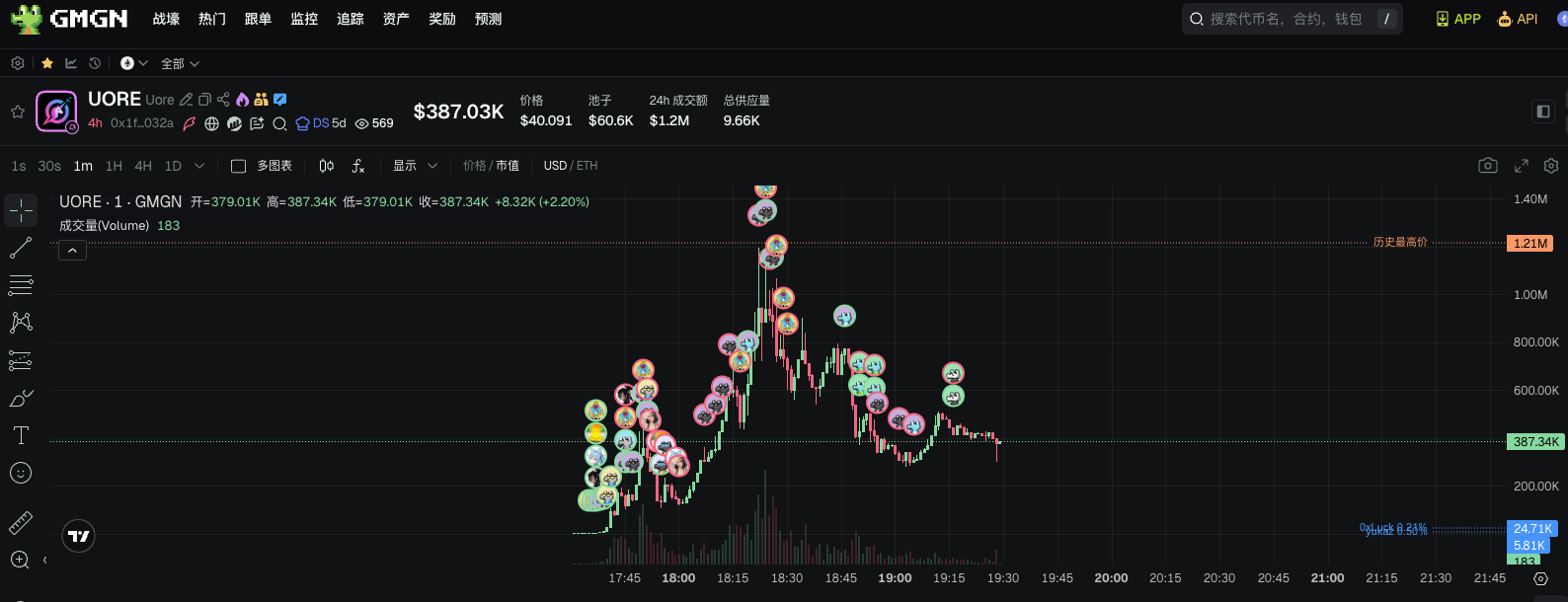
At first glance, risk is extremely high. After a quick analysis, I personally believe this is the most complex mechanism within the V4 Hook ecosystem (this round of on-chain trends consistently leans toward obscurity in mechanics…).
It functions simultaneously as a token, an NFT collectible, a staking farm, and a lottery system—and these four components aren’t independent; they’re fused together.
Four-in-One Farm
Most NFT projects treat tokens and NFTs as separate assets, bought and sold independently.
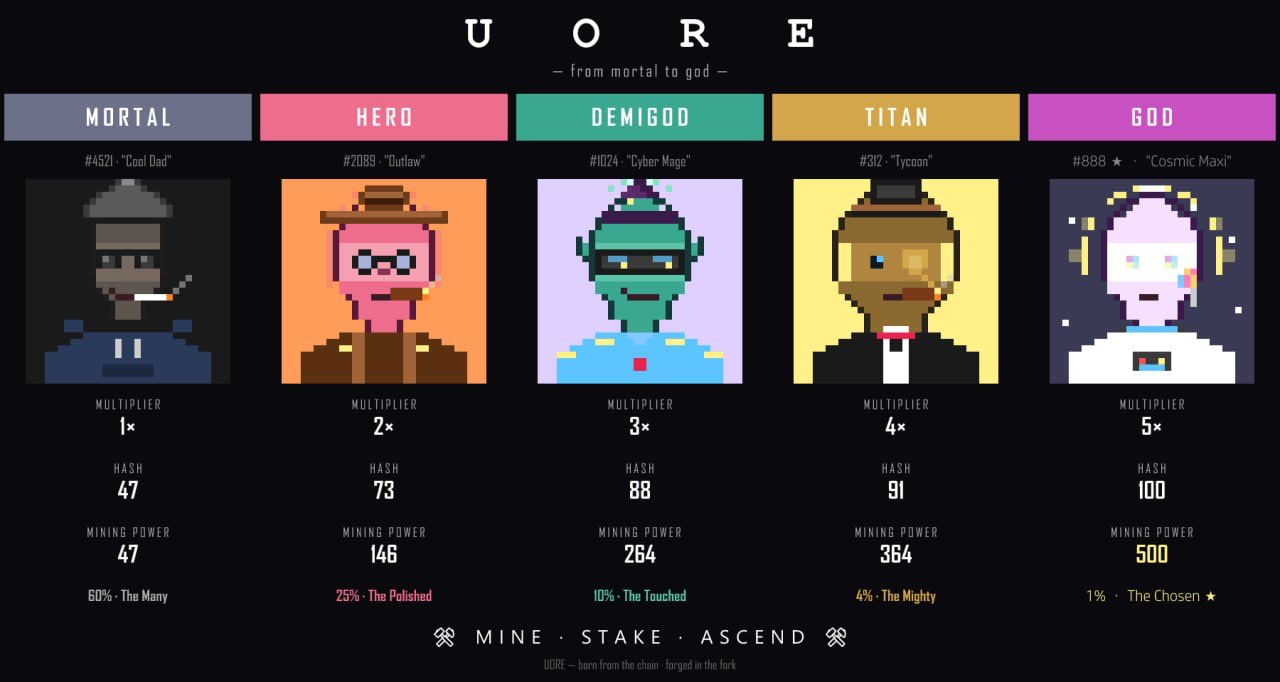
Not UORE. Its NFT is called Oreling—a 32×32 pixel miner character embedded directly into the token. Every whole UORE held in your wallet automatically corresponds to one Oreling.
When you buy, the contract mints it for you; when you sell, the contract burns it; when you transfer, the Oreling moves with it. You can’t buy an Oreling separately, nor extract it from UORE.
Each Oreling’s traits are determined by the hash of the next block at mint time. This means you don’t know what kind of miner you’ll get when purchasing—neither validators nor observers can preview the result beforehand.
The differences between Orelings go beyond aesthetics.
Each Oreling has a Class (rarity) and a Hash (a random number from 1 to 100). Their product determines Mining Power—the actual mining compute power.
The common Mortal class accounts for 60%, with a 1x multiplier; the rarest God class appears only 1% of the time, with a 5x multiplier. A lucky draw of a Hash-100 God yields 500 Mining Power—over ten times that of a regular miner.
So what’s the use of Mining Power? Classic play: staking.
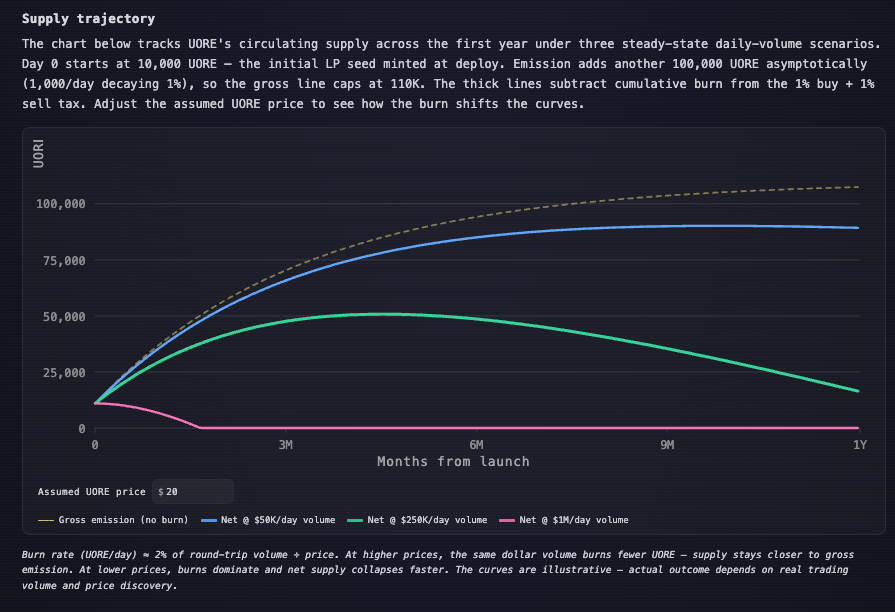
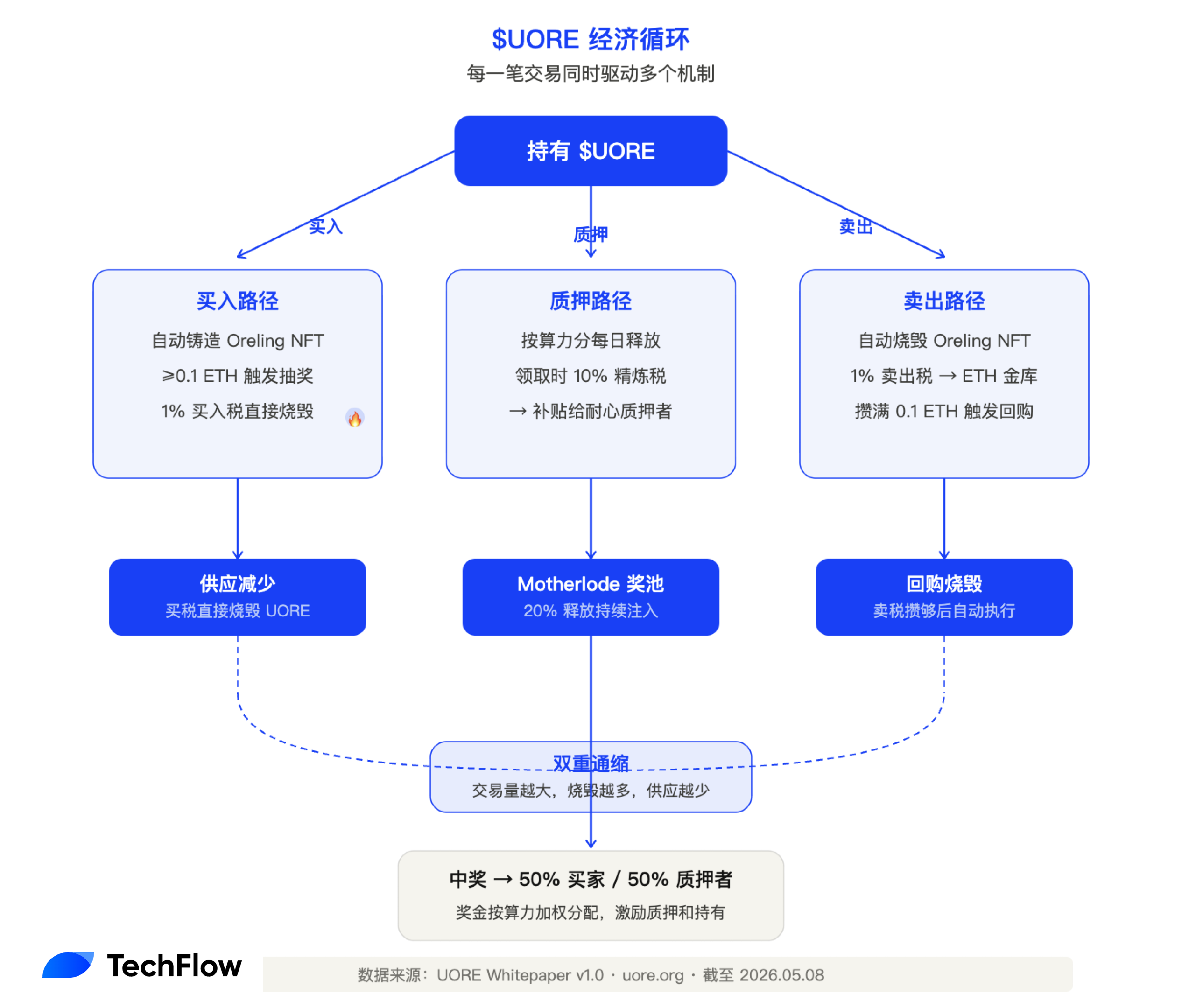
Stake your Oreling into the farm, and start earning daily UORE releases proportional to your share of total compute power. According to the official whitepaper, Day 1 releases 1,000 UORE, decaying by 1% daily—half-life approximately 69 days. 80% of emissions go to stakers, 20% to the Motherlode prize pool.
This decay rate implies that 97% of total emissions will be released within one year. The earlier you stake, the larger your slice of the pie.
A noteworthy design during reward claiming: 10% “refined tax” is deducted and redistributed to all stakers who haven’t claimed yet. The whitepaper calls this the refined-ore boost.
In plain terms: the later you claim, the more tax you receive from those who claimed early. Those eager to cash out are subsidizing patient stakers.
Then comes Motherlode—translated as "mining vein jackpot."
Every time you buy ≥0.1 ETH of UORE via official channels, you automatically receive one lottery ticket. Winning odds scale with purchase amount: ~1/600 at 0.1 ETH, ~1/200 at 0.5 ETH, capped at 1% for 1 ETH—no further increase beyond that to prevent whales from gaming odds.
If you win, the prize pool splits evenly: 50% goes directly to the buyer, 50% distributed randomly among stakers (weighted by mining power). As of this writing, only four wins have occurred historically, with the largest being 6.4 UORE.
Finally, the deflationary flywheel.
1% tax on purchases is burned immediately; 1% tax on sales goes into a buyback treasury. When the treasury reaches 0.1 ETH, anyone can trigger an automated buyback—any purchased UORE is then fully burned. As of this writing, 58 buybacks have been executed, burning 358 UORE total.
Looking across the entire design, this is a minor innovation in tokenomics, a familiar scarcity tactic, and ultimately another Ponzi-style economic model.
Project Code Is Forked, Gameplay Is Sewn Together
$UORE wasn’t built from scratch.
Community members dug into the source code and found a directory named reference/unipeg-hook-source/. The founder Noah himself didn’t hide it—he openly tweeted that UORE’s contract is forked from uPEG and includes fixes for two known issues in uPEG: duplicate NFT generation and flash loan-based rarity manipulation attacks.
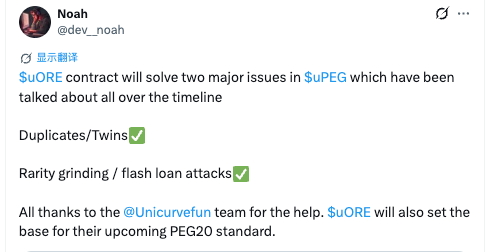
Checking the founder’s account, his bio reads “Ethereum dev & BAYC holder.” His first tweet about UORE was posted on May 2nd, stating the project combines Solana’s ORE mining logic with uPEG’s V4 Hook architecture.
He even proactively @’d Unicurvefun and Openpeg, asking whether they’d support Orelings trading after their platform launches.
From these public signals, UORE’s lineage is clear:
Solana ORE provides the “on-chain mining + raffle” gameplay template; uPEG offers the V4 Hook code skeleton. Noah improved and assembled both into a new hybrid.
Forking itself isn’t problematic. The real issue lies in:
Moreover, the whitepaper is telling: Read the contracts and understand the mechanics before deploying capital.
Translated into Chinese: “Read it thoroughly before coming in—don’t blame me if you don’t understand.”
Combining insights from previous Hook projects, we see that this wave of on-chain momentum hinges on complex mechanism design + massive information asymmetry—high alpha potential, but alpha shelf life keeps shrinking.
SATO offered a week, uPEG gave just a few days, and now with UORE, the window to understand the rules may last mere hours...
By the time you figure it out, the rally might already be over.
Original: DeepFlow TechFlow
Disclaimer: Contains third-party opinions, does not constitute financial advice
Base Ecosystem Onboarding Guide: Follow the Profit Leaderboard "Copy Work" and Catch the Next $TSG
05-22
FBI has launched a token, more trustworthy than half the projects in the crypto space
05-21
Base's Local Bull Run: What's the Ecosystem Playing With Now?
05-19
Luo Yonghao Faces Off Against CZ, Stirring Up Past Ties with the Crypto Community
05-17
Hook Narrative Redefinition: Capturing the Next Wealth-Building Opportunity
05-08
Bull Run Drives New Coin Speculation — Will the "Hook" Concept Unlock the Bull Market?
05-07
Overnight Gain of 10x Again—Is Sato a Ponzi Scheme or a New Narrative Innovation?
05-07


