Attracting global capital, a new round of "super cycle" is unfolding across Asia
Attracting global capital, a new round of "super cycle" is unfolding across Asia


Investors are turning their attention to Asia, seeking the next breakthrough in the global equity rally.
Driven by the artificial intelligence wave, South Korea’s stock market has led global gains this month, drawing massive capital inflows. Implied volatility in options markets has surged to extreme levels, prompting derivatives strategists to aggressively recommend long structures.
All these signals point to a singular conclusion: the Asian rally may have only just begun.
According to Chasing the Wind Trading Desk, Morgan Stanley’s Asia-Pacific team has recently emphasized repeatedly that the underlying drivers of the Asian industrial cycle are shifting from traditional real estate and general manufacturing inventory rebuilding toward AI and its infrastructure, energy security and energy transition, defense, and supply chain resilience investments.
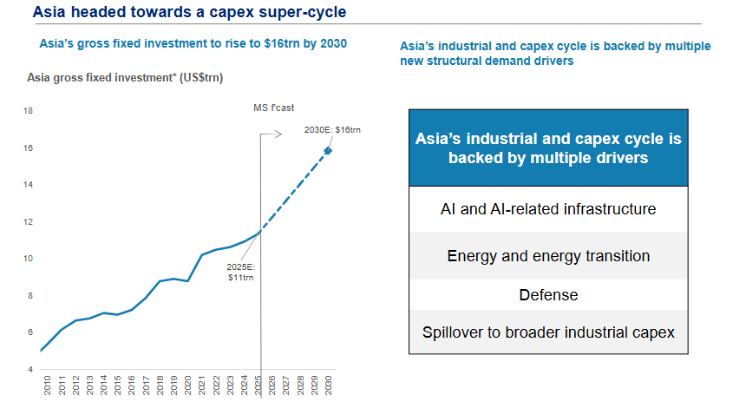
Morgan Stanley forecasts that fixed capital investment in Asia could rise from approximately $1.1 trillion in 2025 to $1.6 trillion by 2030, with a nominal annual compound growth rate of around 7% between 2026 and 2030—significantly higher than recent trends.
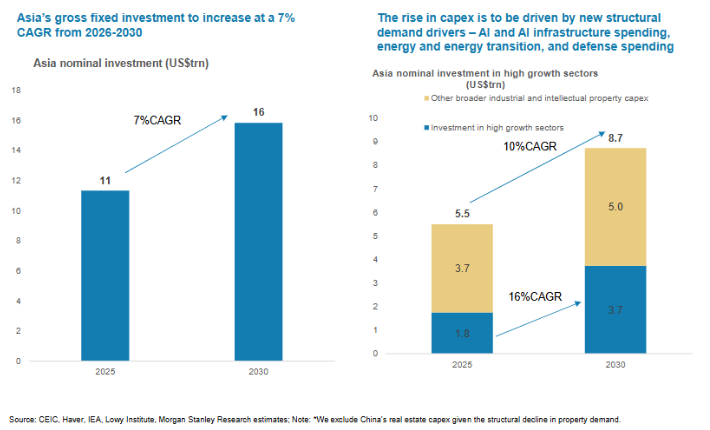
The Underlying Logic of the “Super Cycle”: Capital Expenditure in Asia to Accelerate Significantly
The most distinctive feature of this Asian industrial cycle is that AI is once again pushing capital expenditure to center stage.
Over the past two years, market discourse on AI has largely focused on models, applications, and the U.S. "Magnificent Seven." However, from an Asian perspective, AI truly means comprehensive expansion across chips, memory, servers, optical modules, data centers, power systems, and cloud infrastructure.
Morgan Stanley notes that the share of global CIOs listing AI as their top priority has risen to 39%. Correspondingly, global AI data center investment is projected to reach approximately $2.8 trillion between 2026 and 2028, growing at an annual rate of about 33%.
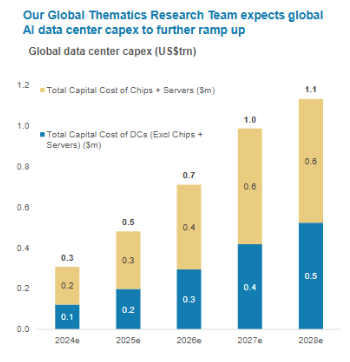
Asia sits at the heart of the AI hardware supply chain: from TSMC, Samsung, SK Hynix, to Chinese semiconductor, server, optical communications, and cloud infrastructure firms—all stand to benefit from this investment cycle.
The report also projects that major chip companies’ capital expenditures could increase from around $105 billion in 2025 to roughly $250 billion annually by 2028—indicating that AI is fundamentally a capital-intensive race.
China’s role is particularly noteworthy.
Morgan Stanley argues that China’s AI advancement represents a full-system capability competition: computational power determines speed, cloud platforms determine scale, token usage determines economic efficiency, and application scenarios determine value capture.
Amid ongoing external chip restrictions, the synergy among domestic AI chips, local cloud platforms, and large model ecosystems is becoming the new core theme in China’s tech investment landscape.
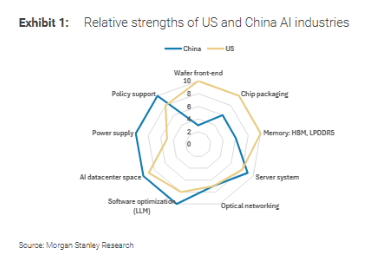
The analysis suggests that China’s AI chip market could reach $67 billion by 2030, with indigenous self-sufficiency potentially rising to 86%.
Whether this forecast fully materializes remains to be seen, but the direction is clear: domestic computing power localization has evolved from a policy-driven agenda into a commercial imperative.
The Export Story of Made-in-China Is Expanding from “New Three” to Robotics
Over the past few years, the most prominent segment of China’s export structure has been the “new three”: electric vehicles, lithium batteries, and photovoltaics.
The report suggests that the next phase of China’s manufacturing expansion may come from robotics—particularly industrial robots and humanoid robots.
Morgan Stanley notes that China has already captured about half of the global incremental demand for industrial robots. Global humanoid robot shipments in 2025 are expected to range from 13,000 to 16,000 units, with approximately 90% originating from Chinese manufacturers. By contrast, markets such as the U.S. and Japan remain largely in prototype or early validation stages.
More intriguingly, the report draws a parallel between China’s current robot exports and the EV export phase around 2019: back then, EV exports had not yet entered explosive growth, but supply chains, policy support, and manufacturing capabilities were already well-established.
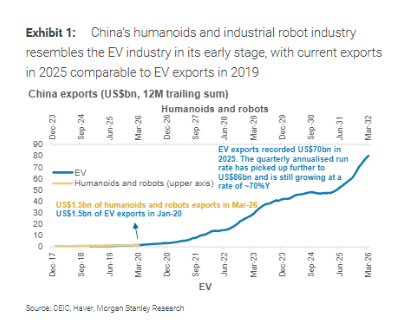
Today, the robotics industry exhibits similar characteristics—market size is still modest, but industrial chain expansion is rapid.
Data shows that China’s humanoid robot and related robot exports reached a 12-month rolling scale of approximately $1.5 billion by March 2026—comparable to the level of China’s EV exports in early 2020.
In subsequent years, EV exports expanded rapidly; by 2025, total annual exports reached around $70 billion, with quarterly annualized run rates further climbing to about $86 billion.
Naturally, whether robotics can replicate the EV trajectory depends on cost reduction, broader application deployment, and evolving overseas regulatory environments. Nevertheless, China’s advantages in components, system integration, supply chain coordination, and rapid iteration are already becoming evident.
Energy Security and Defense Spending Are Creating Second and Third Growth Engines
The other side of AI data center expansion is massive demand for power and energy infrastructure. The denser the compute capacity, the greater the importance of electricity, cooling, grid stability, and energy storage.
Morgan Stanley believes energy shocks will accelerate investment in energy security across Asia, where renewable energy still accounts for a relatively small share of primary energy consumption—indicating substantial room for future investment.
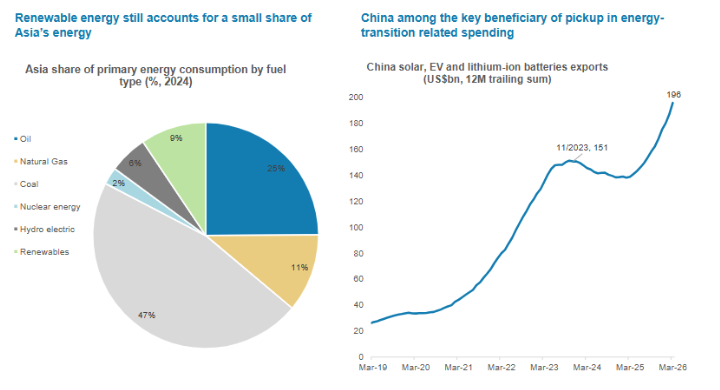
China holds strong industrial advantages in photovoltaics, EVs, and lithium batteries, with related exports now approaching a 12-month rolling scale of nearly $200 billion—making it a key beneficiary of this round of energy transition capital expenditure.
Meanwhile, defense spending is showing a structural upward trend across multiple Asian economies.
Defense budgets as a share of GDP have risen in Japan, South Korea, India, and other regions. China and South Korea remain among the world’s top ten defense exporters.
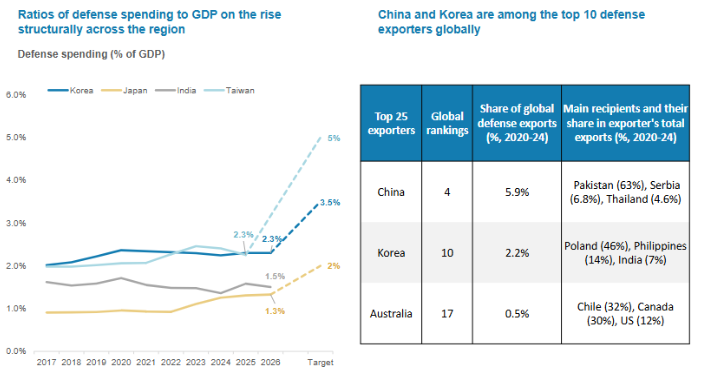
For capital markets, this implies longer-term demand support for high-end manufacturing, materials, electronic components, and precision equipment supply chains.
In short, AI drives compute demand, energy secures infrastructure constraints, and defense and supply chain resilience provide the geopolitical backdrop for “resilience investing.” Together, these three pillars form the foundation of Asia’s super cycle.
Who Benefits Most? China, South Korea, and Japan Stand at the Core of the Supply Chain
From a regional benefit sequence perspective, Morgan Stanley highlights China, South Korea, and Japan as key beneficiaries.
Mainland China excels in supply chain completeness, manufacturing scale, engineering execution capability, and emerging export categories like new energy and robotics.
South Korea holds advantages in memory, HBM, batteries, and certain equipment materials. Japan maintains deep expertise in semiconductor equipment, materials, precision manufacturing, and industrial automation.
Capital goods export shares illustrate the point clearly: Thailand (~38%), China (~36%), Japan (~35%), South Korea (~30%). This indicates that when the world enters a new equipment investment cycle, these economies will exhibit stronger external demand elasticity.
Finally, from a capital market structure standpoint, these markets have higher weights in industrial, tech hardware, and materials sectors—meaning macro-level capital expenditure cycles are more readily reflected in equity performance.
This implies that in the coming years, the pricing logic of Asian markets may shift, with investors focusing on which players along the capital expenditure chain possess orders, technological barriers, and profit flexibility.
Risks Not to Be Ignored: Overcapacity, Margins, and Geopolitical Friction
The narrative of a super cycle is highly compelling—but does not imply that all industries or all firms will benefit simultaneously.
First, the expansion of capital expenditure may lead to temporary supply pressure.
China’s new energy sector has already demonstrated that scale advantage can quickly open global markets, but it may also bring price competition and margin volatility. Industries such as robotics, AI hardware, photovoltaics, and energy storage could face similar challenges in the future.
Second, technological limitations and export controls remain key variables.
While there is vast potential for domestic AI chip development, gaps persist in advanced process nodes, HBM, EDA tools, and equipment materials. The report acknowledges that domestic chips still lag behind U.S. top-tier counterparts—but can enhance competitiveness through system optimization, advanced packaging, and software adaptation.
Third, employment structures will be impacted by AI.
In Morgan Stanley’s “Future of Work” research, it is estimated that around 90% of occupations will be affected to varying degrees by AI-driven automation and augmentation. Early AI adoption in its sample companies has already delivered over 11% productivity gains, but also accompanied a net job reduction of about 4% on average—and disparities vary significantly across countries and industries.
For China, how to advance retraining and job transitions while boosting efficiency will be a critical long-term policy and corporate management challenge.
Fourth, market volatility may intensify. The report cautions that the gap between bull and bear scenarios in regional markets is widening, meaning investor divergence regarding expectations for AI capex, export orders, and profit realization will persist.
Author: Bao Yilong, (By 2030, Asia's total fixed investment will rise to $1.6 trillion), (Between 2026 and 2030, Asia's gross fixed capital formation will maintain a 7% CAGR), (Global AI-related data center capex will further increase), (Relative strengths of AI industries in China and the U.S.), (The developmental stage of China’s humanoid and industrial robotics industries parallels the early phase of the EV industry), (Renewables still represent a small share of Asia’s energy mix, and China benefits significantly from increased spending on energy transition), (Defense spending as a share of GDP is rising across the region)
Disclaimer: Contains third-party opinions, does not constitute financial advice
NVIDIA attracts $85 billion in investor demand during massive bond issuance
06-16
Ethereum surges over 10% in 24 hours, currently priced at $1,841.31
06-16Amazon announces a multi-billion dollar investment in Missouri to build a data center campus, expected to create over 400 long-term positions
06-16Binance Platform's SpaceX Perpetual Contract Trading Volume Surpasses $9 Billion, Capturing Over 60% Market Share
06-16Binance platform XLM/USDT short-term spike down to $0.17, now recovered to $0.225
06-16
Trump: The Strait of Hormuz has been fully reopened as of Friday, and all agreements have been signed
06-16SlowMist: Aztec Connect Contract Hacked for $2.19 Million Due to ZK-Rollup L1/L2 State Boundary Vulnerability
06-15
