Workers Who Go Broke Buying AI Subscriptions
Workers Who Go Broke Buying AI Subscriptions


Being proficient with AI has become a hard requirement in the workplace.
The rule of "Token consumption counts toward KPI" has spread from giants like Alibaba and ByteDance all the way down to small startups with just dozens of employees, who now issue notices urging everyone to embrace AI.
Efficiency has marginally improved—but no one can actually quantify it. Workers’ wallets, however, have already shrunk.
Not every company is like Alibaba, which treats Token quotas as free office benefits. Most bosses care only about results, not costs. To avoid falling behind or getting phased out, employees are forced to pay out of pocket, one after another, for top-up subscriptions.
Wallets Can't Take It Anymore
It's not even halfway through April, and Long Shen’s AI tool library is already seeing another account run dry.
Long Shen is a frontend developer at a major e-commerce firm, a 2024 campus recruit and among the first generation of “AI-native” employees in his company. From day one, he experimented with using AI to assist in coding. Last year, he began paying for AI tools.
His first payment went to Cursor, the hottest AI coding tool in the developer community. The official monthly fee is $20, but annual subscription drops it to $16 per month.
That $16 doesn’t buy unlimited access—it buys a monthly reset quota pool. Cursor bills based on actual Token consumption; launching multiple long-context conversations for complex tasks can exhaust the equivalent of $16 worth of API calls within days.
The money was spent on work, yet there’s no reimbursement path. His big tech employer loudly proclaims “AI-driven productivity,” filling internal emails with grandiose talk of “intelligent transformation.” But when it comes to execution, no one ever mentions how Token quotas are allocated or how much can be reimbursed. Employees are left to foot the bill themselves.
Long Shen skillfully opens Xianyu, types “Cursor” into the search bar, and instantly sees a list of listings: “white accounts,” “quick-refreshed finished accounts,” “dedicated accounts.” Like an underground exchange, he clicks a link—the seller replies instantly: “brand-new dedicated account, refund proportionally if banned within 30 days.”
Beneath these links lie gray-market shared accounts or suspiciously sourced top-up credits. Long Shen occasionally wonders: could this account have been funded by stolen foreign credit cards?
He hasn’t considered buying directly from the official site. But when work gets busy, Token consumption flows like water. To ensure output, his “tool arsenal” extends far beyond Cursor. ChatGPT Plus, Midjourney, various APIs—monthly spending routinely exceeds a thousand yuan, peaking at 2,000 yuan in one month.
Paying for work, so save wherever possible. After some hesitation, Long Shen still risks account bans and clicks “Buy.”
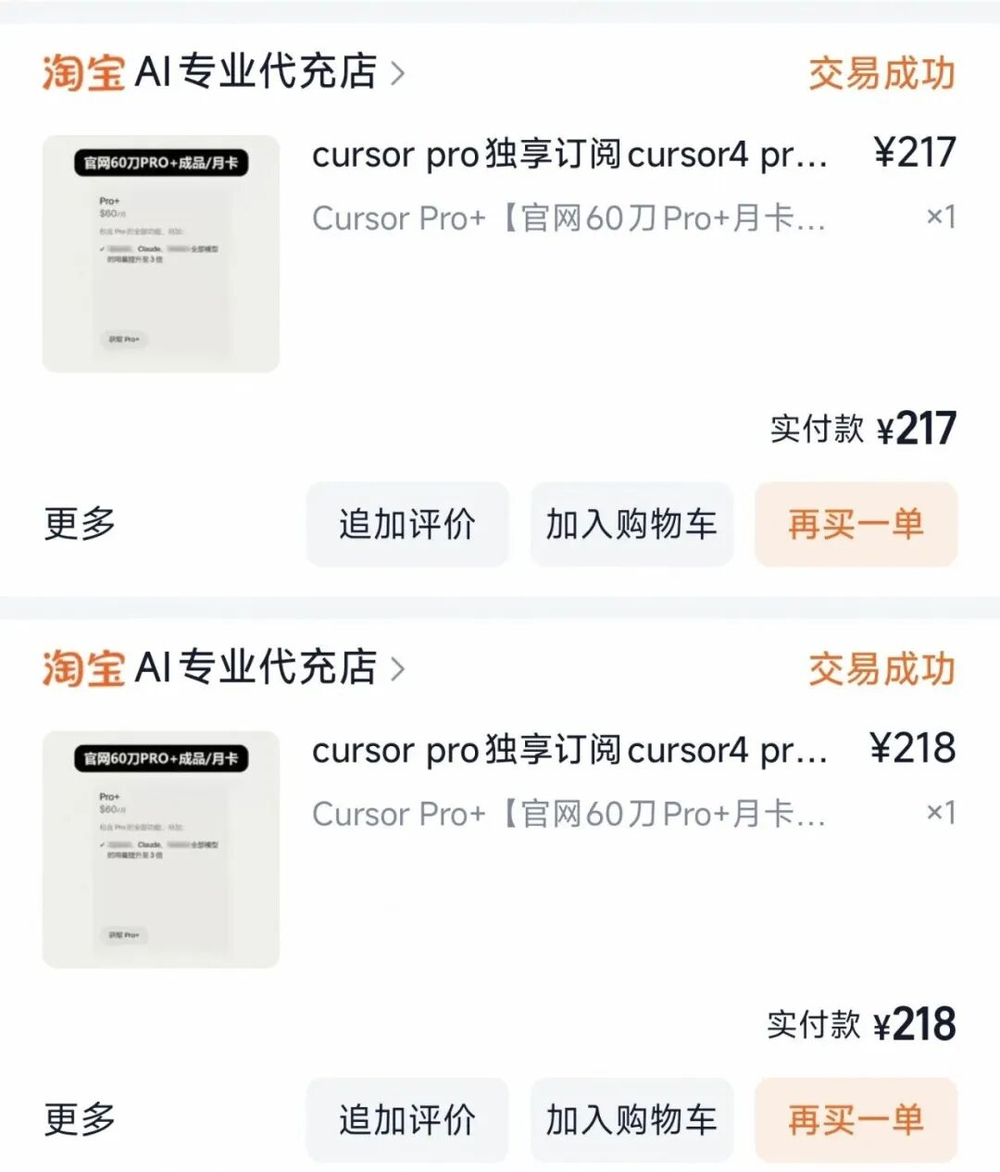
The cost stings, but he’s done the math in his head: spending an extra 1,000 yuan a month—only around 3% of his salary—enables him to complete 80% to 90% of his coding tasks. The ROI is undeniable.
After paying, Long Shen’s workflow completely transformed. He took on a graphics-related project—high barrier for most frontend engineers, rarely touched in daily practice. Starting nearly from zero, he didn’t bother explaining to his manager; instead, he dove straight into AI-assisted development for three months.
“My boss doesn’t read code—he only cares whether the page runs and features work.” The project launched successfully, earning Long Shen managerial approval. Only afterward did he slowly fill in the missing foundational knowledge.
The company does offer a free internal coding tool. He tried it briefly but found it clunky. The tool only integrates domestic models, lacking core capabilities of the most advanced systems—every interaction feels constrained. After a few weeks, he gave up and resumed self-funding external tools.
He even tried promoting Cursor within his department. But once colleagues exhausted their free quotas, no one wanted to keep paying.
A colleague nearing 40 only rushed to him last year when the company mandated all-in AI adoption: “How do you use this thing? Teach me.”
Not everyone willingly spends like Long Shen.
“Sometimes I really think life would’ve been better without AI,” Pei Pei mutters while calculating her recharge amounts, navigating between corporate AI bans and her boss’s demands.
She works in design at an auto manufacturer’s R&D department, where confidentiality rules are extremely strict. All external AI websites are blocked outright—accessing them from work computers triggers a “connection failed” error.
Last August, everything changed after her boss discovered ChatGPT. Once exposed to AI-generated images, he dismissed any material downloaded from Pinterest or Instagram as “secondhand”—already widely circulated online, prone to duplication.
He believed AI-generated visuals carried a futuristic edge, perfectly matching the need for bold, eye-catching designs. In meetings, he’d directly demand AI outputs, speaking as if it were a trivial task requiring just a finger tap.
Caught in the middle, Pei Pei had to log into AI platforms via personal devices, save generated images, send them to her personal email, then transfer them to her company computer for editing. This convoluted process was time-consuming and inefficient—yet she had no alternative.
She gradually subscribed to Midjourney, Jimo, and Keling, learning each tool’s quirks. Her go-to tools are Douba and Midjourney: Douba is free and easy to use, ideal for basic color changes and adjustments, though its aesthetic tends to be flat; Midjourney delivers high-quality visuals perfect for premium mockups, but it’s notoriously difficult to control—adjusting a single detail often ruins the entire image.
One month, she spent hundreds of yuan across multiple accounts. She tried requesting reimbursement, only to hear: “No budget for that.”
She pays out of pocket, but the workload keeps growing. After tasting the benefits of AI-generated images, her boss’s appetite expanded. Previously, a design revision allowed two-day buffer time; now, he expects double the efficiency because AI is used. Today’s request must yield new versions by tomorrow morning. One batch of ten images becomes twenty.
“But humans aren’t AI, nor machines,” Pei Pei complains aloud, though deep down she knows: her boss only judges outcomes, not effort—and certainly doesn’t care how much money she’s spent behind the scenes.
Sometimes she thinks: Edison invented the light bulb, yet people didn’t enjoy easier nights—they just gained more nighttime work.
Once, her boss asked for a specific material effect. She fed the prompt repeatedly into AI, generating over thirty images, none fully meeting requirements.
Finally, she shut off AI, opened Photoshop, manually pieced together and color-corrected fragments from several images. After over two hours of meticulous work, she dared submit the final version.
The Membership Assassin Disrupts the Workplace
Li Huahua has recently become increasingly paranoid.
At first, AI’s arrival didn’t pressure her. As a programmer at a state-owned enterprise, her company enforces strict confidentiality rules restricting external tools. She treated AI as someone else’s problem—unrelated to her.
Until recently, during a late-night call, a friend vented. Working at a private firm, he secretly activated an AI membership to boost efficiency. After delivering results, he proudly reported to his boss—only to have his performance targets raised immediately. Now everyone must do the work of two people.
Listening to her friend’s gripe, Li Huahua fell silent. Finally, she blurted: “Aren’t you exactly the kind of ‘code traitor’ people warn about online? Just chasing personal glory and dragging down your whole team?”
Her friend snapped back: “Then why don’t you start using it too?”
After hanging up, she couldn’t sleep. The next day, she spent an entire day researching how to top up Codex membership.
But after subscribing, she felt even more anxious. Her friend’s experience acted like a mirror: using AI for efficiency might not be beneficial at all. Maybe one day, she’d be used as a case study for “productivity gains”—and then her KPIs would be raised, possibly leading to staff cuts. And recently, due to strained relations with her supervisor, she’d received low performance ratings for two consecutive months.
“When not using AI, fear being left behind. When using it, fear everyone else is using it too. Constantly feel threatened, but can’t pinpoint where the threat truly lies.”

Since then, she’s started subtly observing her colleagues. Any sudden increase in work pace makes her suspect: “Has this person secretly bought an AI membership too?” She never asks—nor would anyone answer honestly.
Li Huahua fears layoffs. Meanwhile, Long Shen’s company is aggressively hiring AI talent this year.
Long Shen once briefly participated in recruitment, receiving resumes until he was overwhelmed. The company explicitly required candidates to have real AI project experience and proven deployments. Yet those sitting in interview panels were veteran engineers with 15–20 years of experience—whose entire understanding of AI might boil down to letting their kids chat with Douba about Ultraman.
After AI-driven efficiency, Long Shen gained more time for reflection—but realized the company was letting outsiders guide insiders.
For management, this isn’t an issue. They hold grand meetings and presentations, breaking down KPIs layer by layer, forcing engineers below to experiment, produce, and report—all while they themselves needn’t learn or pay for memberships.
“They treat us like Agents,” Long Shen sighs. “Just issue commands and consume our labor—without doing anything themselves.”
AI indeed saved him time—but that time turned into invisible labor: performing diligence.
Now he finishes his full day’s work in under an hour. To avoid drawing attention and triggering new tasks, he sits at his desk pretending to be busy. Company PCs are monitored—he dares not even connect to freelance gigs. Often idle, yet unable to leave.
This emptiness weighs heavily. His mind wanders uncontrollably: Should he invest in stocks? Buy gold? Will he just keep working until he’s replaced at 35?
He knows the AI boom is rapidly fading. In 2024, he could still leverage AI to stand out and earn recognition. By 2026, when everyone uses AI, individual advantage will vanish.
Like school: when everyone takes tutoring, efficiency rises, homework increases—but no one gets to go home earlier.
In another major tech firm, programmer Zhang Mu finds himself trapped in a “AI-induced promotion trap” by his boss.
One day, the department head suddenly dropped a leaderboard showing March’s Token consumption in the work group, declaring: “Promotion, KPI, and advancement will all reference Token usage. Low users may be replaced.”
Zhang Mu inexplicably landed at the top. The boss publicly praised him and asked him to share his efficient AI usage strategy post-holiday. Instantly, he panicked: over half his Token usage was actually spent on organizing personal data, taking notes—tasks unrelated to work.
This put him on the spot. Forced to prepare a presentation, he dared not reveal his true, highly effective methods—those insights took weeks to refine. “I constantly feel closer to replacement. If I share them, my competitive edge vanishes.”
This pressure is spreading beyond companies into the entire industry. Previously, people could barely cope using free tools like Douba and Kimi—chatting, editing materials, managing daily tasks.
But that safety net is narrowing fast. Kimi started charging in September last year, starting at 39 yuan/month; Douba launched paid tiers on the App Store this May—Standard: 68 yuan, Enhanced: 200 yuan, Professional: 500 yuan.
The era of “free assistant” is ending visibly. To use AI, you must pay.
Can’t Stop Now
Before starting his own business, Jin Tu never imagined he’d spend so much on AI.
With years of experience in brand marketing content, like most, he used Douba and Kimi for chatting, rewriting copy, and gathering research—enough to handle daily work.
Then one day, he saw a friend conversing with AI inside a code editor—realizing AI could directly generate documents locally, saving revisions without endless back-and-forth copying and pasting in chat windows.
After trying it, he unlocked a new world.
From then on, he began using AI for deeper creative and systematic tasks. He wanted to organize all his past public account articles into a knowledge base fed to AI. But WeChat’s anti-scraping measures made direct extraction impossible. He described the need to Codex, who delivered a custom browser extension in just 2 minutes and 25 seconds. Open any article, click the plugin, and export it instantly as a local MD file.
Later, he built a personal knowledge workflow. Randomly saved tweets, excerpts, long-form insights—all dumped in, and AI automatically structured them into coherent notes, adding his own analysis and commentary.
What shocked him most was that his personal website was entirely built from scratch by AI—no line of code written by him. The site has now undergone 577 iterations and received thousands of visits. Each update requires only one sentence: “Good, proceed.” AI then autonomously checks, modifies, commits, and generates a detailed run log.

Through this website, Jin Tu placed well in an AI startup competition and secured government-backed entrepreneurial support resources.
To maintain this entire toolchain, he spends significantly each month on AI memberships—but believes it’s worth every penny. He quotes an AI entrepreneur: “Paying $200/month for Claude’s top-tier membership is like hiring a $1M/year developer for your team.”
“Only after paying can you truly access real AI.” In his view, most people unwilling to pay only experience stripped-down, discounted versions. Using “true AI” is like buying a luxury bag—it feels different from a regular one, though you can’t quite articulate why.
Currently, he’s already planning his next move. Soon, he’ll head to Hangzhou to launch his venture.
Pei Pei still recharges her AI memberships periodically.
Her boss specifically praised her growing proficiency with AI, asking her to keep it up. But she feels uneasy. Half the creations generated by AI aren’t truly hers. The inspiration is hers—but the credit for the final image easily goes to AI. For designers, the validation of having a proposal selected is crucial.
Does her boss truly value her ideas—or AI’s?
She remains unsure.
Li Huahua’s “tense heart” has finally settled.
Even her department’s near-50-year-old leader has recently started preaching AI efficiency in meetings. Though no one has yet said “one person must do two people’s work,” Li Huahua knows that direction is inevitable. Now, she quietly activates her membership every day, secretly using it, waiting for that moment to arrive.
Long Shen still buys accounts on Xianyu. With AI’s help, he’s been promoted three times in just one and a half years, earned an A-level performance rating last year, and received nine months’ bonus.
This is AI’s real power: it slowly offers sweet rewards, gradually eroding your work rhythm, making you willingly hand over money—and grow dependent.
After writing tens of thousands of lines of code with AI assistance, Long Shen realizes he can’t live without it.
“I can’t possibly review all the tens of thousands of lines AI wrote before taking over. Once this cycle starts, it’s nearly impossible to exit.”
What he faces now isn’t just the question of paying or not—it’s a technological dependency. Maintaining work can only continue relying on AI. The cost of stopping far exceeds the cost of continuing to pay.
Author: Tian Mi | Images | Long Shen’s partial payment records | Image | Li Huahua, after using AI, always feels under threat | Image | Website designed by Jin Tu using AI
Disclaimer: Contains third-party opinions, does not constitute financial advice
Sei has disabled IBC asset inbound functionality, and the network is gradually transitioning to a pure EVM architecture
1 hour ago
Bitcoin breaks below $80,000
1 hour agoCleanSpark stock drops over 12%, market cap falls to $3.219 billion
1 hour agoPrivacy may become the next 'killer application' for the crypto industry, with Arc, Canton, and Tempo collectively raising over $1 billion in funding
1 hour agoMicron Technology's decline widened to as much as 10%, after a 147% rally over the previous 29 trading days.
1 hour agoThe U.S. Senate has secured sufficient votes to confirm Wash as a member of the Federal Reserve Board
1 hour agoU.S. Energy Information Administration lowers its oil price forecasts for this year for both U.S. and Brent crude
2 hours ago