Clarity Act Clears Senate Committee, Market Begins to Reflect Positive Impacts
Clarity Act Clears Senate Committee, Market Begins to Reflect Positive Impacts


Original | Odaily Star Daily (@OdailyChina)
Author | jk
The U.S. Senate Banking Committee passed the Digital Asset Market Clarity Act (CLARITY Act) in a committee vote on May 14 local time, with a 15-to-9 result, advancing the bill to full Senate floor consideration.
The vote largely followed party lines: all Republican committee members voted in favor, while two Democratic senators broke ranks to support the measure—Ruben Gallego of Arizona and Angela Alsobrooks of Maryland.
Notably, Alsobrooks stated after the vote that her yes vote was "a commitment to continue working in good faith," and explicitly affirmed she would not support the bill in full Senate voting until key issues are resolved.
Committee Chair Senator Tim Scott, a Republican, secured this bipartisan outcome through procedural maneuvering as the hearing concluded. The extended hearing featured intense partisan debate over multiple amendments, with several Democratic-proposed amendments blocked or procedurally dismissed.
What is the CLARITY Act? A Plain-Language Explanation:
In simple terms, the CLARITY Act seeks to answer a long-standing core question for the U.S. crypto industry: Who should regulate digital assets like Bitcoin and Ethereum?
Currently, the U.S. Securities and Exchange Commission (SEC) and the Commodity Futures Trading Commission (CFTC) have long operated under ambiguous jurisdictional boundaries, leading to regulatory overlap and conflict. This uncertainty has left businesses paralyzed and investors without adequate protection.
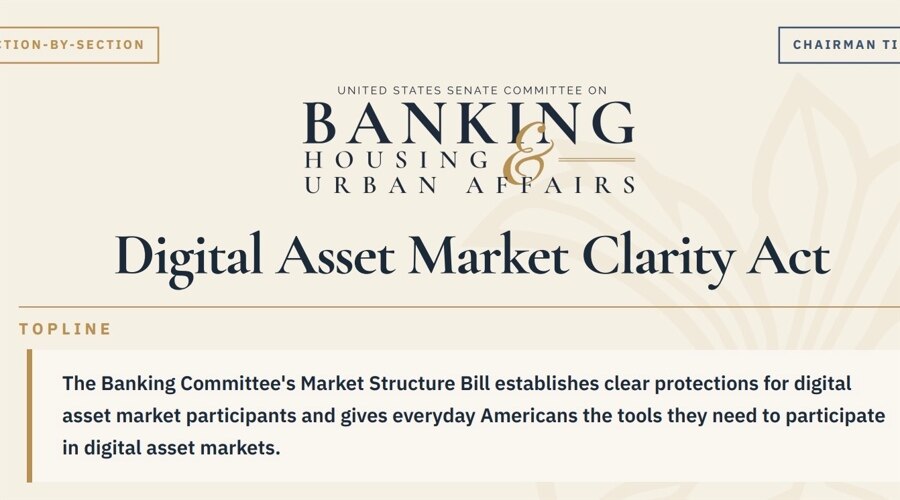
The core logic of the CLARITY Act is to clearly classify digital assets as either “securities” or “commodities,” assigning them to SEC or CFTC oversight respectively, thereby establishing a clear federal regulatory framework. It represents the first comprehensive legislative attempt targeting the crypto industry in U.S. history, spanning 309 pages.
The bill also addresses several critical issues:
Stablecoin Yield Rules: In the past, some platforms allowed users to earn interest-like returns simply by holding stablecoins—resembling bank deposit yields—which triggered strong pushback from traditional banking. The latest version of the bill prohibits paying interest on “passive” stablecoin holdings, but allows earnings generated through active behaviors such as trading, transferring, or staking. This distinction aims to prevent direct competition with bank deposits while recognizing legitimate market participation rewards.
Regulatory Standards for DeFi Platforms: Since DeFi lacks traditional corporate entities or centralized managers, regulators have struggled to identify enforceable parties. The CLARITY Act attempts to establish rules requiring relevant platforms to comply with anti-money laundering (AML) obligations, monitor suspicious transactions, conduct user identity verification, and adhere to sanctions imposed by the U.S. Department of the Treasury’s Office of Foreign Assets Control (OFAC).
Legal Protection for Software Developers: This clause addresses a real-world dilemma: developers have previously faced regulatory scrutiny merely for writing open-source code, even when their protocols were exploited by bad actors. The bill explicitly states that if illegal activities are carried out using a protocol, liability should not automatically fall on the software developer unless they personally participated in wrongdoing. This provision is widely seen as essential to encouraging compliant innovation and preventing “collateralized enforcement.”
What Are the Core Tensions Between Traditional Banking and Crypto?
This has been one of the central contradictions behind the bill’s prolonged stagnation over recent months.
Banks fear that allowing stablecoins to pay interest akin to savings accounts will directly compete with deposits, triggering massive capital flight and weakening banks’ ability to lend to the real economy. Major banking groups, including the American Bankers Association, jointly issued statements demanding stricter limits on stablecoin yield mechanisms.
Crypto advocates argue that excessive restrictions on stablecoin yields would stifle innovation and put the U.S. at a disadvantage in global digital finance competition.
The final compromise: the latest version of the bill (May 11 draft) bans interest-like returns on “passively held” stablecoins, but permits earnings from active use cases such as trading, transfers, and staking. This distinction is viewed as a balanced middle ground, though banks have signaled they will continue pushing for tighter regulations.
Where Is the Bill Headed Next?
Passage through the committee is just one milestone in a long legislative journey; several hurdles remain:
First: Committee Version Consolidation. The Senate Banking Committee and the Senate Agriculture Committee each have separate drafts. These must be merged into a unified text before further progress can be made.
Second: Full Senate Vote. The consolidated bill must first pass the 60-vote threshold to end debate (cloture motion), then secure a simple majority for passage. This means Republicans must win support from at least nine Democratic senators—the key leverage points being the ethics provisions and law enforcement enforcement issues still unresolved.
Third: House-Senate Coordination. The House had already passed its own version in July 2025 by a 294-to-134 vote, but differences remain between the two chambers. Both houses must reconcile their versions into a single text, which will then require approval by both chambers.
Fourth: Presidential Signature. Former President Trump is widely expected to sign the bill into law. White House advisor Patrick Wit previously stated the signing could occur around Independence Day (July 4), though this timeline remains extremely tight.
The crypto industry's goal is to complete the entire legislative process before the November midterm elections, as congressional attention will shift entirely toward campaigning, potentially closing the legislative window permanently.
Two Key Uncertainties
1. Government Ethics Provisions
The bill includes provisions restricting government officials from holding or profiting from digital assets—widely perceived as implicitly targeting Donald Trump, who held and promoted multiple crypto projects during his presidency. Democrats view this as a prerequisite for supporting the bill, while Republicans remain ambiguous. Cody Carbone, head of the Digital Chamber, said this deal is likely to be finalized before the bill reaches full Senate floor vote.
2. Law Enforcement and Anti-Money Laundering
Senators like Elizabeth Warren maintain that the bill does not go far enough in addressing illicit financial activity within DeFi platforms. Related amendments were defeated 11 to 13 today in committee voting, ensuring this issue will remain a central point of negotiation.
Market Reaction
Following the announcement of the bill’s committee passage, the crypto market reacted positively with a notable rebound. Coinbase (COIN) rose more than 10% intraday, while Bitcoin (BTC) gained approximately 2.4%.
Industry institutions offered generally favorable responses. Ripple CEO Brad Garlinghouse stated: “If the world’s largest economy is going to lead in crypto—it must. This is that moment.” Dante Disparte, Chief Strategy Officer at Circle, called the vote “a meaningful bipartisan step forward toward comprehensive digital asset regulation.”
For the broader crypto industry, the CLARITY Act carries significance akin to a “crowning of legitimacy.” For years, ambiguous regulatory classifications and inconsistent enforcement by U.S. agencies have kept institutional capital on the sidelines. Once enacted, clear delineation of SEC and CFTC jurisdictions will make compliance costs predictable, removing the primary barrier for institutional entry.
This also marks a clear strategic signal from the U.S. in the global race for digital asset regulation. The EU passed MiCA in 2023, while Hong Kong, Singapore, and Dubai have each established robust regulatory frameworks—U.S. regulatory inertia has enabled competitors to gain an edge.
Naturally, the bill still faces a long road ahead. Today’s committee vote is an important beginning.
Author: jk
Source: Odaily Star Daily
Disclaimer: Contains third-party opinions, does not constitute financial advice
NVIDIA attracts $85 billion in investor demand during massive bond issuance
06-16
Ethereum surges over 10% in 24 hours, currently priced at $1,841.31
06-16Amazon announces a multi-billion dollar investment in Missouri to build a data center campus, expected to create over 400 long-term positions
06-16Binance Platform's SpaceX Perpetual Contract Trading Volume Surpasses $9 Billion, Capturing Over 60% Market Share
06-16Binance platform XLM/USDT short-term spike down to $0.17, now recovered to $0.225
06-16
Trump: The Strait of Hormuz has been fully reopened as of Friday, and all agreements have been signed
06-16SlowMist: Aztec Connect Contract Hacked for $2.19 Million Due to ZK-Rollup L1/L2 State Boundary Vulnerability
06-15
