OpenAI's Century-Long Lawsuit, Musk Loses
OpenAI's Century-Long Lawsuit, Musk Loses


Just moments ago, the Silicon Valley trial of the century came to its dramatic conclusion!
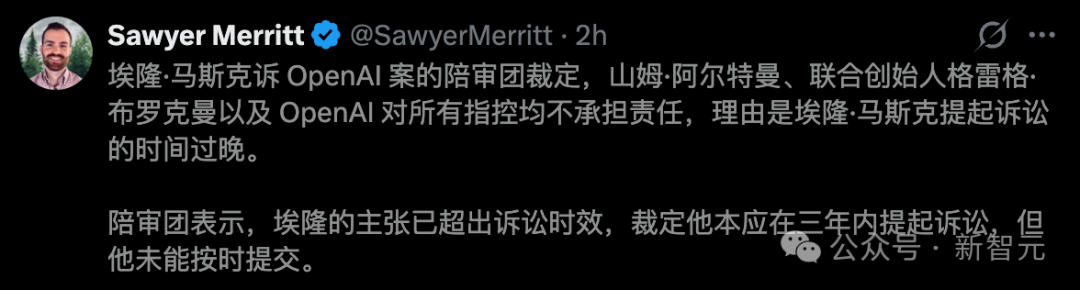
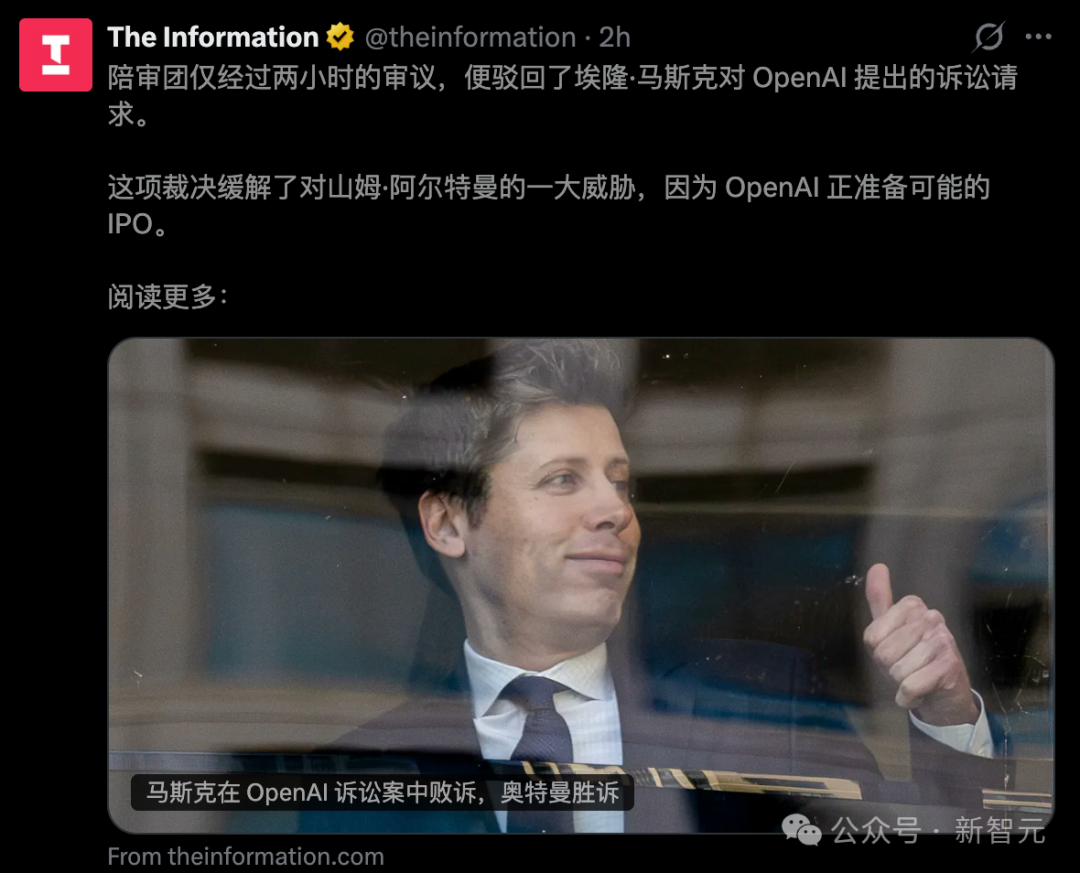
The $150 billion lawsuit filed by Musk against OpenAI was unanimously dismissed by the jury in under two hours.
All allegations were rejected without exception.
The sole reason for the collapse of this legal battle? Musk sued too late—the statute of limitations has expired...
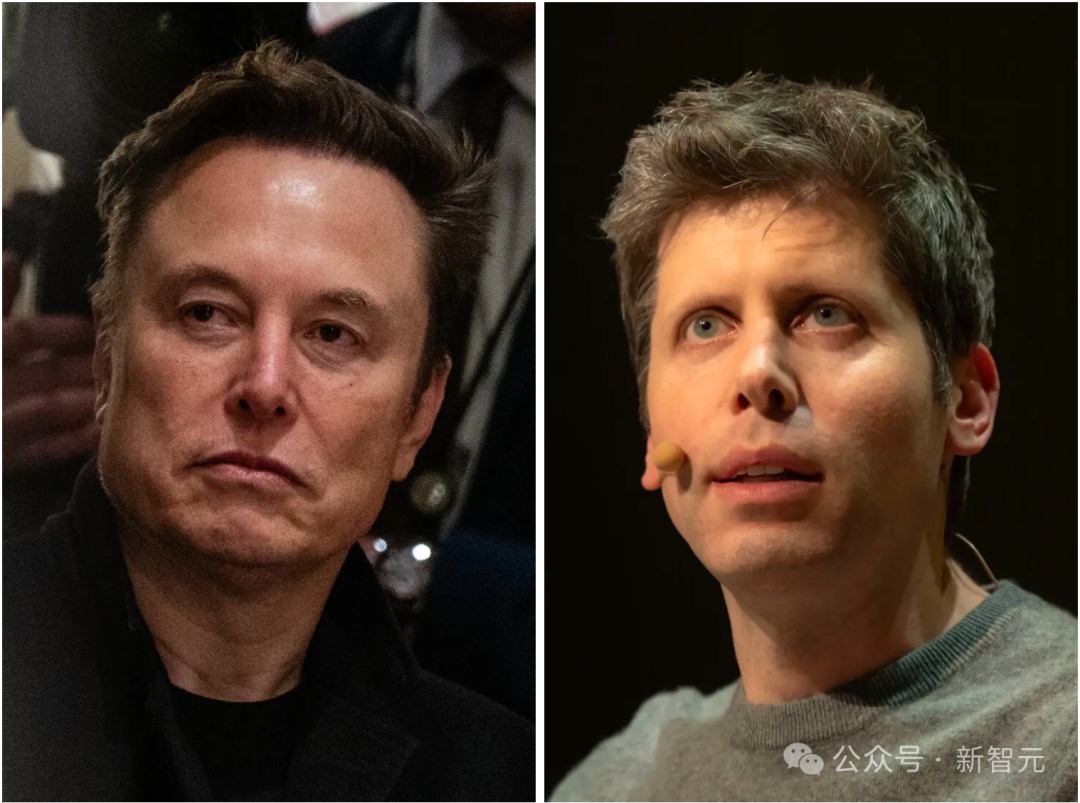
This may be the most absurd courtroom scene of 2026.
Before this, it had been an epic, high-stakes showdown—
Three weeks of trial, 11 days of testimony, dozens of top-tier Silicon Valley executives taking the stand, hundreds of pages of private emails, texts, and diaries laid bare.
Yet, as everyone held their breath, the jury delivered a swift and decisive verdict.
Judge Yvonne Gonzalez Rogers publicly affirmed her full agreement with the jury’s conclusion.
Upon the ruling’s announcement, the internet erupted. Countless netizens expressed bewilderment: Was the three-week spectacle merely a farce?
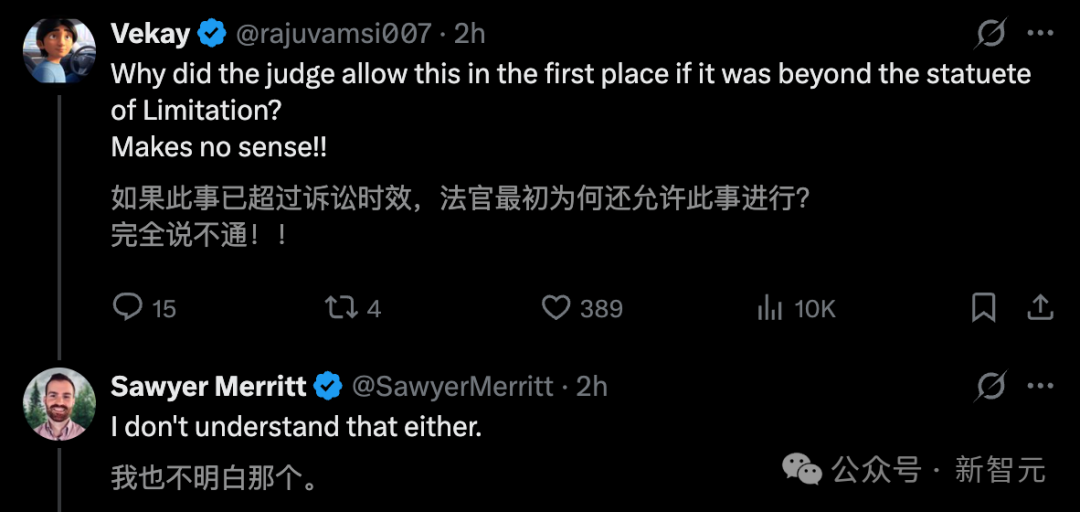
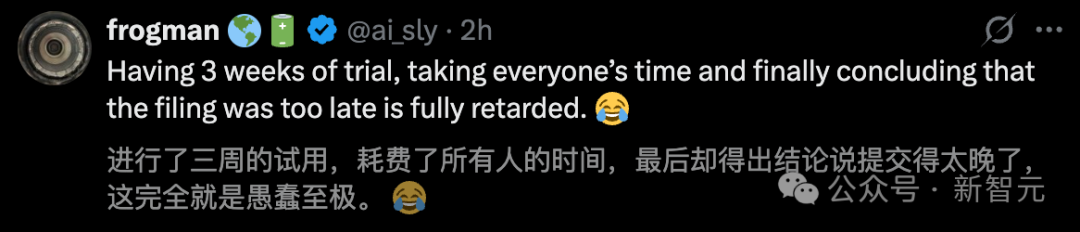
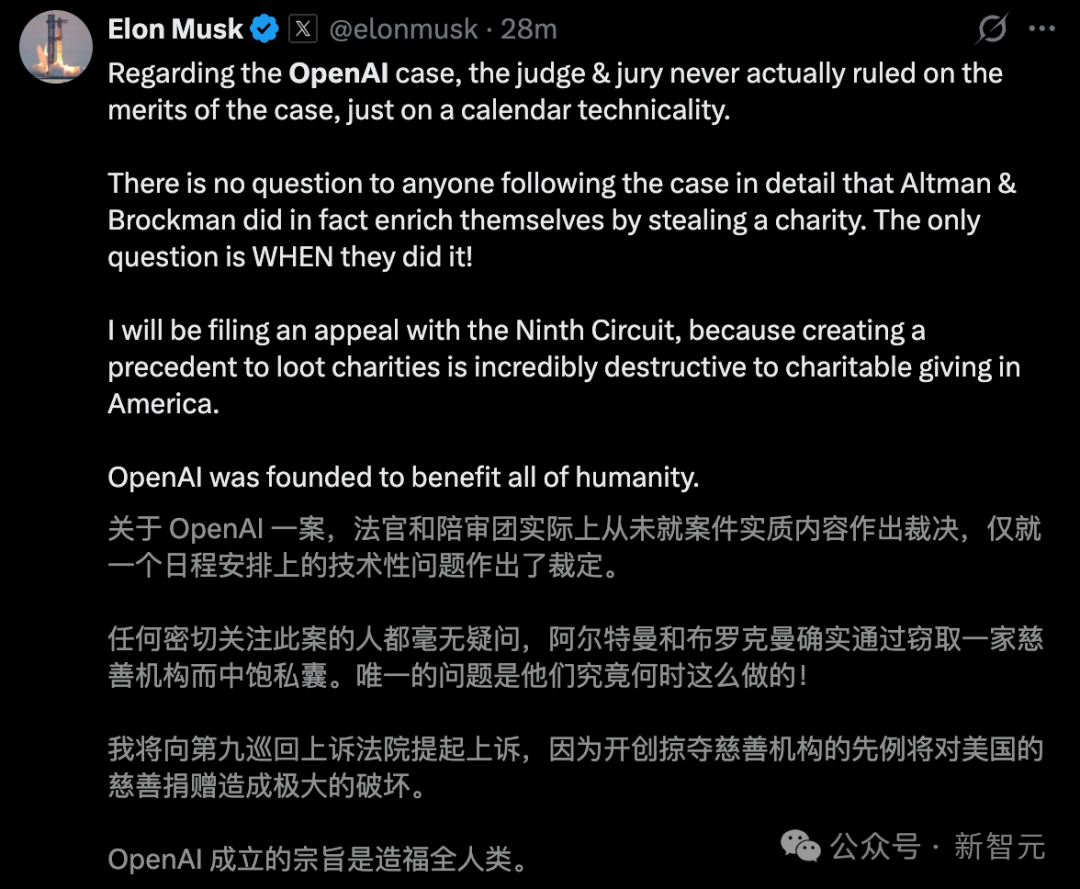
In response, a visibly frustrated Musk posted again—
Next step: appeal.
OpenAI’s Century-Long Lawsuit: None of the Three Men Showed Up
At 8:30 AM Monday, the jury began closed-door deliberations.
At 10:23 AM Pacific Time, court clerk Edwin Cuenco handed Judge a note.
The judge announced: “The verdict is in.”
From deliberation to verdict: 90 minutes.
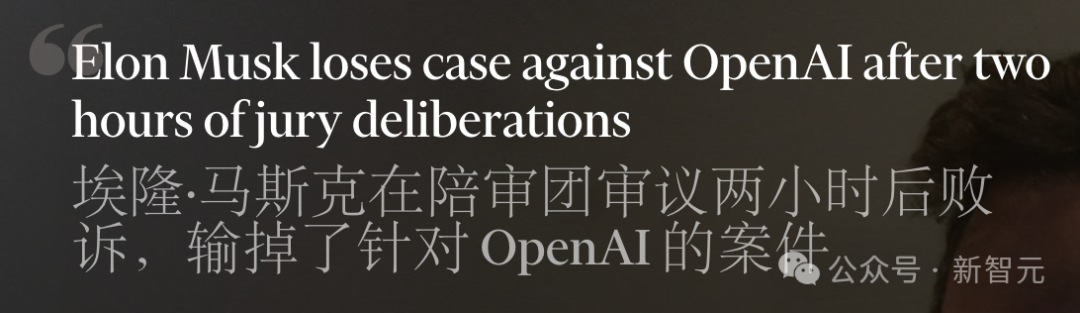
This speed was unprecedented. Musk alone sat on the witness stand for three full days.
Brockman testified for five hours.
After three weeks of accumulating massive evidence and testimony, the jury barely glanced at the timeline before rendering their decision.
Even more surreal? At the moment of the verdict, none of the three central figures in this historic clash—Musk, Altman, and Brockman—were present in the courtroom.
A $15 billion lawsuit concluded with both plaintiff and defendant absent.
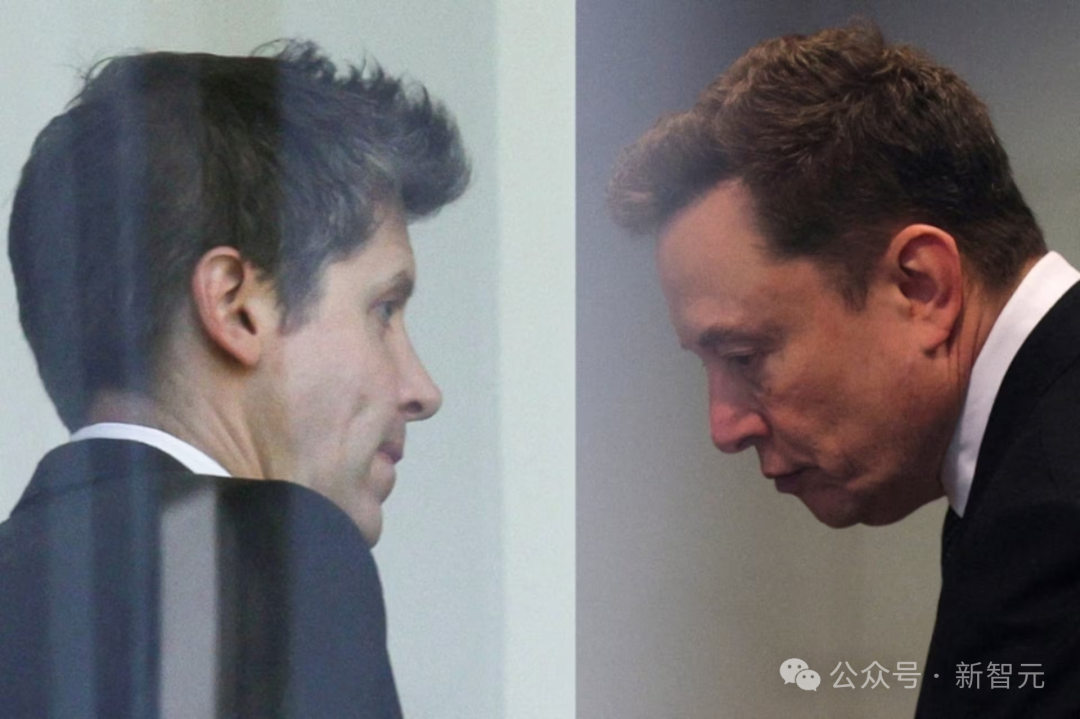
Only the legal teams delivered emotional performances.
During the brief recess following the verdict, lawyers from OpenAI and Microsoft embraced and patted each other on the back in celebration down the courthouse corridor.
Marc Toberoff, Musk’s lead counsel, stepped out of the courtroom door, facing a swarm of reporters, and simply uttered two words:
“Appeal.”
Musk Lost to Time
The jury’s logic was remarkably straightforward.
California law sets a three-year statute of limitations for breach of charitable trust claims, and two years for unjust enrichment.
OpenAI’s legal team presented a pivotal fact: Musk had known about OpenAI’s pivot to profitability as early as 2021.
He himself sent a text to Altman stating: “I’m deeply unsettled seeing OpenAI valued at $20 billion”—a clear sign of hypocrisy.
This occurred in late 2022 to early 2023. Yet Musk didn’t file suit until February 2024.
The jury ruled: the statute of limitations has passed—too late to sue.
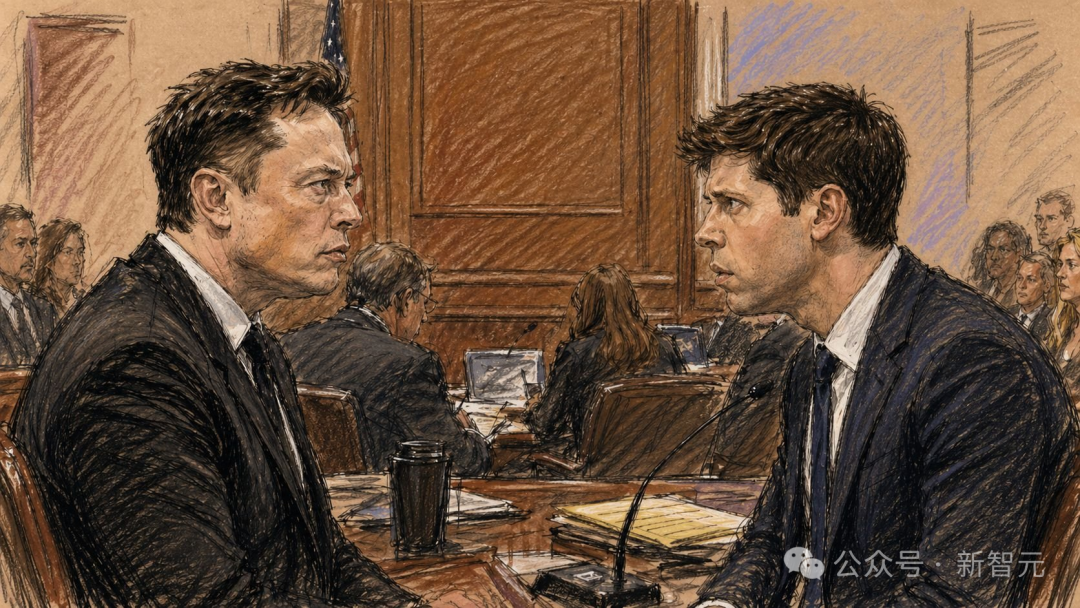
Musk’s explanation in court was that he had consistently trusted Altman’s assurances—until Microsoft’s $10 billion investment solidified in 2023, when he realized “the tail was wagging the dog.”
“Believing someone might steal your car,” Musk said on the stand, “is not the same as knowing they’ve actually stolen it.”
“If I’d known they stole from a charity, I would’ve sued immediately.”
But the jury wasn’t convinced.
Because of the procedural barrier of the statute of limitations, the jury never even entered substantive review.
That means none of Musk’s three core allegations—“breach of charitable trust,” “unjust enrichment,” and “Microsoft’s complicity in incitement”—were formally examined.
All those explosive testimonies, earth-shattering figures, and dramatic betrayals were legally rendered null and void.
The Mansion Party That Marked OpenAI’s Turn to Profit
Though the jury did not examine the substantive claims, the three-week trial already exposed the most confidential internal operations of OpenAI over the past 11 years.
Some of these details were unknown even to Silicon Valley’s seasoned gossipers.
Summer 2017: OpenAI’s AI defeated global elite players in Dota 2.
Musk immediately sent an email: “It’s time to move forward. This is the trigger event.”
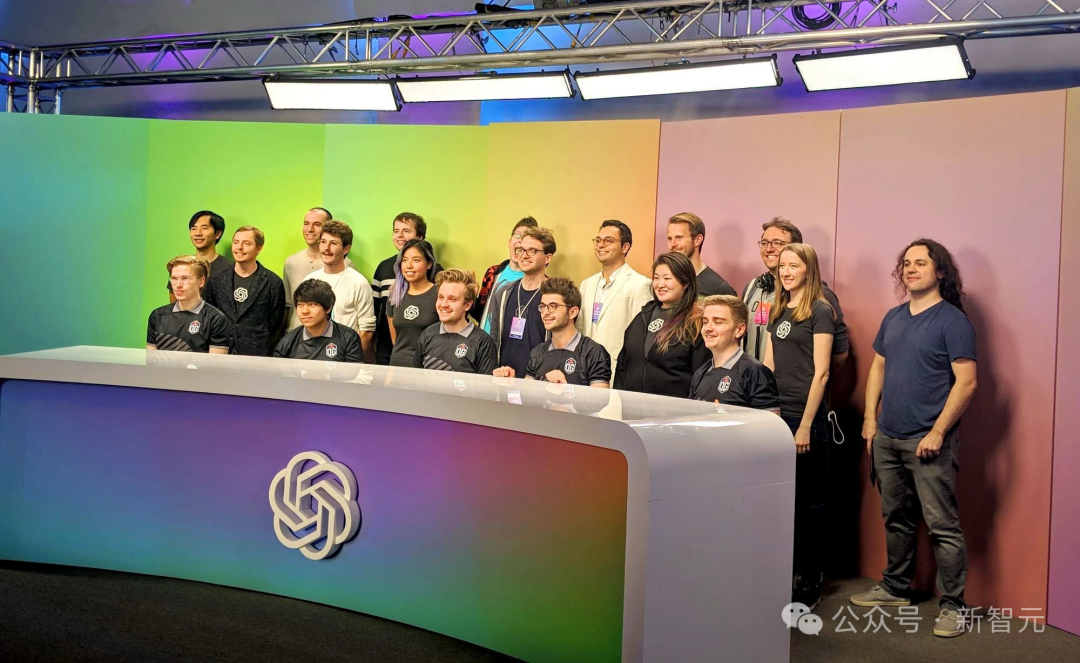
He summoned his core team to his 16,000-square-foot mansion in South Bay—internally known as the “Ghost House.”
Brockman recalled upon entering: “The floor was littered with confetti and plastic cups from last night’s party.”
It was amid this post-party wreckage that the discussion of OpenAI’s commercialization officially began.
Musk’s attorney Steven Molo projected Brockman’s digital diary onto the courtroom’s giant screen. One entry from that period read: “What would get me to $1 billion?”
Another from November 2017: “Transitioning to a B Corp without him (Musk) would be morally bankrupt.”
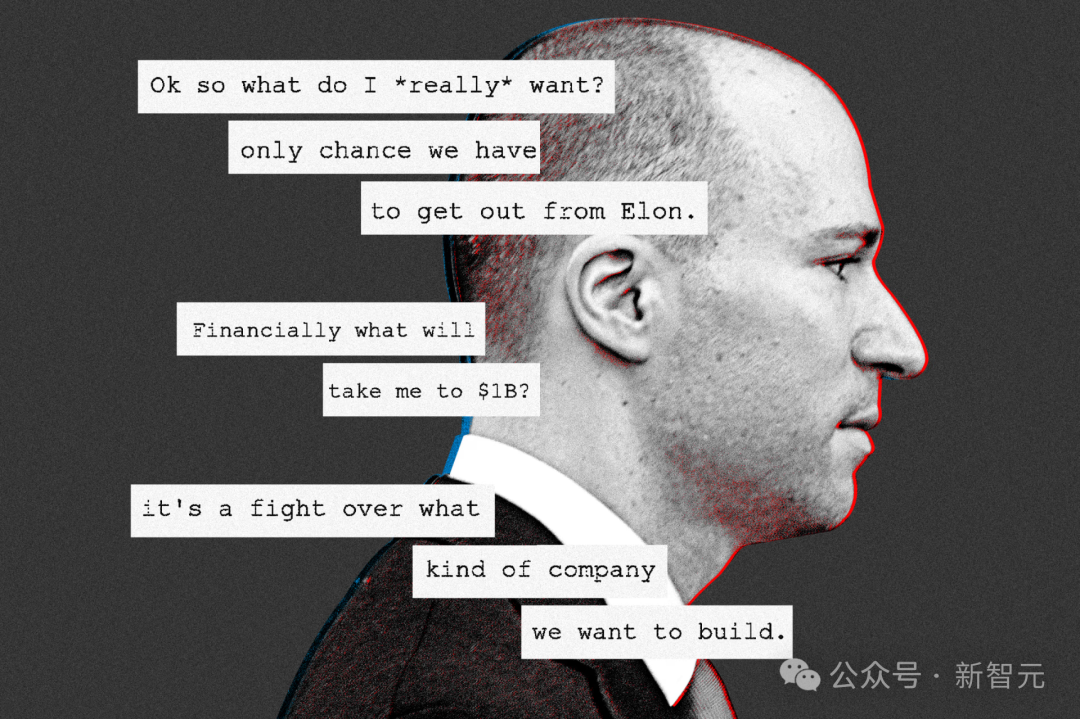
Nine years later, he sat at a $30 billion equity stake, enduring cross-examination.
Court evidence also revealed other buried narratives—
Musk and Zuckerberg exchanged texts discussing a joint acquisition of OpenAI;
OpenAI once seriously considered crypto-based fundraising. From crypto to Microsoft’s $13 billion investment, this funding path is emblematic of an entire era.
This trial could have been a documentary—but the jury flipped the page in just 90 minutes.
The Trillion-Dollar IPO Is About to Begin: No Timeout in the Final Round
After the trial, OpenAI’s lawyer Savitt told reporters:
“OpenAI remains a nonprofit, mission-driven organization—past, present, and future.”
Microsoft quickly issued a statement: “The facts and timeline in this case were already clear. We welcome the jury’s dismissal based on statute of limitations.”
While OpenAI’s victory was far from graceful,
Everything revealed during the three-week trial—
Brockman’s zero-cost exit worth $30 billion, Altman’s lies on safety approvals, Cerebras’ related-party transactions, Ilya’s 52-page evidence, Murati’s accusations of “chaos and distrust”—these will not vanish from public memory simply because the statute of limitations expired.
When asked on the stand if he was fully trustworthy, Altman couldn’t even say a clear “yes.”
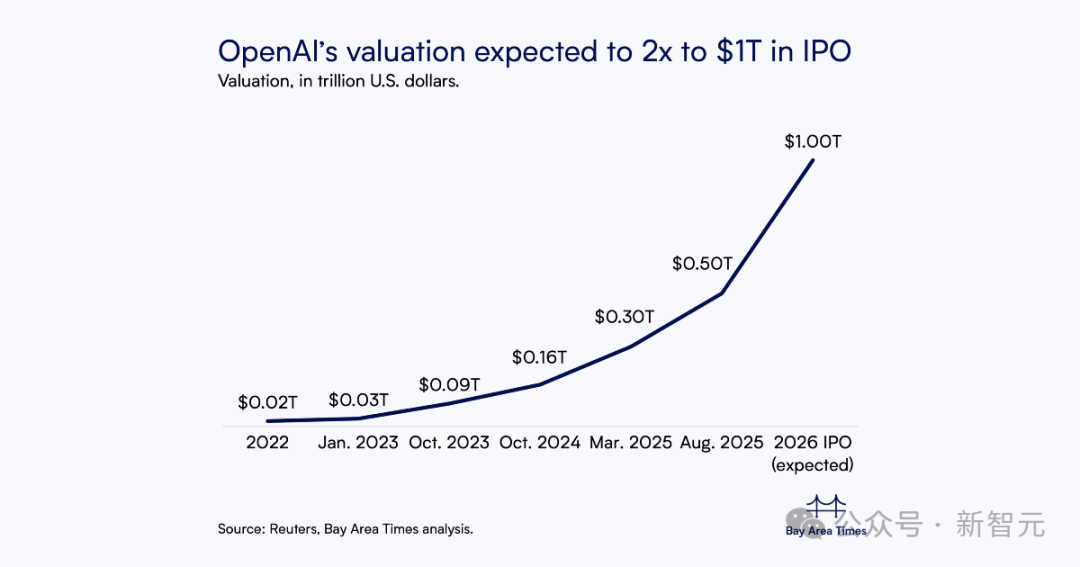
But the verdict’s biggest impact? It cleared the most significant legal hurdle for OpenAI’s upcoming IPO.
ASI Showdown Awaits: The Moment Is Now
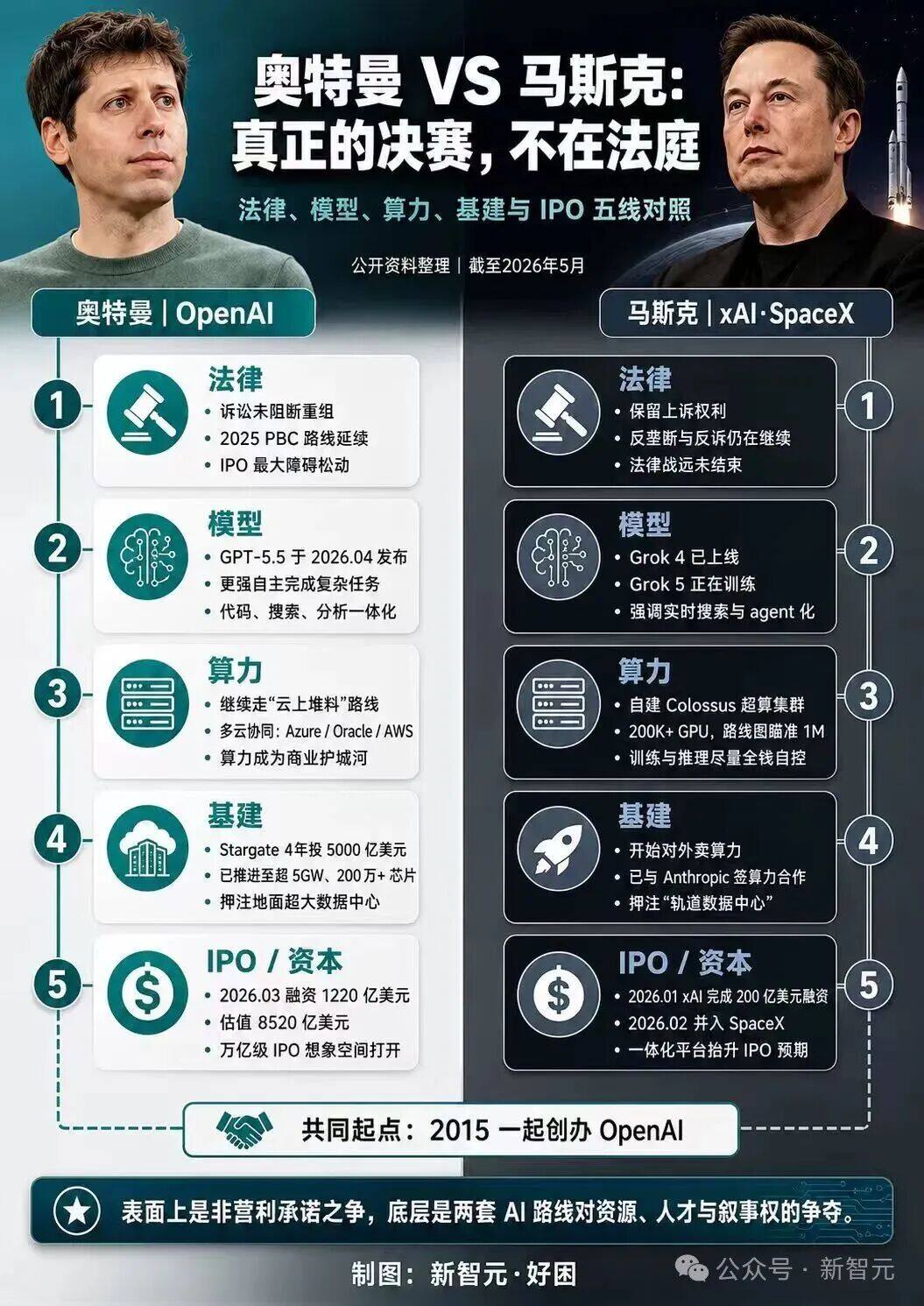
In March, OpenAI completed a $122 billion funding round, valuing the company at $852 billion.
The 2025 for-profit reorganization stands unchallenged; Microsoft’s over $100 billion partnership remains intact; Altman and Brockman remain in leadership. The path to a trillion-dollar IPO is now open.
Underpinning this sky-high valuation is OpenAI’s true ace:
The recent launch of GPT-5.5, designed to independently complete complex tasks—from coding to data analysis—without requiring step-by-step human prompting.
In compute infrastructure, Altman is betting on traditional scaling: pouring capital into cloud computing.
Compute procurement has ballooned to a staggering $600 billion scale, spanning five major cloud providers: Microsoft Azure, Oracle, AWS, and others.
Musk, meanwhile, secretly filed for SpaceX’s IPO in April. After merging with xAI, the combined entity is now valued at $1.25 trillion—its prospectus expected to be released this week.
In model development, they’re taking a bolder approach: training seven large models simultaneously, burning through $1 billion per month.
From Grok 4.4 to the full Grok 5 series, Grok 5’s parameter count is multiple times that of GPT-5.5—running entirely on Colossus 2.
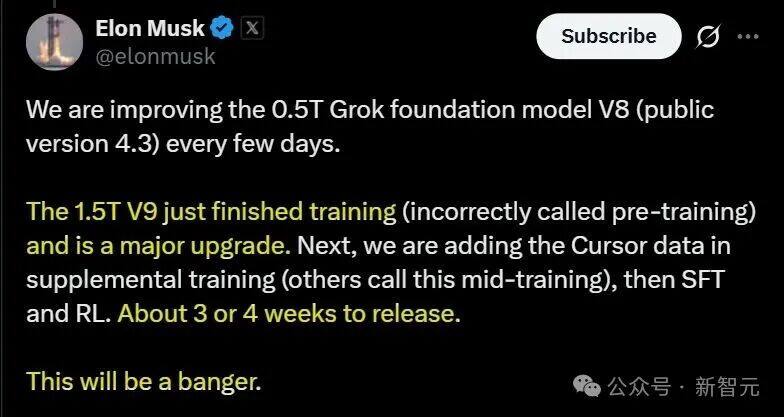
But even more telling is a detail: In early May, Colossus 2 signed a compute contract with Anthropic, beginning to sell compute capacity to external clients.
This means Musk isn’t just building models—he’s becoming an arms dealer in the AI era:
Training his own models while selling compute power to competitors. Such a dual strategy has no precedent in tech history.
Today, two men who once co-founded OpenAI are racing toward separate trillion-dollar IPOs.
But the legal battle isn’t truly over.
Musk’s legal team has explicitly reserved the right to appeal—though the judge’s stance makes reversal unlikely.
More importantly, this is just one front in a broader war:
xAI’s antitrust lawsuits against OpenAI and Apple, xAI’s trade secret theft claims against OpenAI, and OpenAI’s counter-suit against Musk—all remain active.
The legacy of this trial lies not in the verdict itself.
It brought the core governance issues of the AI industry into federal court for the first time—under global scrutiny.
On the path to ASI, questions of trust and safety won’t disappear with a single ruling.
As for Musk? The next chapter—“appeal”—has yet to conclude.
References:
https://www.bloomberg.com/news/articles/2026-05-18/elon-musk-loses-case-against-sam-altman-to-force-openai-overhaul
https://www.cnbc.com/2026/05/18/musk-altman-openai-trial-verdict.html
https://www.reuters.com/legal/government/elon-musk-loses-lawsuit-against-openai-2026-05-18/
https://www.wired.com/story/musk-v-altman-jury-verdict/
https://nypost.com/2026/05/18/business/elon-musk-loses-lawsuit-against-openai-in-unanimous-verdict/
Disclaimer: Contains third-party opinions, does not constitute financial advice
Cloudflare CEO: How I Decided Which Employees to Replace with AI?
4 days ago
What’s Anthropic’s next breakout after Claude Code?
7 days ago
Did Duan Yongping get caught in a bottom trap? oreWeave plunges 11% in a single day—despite billions in orders, the company remains trapped in a 1% profit margin crisis
15 days ago
The AI Hub business is so lucrative that even the U.S. presidential family has shown up
19 days ago
Claude's Transit Hub Business: The Tighter the Blockade, the More Mature the Gray Market
19 days ago
xAI Leases Computing Power to Anthropic: Musk's Compute Empire Begins to Leak
19 days ago
Anthropic launched an all-AI Xiaomi group, where large models are now cutting each other's grasshoppers
19 days ago


