Even the most loyal ETH bull has liquidated, what's wrong with Ethereum?
Even the most loyal ETH bull has liquidated, what's wrong with Ethereum?


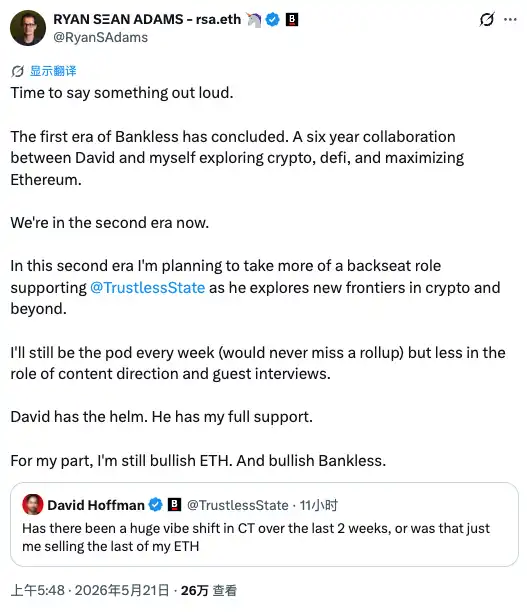
On May 21, David Hoffman posted on X, announcing he had liquidated his entire ETH holdings.
On the same day, Ryan Sean Adams followed up with a post. He stated that he “still believes in ETH” and “still believes in Bankless.” However, Bankless is entering its “second era,” and he plans to step back further into the background. Weekly podcasts will continue, but content direction and guest selection will no longer be led by him—“David will take full control.”
Former Bankless member Lucas took to social media to say: “Let me just lay it out plainly—Bankless clearly laid off most of its team yesterday. No thanks, no public announcement to help team members find new roles.”
All of this unfolded during the same period when the Ethereum Foundation underwent another major leadership overhaul.
They Were Once ETH’s Most Loyal Amplifiers
Bankless is not an ordinary crypto media outlet.
In September 2020, David Hoffman and Ryan Sean Adams co-founded the brand, starting from a newsletter. Over five years, it grew into one of the most important content ecosystems in the English-speaking crypto space. The platform includes podcasts, videos, paid membership program Citizenship, a derivative DAO, and in 2023, a standalone venture fund—Bankless Ventures—with a fund size of approximately $35 million. It features a dedicated column, Ethereum Weekly.

It was the single most influential amplifier of the ETH narrative. And at the core of this amplifier stood David Hoffman.
David Hoffman is a former clinical psychologist. He entered the crypto space in 2017, initially serving as COO at RealT, a real estate tokenization platform. In 2019, he began publishing long-form fundamental analyses on ETH. He served as the internal research lead and narrative architect at Bankless. Ryan Sean Adams has a longer investment pedigree, having accumulated positions in crypto through Mythos Capital around 2017. On-air, he played a macro-cycle and evangelist role.
Starting in 2019, David Hoffman authored works including Ether: The Triple Point Asset, Ether is Equity, Ethereum's Economic Engine, and The Ethereum Watershed. His central thesis: ETH possesses three attributes—currency, bond, and equity—making it a “triple-point asset.” This narrative provided ETH holders with a fundamental framework, transforming ETH from mere speculation into a foundational asset of the digital financial stack.
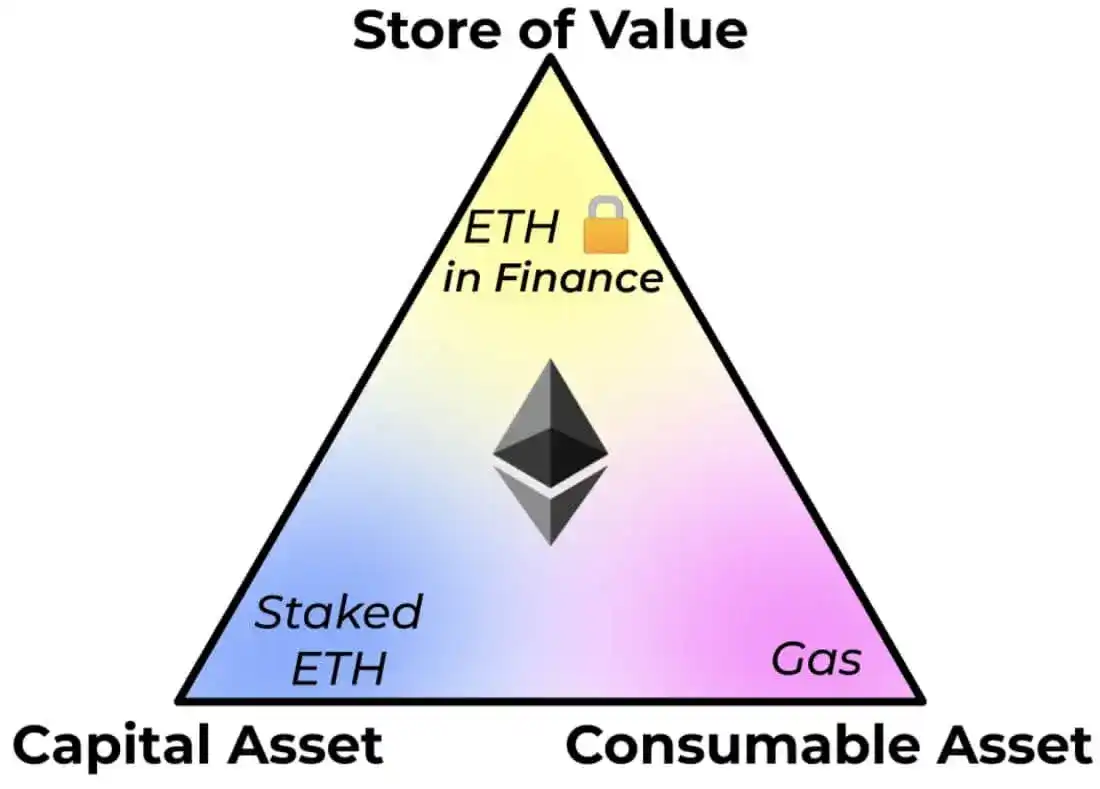
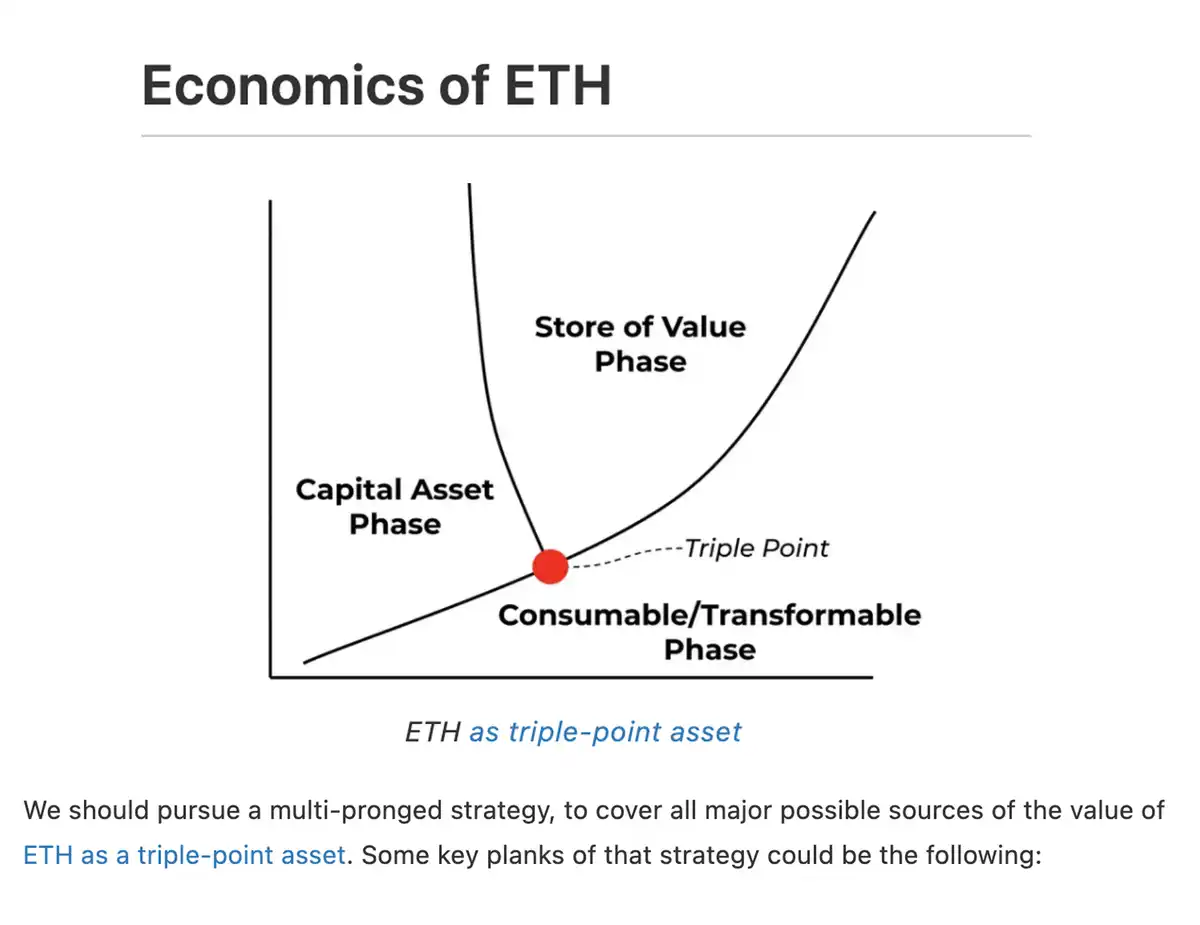
Dave Hoffman took this argument to extremes. He once publicly stated that 99% of his net worth was invested in Ethereum, and he personally had no bank account. At the World Economic Forum in Davos in January 2026, he still claimed Ethereum would build a new global order by 2026.
Only four months have passed since his recent liquidation announcement.
What Happened Inside Bankless
The collapse of Bankless’s ETH narrative did not happen overnight:
In April 2025, ETH dropped to $1,415. David Hoffman publicly criticized Ethereum’s leadership and culture for “driving away users and developers,” demanding a strategic pivot from the Ethereum Foundation.
In October 2025, he “mourned” the departure of Dankrad Feist, the longest-serving researcher at the Ethereum Foundation, who joined Tempo—a stablecoin Layer-1 project—publicly expressing concern over talent drain from the Ethereum Foundation to profit-driven firms.
In December 2025, he published Crypto's Yearly Candles, acknowledging 2025 as a bearish year for both ETH and BTC.
In January 2026, he wrote This Crypto Cycle Skipped ETH, arguing that this cycle bypassed ETH entirely. In March 2026, upon the release of the Ethereum Foundation’s new Mandate, he published The EF's Endless Manifestos, blasting the foundation for “having no intention to fight for ETH’s market share.”
Thus, today’s liquidation was not sudden.
Beyond Hoffman, Adams’s approach deserves attention. He said “still believe in ETH,” not “reduced exposure” or “followed David.” This represents a relatively dignified internal power transition, coinciding with recent layoffs at Bankless.
By handing editorial control to David, Bankless is now poised to become more “de-ETH-centric,” embracing greater coverage of Solana, Hyperliquid, prediction markets, and ICO revival trends.
Ethereum Foundation Undergoes Another Mass Reshuffle
Since Vitalik Buterin initiated the Ethereum Foundation reorganization in 2025, the organization has undergone several rounds of large-scale leadership turnover:
Longtime leader Aya Miyaguchi stepped down as Executive Director, replaced by co-EDs Tomasz Stańczak and Hsiao-Wei Wang. The community had long harbored frustration over the foundation’s lack of transparency, slow pace, and failure to actively capture ETH value.
Yet, this reshuffling continues into 2026.
On February 13, 2026, Stańczak announced his resignation as co-ED by month-end, after less than a year in office. Bastian Aue succeeded him.
On March 13, 2026, the Ethereum Foundation released a 38-page document titled Ethereum Foundation Mandate. Its core framework is CROPS: censorship-resistant, open source, private, secure. The document explicitly states the foundation is retreating into a “neutral watchdog” role—no longer driving ecosystem expansion, no longer responsible for ETH price performance. The document also includes a manga-style illustration referencing Remilia’s “Source Seppuku License” (Seppuku License), depicting the foundation swearing allegiance to Ethereum, pledging to commit ritual suicide if betrayed.
Rumors circulate that the Ethereum Foundation required employees to sign the new Mandate—or face termination.
Between March and May 2026, all three leads of the Protocol Cluster departed. Five senior researchers left in May alone. The full list: Carl Beekhuizen (seven-year veteran), Julian Ma, Barnabé Monnot, Tim Beiko, Trent Van Epps, Alex Stokes, Josh Stark, plus former co-ED Stańczak. Eight departures in one year.
The controversy surrounding the Mandate document itself mirrors the core debate in ETH investment theses.
We can interpret this as the Ethereum Foundation returning to a neutral, decentralized guardian role—strengthening censorship resistance, open source principles, and trustless neutrality. But we can also read it differently: at a time when institutional interest is accelerating into blockchain, the Ethereum Foundation has voluntarily disavowed responsibility for ETH value capture—effectively tearing out the most critical pillar of ETH’s investment thesis.
As David Hoffman put it in his March article: He didn’t want to read another Ethereum Foundation document in 2026 telling readers “we don’t intend to fight for ETH’s market share,” while focusing instead on a “cyberpunk ideology that contributes nothing to ETH’s market cap.”
The exit of a major ETH mouthpiece may not immediately impact ETH’s price.
But every asset is ultimately a narrative asset. Without its loudest advocate, where does ETH go next?
Original: BlockBeats
Disclaimer: Contains third-party opinions, does not constitute financial advice
SpaceXAI to Tidy Up Subscription Chaos, Grok and Cursor to Unify Plans Within Weeks
16 days ago
JPMorgan: Oracle's Backlog Orders Up by $26 Billion, Funding Trail Raises Questions
16 days ago
The Nasdaq-100 Index futures decline widens to 1.5%
16 days agoJefferies: Expecting Fed rate hike this week, Wunsch's comments to be pivotal
16 days agoData: Bitcoin's current holding volume has decreased by 13.5% compared to September 3rd, suggesting the market may have already begun deleveraging ahead of time
16 days ago
The UK's Financial Conduct Authority is exploring regulatory exemptions for tokenized gold
16 days agoKOSPI Index drops over 3%, SK Hynix down 6.34%
16 days ago

