SEC Pushes for Tokenized Stocks, Is the Traditional Finance Industry Starting to Panic?
SEC Pushes for Tokenized Stocks, Is the Traditional Finance Industry Starting to Panic?


The U.S. Securities and Exchange Commission (SEC) is preparing to formally announce its "Innovation Exemption" framework this week, which would allow third parties to tokenize U.S. equities such as Apple and Tesla without requiring approval from public companies. This move could accelerate the migration of traditional stock markets onto blockchain infrastructure, while simultaneously triggering deep concerns among exchanges about liquidity fragmentation and revenue erosion.
According to a Bloomberg report on May 18, the framework stems from a deregulatory vision proposed in February by pro-crypto commissioners Paul Atkins and Hester Peirce. Coinbase and the Blockchain Association have previously submitted formal letters of support, strongly advocating for granting third-party tokenization rights. However, Peirce’s guidance released on May 22 was narrower than market expectations—limited exclusively to on-chain stock instruments that fully preserve shareholder rights, explicitly excluding synthetic stock tokens lacking voting or dividend entitlements.
Two Core Threats: Liquidity Fragmentation and Revenue Fragmentation
The fundamental impact of tokenized stocks lies in "fragmentation." While the crypto industry frequently discusses liquidity aggregation, traditional finance views it as a structural threat.
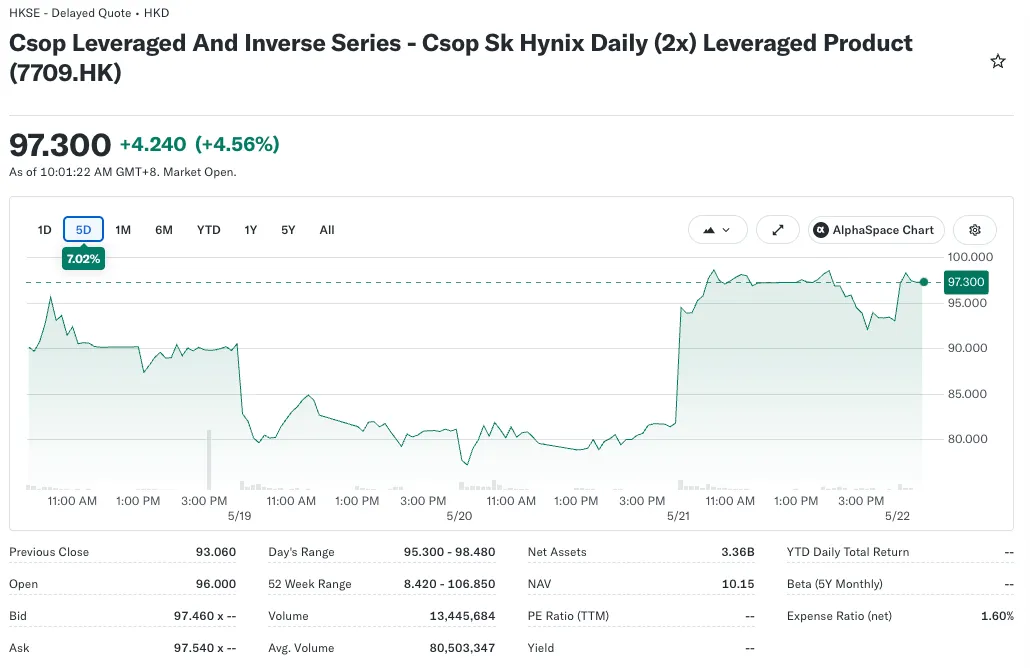
A Tiger Research report uses South Korea as an example: Hong Kong-based asset manager CSOP’s SK Hynix 2x leveraged ETF has grown into the world’s largest single-stock leveraged ETF, with assets exceeding KRW 11 billion (approximately USD 800 million). If South Korea had pioneered a regulatory sandbox for similar products, these management fees and financial revenues could have remained domestically captured.
The End of Traditional Exchanges’ "Supermarket" Monopoly
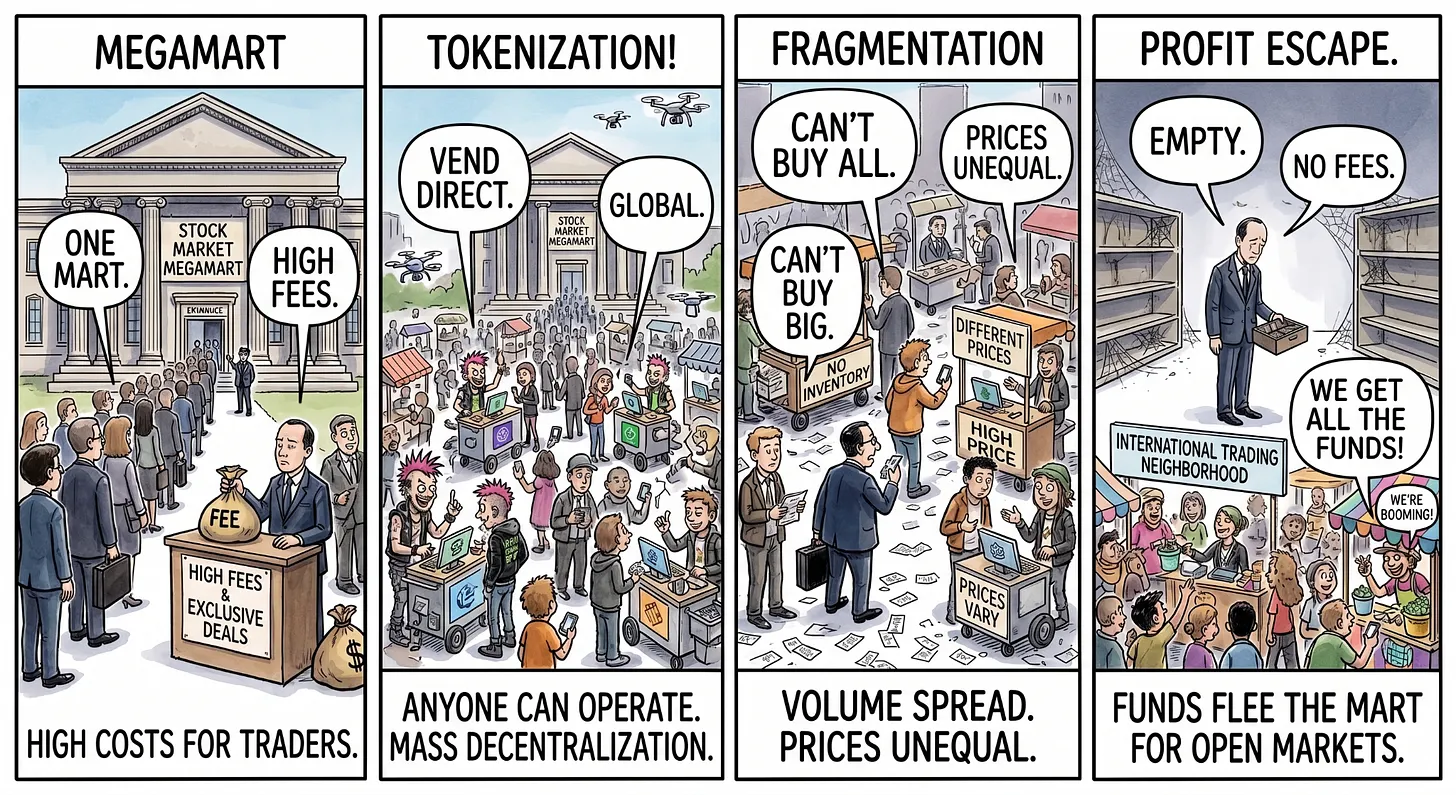
The report employs a vivid analogy to illustrate this shift: traditional equity markets resemble a dominant supermarket where all buyers and sellers are centralized, with exchanges monopolizing trading and collecting fees. Tokenized stocks, however, are akin to allowing anyone to open thousands of unlicensed street stalls outside the supermarket, enabling direct trades beyond the exchange’s control.
This dispersion leads to buyer attrition, thinner inventory per stall, difficulty executing large trades, and fragmented revenue streams. Should domestic exchanges hesitate due to regulatory constraints, competing platforms in other jurisdictions will seize global capital flows and intermediary revenues first.
Capital Fragmentation Is Already Underway
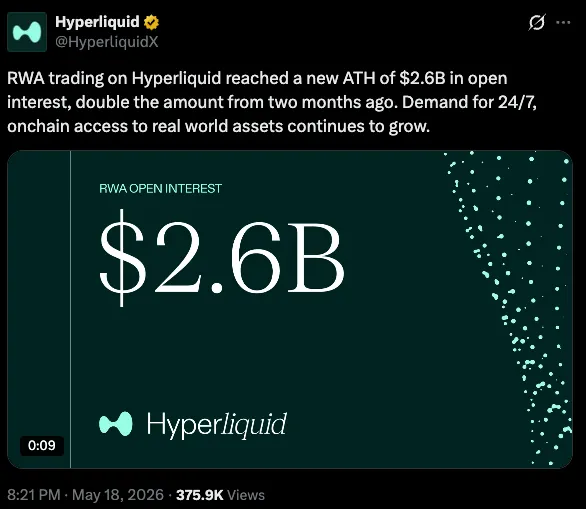
On the very same day SEC signaled the framework (May 18), Hyperliquid’s RWA (Real World Assets) open interest on its decentralized platform surged past USD 2.6 billion, setting a new all-time high. Driven by 24/7 demand for on-chain trading of traditional assets, RWA volume on perpetual DEXs is expected to further spike.
Traditional financial institutions and regulators now face a dilemma: either proactively build tokenization infrastructure through collaboration—like the NYSE—or lobby regulators to block innovation to protect existing revenue streams. Regulators themselves are torn—balancing the need to control the pace of innovation while preventing domestic revenues from being eroded by offshore platforms.
Even after the framework is officially unveiled, the underlying conflicts have only just begun. Two key issues will dominate the future:
In the digital asset era, financial institutions and jurisdictions that fail to act swiftly risk permanently losing their long-standing fee advantages and leadership positions in global finance. Capital will continue to disperse across multiple fronts.
Written by: Tiger Research, Compiled by: AididiaoJP, Foresight News
Original Source: DeepFlow TechFlow
Disclaimer: Contains third-party opinions, does not constitute financial advice
NVIDIA attracts $85 billion in investor demand during massive bond issuance
06-16
Ethereum surges over 10% in 24 hours, currently priced at $1,841.31
06-16Amazon announces a multi-billion dollar investment in Missouri to build a data center campus, expected to create over 400 long-term positions
06-16Binance Platform's SpaceX Perpetual Contract Trading Volume Surpasses $9 Billion, Capturing Over 60% Market Share
06-16Binance platform XLM/USDT short-term spike down to $0.17, now recovered to $0.225
06-16
Trump: The Strait of Hormuz has been fully reopened as of Friday, and all agreements have been signed
06-16SlowMist: Aztec Connect Contract Hacked for $2.19 Million Due to ZK-Rollup L1/L2 State Boundary Vulnerability
06-15
