SEC Delays "Crypto-Stock" Innovation Exemption—Who Is Fiercely Opposing It?
SEC Delays "Crypto-Stock" Innovation Exemption—Who Is Fiercely Opposing It?


At 5:00 a.m. Beijing Time on May 23, Bloomberg reported, citing informed sources, that the U.S. Securities and Exchange Commission (SEC) has postponed the previously scheduled rollout of its "Innovation Exemption" initiative. Originally intended to pave the way for tokenized U.S. stocks, the program has been delayed due to widespread concerns raised by market participants, prompting the SEC to halt further progress.
Reacting to this bearish news, the crypto market plunged sharply in the short term: BTC broke below 76,000 USDT, while ETH also fell beneath 2,100 USDT. The impact on related concepts was even more severe—ONDO erased yesterday’s gains driven indirectly by the SEC’s enforcement actions against brokers like Tiger Brokers, Futu, and Longbridge, dropping to 0.382 USDT as of publication, with a 24-hour decline of 6.4%.
The Innovation Exemption: Braked at the Doorstep
Since the appointment of Chairman Paul Atkins, the SEC has shifted from its historically enforcement-heavy stance toward a more regulatory-friendly approach, aiming to establish compliant testing grounds for the crypto industry.
Earlier this week, rumors circulated that the SEC would unveil a proposed exemption within days, allowing exchanges to offer blockchain-based tokenized trading services for publicly listed securities—such as NVDA, AAPL, and TSLA—under relaxed regulatory conditions. Spearheaded by SEC Chair Paul Atkins and Commissioner Hester Peirce, the initiative aimed to create legal space for tokenized securities, which the market interpreted as a strong signal of the U.S. regulator's growing support for asset tokenization.
However, the innovation exemption—originally expected to be formally disclosed this week—was abruptly halted at the final stage. According to insiders, the SEC has now sent the draft back for revisions and is intensively reconsulting with stock exchanges and other market participants.
From “full green light” to “emergency brake,” what kind of resistance has the SEC faced? Who exactly is fiercely opposing this move in the epic battle over “tokenizing U.S. equities”?
Opposition Forces: Once Again, Wall Street
Similar to the stalled CLARITY Act (see: “CLARITY Review Suddenly Postponed—Why Is Industry Division So Deep?”), the most vocal opposition to this exemption proposal comes from traditional financial powerhouses on Wall Street, including Citadel Securities and the Securities Industry and Financial Markets Association (SIFMA).
Even during the early stages of policy speculation, these established financial giants had already submitted sharp objections to the SEC. Collectively, their core arguments fall into three main categories.
First, they fear fragmentation of market liquidity. Institutions like Citadel Securities warn that permitting third parties to issue unregulated “synthetic U.S. equities” without issuer authorization could fragment equity assets across countless decentralized, illiquid, and low-transparency DeFi platforms. This would not enhance efficiency but instead make it difficult for investors to ascertain the real-world value represented by any given tokenized stock at any moment.
Second, there are serious concerns about compliance risks posed by tokenized equities. On anonymous or pseudonymous public blockchains, how can regulators ensure such third-party tokens aren’t exploited as money laundering conduits? Wall Street firms argue that current decentralized platform technologies lack the capability to rigorously enforce core investor protection mechanisms like AML (Anti-Money Laundering) and KYC (Know Your Customer).
Third, critical legal and technical gaps remain unresolved. Legal experts cited by institutions point out that, under existing frameworks, it remains legally and technically uncertain whether a third-party crypto platform—unauthorized by companies like Apple or Microsoft—can legitimately grant token holders voting rights and dividend distribution rights tied to underlying shares.
Internal Skepticism Within the SEC
Notably, this wave of opposition isn't limited to Wall Street’s entrenched interests—the SEC itself harbors cautious reservations.
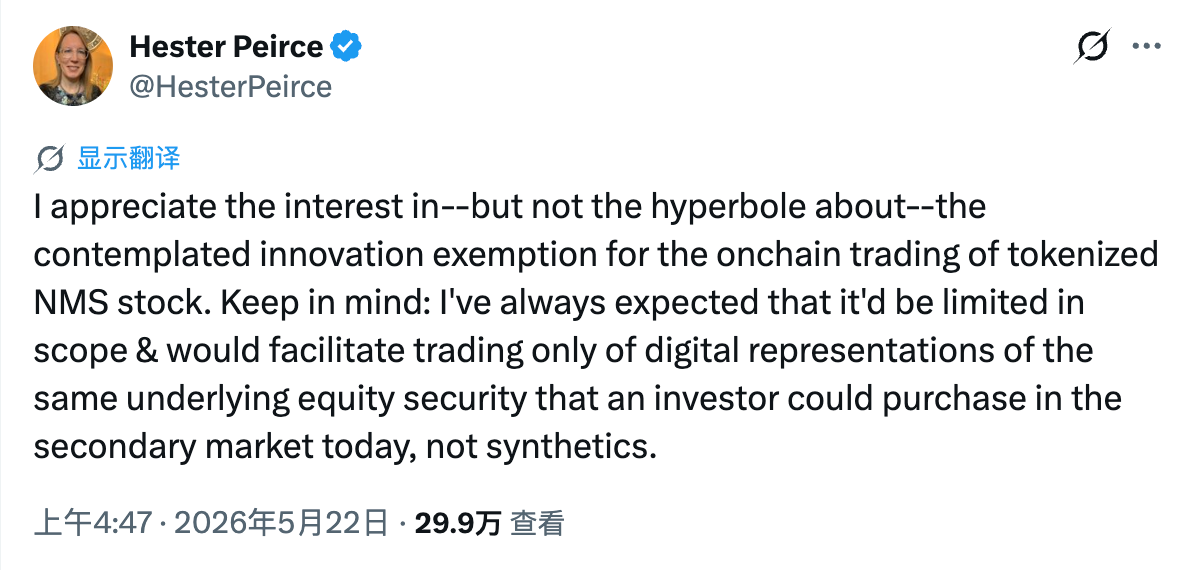
SEC Commissioner Hester Peirce, long regarded as a veteran ally of the crypto community and affectionately known as “Crypto Mom,” publicly reversed her position on X yesterday, calling for strict limitations on the scope of the exemption.
Peirce emphasized that the SEC should only permit initiatives where the issuer or its affiliated entities lead the digitalization or tokenization of their own shares. She warned against enabling a proliferation of third-party synthetic assets operating outside regulatory oversight. In essence, Peirce envisions tokenized U.S. equities as being directly authorized, backed, or issued by the listed company itself—ensuring that token holders enjoy the same rights as conventional shareholders, including dividends and voting rights—not the prevalent model of third-party derivative tokens tracking stock price performance.
Given that even Peirce, a longtime advocate for crypto innovation, has now aligned with restricting the exemption’s scope, it underscores the substantial legal and compliance hurdles embedded in the proposal.
What Lies Ahead for Tokenized Stocks?
This week’s delay is undoubtedly a blow to the RWA (Real World Assets) sector, which stands on the cusp of explosive growth. The sharp drop in ONDO and other related concept tokens reflects an earlier market over-optimism regarding full-scale, compliant tokenization of U.S. equities on-chain. Yet one thing remains undeniable: regardless of regulatory fluctuations, the convergence of U.S. equities and blockchain technology has already become an unstoppable tide. Beneath the shadow of regulatory tug-of-war, both crypto-native innovators and traditional Wall Street institutions are racing headlong along their respective tracks.
On one hand, crypto-native forces are forging pathways from the ground up. Projects like Ondo, xStocks, and MSX are actively bringing U.S. equities onto the blockchain, while Hyperliquid, Trade.xyz, and major CEXs are offering global crypto users indirect exposure to U.S. stocks via perpetual futures contracts. This bottom-up innovation pressure continues to compel regulators to deliver clear guidance.
On the other hand, Wall Street is accelerating its internal preparations. The Depository Trust & Clearing Corporation (DTCC) plans to launch limited production trials for tokenized assets in July, expanding them by October; Nasdaq is rapidly developing a blockchain-based stock issuance framework; meanwhile, Intercontinental Exchange (ICE) is collaborating with top-tier crypto exchange OKX to jointly advance research and development on tokenized equities and related crypto products.
At its core, this exemption delay represents a fierce clash between emerging innovation and entrenched institutional defense mechanisms. With no final decision yet made on revised drafts, the “Innovation Exemption” remains alive—but it is foreseeable that, under intense pushback from Wall Street giants and internal revisions within the SEC, any future iteration will likely come with reduced ambition and narrower scope.
The dream of fully unleashing “tokenized stocks” may still face a long road ahead amid regulatory negotiations, but the door to asset tokenization has already been forcefully breached—and it will never be closed again.
Disclaimer: Contains third-party opinions, does not constitute financial advice
NVIDIA attracts $85 billion in investor demand during massive bond issuance
06-16
Ethereum surges over 10% in 24 hours, currently priced at $1,841.31
06-16Amazon announces a multi-billion dollar investment in Missouri to build a data center campus, expected to create over 400 long-term positions
06-16Binance Platform's SpaceX Perpetual Contract Trading Volume Surpasses $9 Billion, Capturing Over 60% Market Share
06-16Binance platform XLM/USDT short-term spike down to $0.17, now recovered to $0.225
06-16
Trump: The Strait of Hormuz has been fully reopened as of Friday, and all agreements have been signed
06-16SlowMist: Aztec Connect Contract Hacked for $2.19 Million Due to ZK-Rollup L1/L2 State Boundary Vulnerability
06-15
