While OpenAI is still burning cash, has Anthropic quietly turned profitable already?
While OpenAI is still burning cash, has Anthropic quietly turned profitable already?


Mid-May, two AI giants simultaneously unveiled their strategic cards—OpenAI secretly filed for an IPO, while Anthropic released its first financial forecast showing profitability in a quarter.
Data shows OpenAI generated $5.7 billion in revenue during Q1, yet incurred a loss of $1.22 for every dollar earned. Meanwhile, Anthropic reported $4.8 billion in revenue for the same period—nearly $1 billion behind—but its Q2 forecast reveals a staggering month-over-month growth surge, projecting $10.9 billion in revenue and approximately $559 million in operating profit.
This divergence gives the external perception: one is a super-star valuation entity approaching $1 trillion, still asking the market for patience; the other, once a follower, has quietly crossed into profitability territory.
01. $5.7B vs $4.8B
Insiders told The Information that OpenAI generated around $5.7 billion in revenue during Q1 this year—a figure nearly $1 billion higher than Anthropic’s $4.8 billion in the same period.
On the surface, OpenAI's lead appears significant.
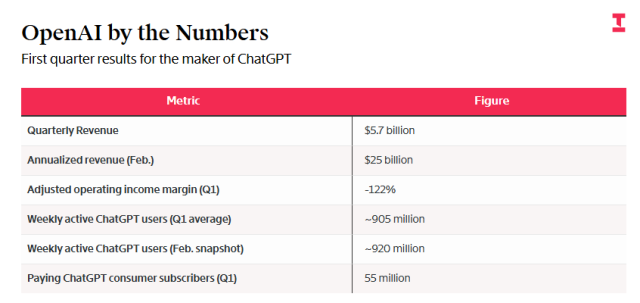
These insiders revealed that three factors drove OpenAI’s Q1 growth: the explosive popularity of the programming agent Codex, increased enterprise sales, and ChatGPT’s test advertising program.
Codex’s surge demonstrates strong demand among developers for tools that deliver tangible productivity—overlapping significantly with Anthropic’s core customer base. Meanwhile, the ad experiment exposes OpenAI’s urgency to monetize its massive free user pool.
OpenAI averaged around 905 million weekly active users in Q1, peaking at 920 million in February.
Once user scale reaches a hyper-saturated benchmark, growth stalls. Despite having 55 million paid consumer subscribers—up from 47 million at the end of last year—the conversion rate remains low relative to its over-900 million weekly active users.
Moreover, the associated inference costs represent a massive financial black hole for OpenAI.
In contrast, Anthropic generated $4.8 billion in Q1 revenue, almost entirely from selling AI models to enterprises and developers. It lacks a vast free consumer base like ChatGPT that requires massive subsidies. This structural difference may prove pivotal in enabling it to surpass its long-time rival.
02. The Fastest Comeback in History
According to financial data obtained by The Wall Street Journal from Anthropic’s investor disclosures, the company forecasts Q2 revenue reaching $10.9 billion—more than doubling from Q1.
Furthermore, its revenue growth rate now exceeds that of Google and Facebook prior to their respective IPOs.
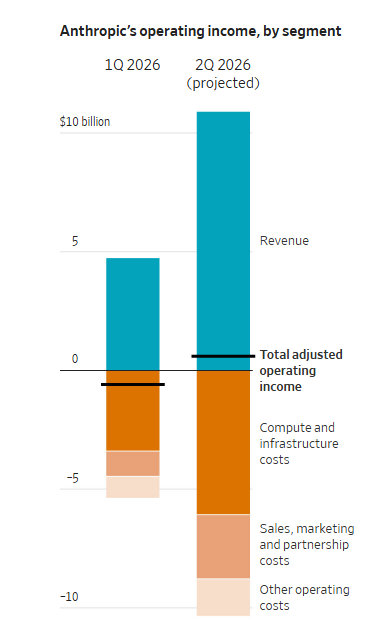
The Information notes that by April 2026, Anthropic’s annualized revenue will exceed $30 billion, while OpenAI’s is projected at around $25 billion.
At its developer conference in May 2026, Anthropic CEO Dario Amodei joked that recent revenue growth has become “unmanageable” due to its pace.
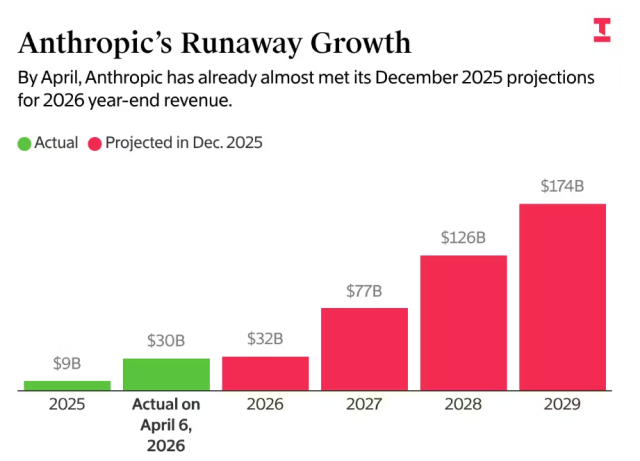
Anthropic anticipates achieving approximately $559 million in operating profit for Q2—a milestone event. Last summer, the company had projected it would not achieve full-year profitability until 2028.
However, operating profit excludes stock-based compensation expenses, and given upcoming massive compute expenditures, Anthropic may not sustain profitability throughout the full fiscal year. Nevertheless, it proves one crucial point: AI model companies centered on enterprise clients can achieve viable profitability within a short timeframe.
By contrast, although OpenAI’s Q2 expectations remain unknown, internal data presented to investors show a Q1 adjusted operating profit margin of -122%. In other words, for every dollar in revenue, the company loses $1.22.
OpenAI expects positive cash flow only by 2029 or 2030—meaning it must continuously fill a massive funding gap before then.
HSBC analysts estimate that, relative to its growth roadmap, OpenAI faces a funding shortfall of $207 billion. CEO Sam Altman hinted during a company-wide meeting that even after filing an IPO application, the actual listing could be delayed, as “filing” and “being ready” are fundamentally different.
The underlying financial pressure is self-evident.
03. Same AI, Different Fates
Why such stark divergence in financial performance despite riding the same AI wave?
The answer lies in their divergent customer structures.
According to Forbes analysis, about 85% of Anthropic’s revenue comes from enterprise and developer clients. Over 500 companies spend more than $1 million annually on the Claude platform, and eight of the Fortune 10 are among its clients.
Enterprise customers have clear willingness to pay, predictable query patterns, lower service costs, and highly sticky contracts—forming a healthy, sustainable business model.
Anthropic spent $71 cents on compute per dollar of revenue in Q1; by Q2, this is expected to drop to just $56 cents—an immediate efficiency gain.
OpenAI, conversely, derives about 85% of its revenue from ChatGPT consumer subscriptions. While it boasts 55 million paying subscribers, it supports over 900 million weekly active users—no corresponding revenue to offset the cost, resulting in structural losses.
OpenAI is not blind to this issue.
Under leadership from executives like Fidji Simo, head of applications, the company has begun cutting high-cost projects such as video generation app Sora, shifting focus toward revenue-generating services and commercial clients. Yet, with a large-scale operation entrenched in a free consumer model, turning the ship is no overnight task.
Naturally, direct comparison of revenue figures must account for a key accounting discrepancy.
The Information explains: Anthropic records all technology sales through cloud partners like Amazon and Google as full revenue. OpenAI, however, due to its long-term exclusive partnership with Microsoft—where Microsoft holds sole rights to use its IP—only recognizes 20% of Azure-based model sales as its own revenue.
Notably, both accounting methods carry some inflationary bias: Anthropic includes 100% of revenue from cloud vendors reselling its models, without deducting partner commissions; OpenAI, meanwhile, fully excludes revenue generated via cloud partners because it must allocate 20% of such revenue to Microsoft through 2030 (potentially $6 billion this year).
Even if OpenAI adopted Anthropic’s accounting method, boosting its annualized revenue by tens of billions, it still cannot close the hundreds-of-billion-dollar gap between the two firms.
04. The Race to IPO
On the IPO path, all financial secrets will be laid bare under sunlight.
OpenAI, Anthropic, and Elon Musk’s SpaceX are all racing toward public markets, each potentially crossing the $1 trillion valuation threshold.
Currently, OpenAI has raised $122 billion from suppliers including Amazon and NVIDIA, aiming for an IPO as early as September 2026. Anthropic, meanwhile, continues a fundraising round that could push its valuation above OpenAI’s, with plans to go public as early as October. Altman privately expressed his desire to list first.
Anthropic currently holds a winning hand: verified quarterly profitability data.
Even if future astronomical investments in compute infrastructure—such as monthly payments of $1.25 billion to SpaceX for data center capacity, plus new massive compute contracts with Broadcom and Google—result in temporary losses, it has already demonstrated that its business model is viable. Its narrative resembles that of an enterprise software company, comparable to Salesforce or ServiceNow.
OpenAI, on the other hand, presents a story requiring greater conviction. It must convince investors that AI agents, image generation, and future massive advertising revenue will ultimately convert its enormous consumer traffic into profits.
In Altman’s vision, ChatGPT’s ad business could generate around $102 billion in revenue by 2030.
But time is precisely what OpenAI lacks most when trading losses for growth.
OpenAI has recently launched over two gigawatts of computing capacity—surpassing the total sum of SpaceX’s entire Colossus cluster—each requiring substantial capital.
Thus, for investors, when the S-1 filing becomes public: should we believe a company that has already cracked profitability, or a giant requesting several more years and hundreds of billions in investment to explore profitability? The answer will shape the fate of both companies.
Original: Lawful BlockBeats
Disclaimer: Contains third-party opinions, does not constitute financial advice
NVIDIA attracts $85 billion in investor demand during massive bond issuance
06-16
Ethereum surges over 10% in 24 hours, currently priced at $1,841.31
06-16Amazon announces a multi-billion dollar investment in Missouri to build a data center campus, expected to create over 400 long-term positions
06-16Binance Platform's SpaceX Perpetual Contract Trading Volume Surpasses $9 Billion, Capturing Over 60% Market Share
06-16Binance platform XLM/USDT short-term spike down to $0.17, now recovered to $0.225
06-16
Trump: The Strait of Hormuz has been fully reopened as of Friday, and all agreements have been signed
06-16SlowMist: Aztec Connect Contract Hacked for $2.19 Million Due to ZK-Rollup L1/L2 State Boundary Vulnerability
06-15
