FDE: Is the Alarm for Career Transition in the AI Era Already Sounding?
FDE: Is the Alarm for Career Transition in the AI Era Already Sounding?


The author has recently encountered four friends preparing for career transitions—front-end developers, solutions architects, product managers, and traditional algorithm engineers—each from different backgrounds, ages, and cities, yet all asking the same English acronym: Is FDE [2] worth pursuing?
FDE, short for Forward Deployed Engineer [2], was once an obscure jargon within Palantir’s circles two years ago. Today, it has quietly evolved into a standard opener for recruiters, a frequent job title in hiring posts, and one of the top contenders for “the most valuable role in the AI era” on social media. In May 2026, OpenAI directly launched a Deployment Company [3] under this name, backed by an initial investment of $4 billion, explicitly stating its intent to embed engineers onsite with clients, integrating deeply into their workflows. Meanwhile, Anthropic’s Applied AI team is simultaneously recruiting FDEs across four time zones. The transformation from niche insider term to mainstream vocabulary took less than a year.
In the author’s previous article, “To the Super Individual” [4], the focus was on the “engine of human potential”—curiosity, self-learning, intrinsic motivation, and hands-on ability—how these traits are fully activated within a complete closed-loop system. But humans aren’t floating entities; they must be anchored by a concrete job coordinate system. If super individuals are the raw material of production relations in the AI era, then FDE is the most visible new job morphology that has emerged in this year’s market landscape.
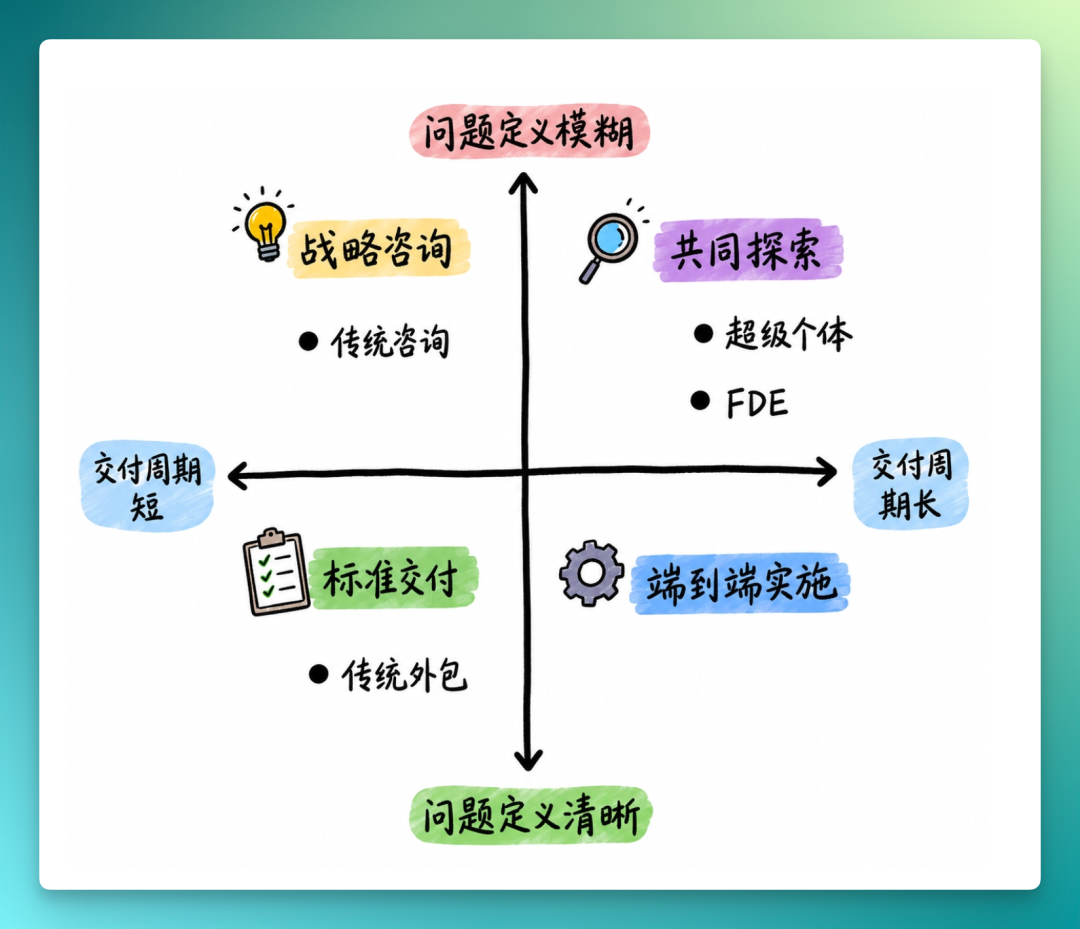
To the author, FDE does not belong in consulting nor in outsourcing. It is closest to the super individual—but the key difference lies in that FDE is a super individual systematically organized within the gap between “model company × client.”
Did you know where the term “Forward Deployed” comes from? Originally, it was a military term—Forward Deployed Forces—referring to units stationed overseas or at the frontlines, capable of rapid local response, as opposed to rear-base forces remaining in domestic locations. Palantir adopted this term in the late 2000s, repurposing it to describe the practice of sending engineers out of headquarters to live and work onsite with clients. Even internal teams were named using military phonetic alphabets like Delta and Echo. Now, OpenAI and Anthropic have reclaimed this concept—not by coincidence. Sending engineers to the frontlines remains fundamentally unchanged.
This article aims to address three specific doubts raised by the four friends recently:
- Is FDE just a rebranded consulting firm dressed in AI clothes? Where exactly does it draw the line with traditional consulting?
- Is FDE merely a higher-tier software outsourcing model? How does it differ from what I’m currently doing as a vendor?
- Am I suited for FDE? Who gets amplified by this role, and who gets worn down?
The author takes a cautiously optimistic stance: FDE is genuinely emerging, but it is far from being a universal exit ramp for career transitions. Clarifying its true nature matters more than glorifying it.
Starting with OpenAI’s Deployment Team
If there were only one event to mark the moment FDE re-emerged into the spotlight, the author would pick May 11, 2026—the day OpenAI announced the founding of Deployment Company [5]. COO Brad Lightcap left his original business line to take on special projects directly reporting to Sam Altman, dedicating himself full-time to this initiative. That same week, OpenAI acquired UK-based AI consultancy Tomoro, instantly integrating 150 Forward Deployed Engineers and Deployment Specialists into the new entity.
Notably, OpenAI’s careers page simultaneously listed over a dozen FDE positions: San Francisco, New York, Washington, plus verticals segmented by industry such as Life Sciences, Semiconductor, and Gov. Even the role of FDE Recruiter [6] was actively being filled. Analysts estimate this team will grow to between 2,000–4,000 people within three years—not the size of a research group, but that of a regular army.
Anthropic’s move was nearly a mirror image. The Forward Deployed Engineer role under its Applied AI team [7] was posted across six locations: Boston, New York, Seattle, San Francisco, Washington, and London, requiring 25%–50% fieldwork at client sites. A frequently cited example is fintech firm FIS, which publicly stated: “Anthropic’s Applied AI team and forward-deployed engineers have been embedded at FIS, co-designing Financial Crimes AI Agents and transferring knowledge so FIS can independently scale more agents afterward.”
This sentence reveals the true essence of FDE work. It is neither a pre-sales architect, nor an SDR, nor a evangelist delivering training. It is an engineer who brings the model and lives within the client’s codebase. Brad Lightcap put it bluntly: “Our clients told us they need the capability to go from pilot to production. The Deployment Company is about embedding our engineers into their teams, giving them full resources to deliver.”
When visualized, the three-party relationship becomes strikingly clear:
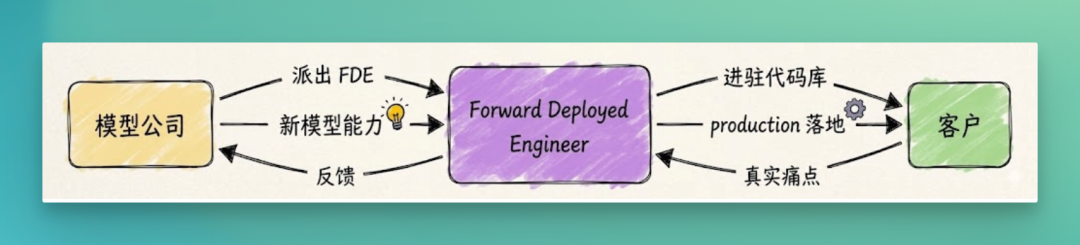
Pay attention to the two most informative lines in this diagram—the feedback loops sent by FDE in both directions. Toward the client, FDE doesn’t sell the model as a SaaS product; instead, it integrates the client’s data, permissions, compliance requirements, and internal systems into a pipeline capable of running the model. Toward the model company, FDE brings back real-world pain points and failure samples to inform product and research roadmaps—an often-repeated flawed tool calling pattern might become the next built-in abstraction in the SDK.
This explains why both leading model companies have simultaneously revived FDE—not simply because “we want to emulate Palantir’s consulting model.” Instead, it functions as a signal acquisition device for model companies: the densest customer pain points at the frontlines can only be captured when someone from the company is physically present. Requests translated through partners always lose nuance. Anthropic’s approach is hybrid: building its own FDE force while partnering with consulting firms and PE giants to establish a joint deployment network. One leans toward direct control, the other toward ecosystem collaboration—but the core principle remains identical: model companies are no longer just API vendors; they now send engineers directly into customers’ products.
Next, we’ll address the two most common comparative questions: Where does FDE draw the boundary with traditional consulting (like McKinsey, Accenture)? And how does it differ from familiar software outsourcing?
FDE Is Not McKinsey: Model Boundary vs. Process Boundary
Many people’s first reaction upon hearing FDE’s job description is: “Isn’t this just a new version of McKinsey or Accenture?”
The author understands this association. Dressed in suits, traveling to client sites, drawing on whiteboards in client meeting rooms, aligning with C-level executives—on the surface, FDE and consultants look alike. But dig deeper, and the underlying work logic diverges completely. Consulting sells process boundaries; FDE sells model boundaries.
Placing these two side by side immediately highlights the differences.
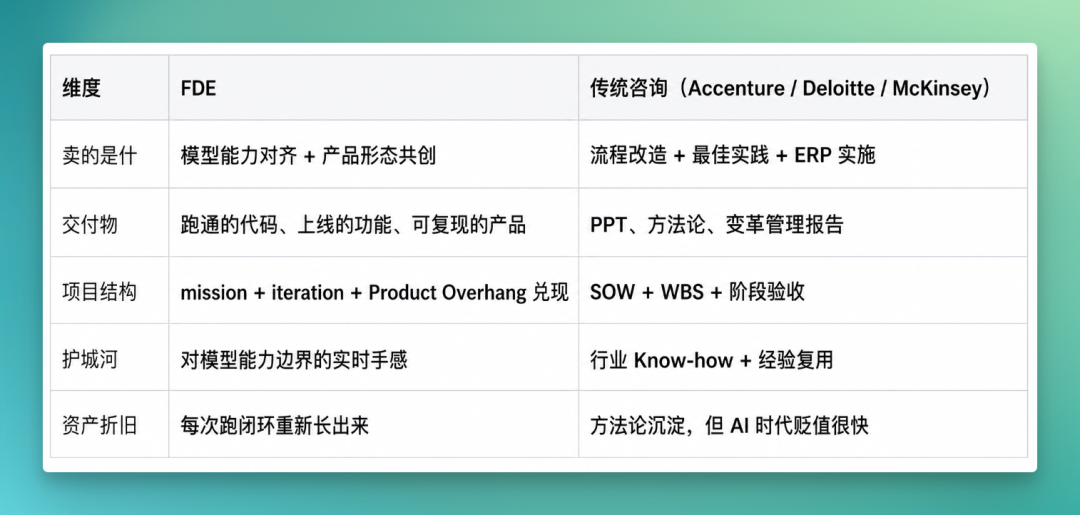
The most noteworthy row in this table is “asset depreciation.”
The traditional consulting model thrives on asset reuse: a solution designed for one bank can be slightly modified and resold to another; a digital playbook for retail can be applied to thirty clients. This has been the foundational economic engine behind Accenture, Deloitte, and McKinsey Digital for the past three decades.
FDE has no such asset. Model capabilities are moving too fast—today’s carefully engineered prompt chains may be replaced by a single sentence in the next model iteration. The “methodology capitalization” central to consulting rapidly depreciates under this velocity. Therefore, FDE cannot rely on asset reuse; each closed-loop must be run fresh—reassessing model boundaries, selecting tools anew, reassembling product forms. Though seemingly inefficient, it’s the only way to keep pace with model evolution.
Do you know what Product Overhang means? The author explained this term in the prior article, “To the Super Individual” [4]: model capabilities have already surpassed existing product forms, but lack product entry points, permissions, and contextual frameworks to realize them. The true value of the FDE role lies in transforming this suspended Overhang into a tangible, runnable product. Clients aren’t buying API call quotas—they’re buying the ability to have someone bring this abstract Overhang into their actual business operations.
This also clarifies the difference in “project structure.” Traditional consulting follows a standard SOW (Statement of Work) + WBS (Work Breakdown Structure) + milestone acceptance: deliverables, timelines, and acceptance criteria are clearly defined in contracts. This model assumes goals are well-defined before signing.
FDE projects don’t fit this framework. The most common client phrase is: “I know AI should help me do something, but I don’t know what.” The goal itself is part of the project. Thus, FDE doesn’t accept SOWs—it accepts missions—a relatively vague direction—and iteratively clarifies it. Only after several rounds does the accumulated model understanding crystallize into a product form.
The “deliverable” row also warrants expansion. What remains in the client’s system after FDE leaves is a functional component—possibly small, possibly ugly, possibly lacking UI—but one that is actually called daily, constantly modified, and frequently criticized. Consulting deliverables are PowerPoint decks and change management reports; even if code was written or ERP configured during the project, the final artifact handed to the client’s leadership remains a methodological document.
The “moat” row is the most subtle. FDE’s moat is real-time tactile awareness of model capability boundaries—you’ve worked with how many real client scenarios this month, and thus you know better than others what Claude 4.7 can do and what must wait for Claude 5. This intuition cannot be documented in a PPT or stored in a knowledge base—it only grows in the mind of an engineer who has personally wrestled with these challenges in the last 90 days.
So the next time someone says “FDE is just a new version of Accenture,” reply: Accenture’s engineers come to redesign client processes; FDE’s engineers come to explore model boundaries. The former’s assets can be reused for a decade; the latter’s assets must be rebuilt every 90 days.
FDE Is Not Software Outsourcing: Co-Exploration vs. Requirement Fulfillment
If “FDE is a new Accenture” is the first layer of misunderstanding, then “FDE is premium software outsourcing” is the second—and more misleading. This layer appears highly convincing on the surface: FDE truly writes code onsite, customizes features per client business, and works within client hours. At first glance, it seems indistinguishable from outsourced engineers.
But once you examine the feedback loop, the difference becomes evident.
The most critical distinction isn’t how simple the top half of the diagram looks, but rather the additional feedback chain extending downward toward the model company. This chain isn’t decorative—it’s the fundamental reason FDE exists. Breaking down this difference reveals at least four contrasts.
What they receive differs. Outsourcing receives SOWs—clearly defined requirement lists established before contract signing: which features to build, which tech stack to use, acceptance criteria, penalties for non-compliance. FDE receives missions—clients themselves haven’t figured out what they want, only knowing “AI should help me with something.” SOWs assume certainty; missions assume exploration. These are entirely different project initiation postures.
The scope of work differs. Outsourcing delivers partial outputs—a module, a website, a data pipeline—then packs up and leaves for the next client. FDE delivers end-to-end: starting from business pain points, progressing through model selection, product form design, to post-launch user retention and churn analysis.
The billing model differs. This is the most counterintuitive point. When a model company sends FDEs onsite, its ultimate concern isn’t just the consulting fee from this project, but whether the client will consume more tokens going forward, whether they’ll become retained customers, and whether they’ll expand to other business lines. The real KPI for FDE is the long-term token consumption curve of the model, not the number on the project acceptance form.
The destination of feedback differs. This is the deepest of the four contrasts. In outsourcing projects, client feedback typically stops at the outsourcing firm and never influences future products sold to others. FDE feedback, however, flows back into the model company’s roadmap—every pitfall encountered in real scenarios, every failed prompt, every tool invocation bug becomes input for the next training data, next tool design, next product feature. In effect, every FDE-deployed client serves as a natural design partner for the model company.
This is why model companies are willing to pay high salaries for FDEs. They aren’t just selling a service; they’re collecting real-world product form signals from the frontline. These signals are unbuyable, uncatchable, and undetectable via surveys—they can only be brought back by a specific engineer, having personally hit walls multiple times within a specific client workflow.
Do you know what total compensation for OpenAI and Anthropic’s FDE roles can reach? According to public data from Levels.fyi on Anthropic software engineers [8], senior SDE median total compensation has already reached $710K. FDE carries higher risk—facing uncertainty in model capabilities, client business, and product form—so industry estimates [9] place mid-to-senior FDE total compensation in the $350K–$550K range, with Staff-level and above reaching $630K+. This price isn’t paid for “outsourced man-hours,” but for bearing the combined risks of product, client, and model—three dimensions of uncertainty.
Recall 2006, when the author started working, employed by a state-owned enterprise undergoing digital transformation. Back then, our group invited Accenture consultants to reside onsite, paying them $3,500 per day for years—earning them the media nickname “golden-collar.” Later, the author joined German SAP, which essentially defined a consulting industry name—SAP consultants became symbols of “golden-collar.” Viewed this way, FDE salaries are likely to rise steadily over the next 24–36 months, with demand also growing consistently.
Outsourcing is labor arbitrage; FDE is a frontline sensor. Confusing the two leads buyers to mistakenly believe they can onboard FDE using SOWs, and candidates to treat FDE with an outsourcing mindset. Both will crash quickly.
Two Roots of Foreign FDE: Palantir and the New Generation of Model Companies
Many mistakenly believe the term FDE was invented by OpenAI. Actually, it has two historical roots—one from Palantir, the other from the new generation of model companies post-2023. Seeing these two roots side by side offers clearer insight into what the FDE role truly entails.
First, consider a timeline.
The first root is Palantir.
Palantir was founded in 2003 by Peter Thiel, Alex Karp, Joe Lonsdale, and others, with early clients being U.S. intelligence agencies. Karp himself had no CS background—he studied philosophy under Jürgen Habermas in Frankfurt before returning to the U.S. and being recruited by Thiel to serve as CEO. The FDE role emerged precisely from Karp’s “non-traditional CEO + highly classified clients” combination: 36Kr’s retrospective [10] puts it plainly—Palantir was heavily criticized early on because engineers couldn’t access real business contexts, and requirements got distorted through layers of translation. Eventually, Palantir negotiated a deal: sending their own engineers directly into client sites to work alongside intelligence analysts. This model was later systematized by Shyam Sankar, forming the prototype of FDE.
By 2009, FDE expanded into commercial sectors. When JPMorgan deployed Palantir’s Metropolis platform, 120 FDEs were stationed onsite for internal threat monitoring. From then on, FDE ceased being just “sending engineers on site”—it became a systematic client embedding strategy: getting Foundry/Gotham truly operational within the client’s business flow, not just handing over a license and leaving.
Palantir’s FDE hiring includes a counterintuitive criterion: no requirement for a CS degree. This belongs in the “Did you know?” section.
Did you know—Palantir FDE doesn’t require a CS degree? According to SkillScouter’s compilation of Palantir’s hiring standards [11] and Palantir’s official careers page [12], Palantir explicitly welcomes non-CS candidates, with recent FDE hires coming from mechanical engineering, economics, philosophy, and other disciplines. The two real filters are: the ability to act with incomplete information, and the capacity to communicate directly with C-level clients. A CS degree is a bonus, not a prerequisite. Karp himself was the earliest embodiment of this standard—a philosophy PhD CEO leading a team of physicists, mathematicians, and philosophers.
The second root is the new generation of model companies post-2023.
After ChatGPT’s release at the end of 2022, OpenAI quickly realized: simply posting model APIs in documentation wouldn’t get clients to adopt them. Clients weren’t unwilling—they just didn’t know how. They had business problems but lacked product forms. Thus, OpenAI, Anthropic, Cohere, Scale, Glean, Sierra, Hebbia, Decagon, and others began hiring FDEs en masse.
This wave of FDEs learned Palantir’s playbook—sending engineers to client sites to run entire workflows end-to-end. But the product vehicle has changed completely: FDEs in the Palantir era focused on data integration and UI customization; today’s FDEs focus on prompt engineering, agent orchestration, tool calling, and workflow embedding.
Pragmatic Engineer’s dedicated piece on FDE [13] calls this new version “embedded with enterprises to make Claude solve real, specific, high-value problems”—a phrasing almost identical to Palantir’s original, except replacing “data” with “model.”
Viewing these two roots together reveals a clear set of shared characteristics and distinctions.
Shared traits: Clients aren’t buying software. They’re buying “an engineer + tool combination capable of solving my problem.” This has historically been abnormal in enterprise software—SAP, Oracle, Salesforce sold software itself, with engineers serving only as auxiliary resources to make the software accessible. Palantir flipped this: tools exist to enable FDEs to solve problems onsite. The new generation of model companies inherit this inverted relationship—OpenAI doesn’t sell a GPT-4 license; it sells “our FDEs can use GPT-4 to automate your customer service.”
Differences: The Palantir era leaned toward OPS integration—focus on data integration, ontology modeling, permission governance. The new era focuses on model capability delivery—emphasis on prompt design, agent orchestration, retention optimization. The former resembles an advanced systems integrator; the latter, an extension of product engineering.
Finally, here’s an interesting fact: Many early Palantir FDEs later became entrepreneurs or joined the new generation of model companies. Early teams at Anthropic, OpenAI, Sierra, Hebbia, and others include a long list of ex-Palantir names. This isn’t coincidental—FDE inherently demands individuals to shoulder product risk, client risk, and engineering risk simultaneously, effectively serving as entrepreneurial training. The author views Palantir as an invisible startup incubator: it produces not just engineers, but people who know how to push initiatives from zero to one amid incomplete information. These two roots converged after 2023.
Domestic FDE: From Solutions Architect to AI Implementation Engineer
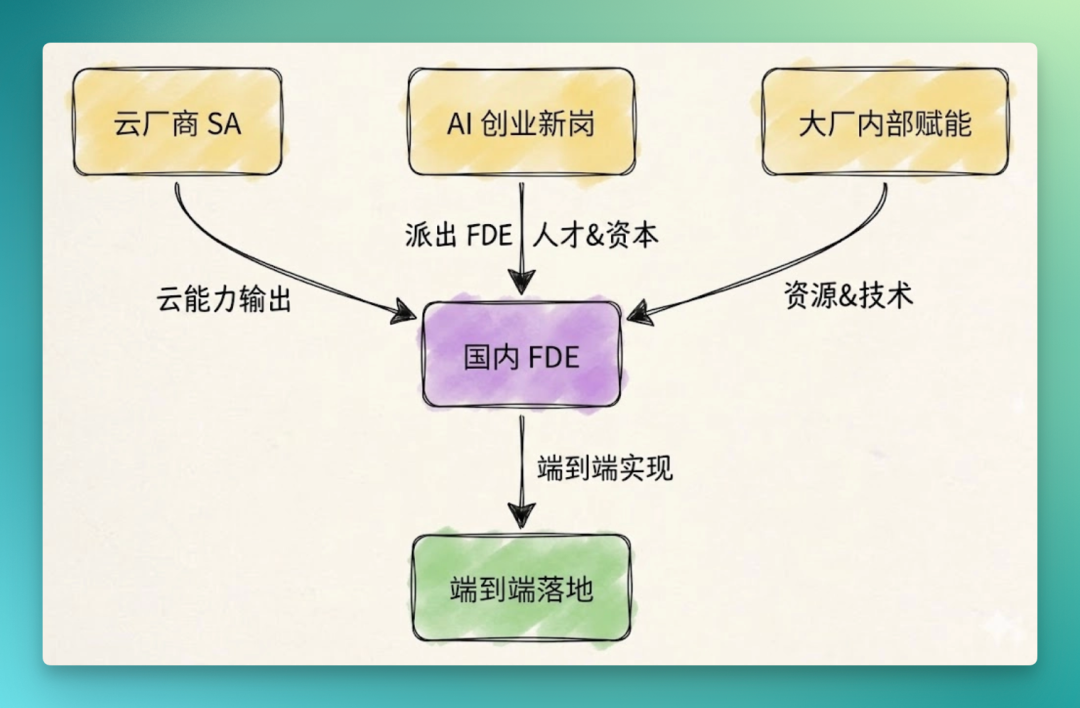
The convergence of these two roots primarily occurred abroad. In China, the term FDE has only recently appeared, but the corresponding work content isn’t newly invented. To understand domestic FDE, one must first recognize its two indigenous predecessors, then identify the three contextual differences from the U.S. version.
Two Indigenous Predecessors
The first predecessor is cloud vendor solutions architects. Over the past decade, Alibaba Cloud, Tencent Cloud, and Huawei Cloud have cultivated entire teams of Solution Architects (SA), advising clients on architecture, writing proof-of-concepts, designing migration plans, and supporting delivery to launch. Huawei even maintains a dedicated “delivery engineer” track responsible for deploying projects into client data centers. This system has already performed 80% of what FDE does—but the focus remains on pre-sales and deployment. End-to-end product iteration responsibility doesn’t lie with SA; changes require change requests, and model upgrades depend on headquarters scheduling.
The second predecessor is newly emerging roles within AI startups. MiniMax lists “AI Pre-sales Solution Expert” on Boss Zhipin; Moonshot, Zhizhi, Tongyi, Hunyuan, and other model companies also post similar roles. While titles vary slightly, JD content is highly convergent: understanding client scenarios, creating demos, tuning prompts, running RAG, writing delivery proposals, and coordinating with client engineering teams until launch. These roles are truly the domestic equivalent of FDE.
Three Contextual Differences
Private deployment + data compliance overrides pure model API calling. Chinese B2B clients demand stricter data localization, model weight controllability, and audit traceability than their U.S. counterparts. In an FDE project, pure API-driven prompt execution may account for only 30% of work; the remaining 70% involves moving models into client data centers, enabling authentication, connecting to data middleware, and completing compliance filings.
Model capabilities still lag behind SOTA, compressing room for innovation into the engineering layer. While U.S.-based OpenAI and Anthropic can impress clients with model power alone, domestic players like Tongyi, Douyin, Kimi, GLM, and DeepSeek show minimal differentiation. Client decisions hinge more on agent orchestration, RAG retrieval quality, tool integration, and workflow design—engineering prowess. Domestic FDE competes not on “my model is stronger,” but on “can I actually run this business successfully?”
B2B payment willingness and pricing rhythm differ from the U.S. The Palantir-style model—send FDEs first, then charge high subscription fees—doesn’t transfer directly. Chinese clients budget according to annual procurement cycles, favoring project-based payments. FDE’s business model often blends subscriptions, private licensing, and project delivery.
A Unique Positioning: Internal FDE
Many large tech companies’ internal AI teams are beginning to serve “internal clients” using FDE-style models. Alibaba Cloud’s PAI sends engineers to Taobao; Tencent’s Hunyuan employs similar mechanisms to connect with WeChat and ad business units. Job postings on JD.com list roles like “Industry Implementation Engineer,” “AI Application Engineer,” and “Intelligent Business Expert”—essentially internal FDEs: bringing model team capabilities end-to-end into business operations. This gives big company leaders a new idea: placing a few internal FDEs onsite, running the first demo, delivering ROI data to business heads—this could dissolve departmental barriers faster than ten alignment meetings.
Who Is Suited for FDE, Who Isn’t
In the prior article, “To the Super Individual” [4], the author discussed five engines of the super individual: strong curiosity, exploratory and innovative spirit, strong self-learning ability, high self-motivation, and strong hands-on skills. These five traits are the entry ticket to FDE—but not sufficient. Beyond these five, FDE demands a distinct set of additional qualities, and certain personality types are clearly unsuited. The author has seen countless skilled engineers struggle with FDE transitions—not due to ability, but due to personality and work preferences.
Five Traits Suited for FDE
Comfortable with sales and communication. FDE’s daily work isn’t closing doors to write code; it’s directly engaging with clients’ CTOs, business leads, procurement, compliance, and IT teams. A typical rhythm: a client CTO interrupts your demo mid-way—FDE’s response shouldn’t be “I’ll revise and return next week,” but opening the IDE on the spot to tweak the prompt and rerun it live. “Client present, I’m modifying” is the norm.
Enjoy ambiguity. FDE receives no clear PRD—only a statement like “We want to do something with AI.” Clients themselves can’t articulate what they want, requiring FDE to help shape that fuzzy expectation into a concrete form. If you only activate when requirements are clear, FDE will leave you anxious daily.
Strong engineering foundation but not necessarily 10x. FDE doesn’t require you to be the cleanest coder or deepest algorithmist in the company. It needs you to deliver end-to-end: building a basic clickable frontend, setting up a functional backend service, and connecting the model to business data sources. In the FDE world, “good enough” isn’t a flaw—it’s a virtue.
Thrives on feedback. FDE’s work includes numerous “being yelled at and restarting” moments: today’s demo rejected tomorrow by business stakeholders; last week’s aligned plan scrapped this week due to a new executive. Those suited for FDE treat such feedback as fuel, able to carry end-to-end responsibility without blaming “the client didn’t clarify.”
Sensitive to model boundaries. This is the most technical and subtle trait. FDE must judge which tasks are suitable for LLMs, which aren’t, and how to fallback—this sensitivity isn’t found in papers, but forged through failure cases. Accumulated failures give FDE muscle memory for model boundaries: when to use RAG, when to apply rules, when to provide a human fallback option.
Four Types Unsuitable for FDE
Those who prefer hiding in code. FDE spends roughly 50% of time away from coding—in client meetings, internal coordination, product discussions, and contract negotiations. If your joy comes from uninterrupted four-hour coding sessions, FDE will lead to chronic mental exhaustion.
People who need OKRs to start. FDE’s goals live with the client, not on your performance dashboard. Progress is shaped by client milestones, model capability shifts, and your own situational judgment. Those used to “first get OKRs, then know what to do” will lack anchor points.
Those who prioritize promotion over output. FDE holds no advantage in large company promotion systems—client satisfaction, deal closure, reuse rates matter more than code volume or deployment frequency in promotion reviews. If your primary motivation is advancement, FDE isn’t a good fit.
Those resistant to business context. FDE must understand clients’ P&L, ROI, procurement processes, and compliance needs. If you naturally dislike talking money, contracts, or business logic, FDE work will make you feel like you’re betraying your technical ideals.
Self-Check Checklist
Seven questions, each reflecting a real FDE work scenario. Answer “yes” to five or more—consider FDE seriously. Answer fewer than three—proceed with caution.
1. Are you willing to shift 50% of your daily time from coding to client meetings, message replies, and phone calls?
2. When a client says “This won’t work, but I can’t explain why,” is your first reaction curiosity or annoyance?
3. Without a PRD, can you build a client-ready prototype within a week using Claude Code?
4. After eight revisions of the same deliverable, can you maintain judgment instead of mechanical execution?
5. When the model gives wrong answers, is your first instinct to design a fallback—or blame the model?
6. Are you willing to sign contracts, write reports, run client acceptance, and negotiate compliance clauses with legal?
7. Can you accept rapid prototyping and rapid failure?
The five traits, four unsuitable profiles, and seven self-assessment questions ultimately converge on one question: Are you willing to have your product sense, engineering strength, and business judgment sharpened simultaneously within a single workflow?
Conclusion: From Super Individual to Super Role
In the previous article, the author discussed the “human engine”: curiosity, exploration, self-learning, self-motivation, and hands-on ability—how these are fully activated within a closed-loop system inside large corporations. This article addresses the other side—the job morphology. FDE is the first new job type in the AI industrial revolution with a name, salary band, recruitment JD, and client-paid validation. It is not synonymous with “super individual,” but rather the first tangible coordinate to emerge from this round of restructuring.
FDE is not the endpoint. The author’s view is that FDE is merely the first job type to gain a name in this new division of labor. More will follow: Forward Deployed PM, Forward Deployed Designer, Forward Deployed Researcher—all roles tightly coupled with client scenarios, needing to grow products amid ambiguity—will develop their own “forward-deployed” versions. Job titles may change, but the underlying logic remains: model capabilities race ahead, product forms trail behind, and job structures reconfigure along evolving workflows.
Leaving one thought for three reader groups:
To technologists: FDE doesn’t require you to be the strongest coder in the company, but it does require you to be willing to shift half your time from code to client-facing work. If your answer is “yes,” the market window has just opened—top Chinese model companies, cloud providers, and internal AI teams at major firms are accelerating hiring. If your answer is “no,” that’s fine too—new divisions will create other opportunities for you.
To HR and OD professionals: Beware “name-content misalignment.” Your company may already have FDEs operating under titles like “Solution Expert,” “Industry Architect,” or “AI Application Engineer.” Identify them, reclassify, and create growth paths aligned with their actual work—far more efficient than hiring from scratch.
To managers: The FDE model isn’t just external—it can be internal too. Placing a few “internal FDEs” onsite within business units, running model team capabilities end-to-end into business processes, may be far more efficient than launching a new AI department and holding ten cross-team alignment meetings. Departmental walls aren’t dissolved by organizational design—they’re dissolved by a working demo.
The career transition in the AI era has begun. FDE is the first signal flare, telling us: the speed of model capability change has accelerated to the point of forcing new job creation. The author leaves readers with a concrete question: If your company’s org chart gains three new roles in three years, what do you think they’ll be? Figuring that out is more valuable than reading this article.
👦🏻 Author: Henry (DeerFlow Team) [1]
Disclaimer: Contains third-party opinions, does not constitute financial advice
Iranian state media denies the existence of a memorandum of understanding between Iran and the U.S.
10 mins ago
Binance Alpha Citrea (CTR) Airdrop Threshold: 211 Points
14 mins agoChina accounts for over 80% of the global humanoid robotics market
26 mins agoGlassnode: Approximately 7.75 million BTC are currently in a loss position
43 mins ago
Bytedance has issued equity incentives for a specific business unit for the first time, opening up "DouBao Shares" subscription rights to Seed employees this month
43 mins agoData: NEAR Intents has generated over $33 million in fees since launch
49 mins ago
Data: 21Shares and Bitwise ETF collectively purchased $68 million worth of HYPE last week
51 mins ago

