10x Faster Than NVIDIA! Micron Surpasses $1 Trillion Market Cap in Just 48 Days—Is the AI Storage Super Cycle Just Getting Started?
10x Faster Than NVIDIA! Micron Surpasses $1 Trillion Market Cap in Just 48 Days—Is the AI Storage Super Cycle Just Getting Started?


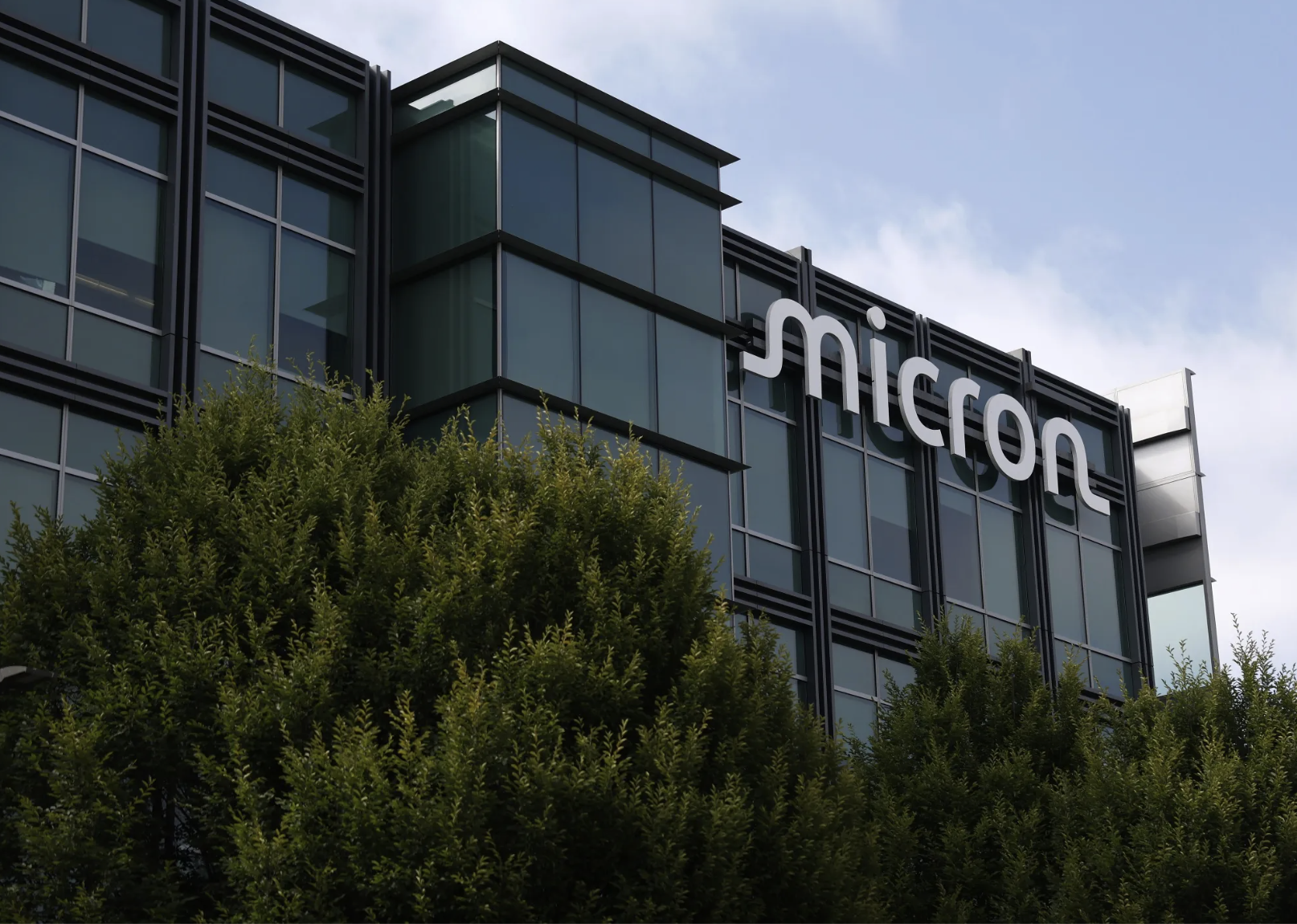
Micron Technology (NASDAQ: MU) saw its stock surge 18-19% on May 26, marking the first time its market capitalization broke through the $1 trillion threshold.
The catalyst was UBS analyst Timothy Arcuri upgrading Micron’s price target from $535 to $1,625—the highest among the 46 Wall Street analysts covering the company. This implies more than double the upside from last Friday’s closing price of $751.
48 Days vs. 490 Days: The Fastest Trillion-Dollar Sprint in History
Micron’s record is not merely “another $1 trillion company.”
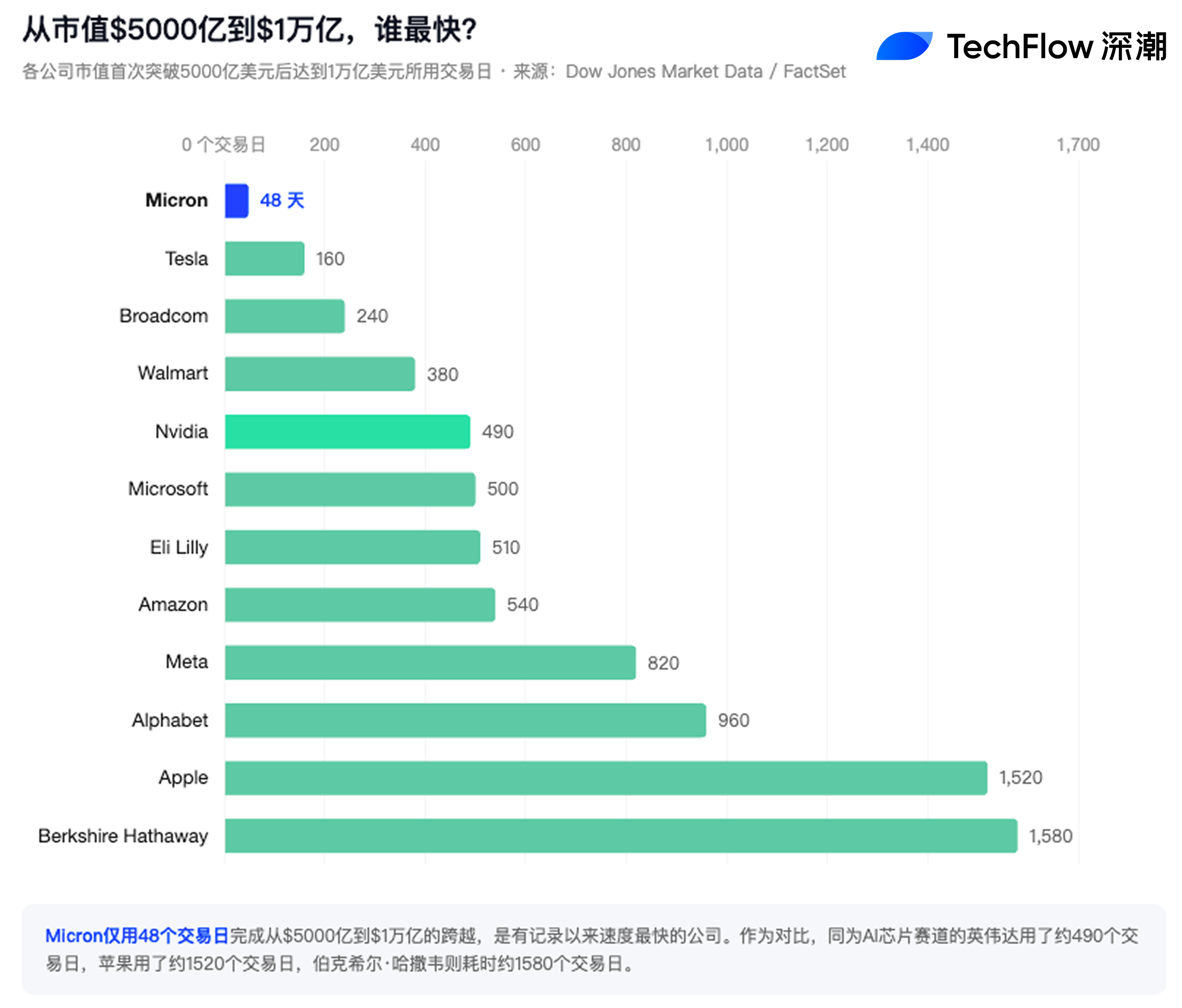
According to Dow Jones Market Data, Micron achieved the milestone from surpassing $500 billion in market cap to entering the trillion-dollar club in just 48 trading days. For comparison, Nvidia—another leader in the AI chip space—took roughly 490 days; Apple took about 1,520 days; Berkshire Hathaway required around 1,580 days. Micron’s pace is ten times faster than Nvidia’s.
This makes Micron the 12th U.S. company to reach a $1 trillion market cap and the first headquartered in Boise, Idaho. Over the past month, the stock has surged nearly 80%; since its March 31 low, gains have reached 180%, contributing nearly as much market value to the S&P 500 as Amazon over the same period.
Dan Russo, Co-Chief Investment Officer at Potomac, said, “From every perspective, this appears unprecedented.”
UBS: There’s No Reason Micron Shouldn’t Trade Like Nvidia
UBS presented a bold valuation framework in its report: Micron is transitioning from a cyclical commodity stock to a structural growth stock underpinned by long-term contracts, warranting a fundamental shift in how it should be priced.
UBS notes that AI-driven demand is fundamentally reshaping the entire memory chip market structure. Long-term agreements (LTAs) lock in production volumes and partially fix pricing, smoothing out Micron’s historically volatile earnings curve. The report bluntly states, “There’s no reason Micron shouldn’t trade at a P/E level comparable to Nvidia’s.”
Per UBS’s projections, Micron’s EPS will exceed $100 in fiscal years 2027–2029. Even at its current intraday high of approximately $891, forward P/E remains only about 8.4x—far below the S&P 500’s overall ~21x.
Michael Rosen, Chief Investment Officer at Angeles Investments, put it more directly: “For years, Micron was seen as a commodity play—producing something very basic. Now, it has become an industry benchmark.”
$107 Billion a Year Ago, Now Breaking Trillion: The Logic Behind the AI Storage Super Cycle
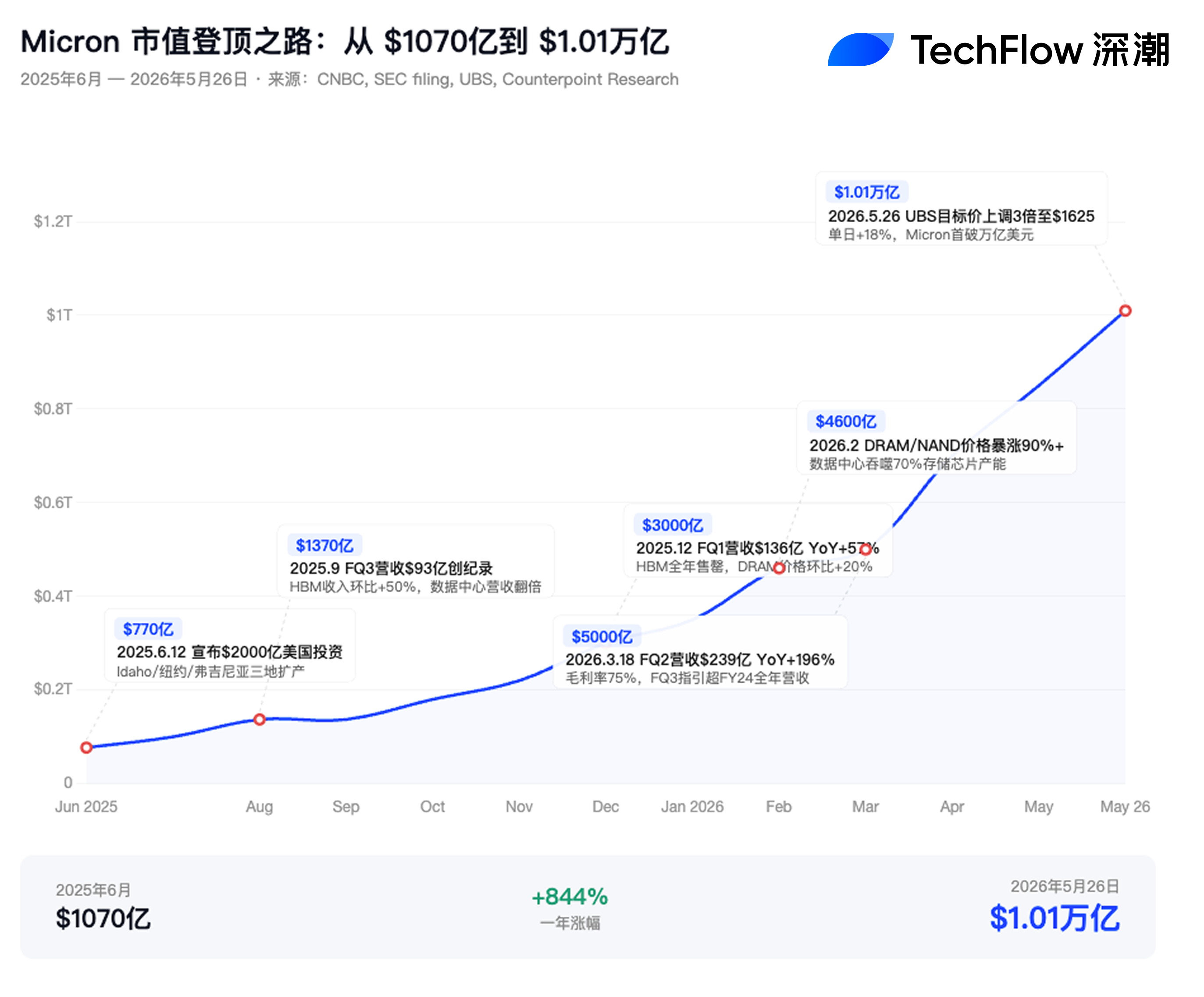
A year ago, in June 2025, Micron’s market cap was around $107 billion. Today, it’s nearly ten times higher. The trajectory is fueled by a cascade of accelerating fundamentals.
In June 2025, Micron announced a $200 billion U.S. investment plan in partnership with the Trump administration, expanding capacity across Idaho, New York, and Virginia—with the goal of relocating 40% of its DRAM production back to America. The FQ1 2026 results released in December confirmed that HBM (High-Bandwidth Memory, a critical component for AI training chips) output was fully sold out for the year, with prices locked in. DRAM contract prices jumped 20% sequentially.
By the time Micron reported FQ2 results on March 18, 2026, numbers had gone completely off the rails: quarterly revenue hit $2.39 billion, surging 196% year-over-year—22% above Wall Street’s $1.919 billion expectation. Gross margin soared to 75%, non-GAAP EPS reached $12.20, 39% above the consensus of $8.79. Even more staggering was the FQ3 guidance: projected quarterly revenue of $3.35 billion—exceeding Micron’s total FY2024 revenue.
The underlying driver is the most severe supply-demand imbalance in memory chips in over 40 years. Data centers are expected to consume 70% of global memory chip output in 2026. HBM capacity is already sold out through 2027. DRAM and NAND prices spiked over 90% in Q1 2026. This isn’t a cyclical rebound—it’s a structural revaluation of storage demand driven by AI infrastructure buildout.
Micron CEO Sanjay Mehrotra stated during the FQ2 earnings call: “AI isn’t just increasing demand for storage—it’s fundamentally redefining storage as a strategic asset in the AI era.”
Storage Mania Masks Nvidia’s Absence, Philadelphia Semiconductor Index Divergence Intensifies
Micron’s single-day 18% gain propelled the Philadelphia Semiconductor Index up nearly 6%, but a notable phenomenon emerged: Nvidia’s absence. The index diverged sharply from Nvidia’s stock performance—a rare split, as memory and equipment stocks took over the baton of the AI semiconductor rally.
Currently, Micron accounts for only about 2% of the Nasdaq Composite and roughly 1.5% of the S&P 500—far below the 6%+ weightings of the “Magnificent Seven.” Yet on May 26, Micron contributed more to both indices than any single member of the Seven.
Last Friday, President Trump mentioned Micron during a rally in New York: “Goodness, Micron is amazing.”
On prediction market platform Kalshi, bets on whether the U.S. government will take equity in Micron by 2026 now stand at 40%. As the only U.S.-based player among the world’s three major memory chip manufacturers—alongside South Korea’s SK Hynix and Samsung—Micron’s domestic status carries additional strategic value amid today’s geopolitical tensions.
Author: Claude, DeepTide TechFlow
Disclaimer: Contains third-party opinions, does not constitute financial advice
NVIDIA attracts $85 billion in investor demand during massive bond issuance
06-16
Ethereum surges over 10% in 24 hours, currently priced at $1,841.31
06-16Amazon announces a multi-billion dollar investment in Missouri to build a data center campus, expected to create over 400 long-term positions
06-16Binance Platform's SpaceX Perpetual Contract Trading Volume Surpasses $9 Billion, Capturing Over 60% Market Share
06-16Binance platform XLM/USDT short-term spike down to $0.17, now recovered to $0.225
06-16
Trump: The Strait of Hormuz has been fully reopened as of Friday, and all agreements have been signed
06-16SlowMist: Aztec Connect Contract Hacked for $2.19 Million Due to ZK-Rollup L1/L2 State Boundary Vulnerability
06-15
