ETF Siphons $100M in Capital, DAT Joins Russell 3000: Hyperliquid’s “Wall Street Moment”
ETF Siphons $100M in Capital, DAT Joins Russell 3000: Hyperliquid’s “Wall Street Moment”



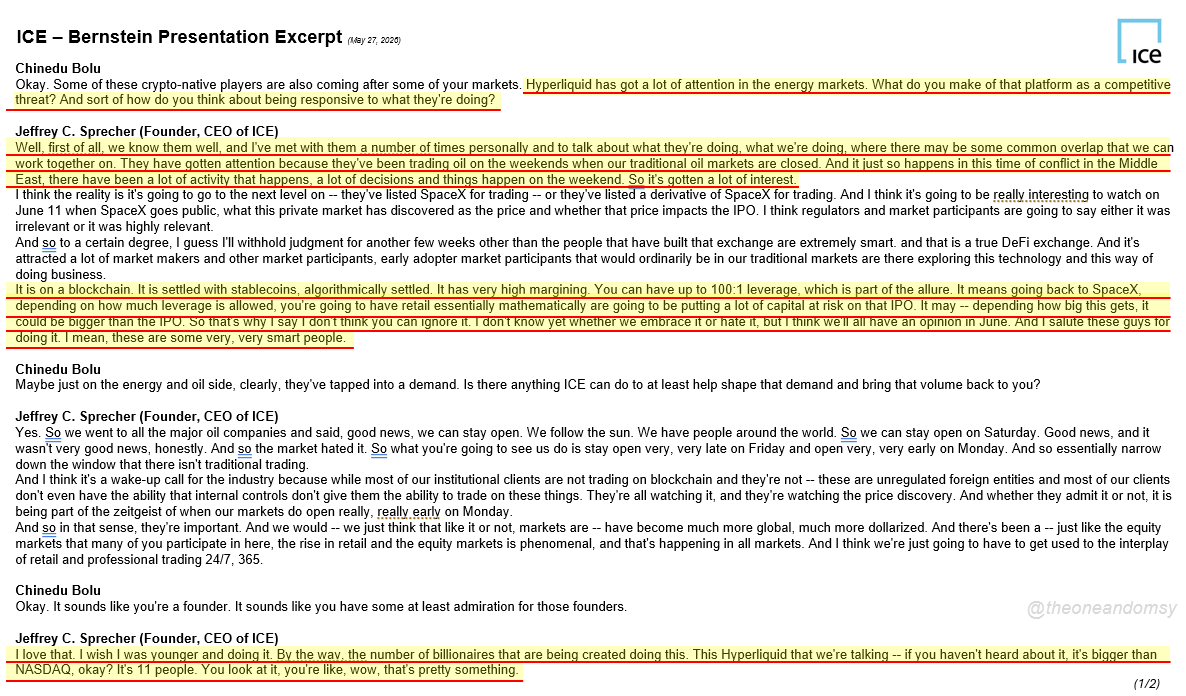
On May 27, Jeff Sprecher, founder and CEO of Intercontinental Exchange (ICE), offered a rare, personally charged assessment of Hyperliquid during an interview at the Bernstein Annual Strategic Decisions Conference.
“This Hyperliquid we’re discussing— if you haven’t heard of it yet, it’s bigger than Nasdaq, okay? Just 11 people. When you see this, you’d say, wow, that’s truly impressive,” said Sprecher. He then added: “I love this. I wish I were younger so I could get in there myself. By the way, billionaires are being created by the batch among those doing this.”
ICE is the parent company of the New York Stock Exchange and operates one of the world’s largest energy futures markets. Sprecher’s remarks represent the most direct public endorsement to date from the highest echelons of traditional finance toward Hyperliquid.
From Joint Lobbying “Crackdown” 12 Days Ago to CEO’s U-turn in Tone
Sprecher’s praise has sent shockwaves, primarily due to timing.
On May 15, Bloomberg reported that CME and ICE executives had issued warnings to CFTC and Capitol Hill officials, arguing that Hyperliquid’s decentralized perpetual contract trading posed risks of market manipulation and sanctions evasion, calling for its inclusion under traditional financial regulatory frameworks. The news triggered a nearly 9% drop in HYPE.
Just 12 days later, ICE’s chief executive publicly expressed admiration on one of Wall Street’s most important investor forums.
In his Bernstein presentation, Sprecher directly addressed the contradiction: “The article headline made it sound like we were scared. We weren’t scared. In fact, we’ve been engaging with these people, learning what they’re doing. They’re understanding our world, and we’re understanding theirs. In that sense, it’s mutual admiration.”
He then pivoted to the core regulatory demand: “What we’re telling regulators is, can we do this too? Why are you banning us from doing something that’s already happening? Can we have a level playing field? This administration is strongly supportive of digitization. If you believe this is legal, let us do it too; if not, why haven’t they received the same harsh letters we got?”
This statement reveals ICE’s true lobbying logic: not to shut down Hyperliquid, but to seek regulatory relief allowing traditional exchanges to enter the on-chain derivatives market.
On the Eve of SpaceX’s IPO: Hyperliquid as a “Shadow Pricing Venue”
Sprecher’s interest in Hyperliquid is far from generic—he has a very specific lens: SpaceX is set to list on Nasdaq on June 12 with an estimated valuation of $1.75 trillion, and derivative contracts on SpaceX are already trading on Hyperliquid.
“I think what really elevates it is SpaceX. They’ve already launched SpaceX derivatives trading. It’ll be fascinating on June 11 when SpaceX officially prices—seeing what the private market discovers, and whether that price influences the IPO itself,” said Sprecher. “Regulators and market participants will say either this is completely irrelevant or highly relevant.”
He then calculated an extreme scenario: given Hyperliquid allows up to 100:1 leverage, if retail traders flood into SpaceX derivatives, the nominal exposure on-chain “could potentially exceed the IPO itself.”
“So I say you can’t ignore it. I don’t yet know whether we should embrace it or despise it, but by June, we’ll all have answers.”
HYPE ETF Launches in 10 Days, Attracts $100M; PURR Selected for Russell 3000
Sprecher’s comments come at a pivotal moment as Hyperliquid undergoes intense mainstream institutionalization.
On May 12 and 15, 21Shares and Bitwise launched the first U.S.-listed HYPE spot ETFs on Nasdaq (THYP) and NYSE (BHYP), respectively. According to bitcoin.com, both funds collectively attracted over $100 million in net inflows within their first 10 trading days, absorbing 1.04% of HYPE’s total market cap—outperforming Bitcoin and Ethereum ETFs on a proportional basis in their initial launches. Bitwise recorded $19.05 million in net inflows on May 27 alone, becoming the world’s largest HYPE ETF.
On May 22, FTSE Russell released the preliminary list for the 2026 June Russell U.S. Index Rebalance, with Hyperliquid Strategies (NASDAQ: PURR) included in the addition list for the Russell 3000, effective June 26.
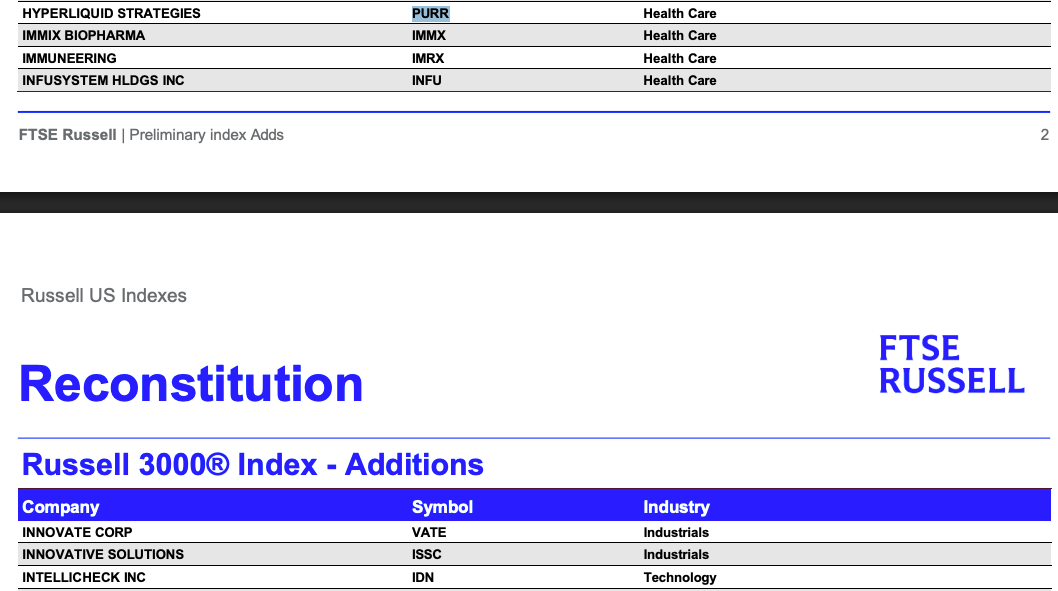
PURR is currently the largest HYPE token treasury entity, holding approximately 20 million HYPE tokens (valued at ~$799 million as of April 29) and $103 million in cash, with zero debt. Inclusion in the Russell 3000 means passive funds tracking the index will automatically buy PURR, further cementing the capital flow channel from HYPE into traditional financial markets.
HYPE surged past $64 earlier this week, hitting a new all-time high, with a year-to-date gain of around 150%, far outpacing Bitcoin’s performance. According to CoinGecko, HYPE’s current market cap stands at ~$12.7 billion, ranking tenth among cryptocurrencies.
Jeff Yan Heads to Washington, Hyperliquid Policy Center Faces Off Directly
Faced with lobbying pressure from CME and ICE, Hyperliquid chose a direct response.
On May 15, Hyperliquid founder Jeff Yan revealed that he and the Hyperliquid Policy Center (HPC) had held meetings in Washington with policymakers. HPC, established in February 2026, is an independent research and advocacy organization led by Jake Chervinsky, former policy lead at Blockchain Association and former chief legal officer at Variant, funded initially with 1 million HYPE tokens from the Hyper Foundation.
Yan stated on X that the discussions centered on “how on-chain trading as a financial innovation meets clear global user demand” and “the regulatory pathway to bring on-chain derivatives markets into the United States.”
In response to Bloomberg’s report on CME and ICE’s lobbying efforts, HPC emphasized that Hyperliquid provides markets “more beneficial and lower-risk than traditional centralized exchanges,” and anticipates the CFTC will establish a dedicated regulatory framework for on-chain derivatives platforms.
An interesting detail: CME and ICE themselves are currently under parallel investigations by the CFTC and Department of Justice over “timing-precise” crude oil futures trades occurring before federal policy announcements on their respective platforms.
By: Claude, DeepFlow TechFlow
Disclaimer: Contains third-party opinions, does not constitute financial advice
Sony's L2 Soneium Launches ipUSD and IP Vault, Allowing Users to Purchase Music Copyright Funds on-chain
12 mins ago
Wall Street Cracks Down on "Shadow Stocks," Bullish Partners with Multiple Financial Giants: Bringing True Shareholder Rights to Tokenized U.S. Equities
24 mins agoBinance Applies for Brazil's Cryptocurrency License, Will Delist 22 Digital Assets in Local Market
39 mins agoCryptocurrency firms unite to support midterm elections: Coinbase commits nearly $58 million; Ripple donates close to $50 million
1 hour agoThe midterm election race intensifies: total cumulative campaign contributions surpass $2.77 billion, with Musk donating $446 million, becoming the largest individual political donor in modern U.S. history
1 hour agoStrategy halts Bitcoin purchases, Strive increases holdings by 6,182 BTC in one week, DAT company undergoes transformation
2 hours agoNVIDIA plans to invest $3 billion to acquire equity in Meta, with both companies also expanding their collaboration on AI infrastructure.
2 hours ago