Early Review | How Is Binance's 7,000 US Equity Trading Experience?
Early Review | How Is Binance's 7,000 US Equity Trading Experience?


The long-awaited Binance U.S. stock product for the weekend is finally here—within the Binance app, nearly all U.S. stocks are now tradable.
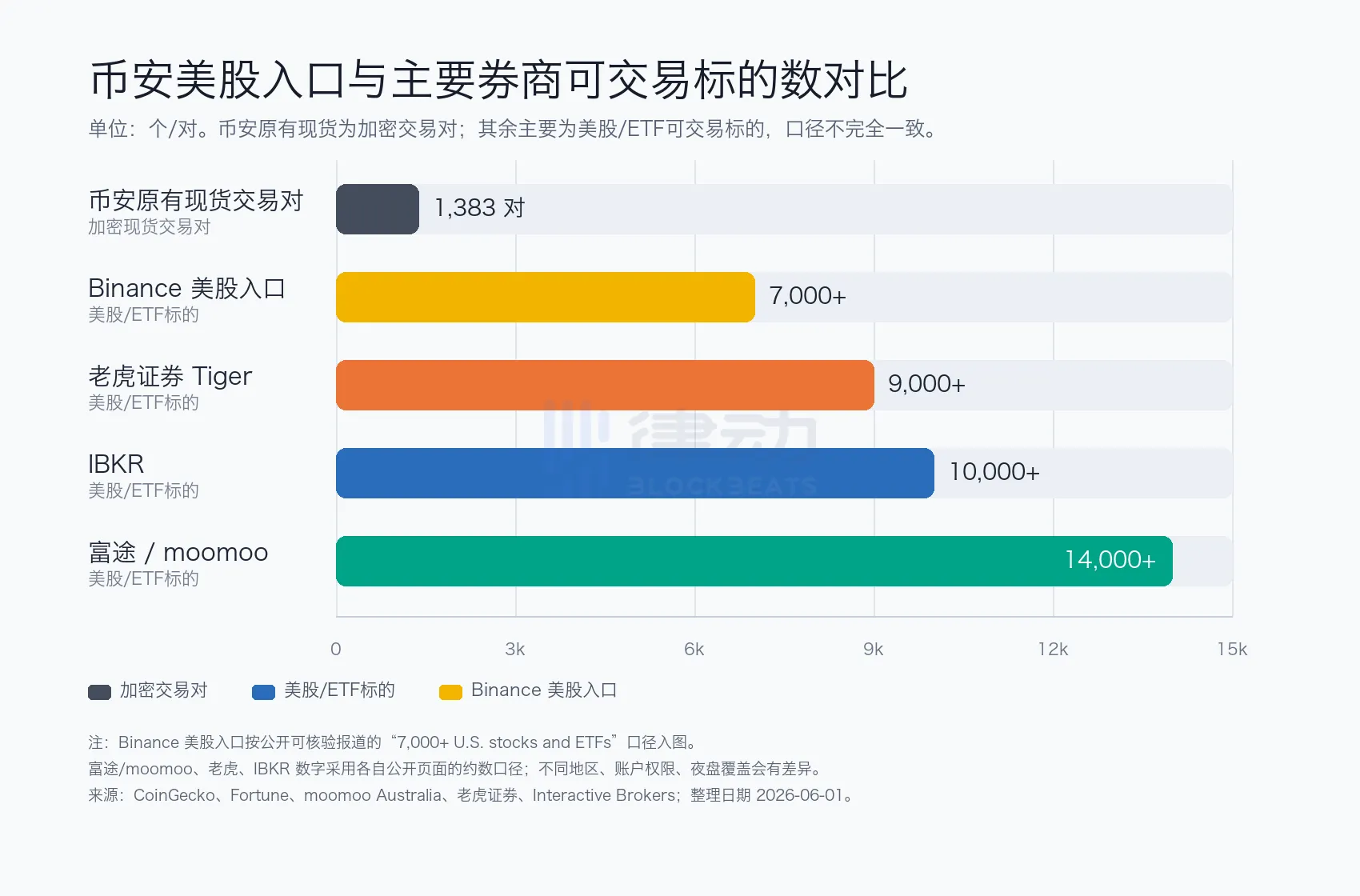
This time, Binance isn’t just launching a few tokenized blue-chip assets as a trial run; instead, it’s opening access to over 7,000 U.S. stocks and ETFs at once, positioning itself as Richard Teng, co-CEO, described—a “multi-asset financial super app.” In his words to Fortune, U.S. equities represent more than half of the global equity market, yet overseas users face high costs and friction when investing. Binance aims to erase that barrier.
Our BlockBeats editor conducted a full-order test using NVDA, experiencing the entire product flow from start to finish.
Opening the Binance App’s “Settings” page, the first step is confirming the version: v3.15.0—the latest. The language has already been switched to Traditional Chinese. This validates prior community feedback: Chinese-speaking users must switch from Simplified Chinese to Traditional Chinese or another language to participate in U.S. stock trading—Simplified Chinese is explicitly excluded.
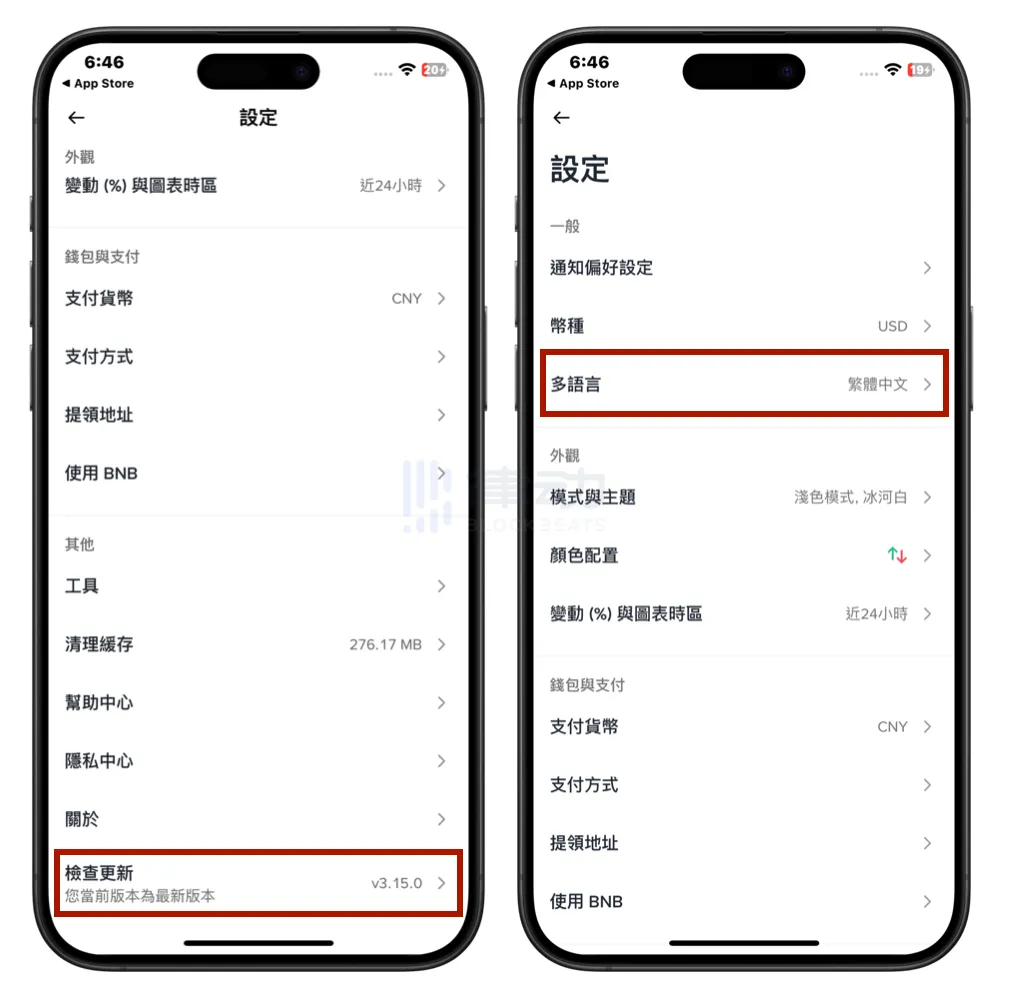
One detail warrants attention. Although the language has changed, the “Payment Currency” field still displays CNY, indicating that KYC identity and payment currency remain unchanged after language switching. Binance merely blocks the U.S. stock entry point on the frontend for Simplified Chinese users, while the underlying account system remains untouched. From a compliance standpoint, Simplified Chinese effectively corresponds to China’s jurisdiction, and U.S. stocks are considered highly regulated assets. This invisible geographic fence is not a technical restriction but a compliance posture: using a simple language switch as a gatekeeper shifts responsibility to users while maintaining nominal compliance.
Navigating to the “Market” tab, a new “Traditional Finance” entry appears alongside “Cryptocurrency” and “Alpha.” Below, three sub-tabs appear: Stocks, Spot, and U-Quoted Contracts. Under Stocks, two filters are available: U.S. Stocks and ETFs.
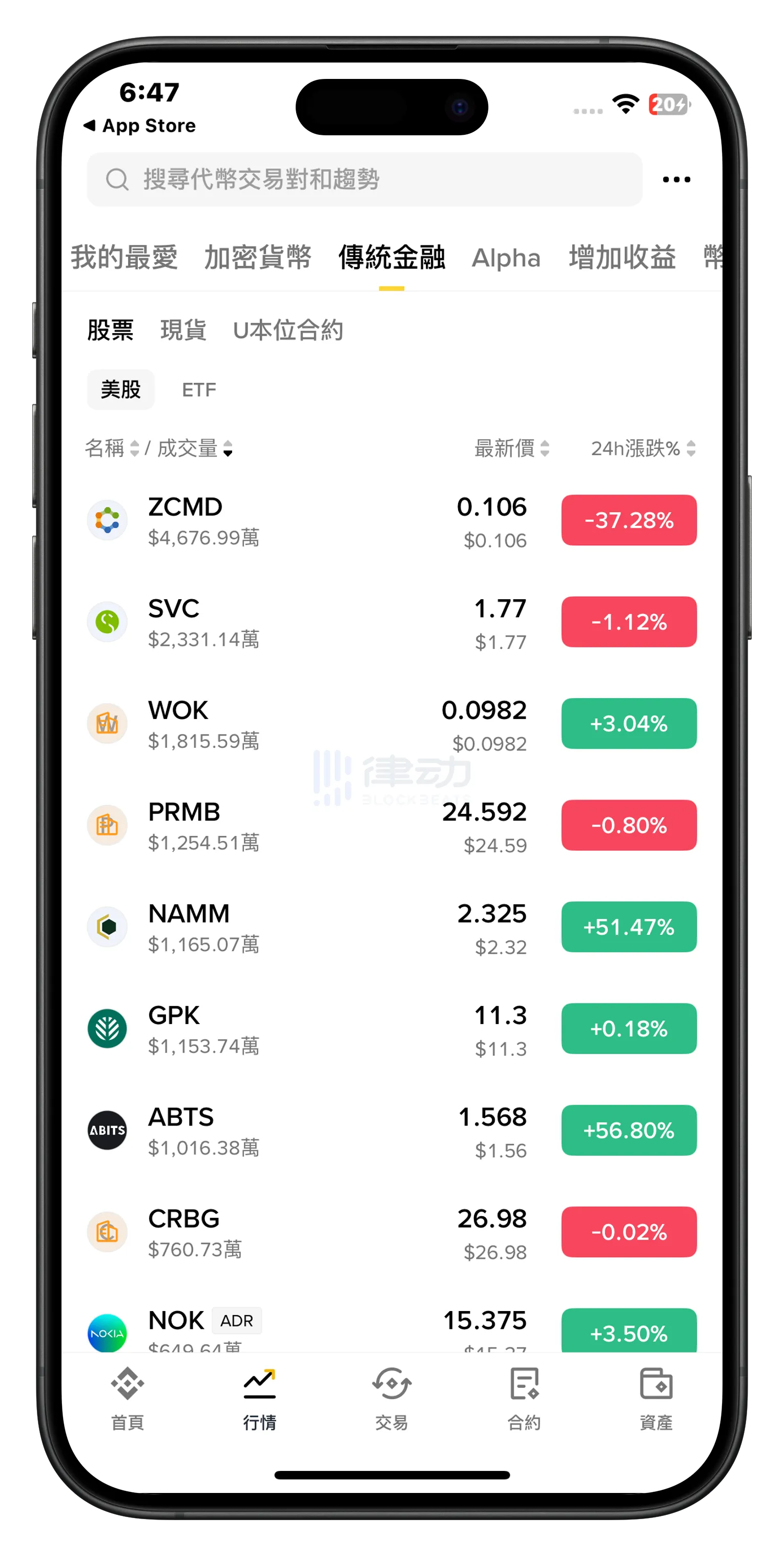
Scrolling through the list, Apple and Tesla aren’t the first names seen—instead, obscure small-cap stocks like ZCMD (market cap ~$46.76M), SVC (~$23.31M), and WOK (~$18.15M) dominate the initial view, even unfamiliar to seasoned U.S. stock traders. NOK also bears an ADR label. This confirms that the 7,000+ coverage isn’t superficial—it genuinely extends down to small caps and ADRs.
This depth is possible because Binance bypasses on-chain tokenization and instead uses real brokerage channels, freeing it from issuance constraints imposed by token creators. Comparatively: Kraken’s xStocks covers only 60+ blue-chips; Backed Finance, its underlying issuer, currently lists around 100 assets with a target of over 500 by year-end; Robinhood’s tokenized coverage in the EU spans roughly 200 companies. While others launch one token at a time, Binance directly connects to the entire U.S. stock market shelf.
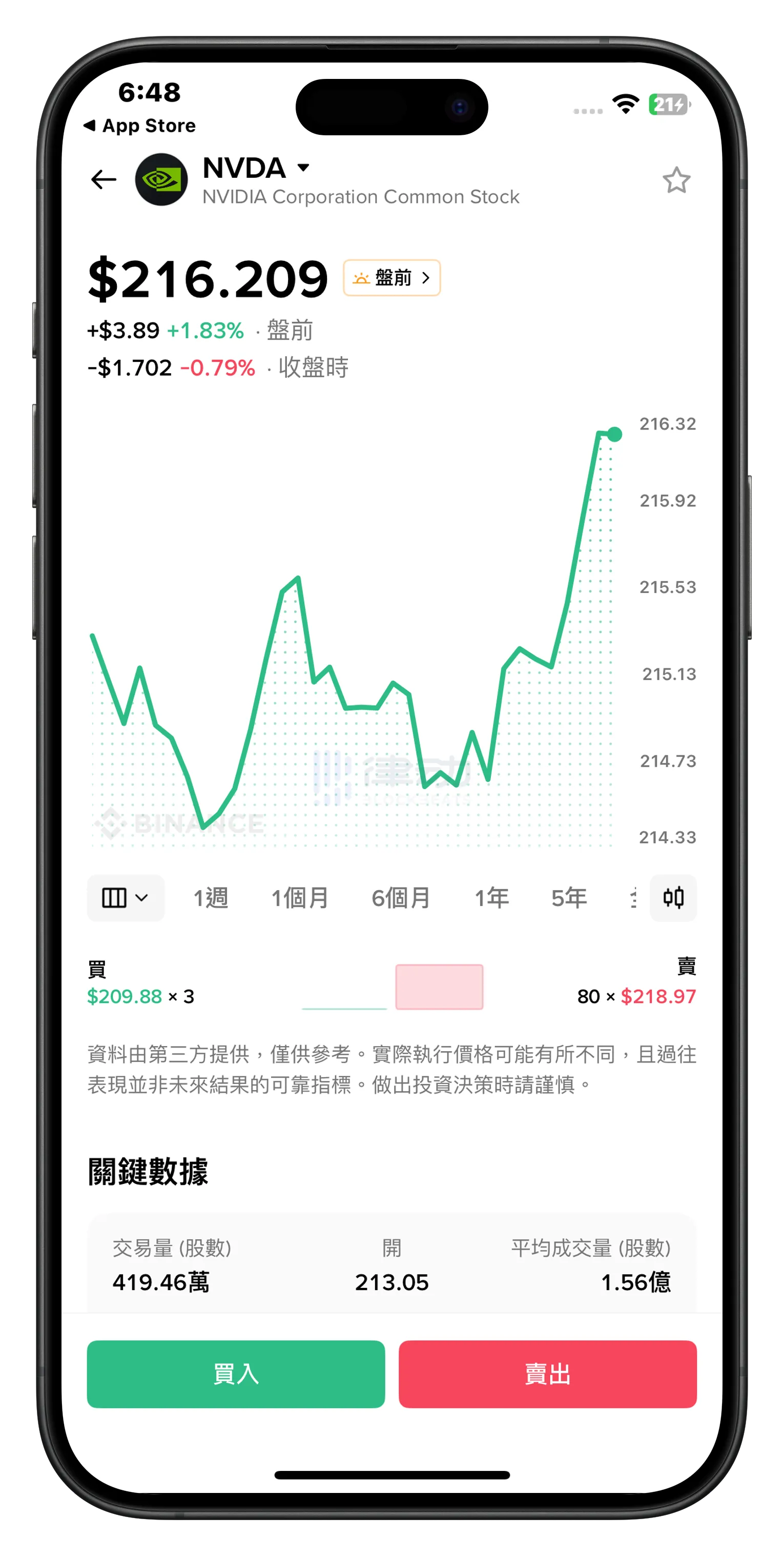
Entering NVDA’s detail page, the quote reads $216.209, marked “Pre-market,” up 1.83% pre-market, down 0.79% from the previous close. K-line charts support timeframes from 1 week to 5 years—on par with mainstream broker apps.
Scrolling down reveals a “Key Data” panel: volume of 4.1946 million shares, open at $213.05, average volume 156 million shares, 52-week high $236.54, low $135.40, market cap $5.11 trillion, P/E ratio 32.04, EPS $6.59, dividend yield 0.02%, free cash flow $119.076 billion. Data granularity reaches levels comparable to Webull or Robinhood. Further down, a “Company Actions” section notes a cash dividend scheduled for June 4.
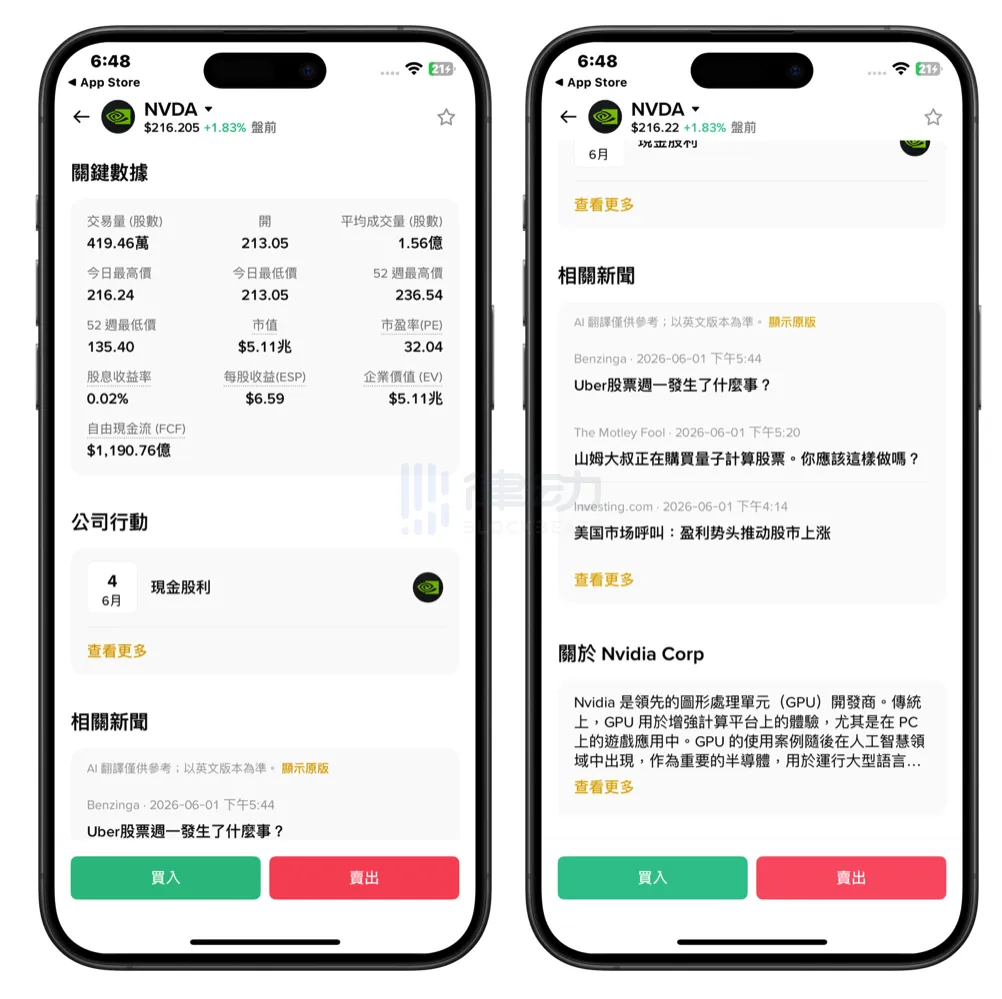
The “News” section aggregates third-party sources like Benzinga, The Motley Fool, Investing.com, translated via AI—with a top banner stating: “AI translation provided for reference only; English version prevails.” At the bottom lies the company profile. Overall information architecture suffices for stock newcomers, but lacks deeper data such as financial statements, analyst ratings, or institutional holdings—falling short of Bloomberg or Tonghuashun by one level. For Binance’s target users, it’s sufficient; for serious stock investors, it may still be inadequate.
Now let’s place an order.
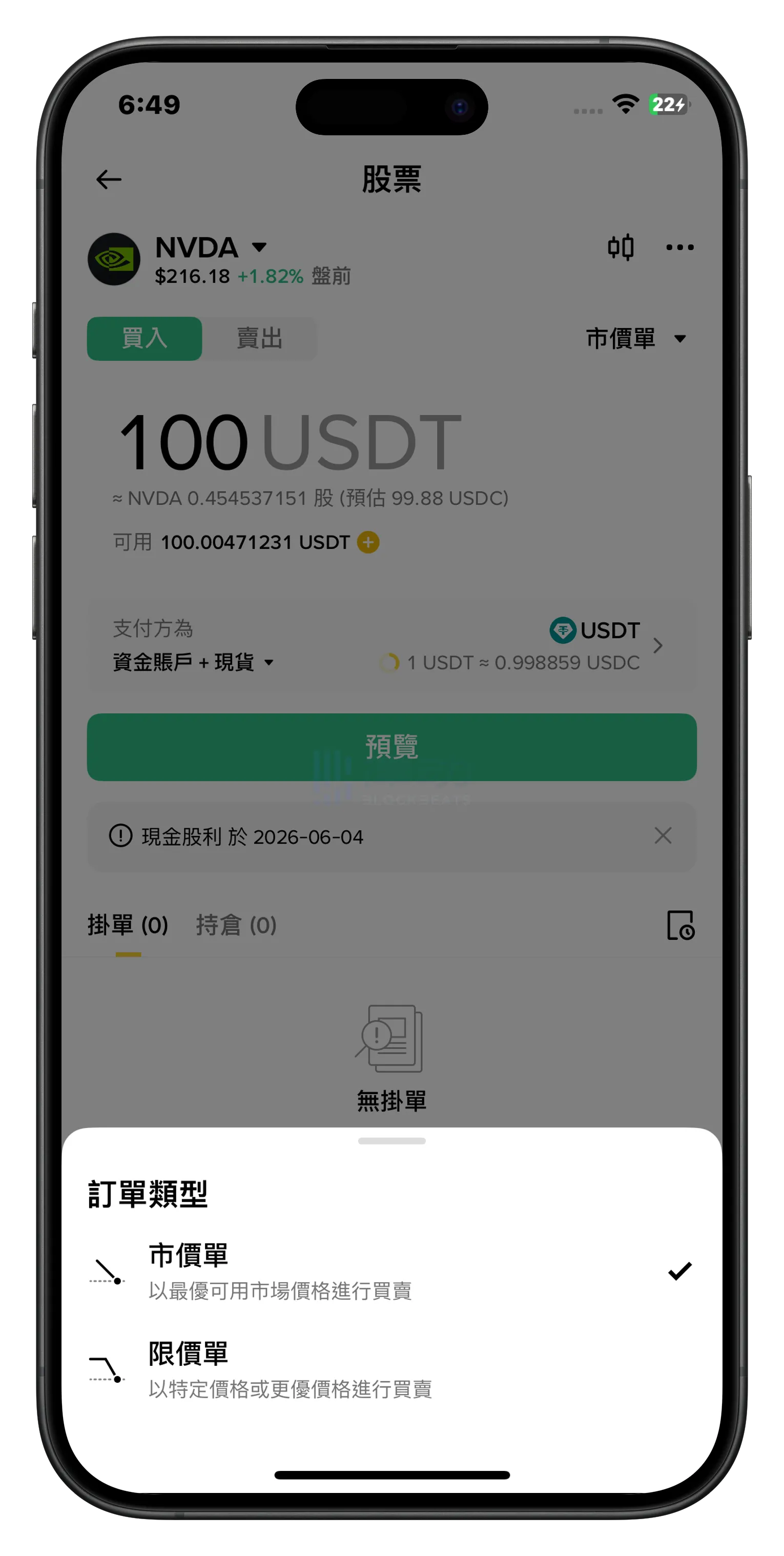
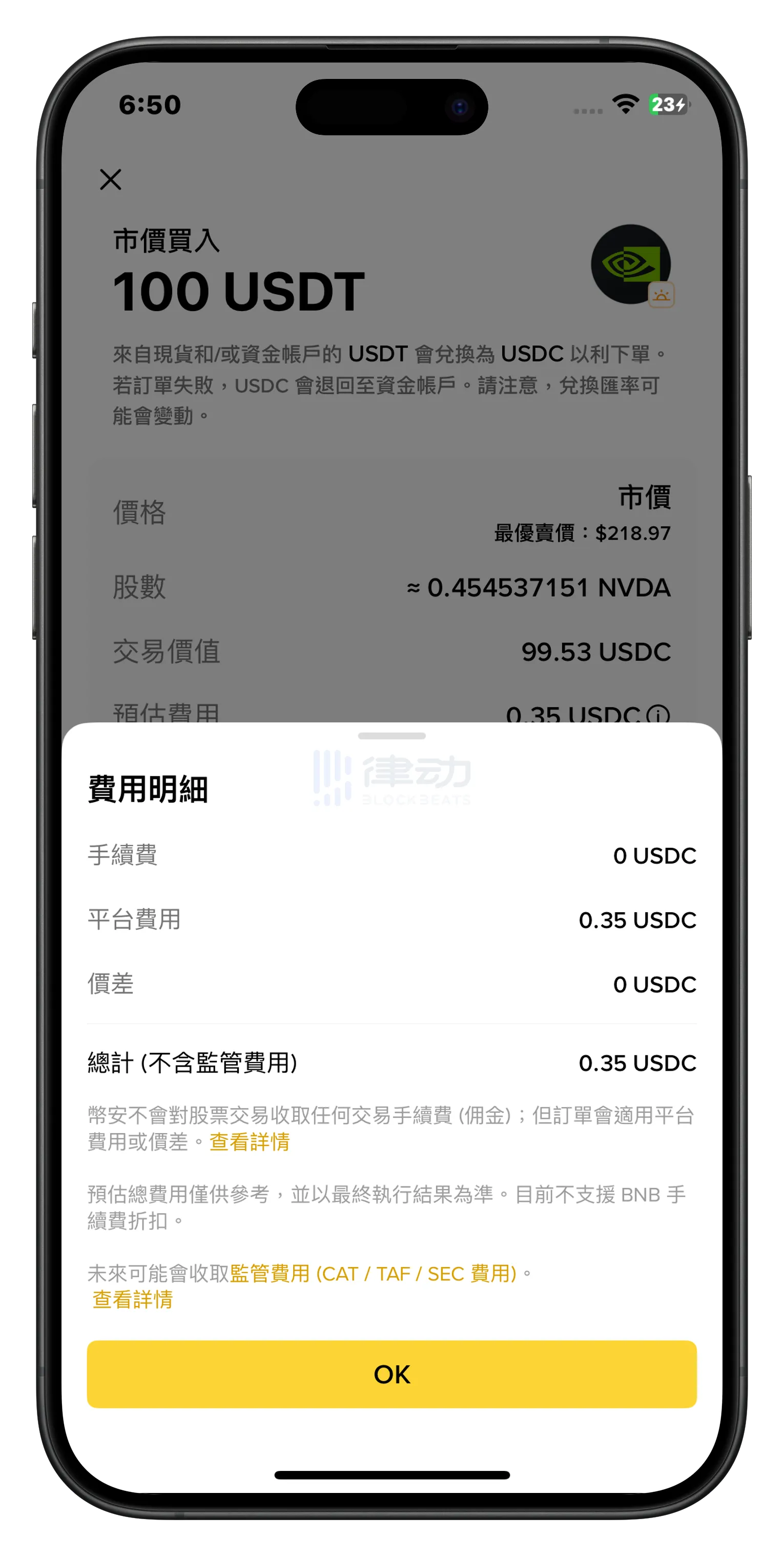
Clicking “Buy,” inputting 100 USDT. The system automatically converts: 100 USDT first exchanges at 1 USDT ≈ 0.998859 USDC into ~99.88 USDC, then buys ~0.4545 shares of NVDA at market price (best ask at $218.97), totaling $99.53 USDC, with estimated fees of 0.35 USDC.
A critical intermediary step emerges: regardless of whether you pay with USDT or BNB, all funds are first converted into USDC before settlement. USDC-to-USD conversion incurs zero fees (spread absorbed by Binance), but conversions from other tokens like USDT or BNB to USDC apply “market spread.” Thus, buying directly with USDC is the lowest-cost path—using USDT or BNB adds a layer of exchange cost.
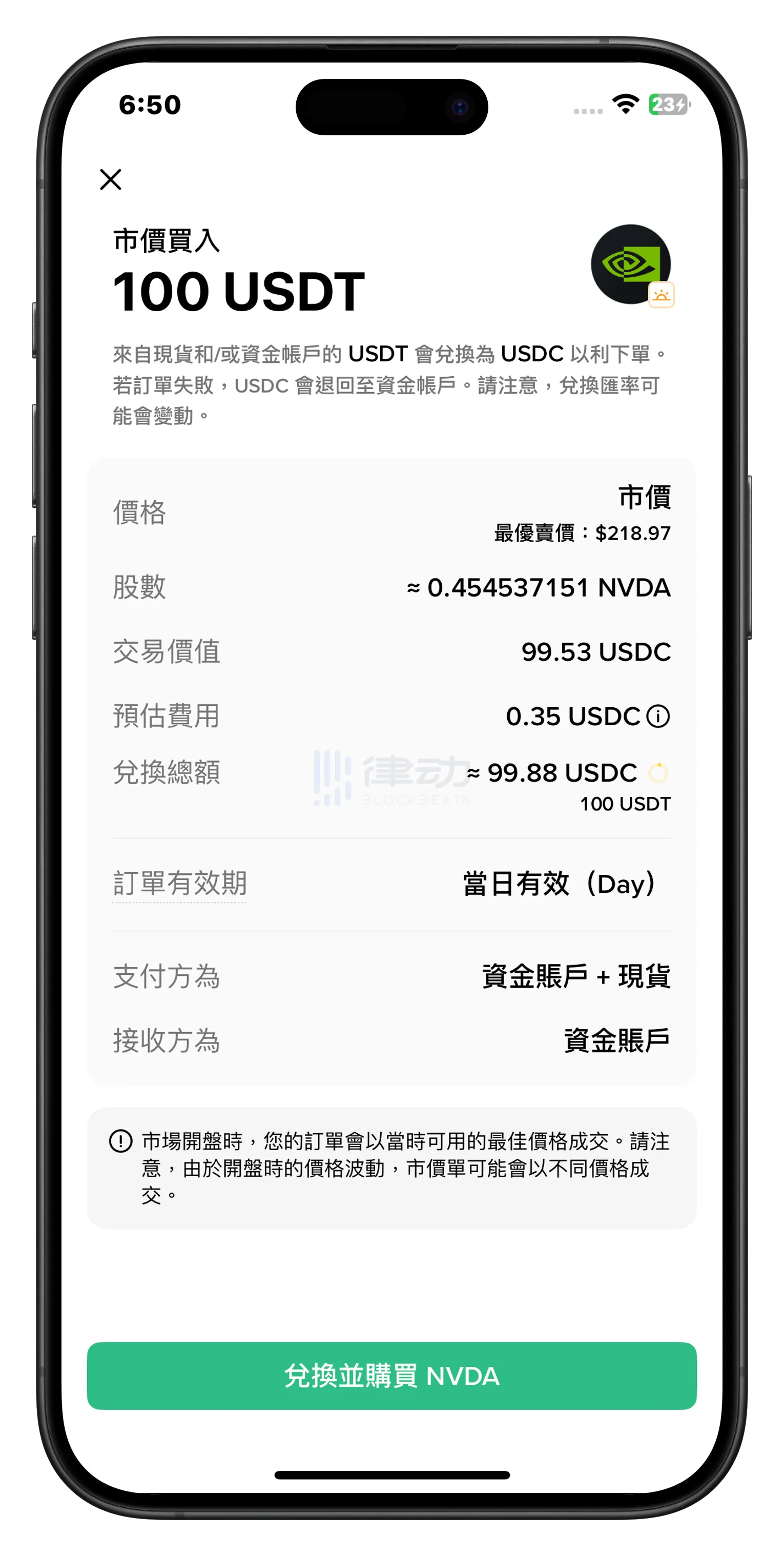
Order types currently include only market orders and limit orders. Order validity is “Day Order.” Payment source is “Funding Account + Spot,” indicating the system automatically draws from both wallets.
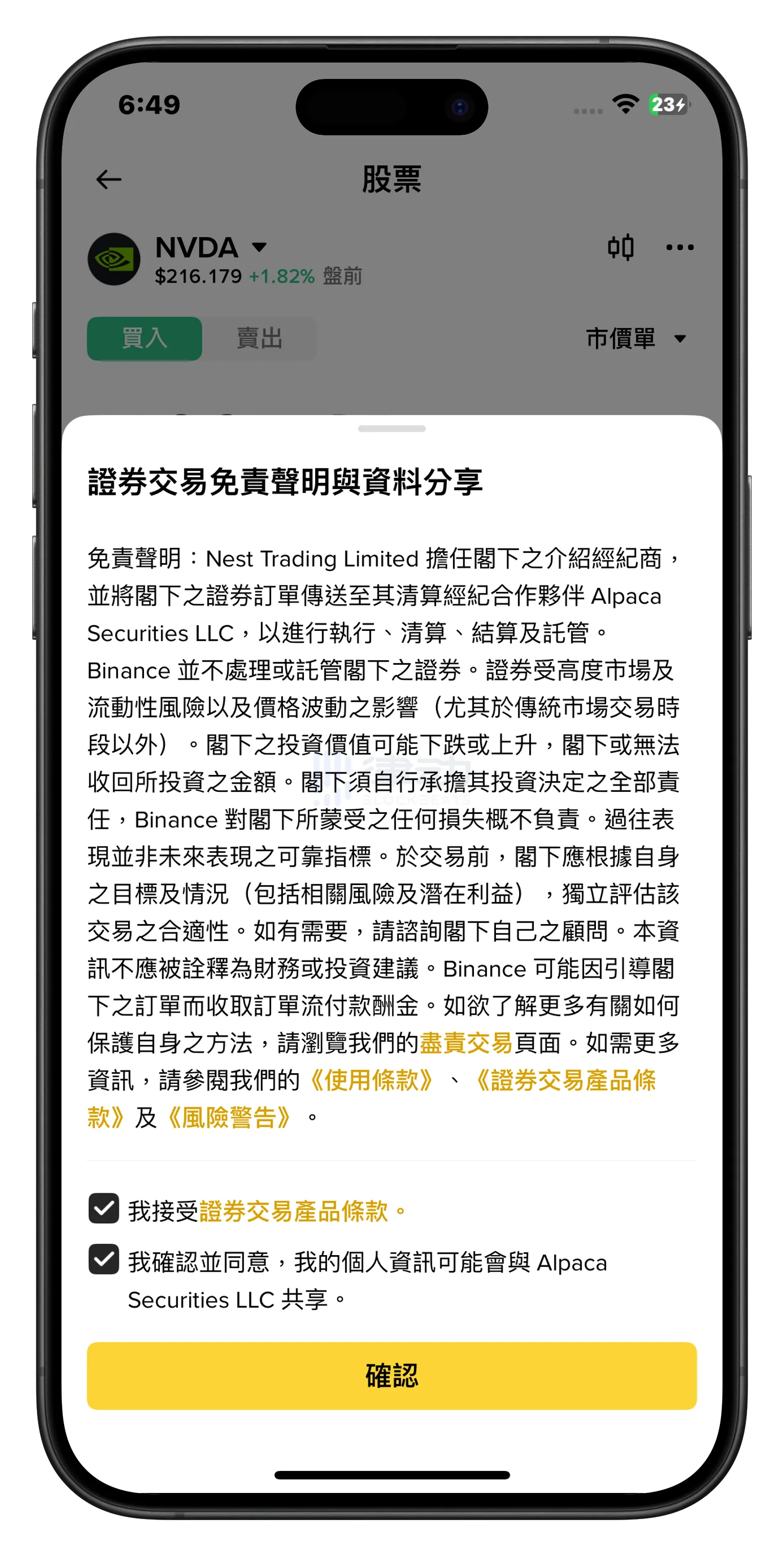
After preview, a pop-up titled “Securities Trading Disclaimer & Information Sharing” appears. The core clause formally states: Nest Trading Limited acts as an introducing broker, routing orders to Alpaca Securities LLC for execution, clearing, settlement, and custody. Binance does not handle or hold your securities. Two mandatory checkboxes: accept securities product terms, and consent to share personal data with Alpaca Securities LLC.
The fee breakdown popup details clearly: commission $0 USDC, platform fee $0.35 USDC, spread $0 USDC, total $0.35 USDC. Three notes below deserve emphasis: First, Binance charges no commission, but orders incur platform fees or spreads; second, BNB fee discounts are not currently supported; third, future regulatory fees (CAT, TAF, SEC fees) may be introduced.
In short, Binance functions solely as a front-end gateway in this chain. It neither holds stocks nor handles funds—matching is handled by Nest, custody by Alpaca. This structure differs fundamentally from purely on-chain tokenized products. You’re purchasing genuine stock exposure via a licensed brokerage channel.
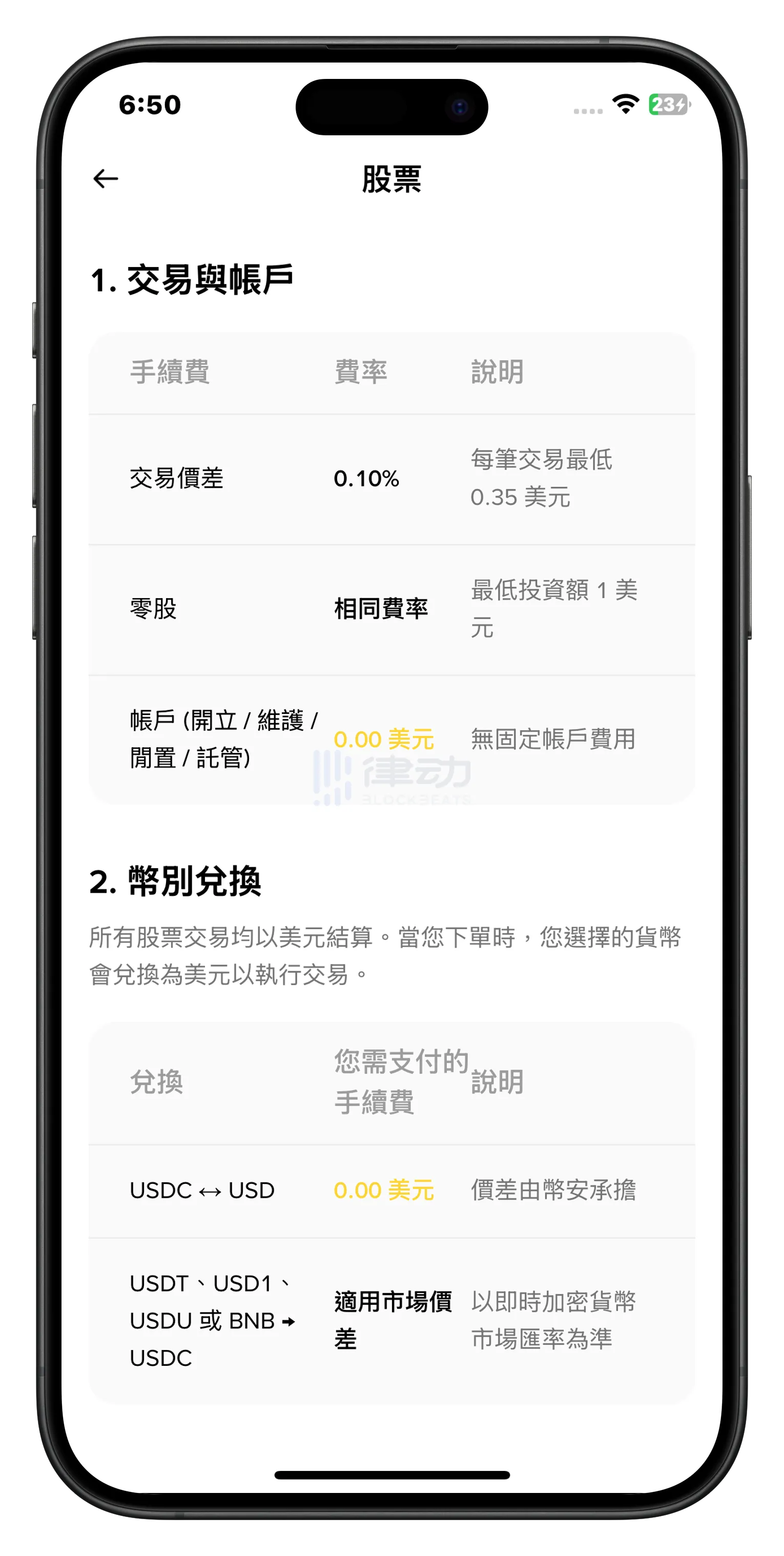
The fee page breaks down the structure further: trading spread 0.10%, minimum per trade $0.35; fractional shares apply same rate, minimum investment $1; account opening, maintenance, inactive, and custody fees are all $0. Regulatory fees: SEC transaction fees (seller-only) are borne by Binance, user pays $0.
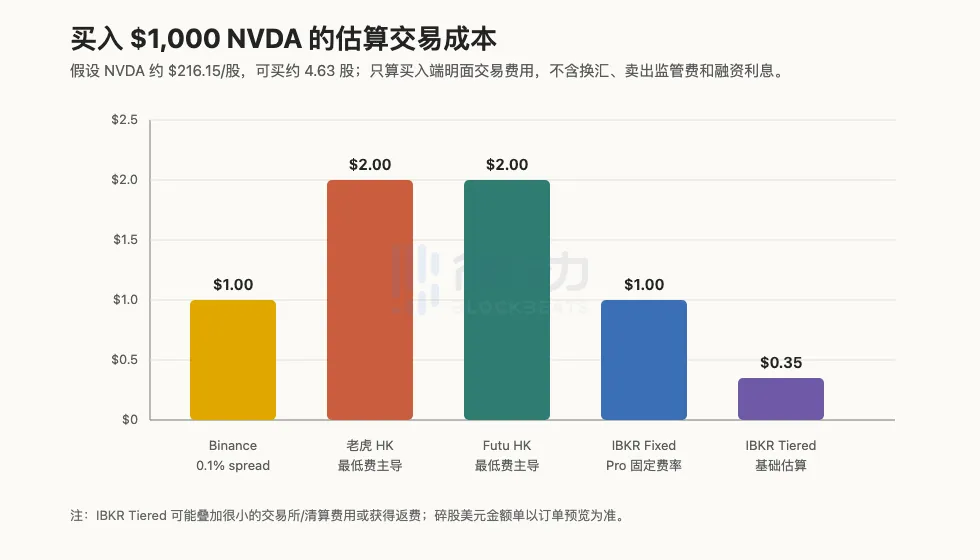
Thus, “zero commission” should be interpreted as: commission is indeed zero, but the platform fee of 0.10% (minimum $0.35) is a hard cost, plus soft costs from exchange spreads when using non-USDC currencies. For this 100 USDT purchase of NVDA, the $0.35 platform fee corresponds to a $99.53 transaction value—actual effective rate ~0.35%. This figure isn’t low in traditional brokerage terms (Robinhood and Webull charge zero), but is moderate within crypto trading platforms (spot trading base rate is 0.10%). Meanwhile, BNB fee discounts remain unsupported—an expected shortfall in Binance’s ecosystem where BNB typically offsets fees across most products.
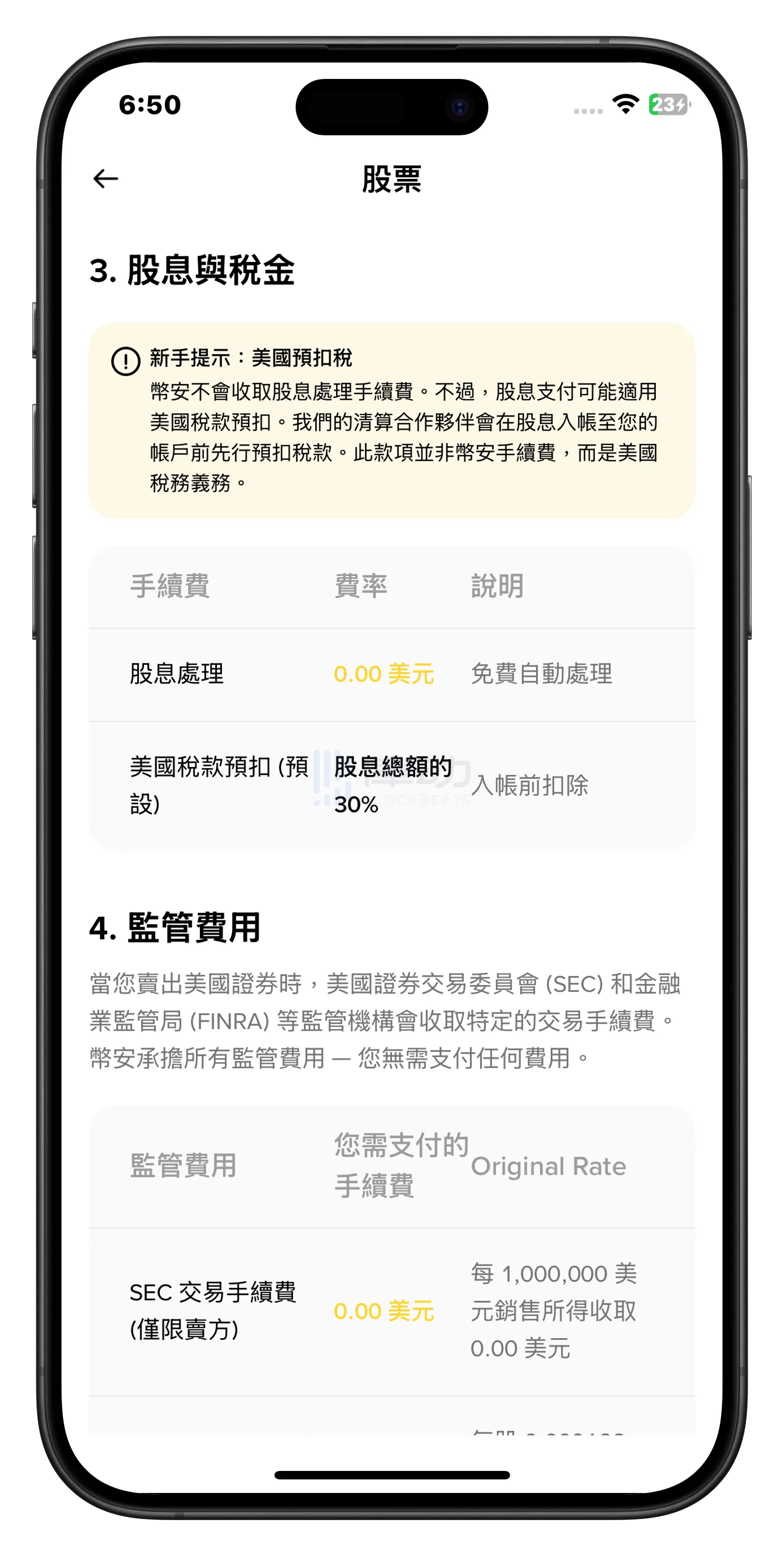
Another crucial number affecting long-term holders: dividend processing fee is $0, but U.S. tax withholding defaults to 30% of gross dividends, deducted before crediting. This is the standard U.S. withholding rate for non-resident foreigners—not a Binance fee—but it means you receive only 70% of the stated dividend. With NVDA’s yield at just 0.02%, the impact is negligible. But for high-dividend ETFs, this 30% cannot be ignored.
Returning to NVDA’s order book page, a more telling metric lies hidden. Pre-market bid-ask spread: Bid 1 at $209.88 × 3 shares, Ask 1 at $218.97 × 80 shares. The spread is ~$9, equivalent to ~4.2% of the $216 quote—buy-side depth is only 3 shares.
This implies: market orders placed during pre-market won’t execute immediately—they’ll wait until market open and fill at the best available price then.
This number alone draws a conclusion: 24-hour trading is enabled, but liquidity outside core hours is extremely thin. Market orders risk significant slippage.
The disclaimer confirms: “Securities are subject to high market and liquidity risks and price volatility, especially outside traditional market trading hours.”
For crypto users, 7×24 trading is standard; but stock market liquidity isn’t replicable simply by extending trading hours. Market makers’ quotes, institutional participation, and order flow density are concentrated within the U.S. Eastern 9:30 AM–4:00 PM window. 24-hour availability mainly enables “always-on order placement,” not “always-on fair-price execution.”
Having completed the trading experience, our BlockBeats editor now dives deeper into Binance’s U.S. stock offering.
For a crypto exchange to sustain a U.S. stock business, the buy button is just the lightest layer. True weight lies in matching, custody, and lending infrastructure. Binance’s approach strictly limits its role to front-end access, delegating backend operations to two entities.
The first is Nest Trading Limited. The disclaimer labels it an “introducing broker”—seeming like an external partner—but investigation reveals it’s a Binance-owned entity. In December 2025, Abu Dhabi Global Market (ADGM)’s Financial Services Regulatory Authority approved licenses for three Binance subsidiaries: Nest Exchange Limited handles trading platform operations (spot and derivatives); Nest Clearing and Custody Limited manages clearing, settlement, and digital asset custody; Nest Trading Limited (formerly BCI Limited) holds a broker-dealer license, managing OTC trading, exchange services, and other non-platform activities. In essence, Nest Trading is not a third party—it’s Binance’s own licensed arm under the ADGM framework, specifically handling non-platform-matching workflows. U.S. stock order routing is a natural extension of such OTC operations.
The second is Alpaca Securities LLC—a true independent third party. Headquartered in New York, Alpaca is a self-clearing, FINRA-registered broker-dealer protected by SIPC (up to $500,000 per customer account), and a clearing member of DTCC, FICC, and OCC. However, Alpaca isn’t a retail brokerage—it’s a B2B infrastructure provider for fintech firms. Its core product is Broker API, enabling partners to embed stock, options, fixed income, and crypto trading into their own apps. To date, Alpaca’s API serves over 200 fintech clients across 40+ countries, supporting over 10 million brokerage accounts. Early partners included Gotrade and Midas; Binance is now its largest crypto platform integrator.
An equally notable update: securities lending launching June 4.
Full-Paid Securities Lending (FPSL) allows users to lend fully owned eligible stocks to market participants (typically institutions needing short positions, arbitrage, or market-making), earning interest income.
FPSL is a mature, established service in traditional finance. Charles Schwab splits revenue 50/50 with a minimum asset threshold of $100,000; Fidelity requires $25,000; Interactive Brokers’ Stock Yield Enhancement Program also offers 50% split with a $25,000 threshold; Robinhood launched its own FPSL in 2022, with the lowest barrier and daily interest calculation. The global securities lending market generates nearly $10 billion annually.
In the crypto space, Kraken leads. It launched FPSL for U.S. stocks in 2025, allowing qualified users to lend fully held stocks for interest—this became a key hook to attract users transferring equity positions from other brokers via ACATS. Alpaca itself rolled out FPSL for its Broker API partners in May 2025. Binance’s upcoming securities lending likely reuses Alpaca’s underlying infrastructure.
For Binance, FPSL is more than a feature tag. It’s a pivotal step toward transforming users from “buy and hold” to “buy and earn yield”—and a foundational move toward integrating stocks into DeFi lending protocols post-bStocks tokenization. First operationalizing lending within the traditional brokerage framework, then replicating the logic on-chain—this is a coherent roadmap.
Zooming out, Binance’s move is not isolated. By early 2026, the landscape is crowded.
Coinbase, OKX, Kraken, Bybit—all announced or launched tokenized stock trading. Tokenized stock market cap surged from $32 million to nearly $1 billion in under a year.
Coinbase pursues an “everything exchange” strategy. Early 2026, it launched traditional stock and ETF trading for all U.S. users: zero commissions, 24/5, fractional shares from $1, backed by marketing partnership with Yahoo Finance—clearly targeting Robinhood. Yet in fine print, Coinbase deliberately excludes tokenized equities from its licensed broker-dealer and primary operating entity, leaving a regulatory gray area.
Robinhood initiated the tokenization narrative. In June 2025, CEO Vlad Tenev unveiled a three-phase plan at “To Catch a Token”: first launch tokenized stocks in the EU, covering 200+ U.S. companies, with the core idea of making tokenization seamless and invisible to users. Underlying technology is its own chain—a custom Arbitrum Orbit-based Ethereum L2 dedicated to real-world asset tokenization, planned for full rollout in 2026.
Kraken emphasizes DeFi integration and self-custody. Its xStocks lets investors withdraw 1:1 backed equity tokens to private wallets as collateral, settled on Solana and Ethereum, covering over 60 blue-chips and partnered with Nasdaq. On the capital side, Deutsche Boerse made a strategic $200 million investment in Kraken in April.
OKX holds strong cards too. In March 2026, ICE, owner of NYSE, announced a $2.5 billion strategic investment in OKX, centered on a unified matching engine, placing NYSE-linked tokenized equities at the core. This marks the first time a traditional exchange operator invests in a top-tier crypto platform and secures board seats.
Other players aren’t idle either.
Coinbase and Bybit are exploring collaborations on tokenized, custodied, and distributed U.S. public and pre-IPO stocks; Bitget and Ondo Finance launched over 100 tokenized U.S. stocks in January 2026, with spot volume surpassing $1 billion. On the issuance engine front, Backed Finance’s xStocks currently lists ~100 assets, aiming for over 500 by end-2026, with cumulative trading volume exceeding $25 billion by March 2026. On-chain, tokenized stock derivatives hit a single-day record of $3.57 billion on May 18, driven primarily by Binance and Hyperliquid.
Notably, this isn’t one-way convergence from crypto to stocks. Traditional institutions are moving toward blockchain too. BlackRock has already tokenized U.S. Treasuries; NYSE and Nasdaq have both announced plans to integrate tokenization into their systems.
Two rivers are flowing toward each other—now we’ll see how they play the game.
Original: BlockBeats
Disclaimer: Contains third-party opinions, does not constitute financial advice
Binance Launches U.S. Stock Trading—Is It Actually Working for This Company?
06-02
With a Trillion-Dollar Market at Stake, Why Has Real Estate Tokenization Failed to Take Off?
05-28
Uncovering the Mysterious Founder of TradeXYZ
05-19
Why Is the RWA Boom Struggling to Benefit DeFi?
05-19
U.S. Stock Registration Leader Acquired by Crypto Exchange, Accelerating Stock Tokenization
05-09
Pantera Capital: Q1 2026 Tokenization Landscape Report
05-08
a16z Crypto Operating Partner: Wall Street Undergoing Its Largest Infrastructure Upgrade in 30 Years
03-26


