As HYPE continues to hit new highs, the community is embroiled in debate over "HYPE vs SOL"
As HYPE continues to hit new highs, the community is embroiled in debate over "HYPE vs SOL"


As HYPE continues to break new highs, a heated debate has erupted on X about "HYPE vs SOL."
The central figure in this verbal clash is Kyle Samani, former co-founder and managing partner at Multicoin Capital and a flag-bearer of the Solana community (see: The Man Best at Pumping SOL, Exiting Crypto), while those lining up outside to attack are loyal "believers" of Hyperliquid led by Arthur Hayes, co-founder of BitMEX.
The Clash Between S-Guardians and H-Guardians
Over the past weekend, Samani unleashed a series of intense posts on X, launching a direct assault on Hyperliquid, accusing it of being fundamentally highly centralized and facing severe regulatory risks.
On May 30 at 6:30 AM, Samani wrote: "Hyperliquid is essentially just a Binance 2.0 without a marketing team (Binance, innocent bystander...). It has made thousands of technical decisions tailored exclusively for centralized environments—none of which are suitable for permissionless, decentralized ecosystems."
"They're already far behind on this path. Moreover, no genuine U.S. company will ever collaborate with them in the future."
On May 31 at 10:53 AM, Samani added: "Hyperliquid is as suspicious as Binance (again, innocent bystander...). All the allegations brought by the U.S. Department of Justice against Binance apply equally to Hyperliquid, with documented evidence for each offense. The so-called 'engagement with regulators' is pure nonsense—Binance has been claiming that for years too…"
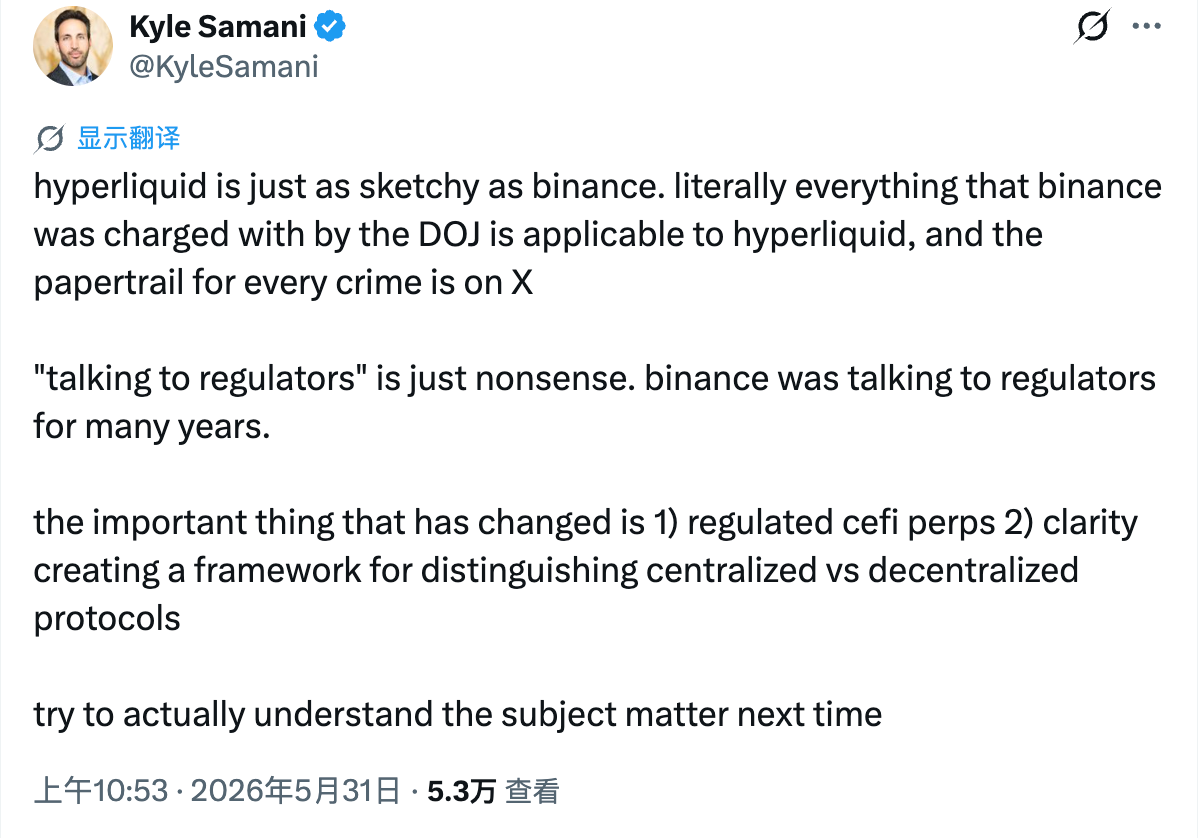
While attacking Hyperliquid, Samani also took another swipe at his old rival ETH, calling it "neutral in reputation but deficient in technology"—in other words, "useless."
Finally, when responding to a question from well-known Bitcoin developer Udi Wertheimer about "which token could be considered a success case," Samani gave an unequivocal answer: Solana.
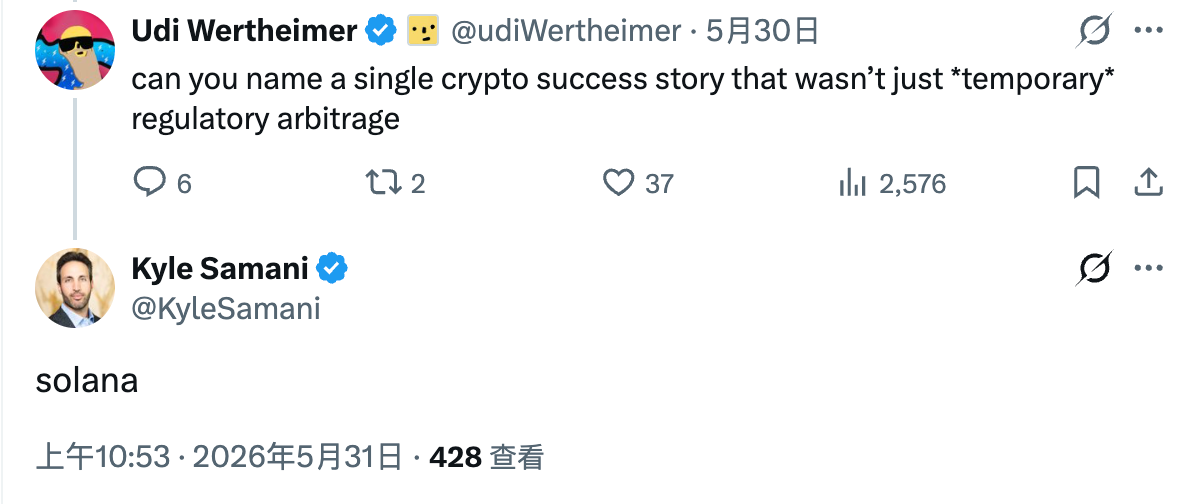
Naturally, Samani’s remarks triggered fierce pushback from the community, especially given HYPE’s dominant momentum. Investors like Hayes, developers like Wertheimer, and traders like Ansem all responded with varying degrees of rebuttal.
Hayes’s response was the most direct. On May 31, he posted a sardonic reply to Samani: "Before this cycle ends, HYPE should outperform SOL at minimum."
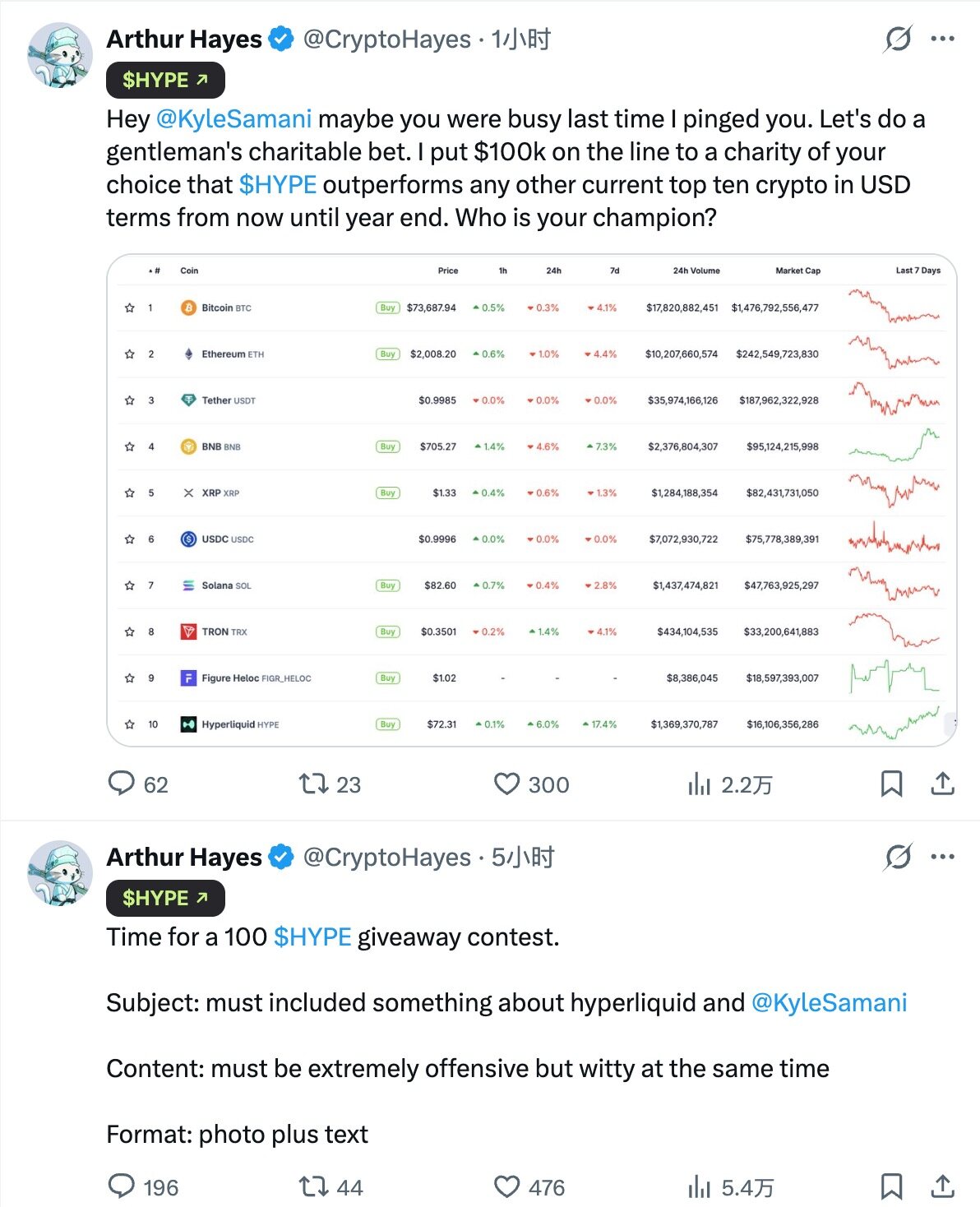
Early this morning, Hayes announced a content contest with a prize pool of 100 HYPE, demanding participants respond to Samani with humor and provocation. At the same time, he directly challenged Samani, offering a $100,000 bet that HYPE would outperform every other token in the top ten of the crypto rankings over the remaining seven months of the year.
Narrative Conflict Between Solana and Hyperliquid
Over the past few years, Solana’s greatest achievement has been building a high-speed, low-cost on-chain financial infrastructure. From memecoins and DeFi to AI agents, diverse assets and applications have chosen to launch and trade on Solana—its core logic being that liquidity naturally concentrates in the most efficient markets.
In contrast to Solana’s infrastructure-first approach, waiting for applications and liquidity to grow organically, Hyperliquid directly targets the most fundamental need in crypto: trading. By accumulating users, trading fees, and liquidity through its perpetual contracts market, it has progressively expanded into spot trading, tokenized stocks, prediction markets, and beyond.
From results, Hyperliquid has created an extremely rare positive feedback loop: more traders → higher fee revenue; more revenue → increased HYPE buybacks and ecosystem incentives; rising HYPE price → attracts more capital; more capital → strengthens platform liquidity and trading depth. This flywheel has generated cash flow capacity that now exceeds even Solana’s public blockchain ecosystem.
For years, Solana’s core narrative has been the “internet capital market.” But as users, assets, liquidity, and pricing power increasingly shift toward Hyperliquid, the latter now appears far more aligned with this narrative than Solana. In short, Hyperliquid seems to have become exactly what Solana once aspired to be.
As Solana’s most devoted advocate, Samani clearly cannot accept this scenario.
Samani’s Tactic: Using Solana’s Past Criticisms to Attack Hyperliquid
A closer look at Samani’s recent attacks on Hyperliquid reveals a striking irony.
Over the past years, in the ongoing debates between Ethereum and Solana, Ethereum’s camp frequently questioned Solana’s degree of decentralization—too high node validation thresholds, excessive hardware requirements, frequent network outages, and over-reliance on a handful of key institutions. To many Ethereum supporters, Solana may be fast, but it sacrifices decentralization for performance.
Solana’s response was straightforward: users don’t care. For most users, what matters is faster confirmation times, lower fees, and better product experience—not a research report on node distribution.
In a sense, Solana’s rise was a massive victory for the “efficiency-first” philosophy. Yet now, as Hyperliquid begins capturing market attention, Samani has picked up the very banner once wielded by Ethereum’s critics.
Centralization, regulatory risk, censorship resistance—these accusations sound eerily familiar. Only now, the accused has shifted from Solana to Hyperliquid.
This feels somewhat hypocritical, but perhaps to Samani, Solana represents the ideal balance—Ethereum is sufficiently decentralized but overly cumbersome, Hyperliquid is slickly optimized but essentially resembles a CEX, while Solana, in his eyes, always looks like the “most trustworthy” option.
In essence, this debate isn’t really about HYPE versus SOL—it’s about a decade-long dilemma in crypto: should decentralization or product excellence and growth take priority?
Years ago, Ethereum and Solana clashed over this issue. Now, Solana and Hyperliquid stand in the same position.
Only this time, facing a more aggressive competitor, Solana’s believers have taken up the banner of “decentralization” once again.
Original: BlockBeats
Disclaimer: Contains third-party opinions, does not constitute financial advice
SpaceXAI to Tidy Up Subscription Chaos, Grok and Cursor to Unify Plans Within Weeks
16 days ago
JPMorgan: Oracle's Backlog Orders Up by $26 Billion, Funding Trail Raises Questions
16 days ago
The Nasdaq-100 Index futures decline widens to 1.5%
16 days agoJefferies: Expecting Fed rate hike this week, Wunsch's comments to be pivotal
16 days agoData: Bitcoin's current holding volume has decreased by 13.5% compared to September 3rd, suggesting the market may have already begun deleveraging ahead of time
16 days ago
The UK's Financial Conduct Authority is exploring regulatory exemptions for tokenized gold
16 days agoKOSPI Index drops over 3%, SK Hynix down 6.34%
16 days ago

