Binance Launches U.S. Stock Trading—Is It Actually Working for This Company?
Binance Launches U.S. Stock Trading—Is It Actually Working for This Company?


On June 1, Binance officially unveiled its highly anticipated new product: the launch of over 8,000 U.S. stocks and ETFs trading for non-U.S. users, with zero-commission fractional shares starting from just $5, enabling purchases using crypto assets such as USDC, USDT, and BNB.
Notably, Binance has selected Alpaca, a U.S.-compliant brokerage firm, as its partner to handle asset custody, dividend distribution, and corporate actions. This company, Alpaca, holds a market position in the stock tokenization narrative far exceeding what one might expect—its clients include Bitget, Gate, Ondo, xStocks, and others.
The Hidden Giant with 94% Market Share
While Binance announced its new product, exchanges like Bitget and Gate are also aggressively advancing along the path of stock tokenization.
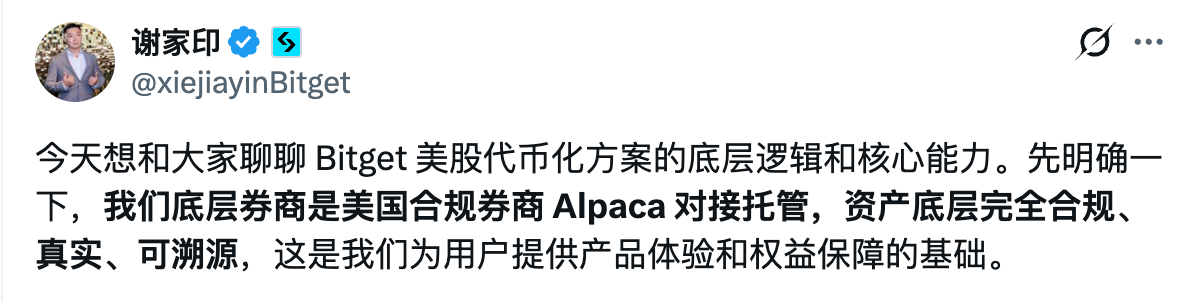
On May 28, Bitget officially announced the launch of its stock tokenization platform, Reality, which will issue rTokens pegged 1:1 to underlying stock assets. According to Xie Jiayin, Bitget’s Chinese-speaking lead, the underlying broker for Reality is Alpaca.
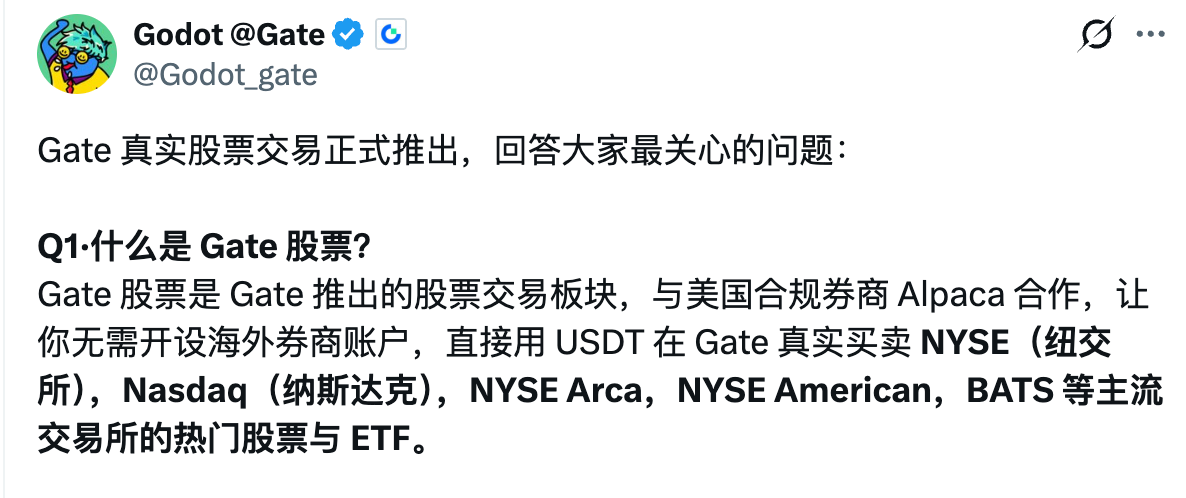
On June 1, Gate officially launched its real stock trading service, allowing users to directly participate in U.S. mainstream securities markets via USDT for stock and ETF trading. Gate’s representative Godot confirmed that Gate’s broker partner is also Alpaca.
Turning to DeFi, Ondo—the undisputed leader in the stock tokenization market—announced in September last year its collaboration with Alpaca to tokenize U.S. equities and ETFs.

Ondo’s direct competitor, xStocks—a stock token protocol under Kraken—also announced in December last year its partnership with Alpaca to accelerate the global expansion and adoption of xStocks beyond the U.S.

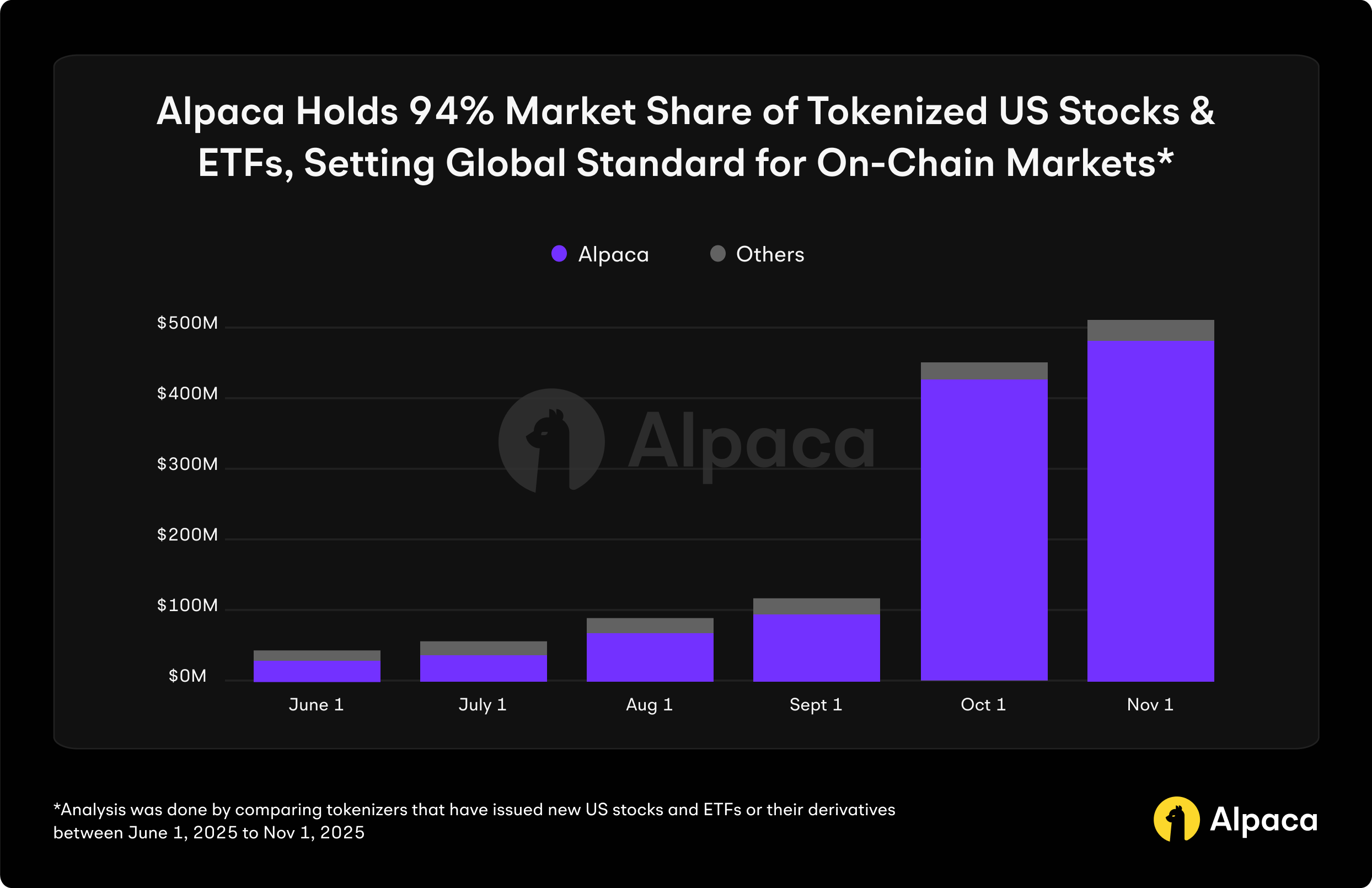
Further examples are unnecessary. In short, whether in CeFi or DeFi, nearly every stock tokenization trading service visible today relies on Alpaca behind the scenes. According to data disclosed by Alpaca on December 4, 2023, the company already holds a 94% market share in the tokenized U.S. equities and ETFs segment.
Who Exactly Is Alpaca?
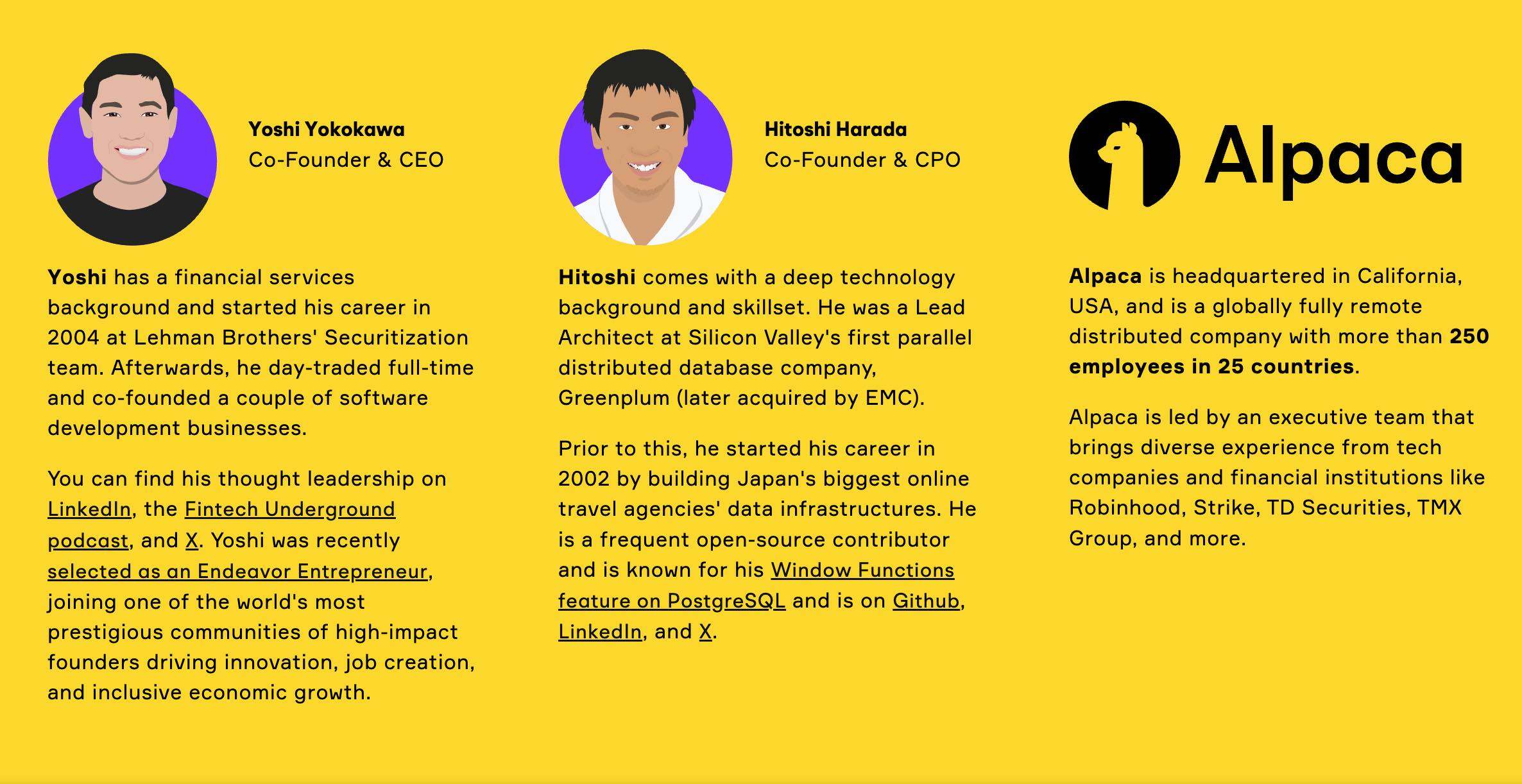
Founded in 2015 and headquartered in California, USA, Alpaca was co-founded by Yoshi Yokokawa, former Lehman Brothers employee and serial entrepreneur (currently CEO), and Hitoshi Harada, an engineer (currently CPO). Alpaca operates with a globally distributed remote work model, employing over 250 people across 25 countries.
Initially, Alpaca was a fintech startup focused on financial databases and machine learning, developing technologies capable of processing large-scale market datasets for predictive analytics. Early on, Alpaca’s primary product was a trading API tailored for quantitative traders. As the business expanded, it evolved from a simple API provider into a full-stack financial infrastructure provider, now supporting trading across equities, ETFs, options, and cryptocurrencies, alongside services including market data, securities lending, high-yield cash accounts, and 24/5 U.S. equity trading.
FundBet data shows that since 2019, Alpaca has raised over $320 million in funding, backed by prominent institutions including Y Combinator, Spark Capital, Portage Ventures, Tribe Capital, and SBI Group.
Seed round completed in 2019;
A round of $10 million raised in 2020;
Two consecutive B rounds completed in 2021 and 2022;
C round of $52 million secured in 2025;
D round of $150 million raised early 2026, valuing the company at approximately $1.1 billion.
According to official disclosures, Alpaca currently serves hundreds of financial institutions and fintech companies across more than 40 countries and regions, having facilitated the opening of over 7 million brokerage accounts through its partners.
A More Accurate Positioning: Brokerage-as-a-Service
Differing from traditional brokers that serve end investors directly, Alpaca’s core customers are developers, fintech firms, and other brokerage institutions. Through its Broker API, Alpaca enables partners to rapidly build comprehensive securities trading systems—including account opening, KYC, account management, order execution, clearing and settlement, and market data services.
In essence, if platforms like Binance, Bitget, Gate, or Ondo wish to enable U.S. stock trading for their users, they would theoretically need to solve complex issues related to broker licensing, compliance reviews, stock custody, clearing and settlement, market data access, and order routing—tasks that are both costly and intricate. Alpaca offers a fully API-driven solution: developers simply integrate the APIs and “one-click” access to these complex backend capabilities becomes possible.
This model essentially functions as “Brokerage-as-a-Service.” With Alpaca’s infrastructure support, platforms such as Binance, Bitget, Gate, and Ondo only need to focus on user acquisition and traffic—while Alpaca handles all the back-end connectivity to the real-world securities markets.
First-Mover Advantage and Network Effects
At this point, you may wonder: why do crypto institutions favor Alpaca? Can’t other brokers do the same?
Indeed, the U.S. compliant financial market is not lacking in brokers. According to FINRA data, thousands of registered brokerages operate in the U.S., and traditional giants like Charles Schwab, Interactive Brokers, and Fidelity boast significantly greater brand recognition and asset scale globally than Alpaca.
Yet, when the wave of stock tokenization emerged, it was not these Wall Street veterans who dominated—but rather Alpaca, a firm founded just over a decade ago. The reason likely lies in Alpaca’s foundational identity: unlike traditional brokers whose customers are investors, Alpaca’s customers are developers.
Alpaca’s product design is almost entirely API-centric. Developers can quickly gain full access to account opening, KYC, order execution, clearing and settlement, and market data simply by calling APIs. This “API-first” philosophy perfectly aligns with the needs of platforms like Binance, Bitget, Gate, and Ondo, which aim to embed securities trading functionality into their own platforms or protocols.
Compared to many traditional financial institutions cautious toward crypto, Alpaca was among the earliest U.S.-licensed brokerages to actively embrace digital assets and the tokenization narrative. Long before stock tokenization became a market trend, Alpaca had already begun building relationships within the crypto ecosystem and exploring integration between securities markets and blockchain technology.
Its first-mover advantage combined with industry alignment explains why Alpaca has captured its current dominant position.
Today, as more CeFi and DeFi players adopt Alpaca’s infrastructure, the network effects surrounding Alpaca are solidifying its moat.
For latecomers, choosing Alpaca means the fastest time-to-market and the most mature compliance pathway—fueling a virtuous cycle: more platforms integrating Alpaca → increased account numbers and trading volume → further refinement of Alpaca’s products and infrastructure → attracting even more new entrants...
Stock tokenization is clearly an inevitable trend. Within this arena, it remains uncertain how many Binance-like platforms or Ondo-like protocols will emerge. But one thing is becoming increasingly clear: as more platforms compete for the stock tokenization market, the entity selling the “shovels”—the foundational infrastructure provider—may ultimately be the biggest beneficiary of this race.
Author: Azuma
Original Source: Odaily Planet Daily
Disclaimer: Contains third-party opinions, does not constitute financial advice
Early Review | How Is Binance's 7,000 US Equity Trading Experience?
06-01
With a Trillion-Dollar Market at Stake, Why Has Real Estate Tokenization Failed to Take Off?
05-28
Uncovering the Mysterious Founder of TradeXYZ
05-19
Why Is the RWA Boom Struggling to Benefit DeFi?
05-19
U.S. Stock Registration Leader Acquired by Crypto Exchange, Accelerating Stock Tokenization
05-09
Pantera Capital: Q1 2026 Tokenization Landscape Report
05-08
a16z Crypto Operating Partner: Wall Street Undergoing Its Largest Infrastructure Upgrade in 30 Years
03-26


