Bitcoin's sharp decline wasn't solely due to Strategy's coin dumping
Bitcoin's sharp decline wasn't solely due to Strategy's coin dumping


TL;DR
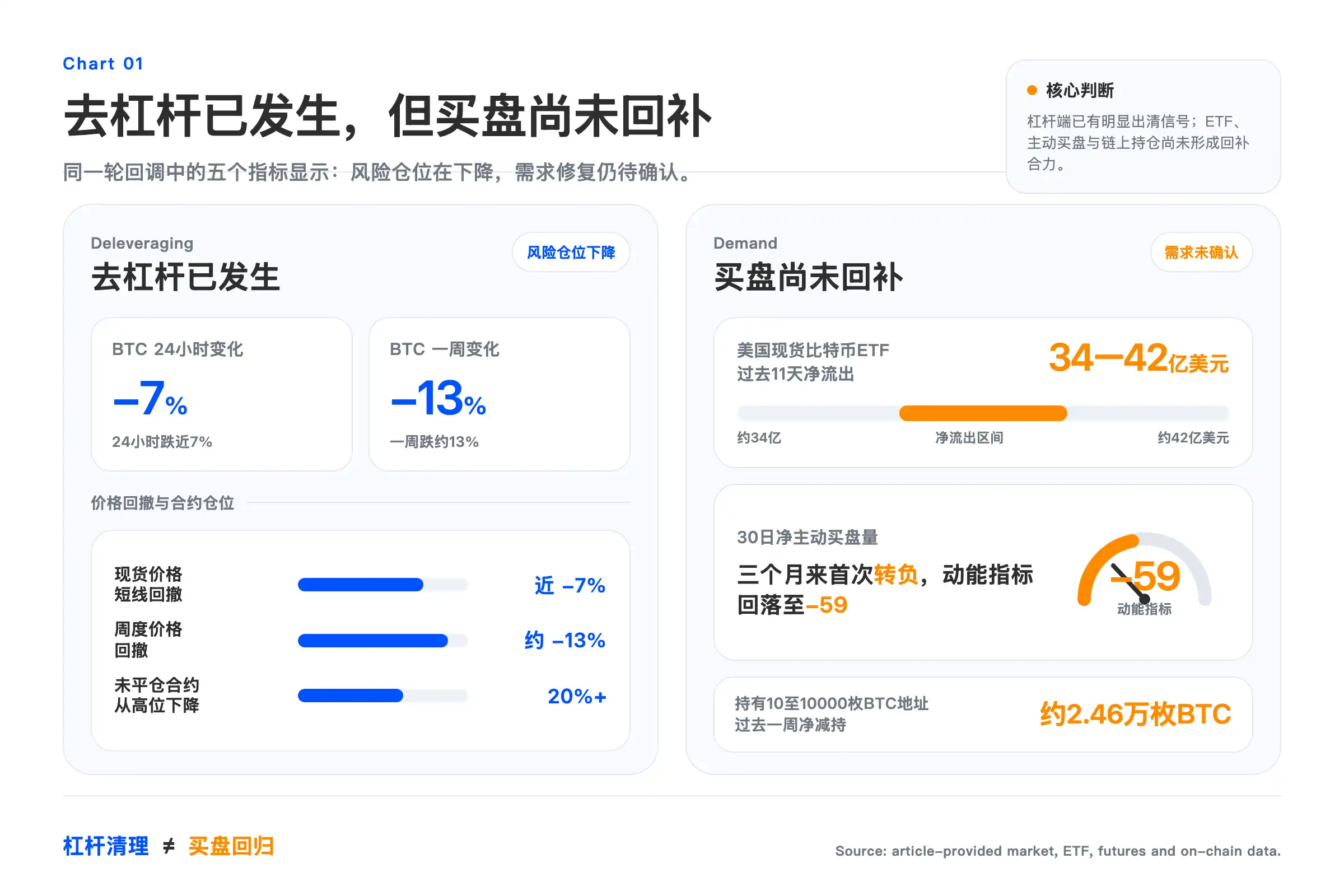
U.S. equities and AI sectors continue hitting new highs, while Bitcoin faces resistance at the critical $66,000 level, with a 24-hour decline approaching 7% and a weekly drop of approximately 13%. The market is currently pricing in deleveraging dynamics. U.S. spot Bitcoin ETFs have experienced net outflows for multiple consecutive days, totaling over $3.4 billion. On-chain net active buy volume (the net difference between buyer- and seller-initiated trades) turned negative for the first time in three months, and momentum indicators have plummeted to -59. Concurrently, whale sell-offs, MicroStrategy’s small-scale sale of 32 BTC for dividend payments, and Mt. Gox’s transfer of roughly 10,422 BTC (approximately $739 million) have intensified market concerns.
These shifts signal the temporary end of a buyer-dominated phase, with the correction grounded in real fundamentals. Most discussions focus on short-term risks from compounded negative catalysts, easily misinterpreting MicroStrategy’s symbolic sale or Mt. Gox’s one-time transfer as signs of long-term weakening demand or an impending supply flood. A more pressing question is: What stage has this correction reached? After deleveraging, what verifiable signals are needed to confirm buyer re-entry and bottom formation?
Is the $66,000 Test About Deleveraging or Permanent Demand Erosion?
Selling pressure has already been significantly released.
Bitcoin has declined by about 13% this week, with single-day losses reaching recent highs, accompanied by surging trading volume and liquidation volumes. U.S. spot Bitcoin ETFs have seen net outflows of approximately $3.4B to $4.2B over the past 11 days, primarily driven by products like BlackRock’s IBIT.
On-chain data shows that addresses holding between 10 and 10,000 BTC have net sold off around 24,600 BTC over the past week, while small addresses registered only marginal inflows.
Active buying demand has been exhausted on a near-term basis.
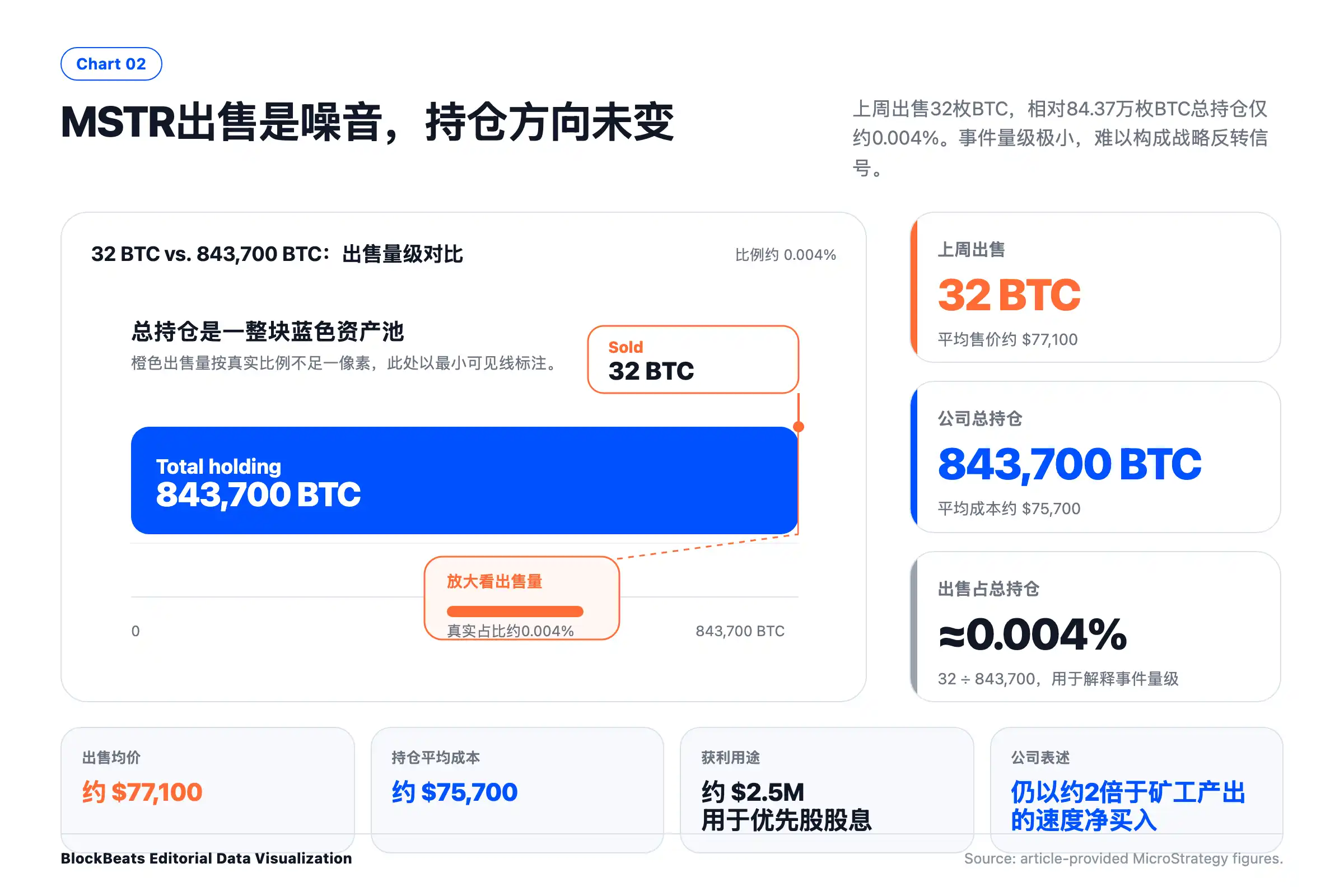
The 30-day net active buy volume has turned negative, and momentum indicators have rapidly approached key negative thresholds. MicroStrategy sold 32 BTC last week at an average price of ~$77,100, generating a profit of ~$2.5M used for preferred dividend payments. Despite holding a total of 843,700 BTC at an average cost basis of ~$75,700 and reaffirming its strategy of net accumulation at roughly twice the rate of miner output, this minor transaction was amplified by the market. Mt. Gox’s transferred funds remain largely on-chain and have not yet materialized into large-scale exchange sell pressure—more likely creating short-term panic than systemic risk.
This correction is significant but not extreme.
Compared to historical bear market weekly declines, this represents a notable but non-catastrophic drawdown. From its 2025 peak, Bitcoin has retraced ~45–50%, bringing prices back near the early 2026 sentiment recovery zone. These data points collectively suggest a temporary exhaustion of buyer strength, making $66,000 a crucial support level to hold. However, market sentiment tends toward linear bearishness, raising the question: Are these factors isolated negative events, or an inevitable step in systemic deleveraging?
Deleveraging Is Clearing Speculative Positions
This reflects systemic removal of speculative risk rather than a structural collapse driven by sellers.
Open interest (unliquidated leveraged positions) has dropped over 20% from its peak, moving in tandem with price. Some traders view this as healthy deleveraging: high-leverage floating positions wiped out via liquidations have reduced market float, resulting in cleaner structure and creating space for future capital inflows.
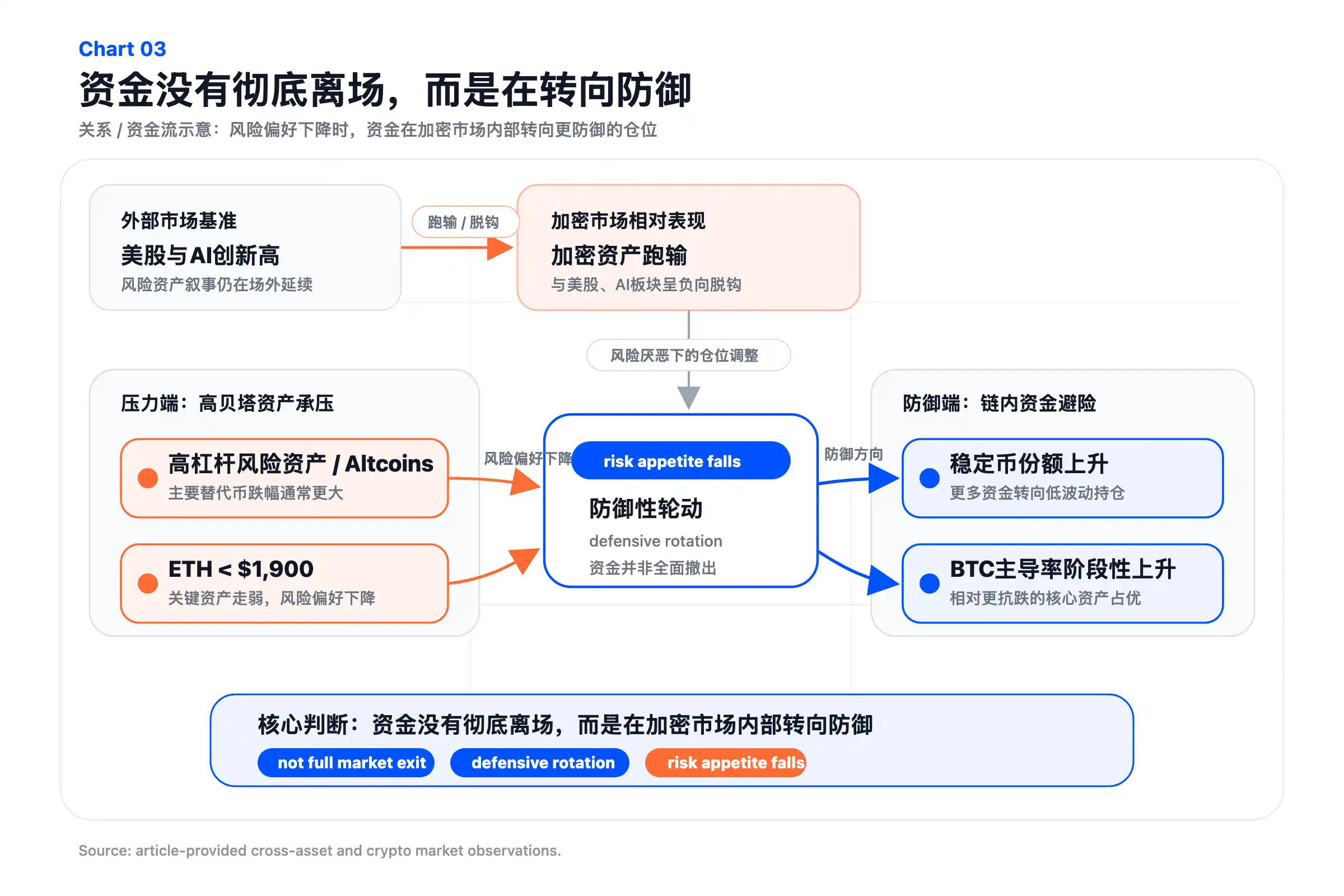
Most of Mt. Gox’s transferred funds remain on-chain and have not yet translated into immediate exchange sell pressure. On-chain records also show signs of accumulation at lower levels, creating mixed signals that contrast with a pure sell-off narrative. Capital hasn’t fully exited the crypto ecosystem—it’s partially rotating into stablecoins (cryptocurrencies pegged to the U.S. dollar), reflecting risk-averse defensive positioning rather than broad-based panic selling. Michael Saylor, founder of MicroStrategy, and the company continue emphasizing long-term net buying, asserting that “the crypto winter won’t return,” reinforcing the institutional rationale for treating Bitcoin as a reserve asset.
Similar to post-high leverage washouts in equities, after liquidations, remaining participants typically hold more resilient positions, with volatility potentially declining temporarily. Whale sell-offs combined with insufficient buying from small addresses have exacerbated short-term volatility, but the key question post-clearing is who will re-enter. If this is a healthy deleveraging process, the cleansing effect will gradually manifest across the broader market and across asset classes. Within crypto, clear differentiation will emerge, and pessimistic expectations—already priced in—are likely to reach their limits.
Crypto Underperforms U.S. Equities as Capital Shifts Toward Stablecoin Defense
The entire crypto market is affected by deleveraging, but divergence has already emerged—and pessimism has been partially priced in without reaching extremity.
Bitcoin dominance (its share of total crypto market cap) has risen temporarily, Ethereum fell below $1,900, major altcoins generally underperformed, and MSTR stock also faced short-term pressure due to news around its holdings. The sector is lagging behind U.S. equities and AI, which are hitting new highs—a negative decoupling. This indicates the current issue stems from internal crypto leverage and demand dynamics, not a broad macro risk aversion transmission.
Capital is choosing defense over complete exit.
Stablecoin market share has increased, contrasting with full capitulation seen during prior panic cycles.
While the scale of deleveraging is substantial, it remains below the 2022 peak. Some institutional views suggest that after the deleveraging phase, market structure becomes healthier, paving the way for new capital entry. As the largest corporate holder, MicroStrategy’s minor sale for dividend distribution does not represent a strategic shift—rather, it reflects dynamic financial management within the asset’s inherent utility, not a wholesale pivot.
This divergence shows that bearish sentiment has already been materially reflected in prices, outflows, and metrics—but has not yet led to systemic collapse. Inflows into stablecoins coexist with low-level accumulation, preserving some market resilience. Determining whether this is a 2026 interim correction or requires extended consolidation hinges critically on the specific signals of buyer re-entry.
Buyer Re-entry Signals Still Pending Validation – What’s the Biggest Risk?
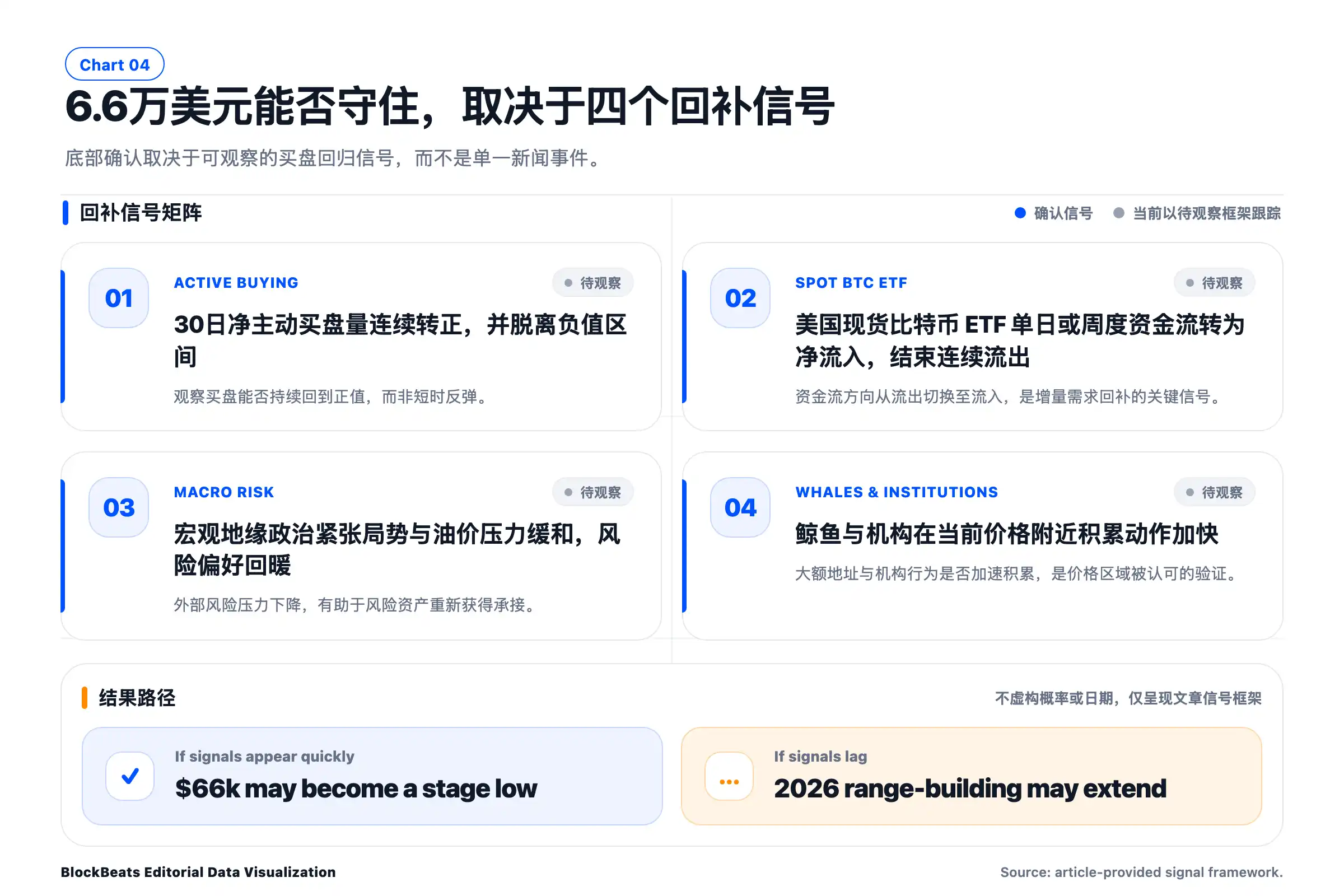
The core assessment hinges on whether buying pressure returns swiftly.
Key indicators to track include: whether the 30-day net active buy volume turns positive consecutively and exits negative territory; spot Bitcoin ETFs shifting to daily or weekly net inflows, ending sustained outflows; easing of macro geopolitical tensions and oil price stability enabling risk appetite recovery; and accelerated accumulation by whales and institutions at current price levels.
Technical analysts such as Peter Brandt suggest a prolonged base-building phase may extend into late 2026 (possibly September–October), followed by the next cycle with higher long-term targets—though the market remains in a transitional window.
If these signals emerge in the near term, $66,000 could mark a temporary floor, with a cleansed market offering better conditions for new buyers. Positions can then be gradually shifted from stablecoin buffers back into risk assets. Conversely, if buyer re-entry lags, macro risks worsen further, or ETF outflows persist, the support level may face renewed testing, prolonging the 2026 consolidation phase.
Investors should avoid predicting precise bottoms or blindly chasing dips. Instead, they must monitor the above verifiable indicators to adjust positions. Moderately reduce leverage, maintain long-term allocation core, and adopt a defensive stance awaiting confirmation. The greatest risk lies in slower-than-expected buyer re-entry or unexpectedly deteriorating geopolitical conditions. This will determine whether $66,000 is a temporary floor or merely a midpoint in an extended 2026 base-building phase. The market has already cleared some speculative positions; long-term institutional and corporate allocation logic remains intact. Yet, patience is essential—position decisions must stem from concrete signals, not emotional reactions to isolated news events.
Original: BlockBeats
Disclaimer: Contains third-party opinions, does not constitute financial advice
UNDP Establishes Blockchain Advisory Group with 26 Institutions Including Ethereum Foundation, Kraken, and Others
16 mins ago
Tencent Plans $3 Billion Dual-Currency Bond Offering, Returns to U.S. Dollar Bond Market After Five Years to Prepare for AI Transformation
18 mins agoThe Israeli military stated that all attacks on Iran were carried out independently by Israel.
21 mins agoAnalyst: Bitcoin ETF is expected to continue experiencing outflows in June, with flows stabilizing or turning slightly inflow in the second half of the month.
32 mins agoSouth Korea's KOSPI Opens Sharp Drop of 8.37%, Triggering Circuit Breaker: The "Two Stocks" That Once Supported the Bull Market Reverse in a Single Day
42 mins ago
Cardano Foundation's 1,090 BTC Become a 'Messy Account', Prominent Debt Investor Calls for Public Disclosure of Fund Destinations
58 mins agoAnalyst: Long-term held Bitcoin continues to flow back into CEXs, making sustained bullish momentum for Bitcoin unlikely
1 hour ago


