Korean Stocks Plunge, Global Capital Withdrawal: Has the Semiconductor Fundamentals Truly Changed?
Korean Stocks Plunge, Global Capital Withdrawal: Has the Semiconductor Fundamentals Truly Changed?


TL;DR
The Korean stock market just experienced its most severe drop of the year.
After opening on Monday, the KOSPI plunged nearly 9% during trading, triggering circuit breakers. Samsung Electronics and SK Hynix both suffered sharp declines, sparking market speculation about whether the AI bull cycle has reached a turning point.
Yet as panic-driven selling unfolded in the market, another significant development was unfolding in Seoul.
During the weekend, Jensen Huang began his visit to South Korea, meeting with Chairman Choi Tae-yong of SK Group, and announcing a new multi-year partnership between NVIDIA and SK Hynix to co-develop next-generation memory products for AI data centers. Meanwhile, he held intensive discussions with other major Korean tech firms including Samsung Electronics, LG, and NAVER, reiterating that AI infrastructure development remains in its early stages.
This created a striking contrast in the market.
On one hand, Korea’s leading AI players faced concentrated sell-offs; on the other, the most critical clients in the AI supply chain were actively deepening their ties with Korean suppliers.
If real demand for AI were collapsing, Huang would have no reason to travel to Seoul specifically to strengthen partnerships.
That’s precisely why fresh debate is emerging today.
Is the Korean market ahead of the curve in pricing in an AI cycle peak—or merely undergoing a typical high-level deleveraging?
South Korea Has Become One of the Most Sensitive Global AI Trading Markets
Although this downturn occurred in Korea, the catalyst did not originate domestically.
Last Friday, the U.S. semiconductor sector faced massive sell-offs. The Philadelphia Semiconductor Index recorded one of its largest single-day drops in recent years, with AI infrastructure-related companies like Broadcom and Micron experiencing simultaneous pullbacks. Subsequently, markets began reassessing risk exposure to high-valuation tech stocks.
South Korea became the most directly impacted market.
Over the past year, the driver behind Korea’s equity rally wasn’t domestic economic fundamentals—but rather the expansion of AI data center construction, surging demand for HBM (High Bandwidth Memory), and the broader NVIDIA ecosystem’s supply chain growth.
Together, Samsung Electronics and SK Hynix carry extremely high weight in the Korean market. When global capital seeks exposure to AI infrastructure, Korea offers one of the most convenient entry points; conversely, when capital reduces its AI positioning, Korea naturally becomes one of the easiest markets to exit.
As a result, Korea’s market decline far exceeded that of the U.S. itself.
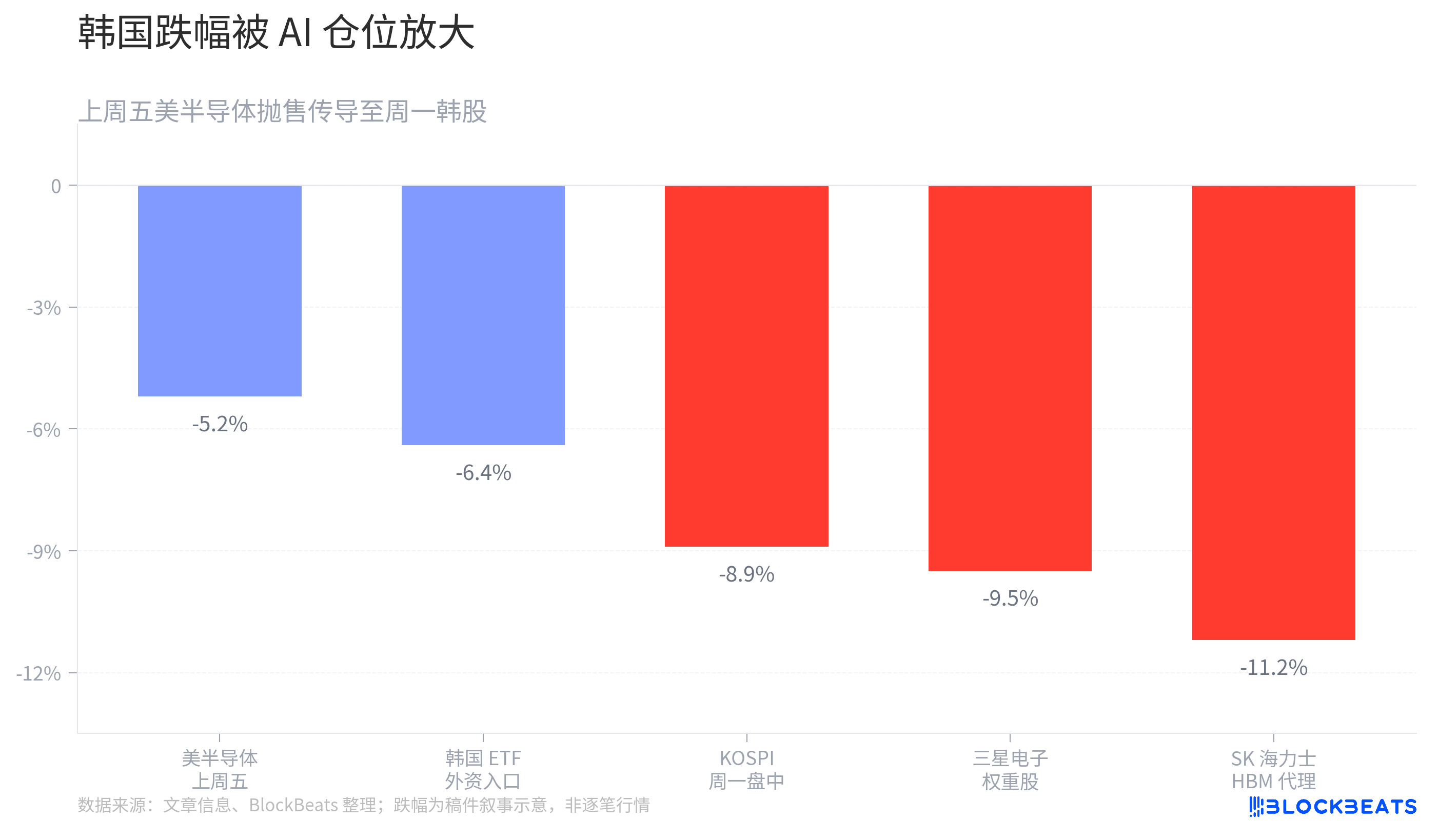
In a sense, Korea is no longer just a national index—it functions more like a large-scale AI memory ETF.
Jensen Huang’s Visit to Korea Contrasts Starkly with Market Panic
If market fear stems from valuation concerns, then the biggest positive signal over the weekend came directly from the industry chain.
Huang’s primary objective during this visit was clear: further solidify NVIDIA’s strategic collaboration with South Korea’s AI supply chain. The most closely watched development was the announcement of a new multi-year agreement between NVIDIA and SK Hynix. Over the past two years, HBM has become one of the most critical components in AI servers, and SK Hynix has emerged as one of the primary beneficiaries.
That’s precisely why the market is paying such close attention to this partnership.
Over recent months, as AI infrastructure buildout accelerated, concerns grew that HBM demand growth might be approaching saturation. Yet Huang’s visit sends the opposite message. If NVIDIA believed AI data center construction were nearing completion, it would have no incentive to deepen long-term supplier relationships at this juncture.
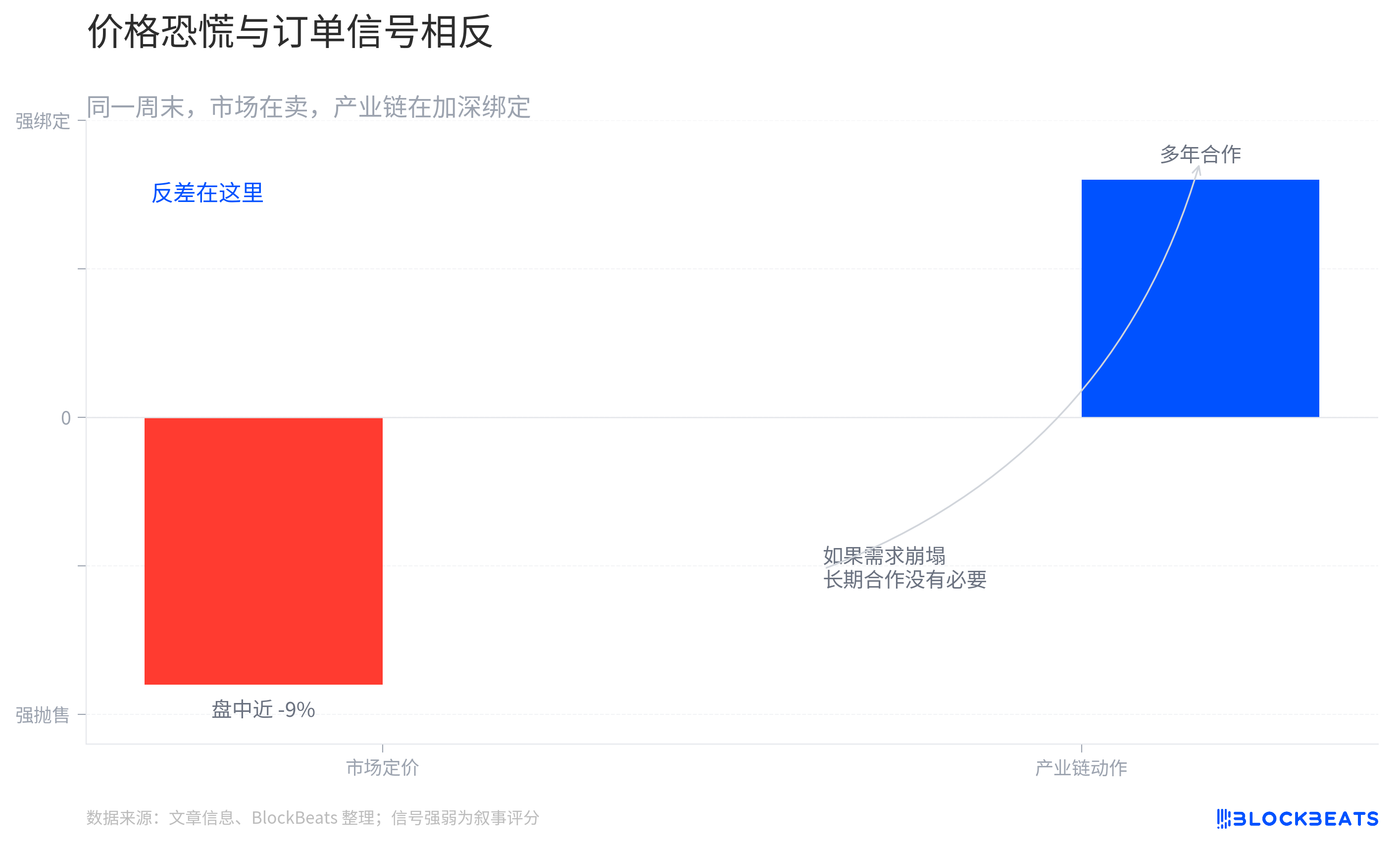
From a supply chain perspective, there is still no evidence that AI demand has suddenly vanished.
What’s most intriguing over the past two days is this divergence: capital markets are expressing concern about AI sector valuations through share prices, while core industry players continue discussing multi-year capacity expansions and cooperation plans. A clear disconnect remains between market pricing and forward-looking signals from the supply chain.
The AI Bull Market Is Entering a Profit Pool Reassessment Phase
This is the central divergence today.
For the past year, market dynamics were driven by a simple narrative: rising AI demand. Thus, NVIDIA rose, Micron rose, SK Hynix rose, Samsung Electronics rose—any company tied to AI saw valuation expansion.
But as gains accumulated, the market entered a second phase.
Investors are no longer satisfied with the abstract story of “AI will grow.” Instead, they’re asking a deeper question: who ultimately captures the profits generated by AI growth? Recent developments—from Rubin rack system memory adjustments, to market reactions after Broadcom’s earnings report, to this week’s Korean market plunge—all reflect the same underlying theme: the market is dissecting the AI profit pool.
SK Hynix benefits from HBM; Samsung Electronics is positioned across HBM, DRAM, and advanced packaging; Micron primarily gains from overall AI server memory upgrades. While all are part of the AI supply chain, their respective profit sources and pricing power differ significantly.
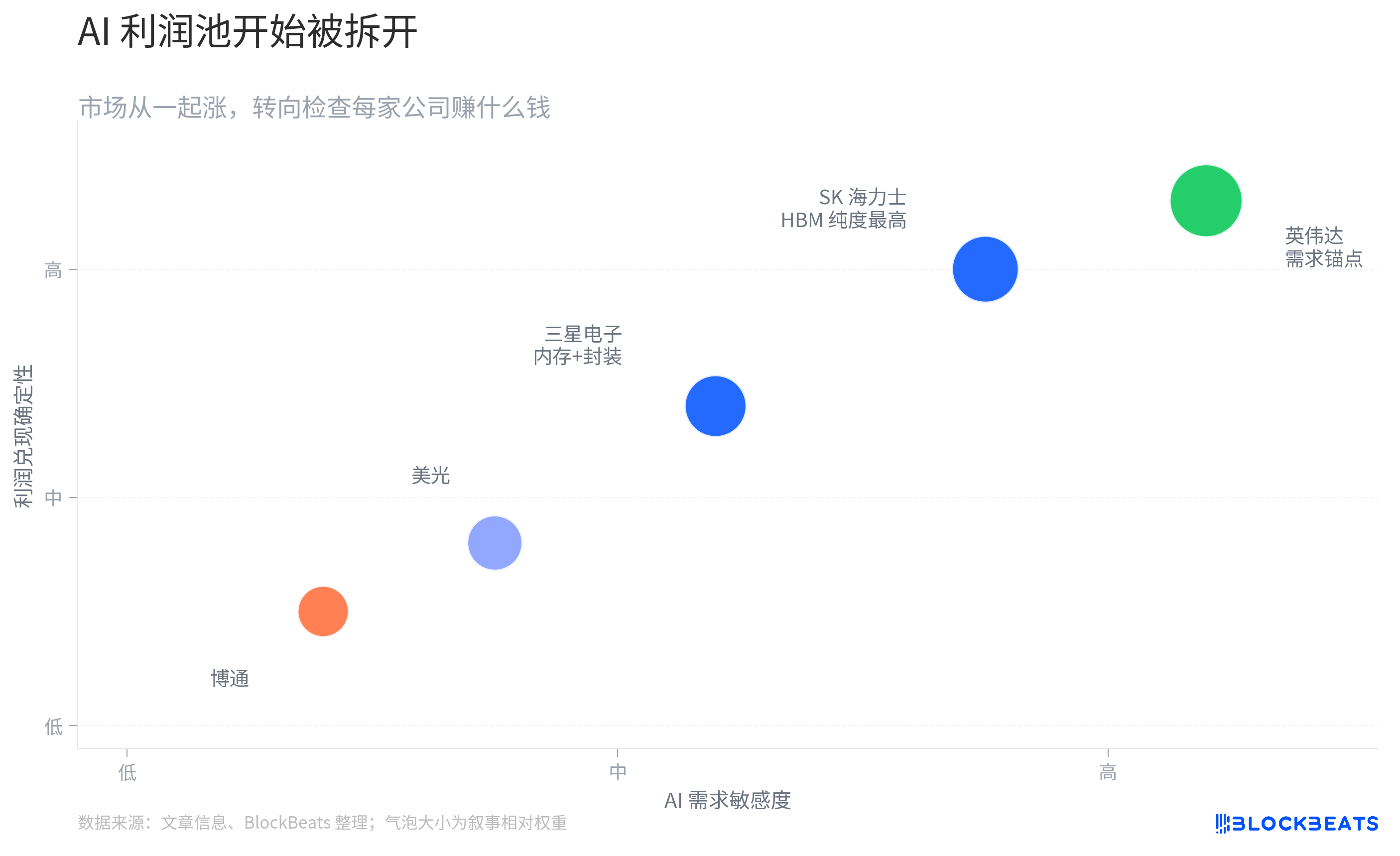
Previously, the market was willing to apply broad valuation multiples across the entire sector. Now, capital is scrutinizing each player individually to assess whether profits can actually materialize.
That’s why a single supply chain rumor, a quarterly guidance update, or even a shift in capex plans can trigger massive volatility across the entire AI sector. The focus of trading has shifted: investors care less about whether AI continues growing, and more about who will ultimately see those gains reflected in their financial statements.
The Direction of Korean Stocks Is Not Determined by Korea Itself
Over the coming weeks, what truly determines the trajectory of the Korean market remains NVIDIA orders, HBM supply-demand dynamics, and cloud provider capex trends.
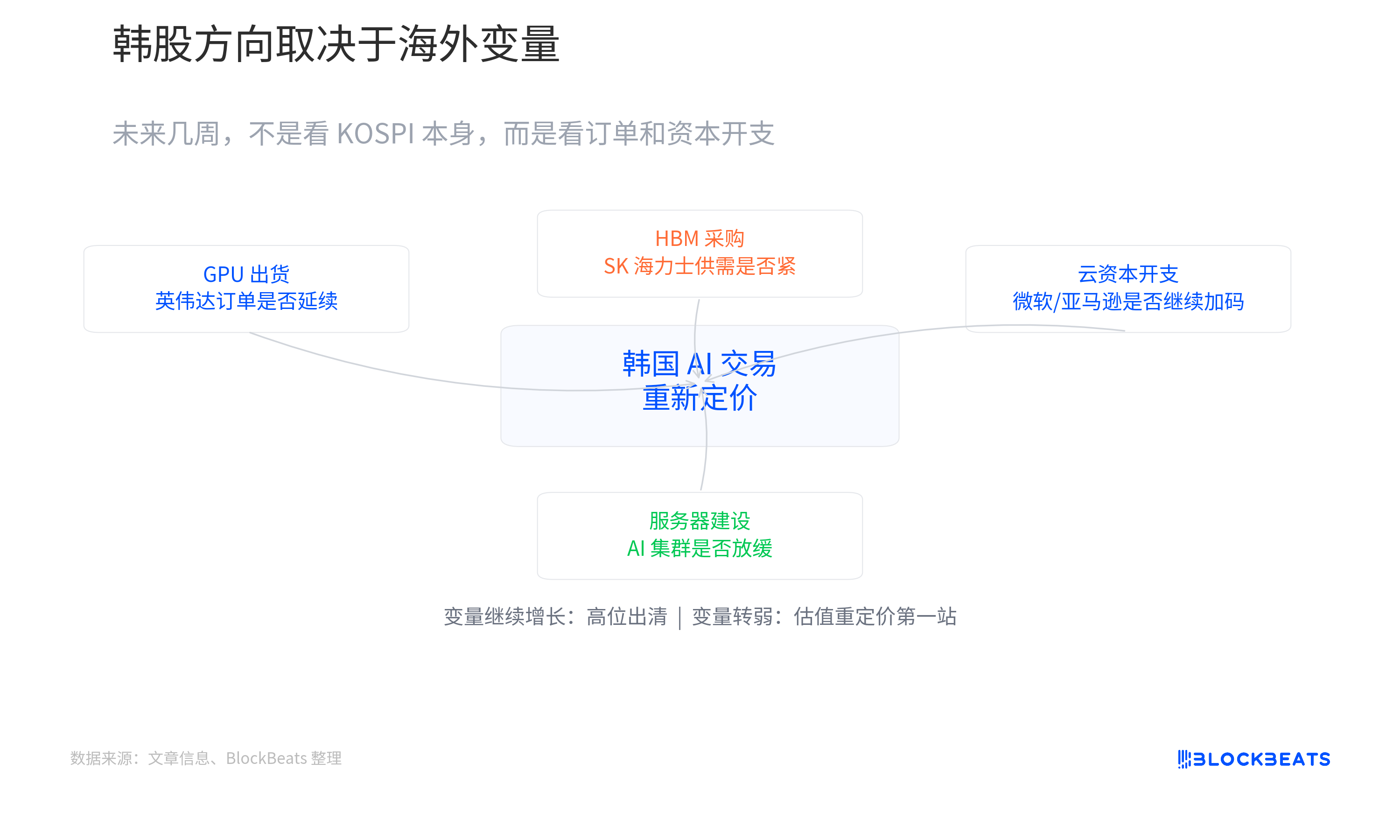
If these indicators begin weakening, this drop may just mark the beginning of a larger-scale valuation correction.
But if data center construction, GPU shipments, and HBM procurement continue high-growth trajectories, Monday’s circuit breaker likely represents a forced unwinding of crowded positions.
At least for now, market pricing and forward signals from the supply chain do not fully align.
On one side, Korea’s top AI firms face their most intense sell-off in years; on the other, Jensen Huang is in Seoul discussing next-generation AI infrastructure with supply chain partners.
Who has the better grasp of reality may soon become evident.
Original: BlockBeats
Disclaimer: Contains third-party opinions, does not constitute financial advice
U.S. Government Senior Official: Specific Arrangements Reached on the Destruction and Transfer of Enriched Nuclear Materials
2 hours ago
Goldman Sachs and Morgan Stanley are expected to each earn approximately $100 million in underwriting fees from SpaceX's IPO
2 hours agoCitrini Research Adds Long Position in Hyperliquid ETF
2 hours agoOpening with a cold splash, prominent institution CFRA issues a "sell" rating on SPCX
3 hours agoBinance: Binance Wallet SPCX x IPO Event Cancelled, Full Refund and SPCXB Airdrop Compensation Provided
3 hours agoSpaceX (SPCX.O) stock surges to $160, up approximately 18% intraday
3 hours agoElon Musk becomes the world's first trillionaire
3 hours ago