From The Big Short to San Francisco: Revelry and Vertigo in the AI Bubble
From The Big Short to San Francisco: Revelry and Vertigo in the AI Bubble


Introduction: San Francisco is once again becoming the epicenter of technological revolution and financial bubble. AI companies, research labs, venture capital, outdoor ads, and rumor networks collectively shape a city charged with intense energy—some propelled forward by valuations and equity packages, others lost in apocalyptic visions of AGI, while still others treat math competition prodigies as the gateway to outsized returns.
The author begins with the iconic line from *The Big Short*: “I smell money.” From there, they document their observations after moving from New York to San Francisco: the city’s technical density, wealth creation, and information asymmetry are real; so too are anxiety, comparison, and Big Bubble Behavior. When AI becomes the sole status game in San Francisco, innovation, speculation, belief, and fear blur together, forming the most tangible on-the-ground manifestation of this current AI mania.
The intrigue of this piece lies not in predicting when the bubble will burst, but in illustrating how bubbles form: how people speak, compare, invest, and fret—and how they seek their place within the narrative of “the future is coming.” The music is still playing, the party hasn’t ended, but the author reminds themselves—and all those caught in the moment—“You can dance, but don’t get drunk.”
Below is the original text:
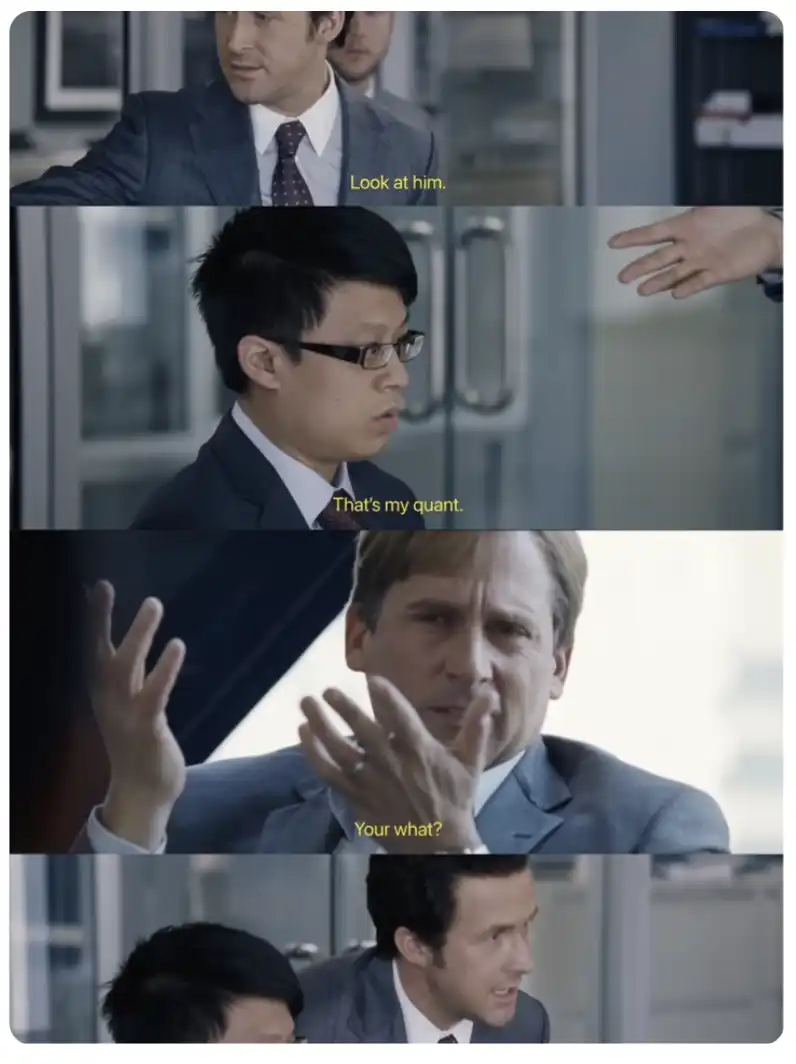
One of my favorite movie scenes is the Jenga tower sequence in *The Big Short*: Ryan Gosling’s character pitches a short bet on the U.S. housing market to Steve Carell’s hedge fund team.
In that conference room, he exudes an arrogant confidence, flanked by three props: his assistant Chris, his quant Jiang, and Jenga blocks printed with mortgage-backed bond ratings. His opening line is unforgettable: “Do you smell it? What’s that smell? Perfume? No. Opportunity? No. Money. I smell money.”
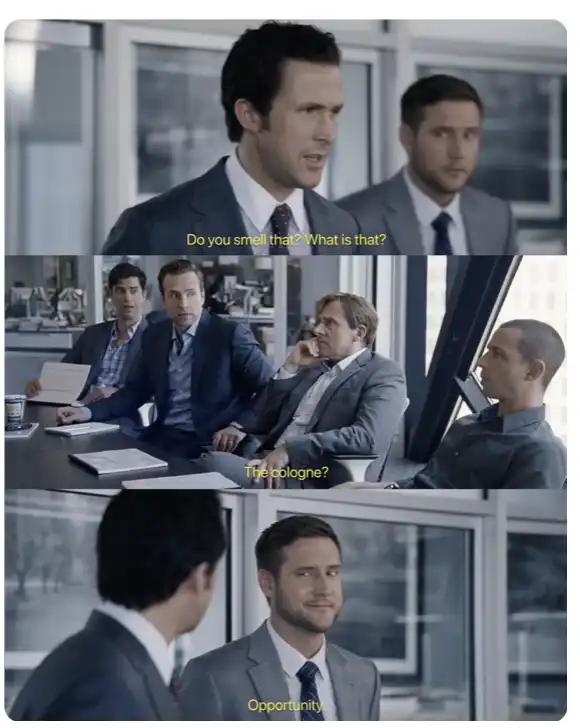
Months ago, I moved from New York to San Francisco to join a friend’s startup. Before arriving, everyone told me: “You must go to San Francisco”—that this was where everything was happening. So for the past few weeks, I’ve been wrestling with one question: Is San Francisco really that important? Did I miss something crucial by staying in New York?
So far, my answer is this: If you want to be at the heart of this massive technological revolution and speculative bubble, then yes—this is the place to be. The density is real. The rumor network is real. And precisely because of that, information asymmetry is real too.
During my time here, I’ve gathered some observations and insights. Here’s what I’ve “smelled” in San Francisco:
1. People are shaking
2. There’s only one status game here
3. A city perpetually screaming “wolf!”
4. Obsession with math prodigies
What struck me most was how stark the contrast in human experience could be within the same city—walking down certain streets, you might feel like you’re in hell; take a different turn, and you’re greeted by views of the bay, distant eucalyptus trees, and scenic beauty. The most futuristic moment comes when you watch autonomous vehicles drifting through city streets. Every time I see a new, friendly, light-blue Waymo car, I can’t help but smile. Or perhaps you feel watched by Ava, this AI BDR (AI Business Development Representative). I hate that ad. But I have to admit—they successfully used “anger bait” to keep me talking about it. Every morning, stepping out of my apartment, this monster greets me:
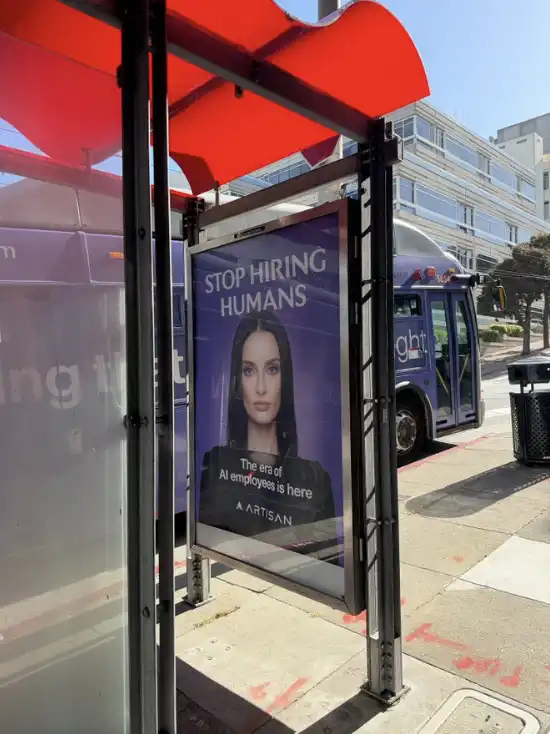
A few weeks ago, I had lunch and coffee with my friend Jared (@imjaredz), who lives in New York but recently joined Cognition. We met at Cognition’s office—the vibe was great, the coffee excellent, the rooftop stunning. I asked him: “What’s your read on San Francisco’s vibe?”
“Have you noticed how everyone in San Francisco is shaking?” I laughed—what? Shaking? Then it hit me: I’d just had cold brew, consumed 300mg of caffeine, and was now slightly trembling myself. “Yeah, literally shaking. I’m not saying we shouldn’t amplify our ADHD tendencies, but next time you’re doing a coffee chat, pay attention—do they seem to be trembling?”
Bubbles and booms generate a jittery energy—one where you feel like if you don’t “make it” now, you’ll never get another chance. I’m no exception—I realized after Jared’s comment that I sometimes shake too. That tired trope about “working nonstop to escape permanent bottom-tier status” has been overused, but every meme gains traction because it captures a cultural mood. If nightlife is a city’s heartbeat and its cultural thermometer, then what does it mean when a 24-hour café run by a “dog startup” becomes the de facto temple of nocturnal grind culture?
Shaking is part of the process of technological revolution and financial bubble. Next time I use AI in writing this article, if you want to kill me, I apologize in advance. But while Googling Carlota Perez, I came across Gemini’s summary of the “Frenzy Phase”:
Frenzy Phase: The peak of installation, where market psychology abandons fundamentals. Financial participants stop chasing dividends and shift toward capital gains, leading to a decoupling between the “paper economy” and the “real economy.”
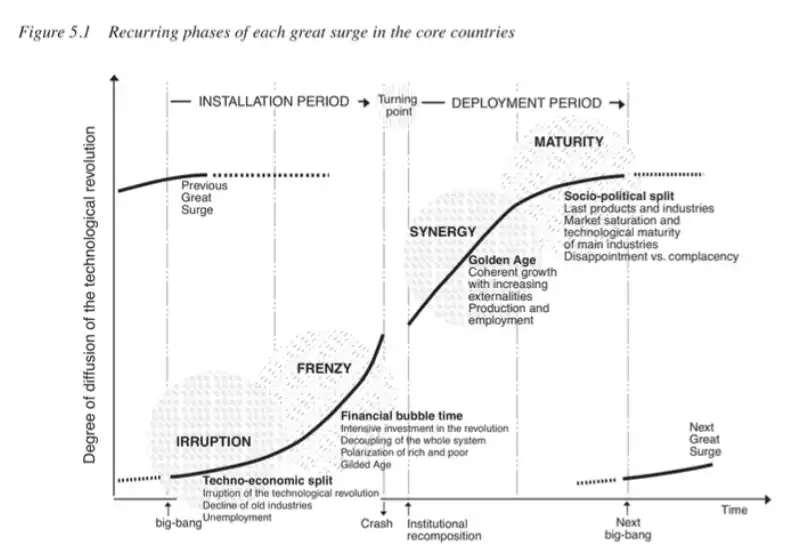
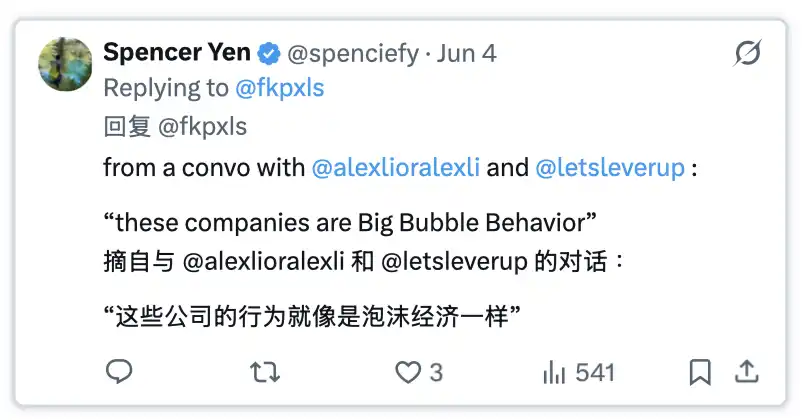
One of my friends coined a term: “Big Bubble Behavior.” It’s a beautiful phrase—I’ve been using it for the past two weeks to label anything exhibiting signs of the Frenzy Phase. Market euphoria can drive irrational behavior. Shaking is Big Bubble Behavior. I’ve seen two plates of lobster tails in my life: once at a crypto party in a Venetian Island mansion in Miami in 2021, and again at ClawCon in 2026.
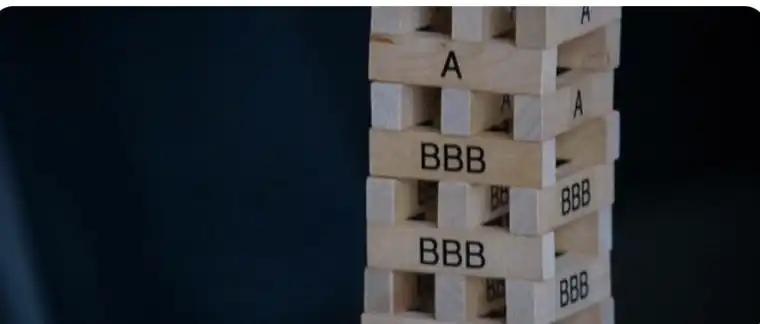

In San Francisco, that water is AI. Outdoor ads are everywhere—billboards, buses, bus stops, shared bikes, even the sky seems colonized by them.
My issue with San Francisco is that there’s only one dominant status game: technology. Whether you’re having dinner or strolling in a park, you hear the same set of buzzwords. You also witness constant alpha farming—because these rumor networks are real. And honestly, I can’t even be mad, because I’m guilty of it too. Don’t hate the players—hate the game.
The problem is, when a city has only one dominant status game, it’s easy to compare yourself to others.
We increasingly measure and benchmark ourselves using vanity metrics: how much funding you raised, or which letter of the alphabet your company has reached. I genuinely hope someone raises Series Z—it would prove just how absurd the private market has become. You hear gossip: which hot startup is being chased by financiers, how high its valuation has soared. Then you start doing nauseating, Blind-style reverse math: How much is that founder’s equity package worth right now?
I once told a friend: if you see Blind-style reverse salary calculations and offer optimization math, you’ll feel so awkward your toes curl. Blind is that anonymous tech industry social network—its most famous meme being: “I’m in an existential crisis—I think my wife might leave me—but should I take Meta’s L6 or Google’s L9? TC: $969k.” So why are we doing the same thing here? Go touch grass. Or maybe that’s just my way of coping.
In New York, at least seven distinct status games coexist: finance, top law firms, music, fashion, celebrity circles, old-money family offices, journalism, sports, entertainment. Because the range is so broad, some games feel so distant they’re almost unattainable—making them oddly fascinating to discuss and study. It disperses the focus of all ambitious people.
I enjoy asking law school friends which top-tier firms have the most prestige, and delight in understanding the subtle differences between them. I love learning about the world of fashion and luxury, and what it takes to survive in that space. I also enjoy studying the opulent lifestyles of quant elites and their arrangements for garden leave (paid non-compete periods after leaving).
San Francisco is creating unprecedented wealth—a strange energy emerges. A researcher friend mentioned that people around them are already investing in land and diversifying into scarce assets. There’s a feeling here: either you own lab equity, or you don’t. There’s even a joke that San Franciscans don’t know how to spend money. This odd energy stems from massive new wealth being created, yet people don’t know what to do with it. First-time rich? Let experienced wealthy kids teach you how to enjoy life.
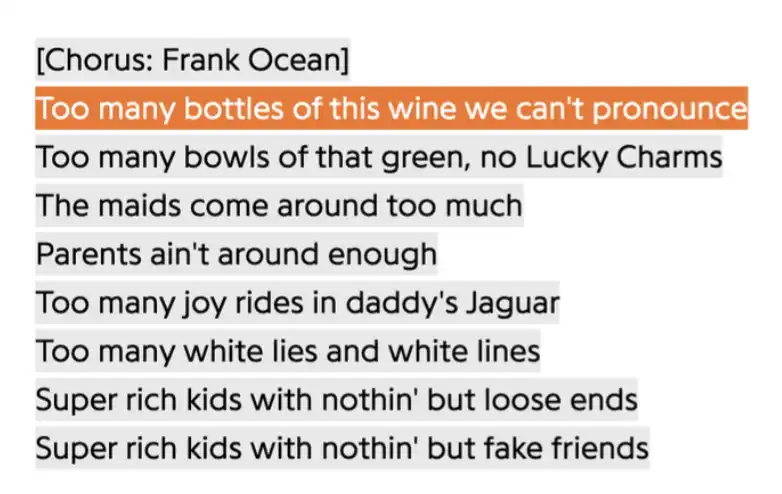
My first impression of San Francisco was a sense of apocalyptic dread. Maybe researchers in labs truly believe they’ve glimpsed a “Second Coming.” If so, their call to slow down and emphasize safety makes perfect sense. But I can’t truly know. All I know is how this apocalyptic mood affects me personally—not well!
I’ve endured plenty of nihilistic conversations: “If Mythos could wipe out everything at once—or break through everything—then what are we even doing building software?” And “Will AI destroy our lives?” “Will AI create massive inequality and bring suffering to society?”
My take: humanity will always find new things to do. Work will migrate to higher levels of abstraction, and new things will become valuable.
We’re terrible at predicting what future societies will look like. I think the anti-capitalist thinkers I read in college were fundamentally wrong in their anger—imagine if they saw humans finding joy in AI-generated fruit trash videos or the “Tung Tung Tung Sahur” from Italian brain rot. What would they say?
“The problem isn’t that AI makes content dumb [sniff], but that we enjoy this stupidity—treating it as sacred trash, a digital fetish object [sniff], isn’t that right?”
From my friend Samir. His bio: not a researcher, but he has a “fish guy.”
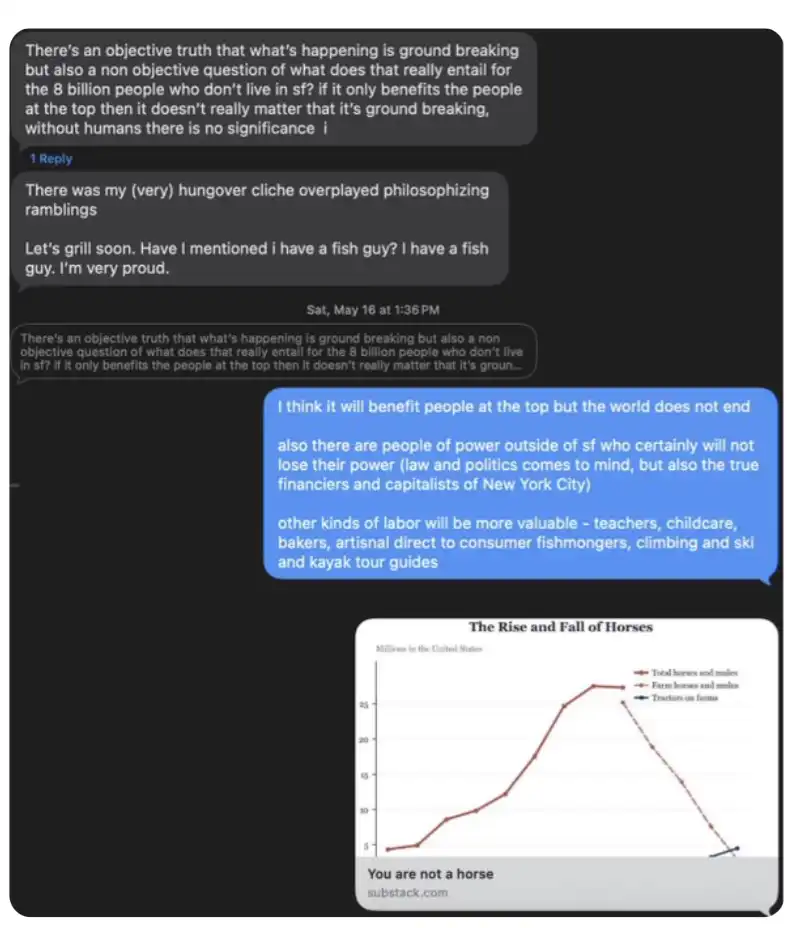
A colleague working in a lab pointed out that within the same company, GTM (Go-To-Market, Sales, Growth) teams and research teams are living entirely different realities. That apocalyptic mood is balanced by another: “Come hang with the GTM crew, grab a beer, touch grass.” The pessimism of model creators versus the optimism of those closest to deployment—there’s real tension worth examining. Time to Forward Deploy!
Six years ago, during university, I wrote about how AI could reshape social structures—my title: *Polanyi and the Second Great Transformation* (no need for Pangram AI detection—Medium before 2023 was like an organic pasture for human writing).
Let me explain the reference: Karl Polanyi was an Austrian-Hungarian economic sociologist whose seminal work is *The Great Transformation*. Written in 1944, it critiqued the rise of modern market capitalism in 19th-century Britain. So the “First Great Transformation” refers to the shift toward capitalism. At age 21, I thought I was clever enough to call AI the “Second” Great Transformation… you get it.
Polanyi’s most famous concept is the “Double Movement,” describing a historical push-pull dynamic: on one hand, free markets expand relentlessly; on the other, society pushes back through regulation to protect itself. The first movement is capitalist elites expanding free markets and commodifying society—today, that means commodifying intelligence. The second counter-movement is society reacting against market-driven destruction and trying to protect itself—today, that means anti-AI and anti-data center rhetoric.
This is how a naive 21-year-old student wrote:
Polanyi wrote: “Nothing could save the common people of England from the shock of the Industrial Revolution. Blind faith in spontaneous progress had seized the minds of men…”
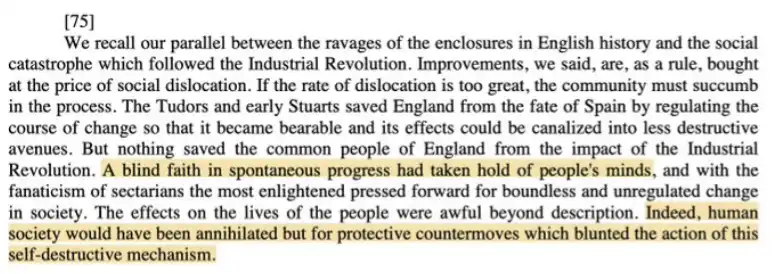
Now reflecting, perhaps those who’ve been shouting “wolf!” all along were actually right. Blind faith in spontaneous progress doesn’t always end well. Polanyi criticized market capitalism for reversing the historical relationship: for most of human history, economic activity was subordinate to social, cultural, and religious institutions. But capitalism inverted this—making society subordinate to economics.
How do we ensure society won’t become subordinate to a nation composed of geniuses in data centers? As Ben Thompson accurately noted in his article on Anthropic’s Mythos, the humor of “The Boy Who Cried Wolf” lies in the fact that the wolf finally arrives.
But what would my inner capitalist say? Then invest in society, culture, and religion! If you have any good deal ideas, DM me your pitch deck.
In that Jenga scene from *The Big Short*, my other favorite line is when Ryan Gosling points to the Chinese guy beside him and says: “That’s my quant.” The atmosphere feels eerily similar to today’s hottest founders—often prodigies who dominated math competitions as children.
Again, Ryan Gosling responds to Steve Carell’s skepticism:
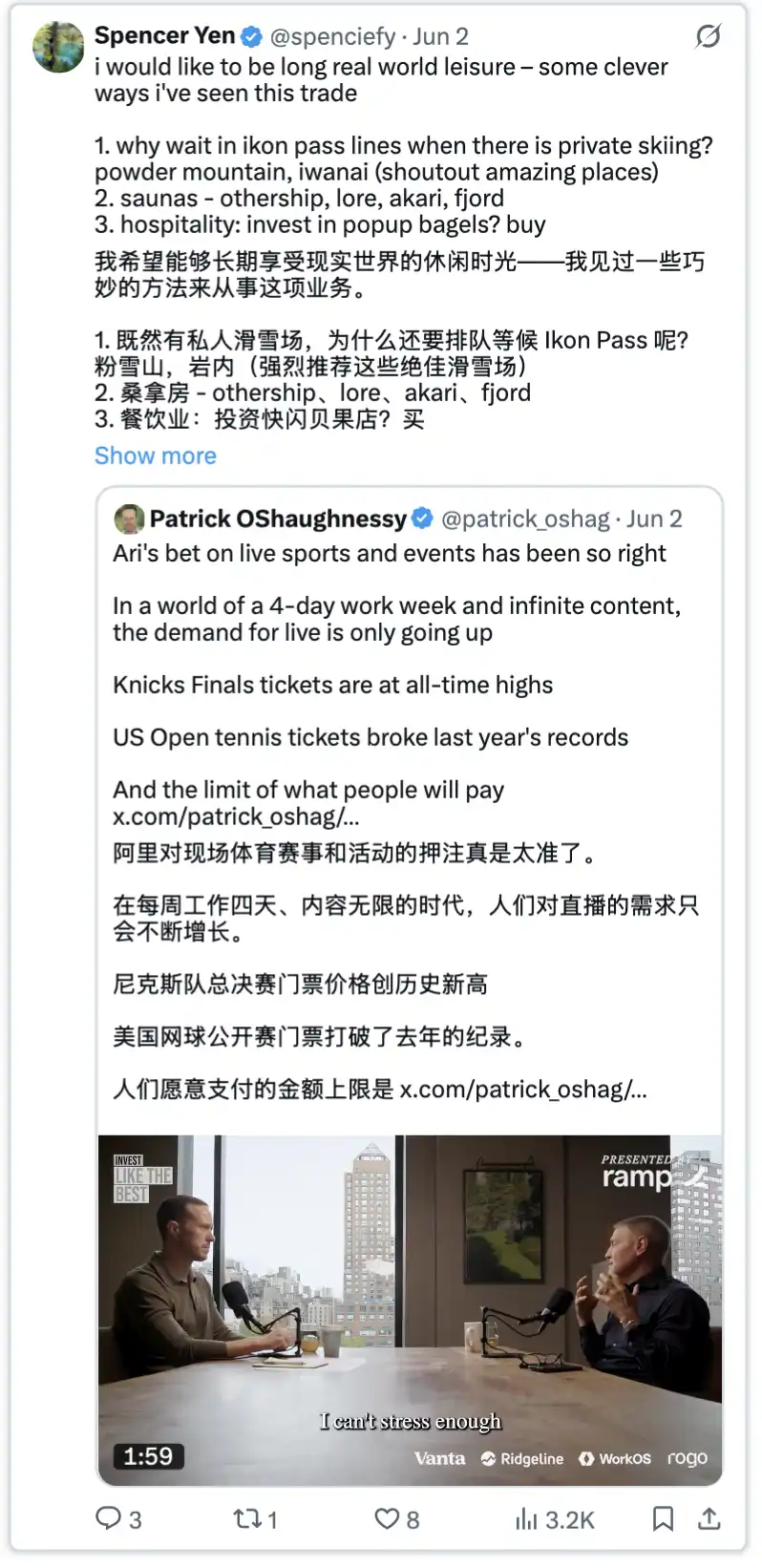
To some investors, the key predictor of a fund’s DPI (Distributed to Paid-In Capital ratio, commonly used to measure fund performance) seems to lie in the founder’s childhood—either they were a math competition prodigy, or they suffered some childhood trauma. I grew up in the Bay Area, and my self-perception of mathematical ability was shattered early, surrounded by genius peers in math competitions. Now, many of them are quants or researchers in large model labs.
I remember one moment in seventh grade vividly: I was flipping through sports channels at home with my dad, and suddenly saw my middle school classmate on ESPN2—he was competing in Mathcounts. At that moment, I knew my path was over. I often joke that when I started the “crunch college application” game in ninth grade, I realized I couldn’t compete with those Intel STS, RSI, AIME, USACO kids, so I had to invent my own rules.
I deeply admire many exceptional CEOs, founders, and researchers. Personally, I’ve even bet financially on one of them. But what amuses me is how today, the entire narrative around “raising the smartest math prodigies and treating them as tickets to outsized returns” has evolved into a full-fledged asset class and investor story. Think about it—this is essentially no different from scouts hunting for the next Wemby (Victor Wembanyama). Still, I’m willing to believe in Jalen Brunson’s story—hard work, perseverance, and grit can win too.
Hyperliquid.

A wise investor once gave me two pieces of advice:
First: You’ll experience three bubbles in your lifetime.
When you encounter your first bubble, you’re completely swept up in euphoria. You lack experience, attend parties, carried away by the frenzy.
By the second bubble, you remember what happened last time, so you can exit with some gains—but still inevitably get sucked in a little.
It’s the third bubble that offers the true opportunity to build generational wealth—you’ve accumulated enough experience from the first two to manage risk, emotions, and timing of exit.
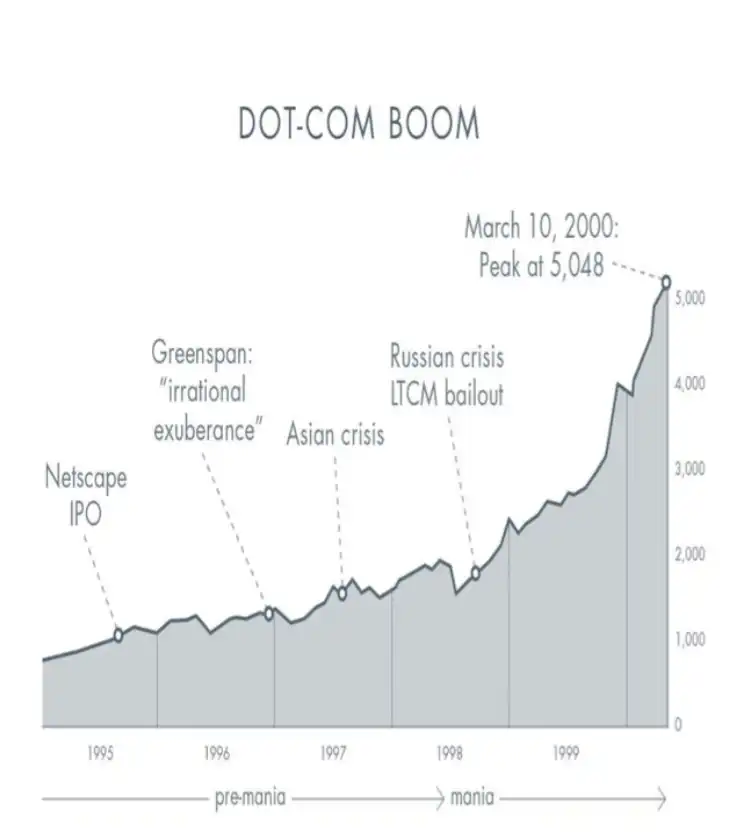
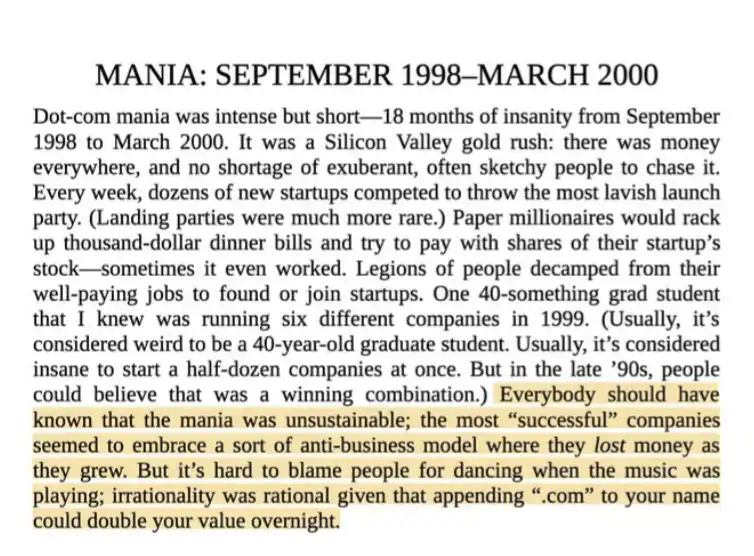
Second piece of advice: When the music starts, dance—but don’t get drunk.
The music is now deafening, possibly on the verge of blowing out the speakers. But bigger backup sound systems are being built. This party clearly isn’t ending anytime soon.
This is a reminder—for myself and anyone who needs to hear it: Remember to touch grass, cook your own food, and don’t let Big Bubble Behavior distort your judgment. Borrowing wisdom from my friend Samir: Let’s grill soon. Do you know anyone who sells fish?
[Original Link]
Original: Ludong BlockBeats
Disclaimer: Contains third-party opinions, does not constitute financial advice
Pharos Network Unlocks AI Model Payment Channels, Introduces New Use Cases for $PROS and USDC as Platform Payment Instruments
9 days ago
NVIDIA Has Plenty of Cash—Why Is It Borrowing $20 Billion?
9 days ago
Will Claude Ban Accounts and Verify ID Cards? Face Recognition Was Old News from Two Months Ago, and "Handing Over Data to Police" Is a Misinterpretation
10 days ago
Japan's Central Bank on the Brink of Rate Hike—Can the AI Bull Run Withstand?
10 days ago
5-Second Breakthrough with Just 1 Interaction: Has the "Strongest Security Mechanism" of Claude Fable 5 Been Cracked by a Chinese Team?
12 days ago
Why Is the "AI Service Subscription Model" Inevitably Headed for Extinction?
12 days ago
Managing a company valued at nearly a trillion dollars, Anthropic's CEO has only one direct report.
12 days ago


