The Promised Crypto IPO Boom? Only One Listed in Half a Year—and It's Down 70%
The Promised Crypto IPO Boom? Only One Listed in Half a Year—and It's Down 70%


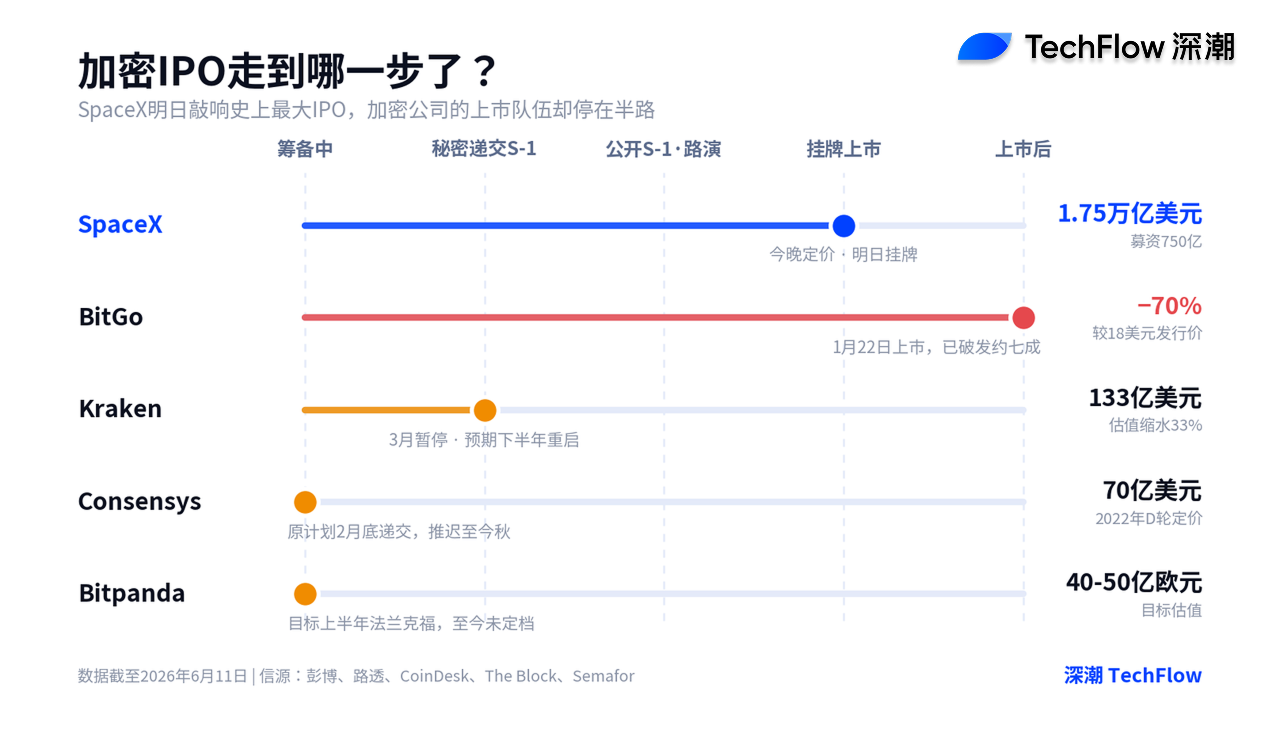
After the U.S. stock market closed tonight, SpaceX will finalize its IPO price. Tomorrow, the ticker symbol SPCX will appear on Nasdaq. According to Reuters, the company plans to issue approximately 557 million shares at $135 per share, raising $75 billion and valuing the company at $1.75 trillion. Regardless of fundraising volume or valuation, this will be the largest IPO in history—more than double the previous record held by Saudi Aramco.
Meanwhile, outside this feast, the lineup of crypto companies going public is falling apart.
SpaceX Siphons Liquidity; Bitcoin Plunges Below $60K in Parallel
SpaceX’s IPO timeline is unusually fast. It secretly filed registration documents on April 1, publicly released its S-1 prospectus on May 20, and launched its roadshow on June 4—days ahead of schedule due to unexpectedly rapid SEC review. From secret filing to listing, it took less than three months.
By contrast, the crypto market showed a clear inverse trend during the same window. According to CoinDesk data, Bitcoin closed at around $61,500 on June 10, then fell roughly 17% over the next week, dipping below $60,000 for the first time since early 2024. The Fear & Greed Index dropped to 9, signaling “extreme fear.” Total crypto market capitalization shrank to about $2.21 trillion. The explanation for capital outflow is straightforward: Bitcoin ETFs continue bleeding assets, while funds are rotating into AI-related stocks and SpaceX’s pre-IPO round. Risk appetite has been siphoned dry by a single $1.75 trillion beast.
For any company aiming to go public, liquidity is oxygen. With $75 billion in demand locked up solely by SpaceX, submitting an S-1 filing at this moment is like flying a kite in a typhoon.
BitGo: Only Public Crypto Company This Year, Stock Down ~70%
Not everyone in the crypto space has given up. BitGo went public on the NYSE on January 22, pricing its shares at $18—above the initial range of $15–$17—and raised $213 million, making it the first, and so far only, native crypto company to complete an IPO in 2026.
The start looked promising. Its opening price was $22.43, a 24.6% premium over the offering price, peaking briefly at $24.50 during the day. But gains were erased by the close, ending with just a 2.7% gain. Since then, it has steadily declined. According to Benzinga data, BTGO closed at $5.61 on June 3—a drop of nearly 69% from the IPO price. Goldman Sachs downgraded its target price from $10.50 to $9.00 on June 4; even that reduced target remains 60% above current levels.
Originally expected to be a bellwether for 2026 crypto IPOs, BitGo has become one—but pointing in the opposite direction. When Kraken paused its IPO plans in March, multiple media outlets cited BitGo’s sharp decline as a cautionary tale for management. A custodian with over $100 billion in assets and a defensive business model still underperformed so badly—what kind of valuation can pure exchange stories expect in the secondary market? Companies waiting in line now have a clear sense of reality.
Kraken: Valuation Slashed 33% in Five Months, Deutsche Börse Moves In
Kraken is the furthest along in the group. On November 19, 2025, its parent company Payward secretly filed an S-1 draft with the SEC, shortly after completing an $800 million funding round led by Jane Street and Citadel Securities, with a valuation capped at $20 billion. At the time, Reuters reported its goal was a Q1 2026 listing.
Then the market turned. In March, multiple reports indicated Kraken froze its IPO plans. On April 14, co-CEO Arjun Sethi confirmed at the Semafor World Economic Summit in Washington that the confidential filings remained valid but refused to disclose timelines, offering size, or valuation ranges. According to Semafor, Kraken’s valuation in a recent round stood at $13.3 billion—down 33% from its November 2025 peak.
A noteworthy detail in that round: Deutsche Börse Group acquired approximately 1.5% fully diluted equity in Kraken for $200 million, with settlement expected in Q2. The operator of the Frankfurt Exchange is stepping in during America’s most challenging valuation phase—clearly seeking opportunity. Combined with Bitpanda’s upcoming move, German players’ intent to capitalize on U.S. market tightening is unmistakable.
Media now generally expects Kraken’s IPO restart to occur in the second half of the year.
Consensys Pushed to Fall, Bitpanda Likely to Miss Deadline
MetaMask’s parent company Consensys has a more direct narrative. According to CoinDesk on May 13, the firm led by Ethereum co-founder Joe Lubin originally planned to file its confidential S-1 with the SEC before the end of February, with JPMorgan and Goldman Sachs leading the underwriting. However, due to continued market weakness, the IPO has been delayed until at least this fall. Consensys last priced itself during its Series D in 2022, raising $450 million at a $7 billion valuation—an figure that may not hold up under today’s market conditions. The truth will only emerge when the S-1 is finally unveiled.
Bitpanda’s issue lies in timing. According to Bloomberg in January, the Vienna-based company backed by Peter Thiel planned a listing on the Frankfurt Stock Exchange with a target valuation of €4–5 billion, underwritten by Goldman Sachs, Citigroup, and Deutsche Bank, with a timetable set for the first half of the year—potentially Q1. Now it’s June 11, with less than three weeks left in the first half, and no official announcement yet. Unless something changes dramatically in the coming days, a delay is all but certain.
Looking at all four together: one listed but down 70%, one filed but paused, one pushed to autumn, one clearly missing its own deadline. Reddit’s original post described them as “racing to list within 12 months”—the phrasing is accurate, but the direction is wrong. This team isn’t racing; they’re each searching for an exit ramp.
Five Months Until Midterm Election
The reason behind the clustering of crypto IPOs in 2026 lies in a shared, unspoken deadline.
This year’s regulatory environment has been relatively favorable for crypto, but the U.S. midterm elections in early November could shift congressional power dynamics. Multiple companies had originally scheduled their IPOs before the election, betting on five months of policy stability.
Precedents aren’t encouraging. Among the batch of crypto firms that listed in 2025, Gemini’s stock once fell over 60% below its IPO price (as of January 31), Bullish traded near its offering price, and Coinbase—listed in 2021—still trades below its debut level. Circle is a rare exception that significantly outperformed. Secondary markets have delivered honest pricing with real capital, far more truthful than any pitch deck.
Returning to the Reddit post, one argument made by the original poster holds weight: once an exchange goes public, its financial books are no longer opaque. Quarterly audit statements will reveal whether revenue comes from trading fees, custody fees, or idle cash interest. For the first time, retail investors can assess an exchange using numbers—not just how smoothly withdrawals work.
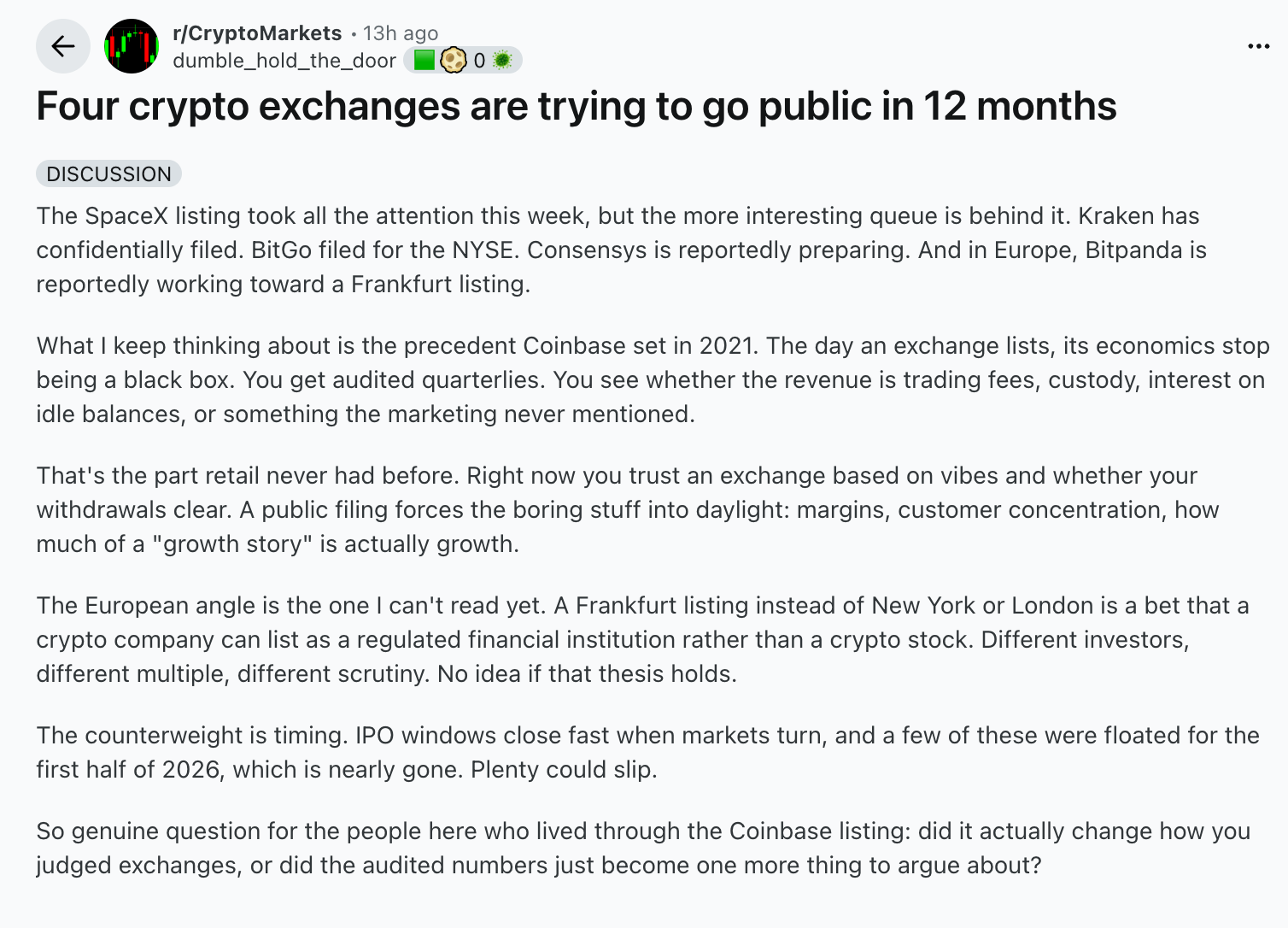
The problem lies in sequencing. Transparency is a consequence of going public, not the motivation. In a market where Bitcoin hovers around $61,500 and the sole public crypto example has plunged 70%, no company is eager to expose itself.
Over the next five months, three key milestones deserve attention: whether Kraken restarts its IPO in the second half, whether Consensys actually files its S-1 in the fall, and when Bitpanda officially acknowledges its delay.
One variable will be revealed tomorrow. If SpaceX’s IPO absorbs capital and triggers a liquidity rebound, this window might reopen slightly. But if even the largest IPO in history performs flatly, the 2026 crypto wave will likely have to wait until after the election.
Author: Claude, DeepTide TechFlow
Disclaimer: Contains third-party opinions, does not constitute financial advice
NVIDIA attracts $85 billion in investor demand during massive bond issuance
06-16
Ethereum surges over 10% in 24 hours, currently priced at $1,841.31
06-16Amazon announces a multi-billion dollar investment in Missouri to build a data center campus, expected to create over 400 long-term positions
06-16Binance Platform's SpaceX Perpetual Contract Trading Volume Surpasses $9 Billion, Capturing Over 60% Market Share
06-16Binance platform XLM/USDT short-term spike down to $0.17, now recovered to $0.225
06-16
Trump: The Strait of Hormuz has been fully reopened as of Friday, and all agreements have been signed
06-16SlowMist: Aztec Connect Contract Hacked for $2.19 Million Due to ZK-Rollup L1/L2 State Boundary Vulnerability
06-15
