Why Is the "AI Service Subscription Model" Inevitably Headed for Extinction?
Why Is the "AI Service Subscription Model" Inevitably Headed for Extinction?


Subscription models are being drained, and must be cherished while they last.
On June 9, Anthropic unveiled its strongest publicly available model to date: Claude Fable 5. By convention, this should have been a celebration for paying users—you finally get early access to the flagship model with your monthly fee.
But one line in the announcement triggered immediate controversy: after June 22, Fable 5 will be removed from all subscription plans, and continued use will require purchasing usage credits separately.
In other words, even if you’re a subscriber, the flagship model is only yours for 14 days.
A model that comes with a built-in “eviction notice” on launch day is unprecedented in the large model industry.
Many see this as an oversight or an act of arrogance. My view is the opposite: this isn’t a mistake—it’s a preview.
The AI subscription model is heading toward an inevitable demise—not because any company is greedy, but because the fundamental premise upon which subscriptions were built is being dismantled by AI itself.
01 The Flagship Model with a 14-Day Countdown
Let’s clarify the facts first. According to Anthropic’s official schedule (June 9, 2026), Fable 5 will be included free of charge in Pro, Max, Team, and per-seat enterprise plans starting at launch, through June 22. From June 23 onward, it will be removed from these plans, and every subsequent token consumed will be deducted from prepaid usage credits, priced at API rates exactly.
This rate is not cheap: $10 per million input tokens, $50 per million output tokens—exactly double the rate of the previous flagship, Opus 4.8. More subtly, even during the free window, Fable 5 consumes usage credits at roughly double the weight of Opus—meaning the same task burns through your quota at twice the speed.
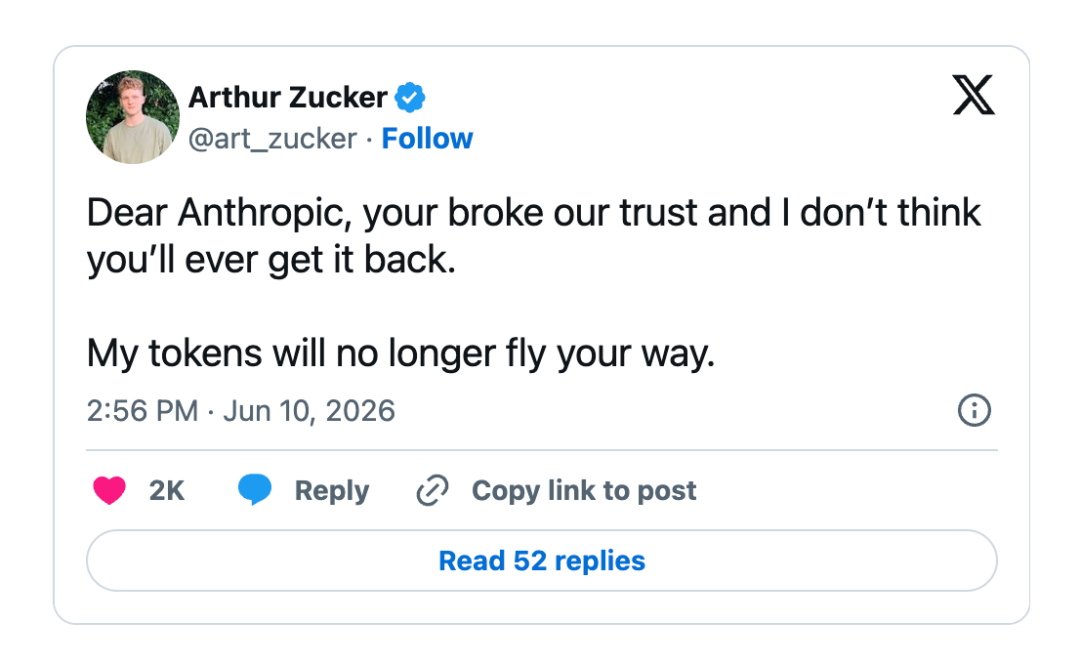
Naturally, user reactions were swift. On Hacker News, one user described this “give then take” approach as unsettling, suspecting Anthropic was trying to push subscribers toward pay-per-use. Developers also tested it: a single agent programming session on the $100/month Max plan consumed nearly $100 worth of tokens.
And this isn’t just Anthropic. Over the past eight weeks, the entire industry has been moving in the same direction. OpenAI changed Codex from message-based billing to token-based pricing aligned with the API on April 2, then extended it to all existing enterprise clients.
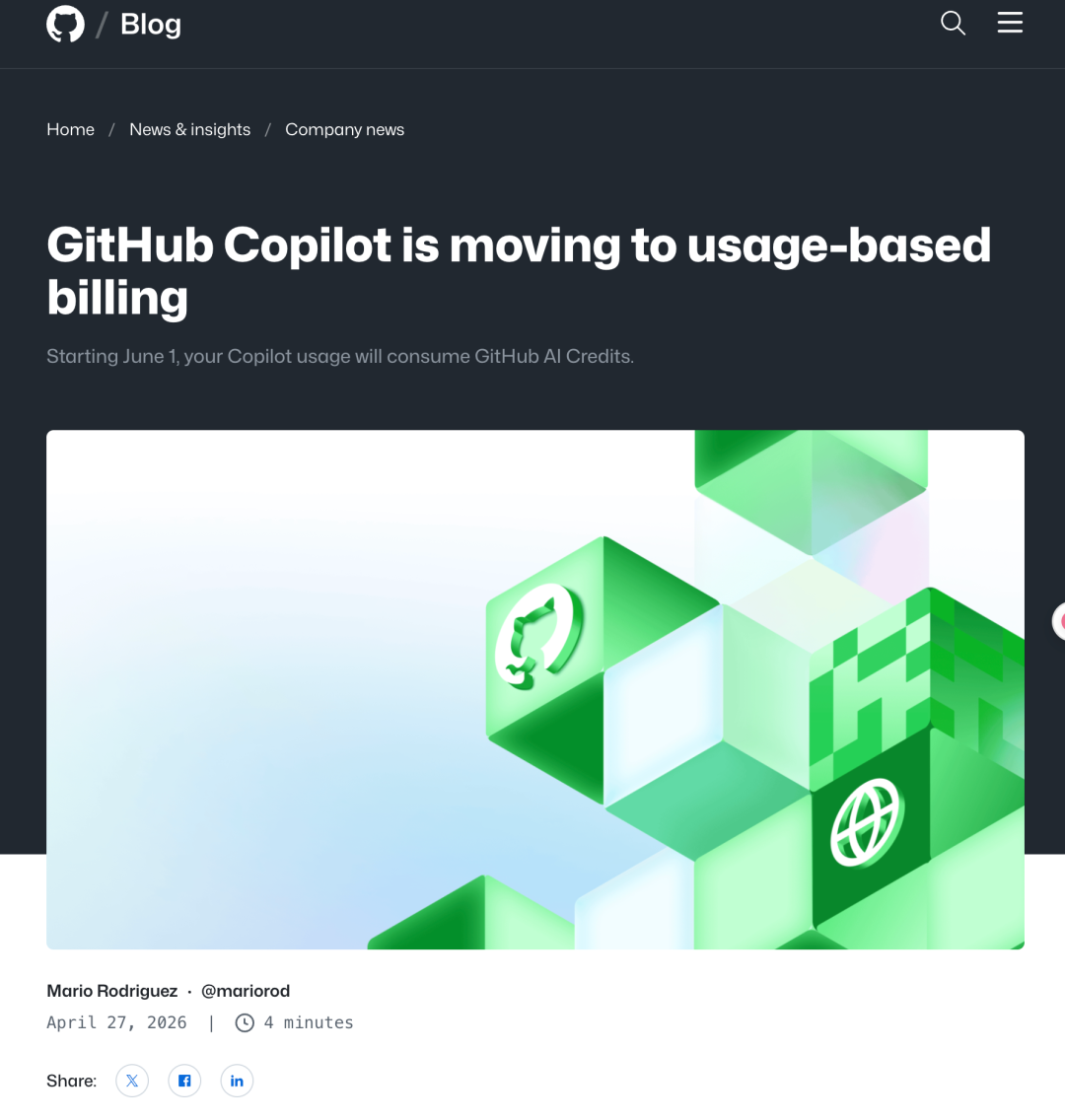
GitHub froze new sign-ups for Copilot Personal on April 20 and announced a full shift to AI Credits billing a week later, completing the switch on June 1—Pro tier at $10/month includes $10 in credits.
Anthropic’s moves have been the most aggressive: since April 4, third-party agent frameworks like OpenClaw can no longer consume subscription quotas; such usage now defaults to pay-per-use. On April 21, the Claude Code entry in the Pro plan pricing page was quietly replaced with a red X. After community outrage, it was withdrawn within 24 hours, with the official explanation being “a small test targeting about 2% of new sign-ups.” On May 14, Anthropic officially announced that Agent SDK and headless API calls would be removed from the subscription pool starting June 15, transitioning to standalone credits priced at API rates.
Three companies, eight weeks, one direction—not coincidence, but the industry collectively solving the same mathematical problem.
What does that equation look like?
02 Pricing Is Never About Compute
Research firm SemiAnalysis recently laid this equation bare. They purchased each subscription tier from both Anthropic and OpenAI, ran long-form coding tasks until exhausting weekly limits, then converted usage into API-list prices: how much did these tokens actually cost?
Previously, the industry assumed a $200/month package could barely cover $2,000 in token usage. Reality far exceeded expectations: $20 Claude Pro reached ~$400 in value; $200 Max 20x hit ~$8,000.
OpenAI’s numbers were even more extreme—$20 ChatGPT Plus delivered ~$700 in usage value; $200 Pro 20x reached ~$14,000.
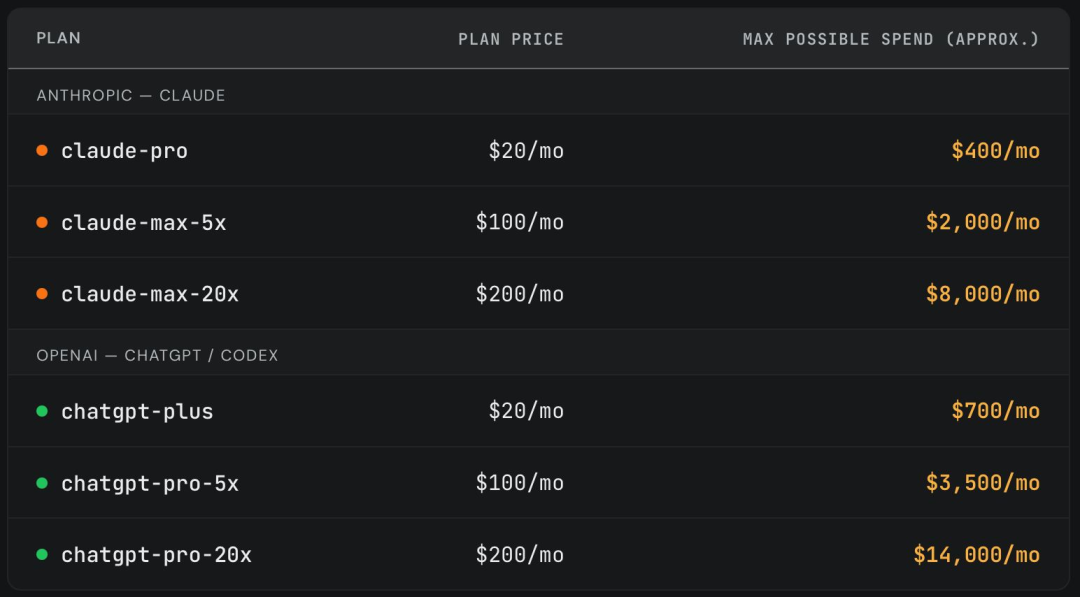
Two fair points must be made upfront: these are ceiling values when pushing limits, not average daily usage; and API prices include margins, so the figures don’t reflect actual compute costs.
But pricing must account for the ceiling—just as insurers can’t assume no claims will ever happen.
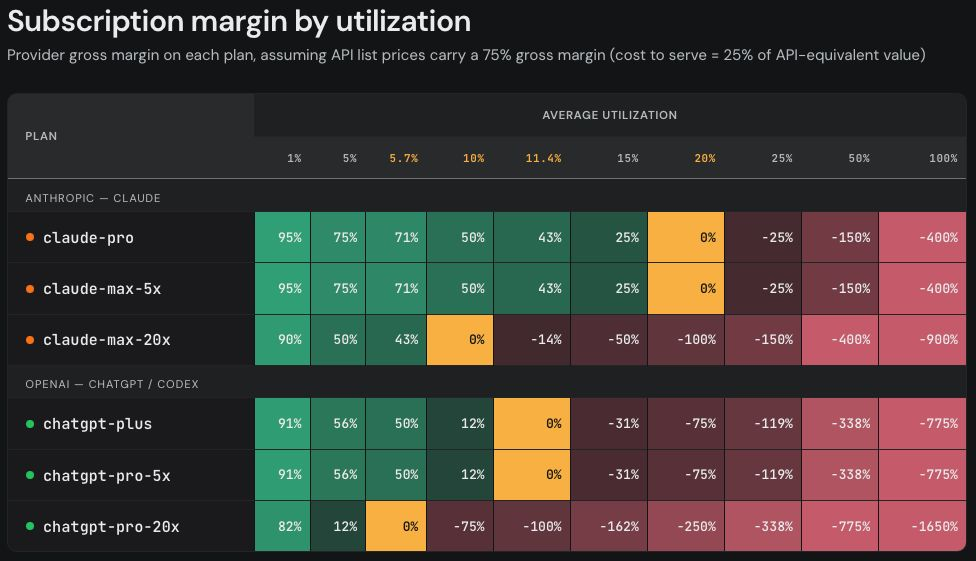
Subsidies themselves aren’t fatal. Streaming services subsidized, ride-hailing apps subsidized—burning money for growth is internet tradition. What’s truly lethal is a fundamental difference between AI subscriptions and past models.
Netflix dared to sell monthly bundles because two things held true: marginal cost of adding one more show approaches zero, and a person has only 24 hours per day to watch. Spotify works the same way. The implicit premise behind monthly subscriptions is that consumption is capped by human physiological limits—the real price isn’t content, but time.
Chatbot-era AI barely met this condition. Even the most talkative user hits keyboard limits. Light users’ idle capacity comfortably offset heavy users’ overconsumption.
Then came agents.
What does a single agent task look like? It reads 20 files, plans, modifies code, runs tests, parses errors, iterates—each round consumes 5 to 30 times more tokens than a normal conversation. Worse, it doesn’t need you present.
I’ve experienced it firsthand: recently, I asked an agent to organize flight data from two airports. I went to take a shower, and when I returned, the task was done—and my quota was gone. You’re asleep, but the meter keeps spinning.
Agents don’t remove price caps—they eliminate consumption caps. And the entire trajectory of AI evolution—longer tasks, greater autonomy, multiple concurrent instances—is hurtling toward one endpoint:
Removing humans entirely from the consumption loop.
GitHub put it plainly in their announcement: agent usage “is becoming default.” That is, the remaining scenarios where subscriptions still make sense—users typing one message at a time—are shrinking in importance within AI’s value landscape.
At this point, someone might ask: Can’t we just raise prices?
We tried. And got worse results. Looking back at SemiAnalysis’s chart, there’s an anomalous detail: higher-tier plans had greater subsidy multipliers.
For Claude, the $20 tier had a 20x multiplier, the $200 tier 40x; for OpenAI, it rose from 35x to 70x. Half is pricing design—higher tiers amplify quotas, effectively offering bulk discounts to big customers. The other half reflects user behavior: those spending $200 on a 20x plan are clearly aiming to max out usage—light users simply don’t appear at this level.
This is known in insurance as adverse selection: when a policy’s pricing attracts only the highest-risk customers, the policy has no sustainable underwriting basis. Any fixed price precisely filters out users who exceed it—this isn’t a management issue, but a structural one. Price adjustments only refine the filter.
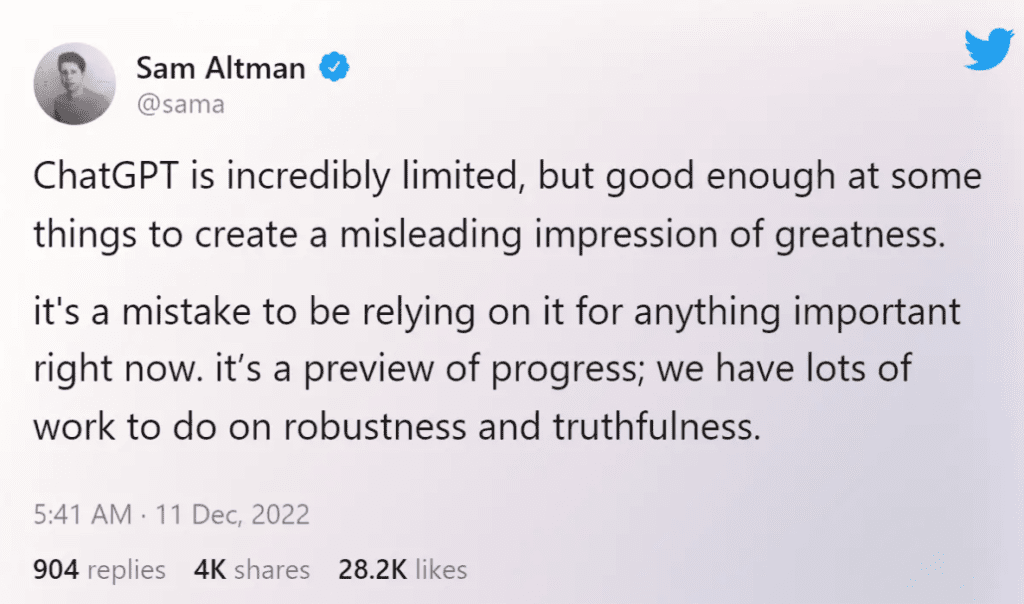
Throughout 2025, the industry tested every patch. In January, Sam Altman admitted on X that ChatGPT Pro at $200/month was losing money due to unexpected usage—price increase failed.
Mid-year, Cursor switched from request-based to compute-based billing, triggering mass cancellations, prompting a public apology from the CEO—rule change mid-stream failed. In summer, Anthropic introduced weekly caps on Claude Code, citing users running agents nonstop, consuming compute costs in the tens of thousands—limiting usage only fueled outrage.
With all patches exhausted, the industry finally staged its collective reckoning over these eight weeks. Nick Turley, ChatGPT lead at OpenAI, made it clear on the BG2 podcast: “Offering unlimited plans in today’s era may be as sensible as offering unlimited electricity.”
03 The Shell Remains, the Core Is Dead
Certainly, one compelling counterargument persists: subscriptions are thriving. ChatGPT Plus remains $20/month, Claude Pro still sells, and GitHub’s code completion even retains monthly plans. Isn’t talk of demise alarmist?
This rebuttal deserves serious consideration—it describes a real phenomenon. But it misidentifies what’s dying.
The soul of subscriptions is never the form—“charged monthly”—but the promise: “fixed price, worry-free usage.” You don’t calculate cost per interaction. That’s why subscriptions beat pay-per-use in the first place.
Now, the charging cycle remains—but the promise is gone.
GitHub Pro’s $10/month includes $10 in credits, used up instantly—this isn’t a subscription, it’s a pre-paid recharge card wearing a subscription disguise. Anthropic’s credits are deducted at API rates; OpenAI’s credits support auto-replenishment. Subscriptions won’t be canceled—they’ll be hollowed out: shell intact, core dead.
One true enclave remains: pure chat. It survives because it’s the last AI scenario where consumption is still constrained by human time. But even this moat won’t hold—the industry’s every dollar in R&D pushes AI from “you ask, it answers” toward “it proactively completes tasks for you.”
Chat subscriptions won’t be killed—they’ll be marginalized: left behind, watching real value and real revenue gradually migrate into the pay-per-use world.
Another timing coincidence is hard to ignore: according to TechCrunch (June 2026), Anthropic is preparing for an IPO alongside OpenAI. For the past three years, subsidies were funded by venture capital. Public market investors won’t accept a P&L that loses money with every heavy user. The exit timeline of capital determines the reckoning won’t be delayed indefinitely.
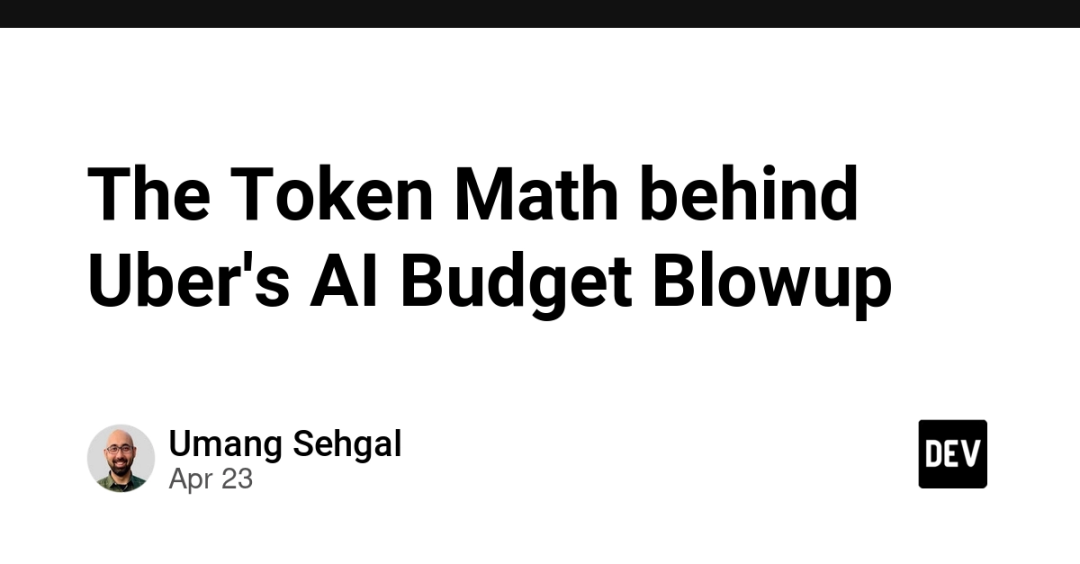
This means different things for different people. For enterprises, AI spending will now be managed like cloud spend—according to The Information, Uber’s CTO noted internally that the company burned through its entire 2026 AI budget in just four months. Budgeting, monitoring, routing models by task will become mandatory for every team.
For individual users, the old model—light users subsidizing heavy ones—is gone. Now, everyone pays for their own meter.
To be honest, this isn’t all bad. With price signals returning, “Is this task worth running on AI?” becomes a genuine question—for the first time. And when an industry starts seriously answering that question, it’s often signaling the end of the burn-rate narrative and the beginning of normal business.
As I write this, I want to insert one thought: before meters are installed, today’s subscription model might be the most generous moment this industry has offered users—use it, cherish it.
The logic lies hidden in SemiAnalysis’s chart. Read from a user perspective, it’s not a death sentence—it’s a live benefits list: you pay $200/month, and the platform lets you burn up to $14,000 in compute.
This level of subsidy last appeared during the ride-hailing wars and food delivery wars—and we all remember how prices never reverted afterward.
So run your heavy workloads now. The window for Fable 5 in subscriptions ends June 22. Rather than wait for the credit era and then carefully ration usage, go ahead and schedule those long, expensive tasks you’ve always wanted to run. This isn’t fleece—just being a rational beneficiary of a pricing error that’s destined to be corrected.

Turley’s metaphor may run deeper than he intended. The true sign that electricity became infrastructure wasn’t that it reached every home—but that every home got a meter. From that moment on, no one debates “should electricity be monthly”—only “what should the rate be?”
There will be no obituary for subscriptions. It will quietly vanish on some quiet billing day, appearing as a small line item labeled “entry fee” in your expense report.
Until then—use it, cherish it.
Original article: Lawful BlockBeats
Disclaimer: Contains third-party opinions, does not constitute financial advice
Pharos Network Unlocks AI Model Payment Channels, Introduces New Use Cases for $PROS and USDC as Platform Payment Instruments
06-15
NVIDIA Has Plenty of Cash—Why Is It Borrowing $20 Billion?
06-15
Will Claude Ban Accounts and Verify ID Cards? Face Recognition Was Old News from Two Months Ago, and "Handing Over Data to Police" Is a Misinterpretation
06-15
Japan's Central Bank on the Brink of Rate Hike—Can the AI Bull Run Withstand?
06-15
5-Second Breakthrough with Just 1 Interaction: Has the "Strongest Security Mechanism" of Claude Fable 5 Been Cracked by a Chinese Team?
06-13
Managing a company valued at nearly a trillion dollars, Anthropic's CEO has only one direct report.
06-13
ERC-8126: A New Ethereum Standard for Issuing "Security Health Reports" to AI Agents
06-12


