ETF Is Just the Ticket In: The Real Institutionalization of Bitcoin Happens Where You Can't See
ETF Is Just the Ticket In: The Real Institutionalization of Bitcoin Happens Where You Can't See


Everyone knows ETFs, but almost no one realizes that while ETFs have captured all the attention, there are dozens of institutional products built around Bitcoin—from a $40 million bitcoin-backed insurance reserve in Barbados to S&P-rated bonds sold by Jefferies to Wall Street investors.
ETFs answer just one question: How can retail and institutional investors hold Bitcoin within a regulated wrapper? The products described in this article answer a different, arguably more important question: Once you own Bitcoin, what can you do with it?
The answer is: exactly what the financial industry has always done with U.S. Treasuries and gold. You can collateralize it for loans, use it as margin in trading, back insurance policies with it, or build corporate balance sheets upon it.
An asset capable of enabling all these functions is sometimes called a financial primitive—a fancy term for "building block": something widely accepted and easily valued, upon which other parts of the financial system can stack loans, bonds, and derivatives. Treasuries earned this status because everyone agrees on their value and how they can be seized if a transaction goes wrong.
Bitcoin is now undergoing the same test, and early results explain why some of the largest players in this market truly, genuinely don’t care about price fluctuations.
Insurance Reserves, Consumer Credit, and the First Rated Bitcoin Bond
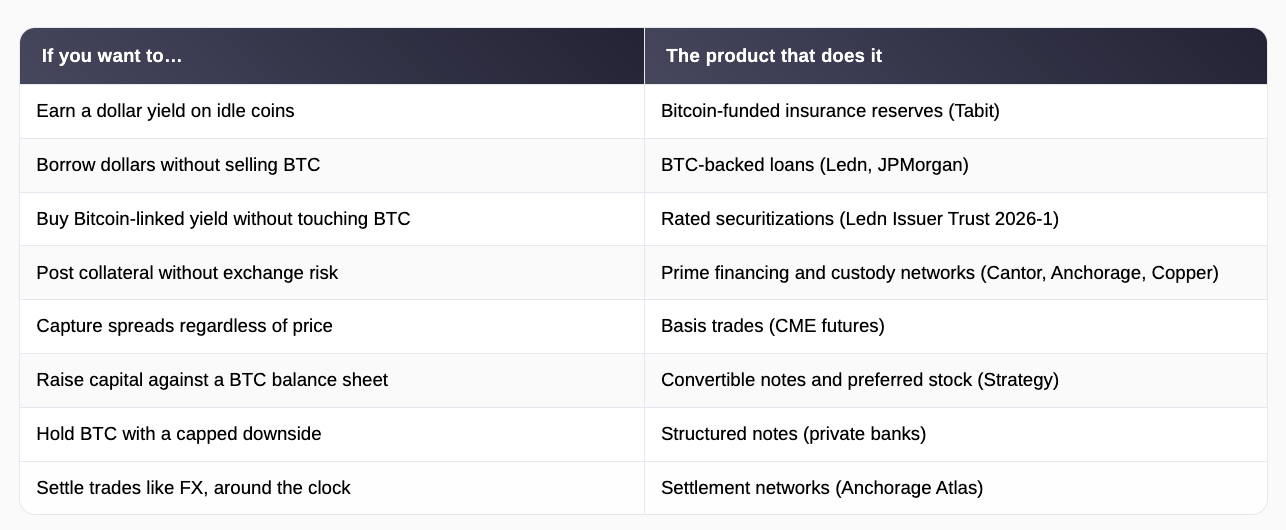
In March 2025, Tabit Insurance, an insurer founded by former executives from the Bittrex exchange and licensed in Barbados, capitalized a property and casualty insurance entity with a fully bitcoin-funded $40 million capital base.
Essentially, Bitcoin holders hand over their coins to back real insurance policies covering storm damage and lawsuits against corporate directors, in return earning near-10% USD yields. Policies and premiums remain in USD, so customers never touch crypto; Bitcoin serves as the reserve, used to pay claims should issues arise.
Tabit holds a Class 2 license from the Barbados Securities and Exchange Commission and is structured as a segregated accounts company, meaning each investor pool is legally isolated from others—so losses in one account cannot drain capital from another.
Regulators and auditors can also verify reserves in real time on the blockchain, offering greater transparency than traditional insurers provide in their quarterly reports. CEO Stephen Stonberg notes that the entire global reinsurance industry operates on roughly $80 billion in capital, while Bitcoin represents an asset class worth trillions—so even a small fraction flowing into underwriting would be felt across the industry.
While insurance reserves are certainly an unexpected use case for Bitcoin, lending is where money starts getting serious. Bitcoin-backed loans work simply: you pledge your coins to a lender, receive USD, and reclaim your coins when you repay.
Owners do this because selling triggers taxable gains and closes their exposure to future price appreciation, whereas borrowing against coins provides cash without surrendering any.
Trading volume across platforms reached approximately $2 billion in 2025, with Toronto-based Ledn alone reporting over $9.5 billion issued since 2018, and JPMorgan and other major banks now launching similar products for their clients.
In February 2026, this lending business crossed into the mainstream bond market. Ledn completed a $188 million securitization, bundling 5,441 loans into a pool and issuing bonds whose interest payments came from borrower repayments.
The bonds were split into two tranches: $160 million in senior notes, paid first and rated BBB- by S&P Global—the investment-grade rating and the first ever assigned to a security backed by digital assets—and $28 million in riskier subordinated notes rated B-, absorbing the first losses in exchange for higher yields.
By crypto standards, the underlying numbers were remarkably conservative. The pool included 2,914 U.S. borrowers owing $199.1 million, but had pledged around 4,079 BTC worth $356.9 million—implying a loan-to-value ratio of 55.8%, meaning they collateralized nearly $2 of Bitcoin for every $1 borrowed.
Ledn CEO Adam Reeds said this structure created a “direct pipeline” between liquidity-seeking Bitcoin holders and the deepest institutional capital pools, while Bitwise’s European research head Andre Dragosch noted the deal proves traditional finance now views Bitcoin as legitimate—even pristine—as collateral.
The structure was subjected to an immediate stress test, revealing both the model’s strength and its vulnerabilities. Bitcoin dropped about 27% from mid-January to February 2026, pushing up the pool’s overall loan-to-value ratio and triggering margin calls—automatic demands for borrowers to either add collateral or watch lenders sell it.
Ledn ultimately liquidated roughly one-quarter of the loans originally planned for this transaction. The sales still went through, partly because the automatic liquidations worked exactly as designed, and Ledn suffered no losses when selling collateral due to defaults.
The reverse consequence to remember is this: When many lenders run the same trigger on the same volatile asset, a sharp price drop forces them to sell simultaneously, which further drives prices down, triggering even more sales. The system passed its first real test—and revealed exactly where it would break under sufficient pressure.
Collateral Networks, Arbitrage Trades, and Corporate Balance Sheets
Beneath these products, the market’s fundamental mechanics are being rebuilt, resembling more closely the money and bond markets, where the entity holding your assets, the platform you trade on, and the system settling transactions are three distinct entities.
Anchorage Digital operates the only federally chartered crypto bank in the U.S., launching its Atlas settlement network in April 2024 to enable institutions to settle trades directly with each other—without parking funds in custodial accounts or pre-funding on exchanges.
By March 2026, Atlas connected nearly 600 participants—four times the number a year earlier—and had processed hundreds of billions in settlements, expanding to manage collateral, meaning the bank now monitors loan positions, issues margin calls, and handles liquidations on behalf of lenders.
In March 2025, Cantor Fitzgerald chose Anchorage and Copper.co to play this role in its global Bitcoin financing operations. Copper’s ClearLoop system allows trading firms to lock their coins in custody while continuing to trade across multiple exchanges—preventing a repeat of the FTX collapse from wiping out client assets.
All of this makes using Bitcoin as margin as routine and secure as using Treasuries—a prerequisite for all the other developments discussed in this piece.
A massive flow of institutional capital moving through this mechanism has zero opinion on Bitcoin’s price. Basis trading—one of the most popular institutional strategies since ETFs launched—exploits the fact that Bitcoin futures typically trade slightly above spot prices: funds buy spot Bitcoin or ETF shares while simultaneously selling futures contracts at a higher price, locking in profit regardless of subsequent price movements, as gains on one leg offset losses on the other.
With ETFs providing a convenient way to access the spot side, hedge funds established record short positions in CME futures, with open interest climbing from around 30,000 contracts at the start of 2024 to a peak near 45,000 by November of that year.
This trade grew large enough that its unwinding alone could now move the market. Open interest on the CME fell below $1 billion in April 2026 as these paired positions were closed, with mechanical selling depressing prices regardless of sentiment.
The CME continued building for this cohort, introducing 24/7 trading in May 2026 and launching Bitcoin volatility index futures in June, allowing institutions to bet on or hedge the intensity of price swings—not just their direction.
Corporate treasuries took this idea furthest. As of late May 2026, Strategy held 843,738 BTC. The company issued $6.7 billion in convertible notes—bonds that convert into stock if equity appreciates—plus $15.5 billion in preferred shares across five different instruments, paying fixed dividends and positioned between debt and common equity, to fund its aggressive BTC purchases.
It raised $25.3 billion in 2025 alone, making it the largest U.S. equity issuer that year, accounting for about 8% of total issuance. It marketed its senior securities as “digital credit”—a complete fixed-income product line whose dividends are ultimately serviced by the Bitcoin balance sheet.
Shareholders effectively gain leveraged exposure to Bitcoin via stock; dividend investors get double-digit yields backed by BTC. From Tokyo-listed Metaplanet to imitators like Semler Scientific, many have replicated Michael Saylor’s high-risk playbook.
Private banks run parallel assembly lines for wealthy clients, packaging structured notes that sacrifice some upside in exchange for capping downside exposure to Bitcoin, allowing conservative portfolios to hold an asset otherwise too volatile for them.
This brings the opening paradox full circle.
ETFs answered how institutions can own Bitcoin; the products described here answer what owning it is for. An asset that simultaneously capitalizes a Caribbean reinsurance company, supports investment-grade bonds, provides margin for CME derivatives, and services preferred share dividends has long surpassed speculative adoption and entered the core machinery of finance.
Historians of this market may eventually view ETFs as the visible first layer of institutionalization, while the lasting transformation occurs in the financing and settlement systems, where Bitcoin is doing the work that Treasuries and gold have done for generations: serving as collateral upon which everything else is built.
Risks are real, as demonstrated by the liquidation wave in February, and they grow with leverage. But the direction appears set: Bitcoin’s most important institutional role may never appear on capital flow charts, because it is becoming part of the machine itself.
Author: Andjela Radmilac, Translated by DeepFlow TechFlow
Disclaimer: Contains third-party opinions, does not constitute financial advice
NVIDIA attracts $85 billion in investor demand during massive bond issuance
9 days ago
Ethereum surges over 10% in 24 hours, currently priced at $1,841.31
9 days agoAmazon announces a multi-billion dollar investment in Missouri to build a data center campus, expected to create over 400 long-term positions
9 days agoBinance Platform's SpaceX Perpetual Contract Trading Volume Surpasses $9 Billion, Capturing Over 60% Market Share
9 days agoBinance platform XLM/USDT short-term spike down to $0.17, now recovered to $0.225
9 days ago
Trump: The Strait of Hormuz has been fully reopened as of Friday, and all agreements have been signed
9 days agoSlowMist: Aztec Connect Contract Hacked for $2.19 Million Due to ZK-Rollup L1/L2 State Boundary Vulnerability
9 days ago
