Why is NVIDIA raising $20 billion if it doesn't lack capital?
Why is NVIDIA raising $20 billion if it doesn't lack capital?


TL;DR
NVIDIA's recent bond issuance is most easily misinterpreted as a simple question: with so much cash on hand, why borrow money?
Based on the company’s most recent fiscal quarter data, ending April 26, 2026, for FY2027 Q1, NVIDIA generated $81.6 billion in revenue and approximately $48.6 billion in free cash flow. At the same time, the company increased its stock buyback authorization by $80 billion and raised its quarterly dividend from $0.01 to $0.25. In other words, this is not a company facing liquidity constraints that relies on bond markets for survival.
Yet precisely because of this strength, the market has shown heightened sensitivity to NVIDIA’s proposed issuance of at least $20 billion in senior notes. The bond maturities span from 2 to 30 years, with proceeds earmarked for general corporate purposes, refinancing, AI data centers and infrastructure, R&D, supply chain prepayments, and strategic investments. For investors, the real question is not “Does NVIDIA have money?” but rather: when the largest cash cow in the AI cycle begins systematically deploying long-term debt, has the capital expenditure narrative of this AI wave entered a new phase?
The core insight is not that NVIDIA suddenly needs capital—but that it is transforming its robust cash flows and credit rating into a different form of expansion capability.
Cash Strength Enables Long-Term Borrowing
To the average investor, “issuing bonds” immediately signals financial distress. But for mature, large-cap companies, borrowing is often not a reactive measure—it’s a proactive choice to access cheaper, less shareholder-dilutive financing.
NVIDIA’s proposed issuance consists of senior notes—corporate promissory instruments—essentially borrowing from bond investors with periodic interest payments and principal repayment at maturity. The key difference from equity issuance is that bond financing does not dilute ownership. As long as future returns exceed the cost of debt, existing shareholders retain a larger share of value.
This is exactly the paradox at play. NVIDIA’s most recent quarter generated ~$48.6 billion in free cash flow—significantly exceeding the scale of the proposed financing. Combined with aggressive buybacks and dividend hikes, this confirms that the bond issuance cannot be simplified as “running out of cash.”
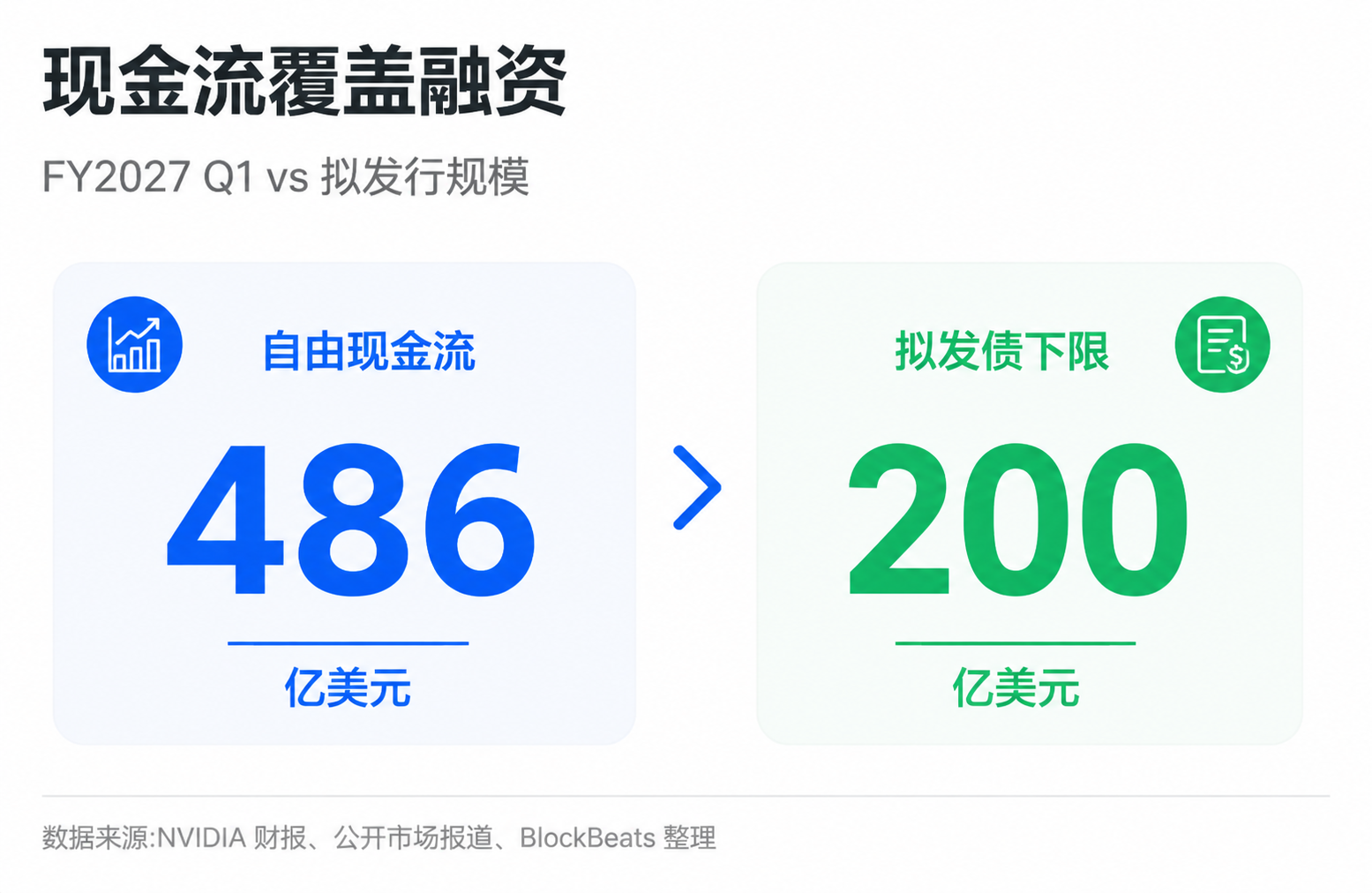
A more accurate interpretation is that NVIDIA is locking in long-term capital during its peak credit strength, when the market is most willing to lend. For a company in the midst of an AI infrastructure expansion cycle, data center builds, supply chain prepayments, ecosystem investments, and R&D are not short-term projects—their payback horizons may stretch over years or even decades. Matching long-term assets with 30-year debt is closer to sophisticated capital management than relying solely on short-term operating cash flow.
This is what “capital structure optimization” truly means: companies don’t just use cash on hand—they strategically blend low-cost debt. As long as the long-term returns from borrowed capital exceed interest costs, debt becomes not a liability but a tool to enhance capital efficiency.
AA Rating Turns Bonds into AI Ammunition
NVIDIA’s ability to execute this strategy hinges on the bond market’s willingness to lend at sufficiently low rates. And the central variable behind that is credit rating.
S&P Global Ratings recently upgraded NVIDIA to AA, citing competitive advantages driven by AI demand, strong cash generation, and a resilient balance sheet. An AA rating can be understood as a high-credit label in the bond market: investors perceive minimal default risk and thus accept lower spreads and longer maturities.
This distinction is critical. Bond issuance isn’t merely about “getting funds”—the true value of the transaction lies in “at what cost, for how long, and within which market window.” When a company is experiencing credit upgrades, rapid cash flow expansion, and sustained institutional interest in the AI theme, its bargaining power for long-term capital is significantly enhanced.
This explains why NVIDIA chose this timing: it’s not waiting until cash flow weakens or expansion pressure mounts. Instead, it’s proactively reducing future financing uncertainty while credit quality remains at its peak. For shareholders, this is far more attractive than being forced to finance under worse conditions later.
The allocation of bond proceeds—refinancing, AI data centers and infrastructure, R&D, supply chain prepayments, strategic investments—should be viewed collectively. Refinancing is financial management; infrastructure and supply chain support expansion resilience; strategic investments target ecosystem positioning. Together, they point to one truth: NVIDIA’s capital needs extend beyond simply “producing more chips”—they are about securing its dominant role across the entire AI ecosystem.
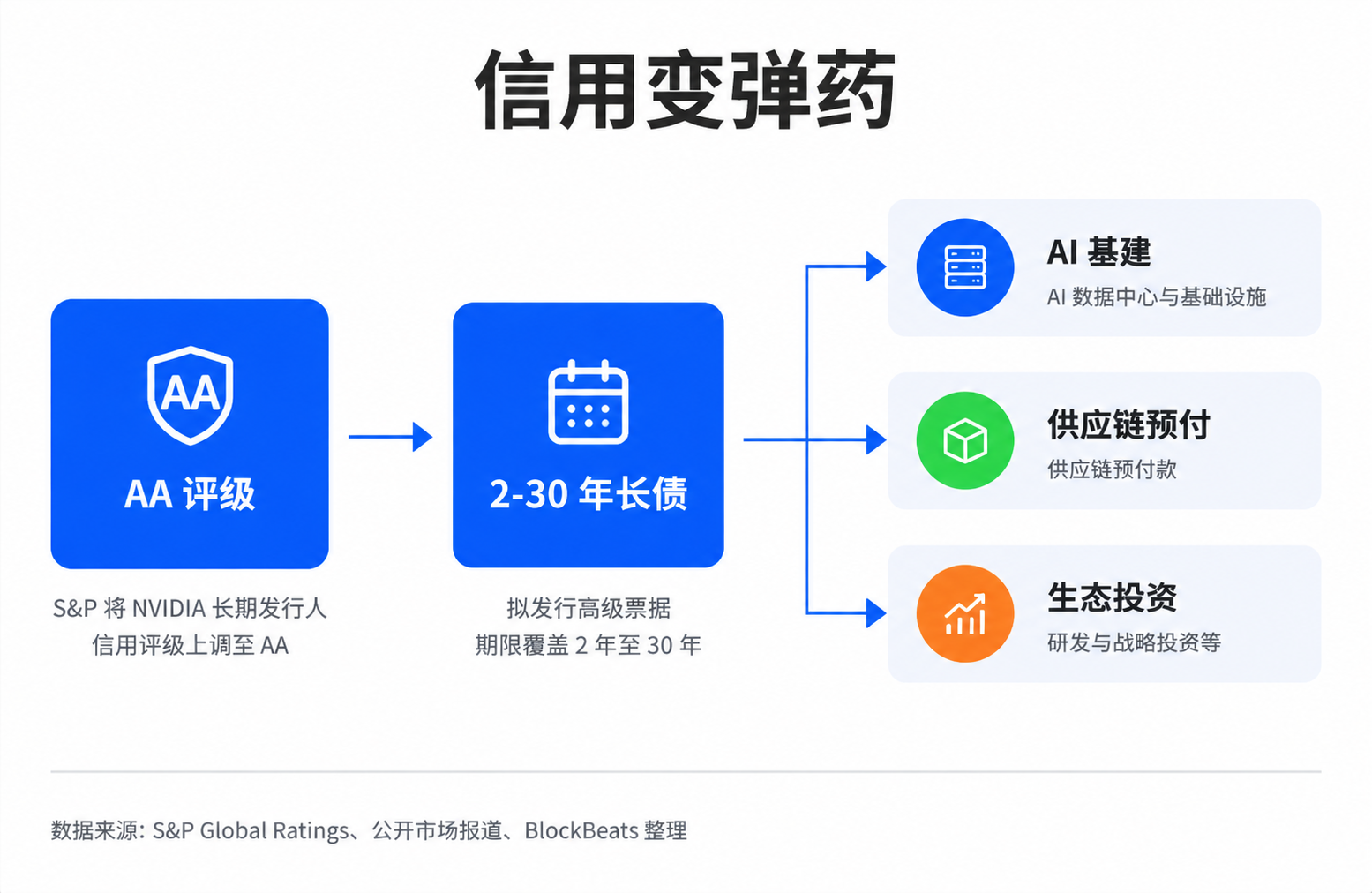
NVIDIA sells the most critical compute tools of the AI era, but it also must ensure customers, supply chains, infrastructure, and ecosystem partners can keep pace. The more pivotal its role, the more its capital allocation resembles that of a platform company—not just a hardware vendor.
Borrowing Beats Issuing Equity for Shareholder Value
For NVDA shareholders, this bond issuance carries a direct implication: the company is maintaining shareholder returns while preserving ammunition for long-term growth.
NVIDIA’s latest quarter not only delivered exceptional cash flow but also expanded its buyback authorization by $80 billion and increased dividends. Buybacks and dividends represent direct cash return to shareholders; bond issuance represents external, long-term funding for future investments. Together, these actions signal not a trade-off between two options, but a dual-track strategy: rewarding current shareholders while accelerating AI expansion without pause.
If NVIDIA had chosen equity issuance instead, existing shareholders would face dilution. Even if future growth continues, per-share value would be diluted. In contrast, debt financing comes with clearly defined costs—interest and principal. For a company with extremely strong free cash flow and a top-tier credit rating, such costs are easier to manage.
Naturally, this doesn’t mean bond issuance is inherently bullish. Debt increases fixed obligations and raises market scrutiny on capital allocation efficiency. NVIDIA currently earns investor acceptance of this debt because the market believes its future cash flows will comfortably cover interest payments—and that AI infrastructure investments will ultimately translate into revenue and profits. Should either assumption falter, debt transitions from a tool of efficiency to a source of valuation pressure.
Thus, the real shift is in how investors view NVIDIA. Previously, the focus was on GPU demand, gross margins, and revenue growth. Now, attention turns to cash flow allocation: how much goes to buybacks and dividends, how much to supply chain and infrastructure, how much to ecosystem investment, and how much is funded via debt to lock in long-term capacity.
This makes NVDA’s valuation anchor more complex. It is no longer just a “profit growth story,” but increasingly embodies characteristics of a “credit asset” and a “long-term capital allocation platform.”
An AI Financing Template for Big Tech Is Taking Shape
NVIDIA is not alone in this approach. Alphabet completed a $20 billion bond offering in February 2026, with maturities spanning multiple tranches, reportedly drawing orders exceeding $100 billion. Meta, Amazon, and other major tech firms are also leveraging debt financing to fund infrastructure spending amid their AI investment cycles.
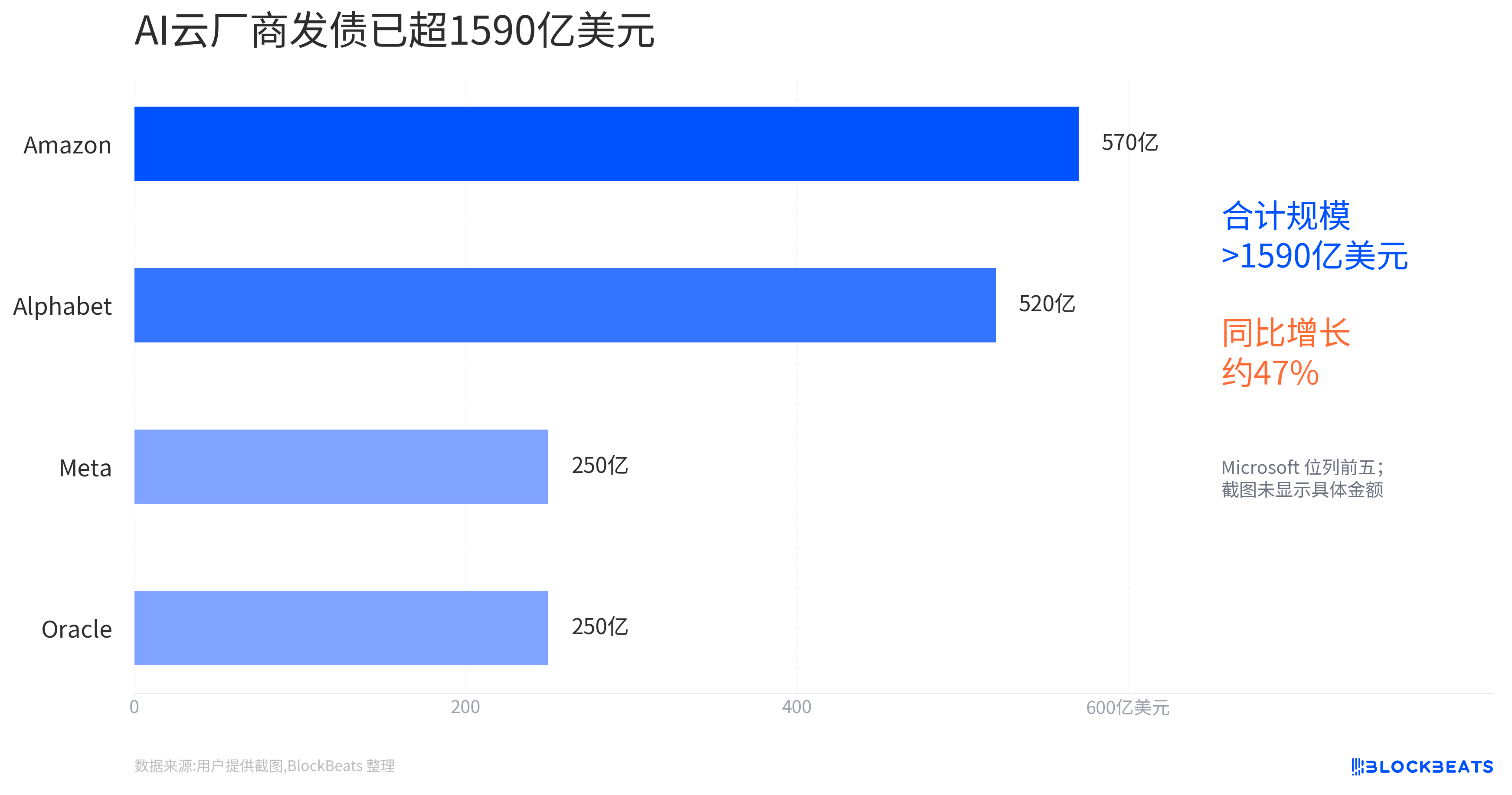
These cases should not be reduced to “tech giants are running out of money.” A more accurate framing is that AI infrastructure has evolved from a light-asset software growth story into a heavy-asset cycle involving data centers, power, chips, networking, and supply chains. Companies that secure long-term, low-cost capital gain greater strategic flexibility in this expansion race.
This shift has two implications for market pricing.
First, debt financing extends the sustainability of AI capex. As long as the bond market continues to absorb issuance, large tech firms need not rely entirely on current cash flow to fund long-term construction. This supports demand expectations across data centers, power, optical communications, and semiconductor supply chains.
Second, debt financing intensifies scrutiny on return timelines. Historically, markets tolerated high valuations for AI investments due to rapid growth. But as capital intensity rises and financing terms lengthen, the central question becomes: when will these infrastructures generate sufficient returns? If AI application revenues fall short of expectations—or if unit economics of compute decline—markets will reevaluate whether today’s debt-fueled expansion is overly aggressive.
NVIDIA’s uniqueness lies in its position at the upstream end of the AI capex chain. The more clients invest, the more NVIDIA benefits. But if industry-wide returns come under doubt, NVIDIA cannot fully insulate itself. Hence, this bond issuance both reinforces market confidence in NVIDIA’s credit and cash flow—and embeds it deeper into the long-cycle AI capital expenditure narrative.
The Real Test: Can Pricing and Returns Hold Simultaneously?
The crucial caveat remains: this is still a proposal to issue at least $20 billion. Final size, coupon rates, yield spreads, and order book strength remain to be confirmed. Only after the deal closes can the market accurately assess how low a cost and how long a tenure bond investors are willing to provide.
If final pricing reflects strong demand and persistently low long-term spreads, this will further validate NVIDIA’s transformation of its AA credit into an expansion instrument. It will not only profit from customer AI spend, but also leverage the capital markets to fund its own long-term positioning at lower cost.
But the more critical validation won’t be in the bonds themselves—it will be in the next earnings report and capital expenditure data. Investors must see whether NVIDIA can sustain strong free cash flow while advancing AI infrastructure, supply chain prepayments, ecosystem investments, and shareholder returns. If all these can proceed in parallel, the bond issuance acts as a capital efficiency amplifier.
Conversely, if future AI infrastructure payback cycles lengthen, or if the company increasingly depends on external financing to maintain growth, market perception of such debt will shift. The question will no longer be “Does NVIDIA need money?” but rather: “Can the long-cycle AI investment returns actually justify the expectations already priced in via low-cost capital?”
Original: Lawton BlockBeats
Disclaimer: Contains third-party opinions, does not constitute financial advice
Anthropic Revenue Explodes—Why Is the AI Market Still Diving?
8 days ago
From Institutional Settlement to Open Ecosystem: Can Canton Replicate Robinhood Chain’s Development Path?
8 days ago
Podcast Notes | Taiki Maeda: Continue Bullish on ZEC to $20,000 – Buy Bitcoin a "Quantum-Resistant" Insurance
9 days ago
Former PayPal President: How to Rebuild the Payment System in the Age of AI Agents After Apps and Buttons Disappear?
10 days ago
$20 Billion Short, How OpenAI Revenue Controversy Is Impacting AI Market Trends
10 days ago
Optimism Takes Over Multiple L2s Including Unichain—Is Single-Point Risk on the Rise?
11 days ago
Building the "AWS of the AI Era": B.AI Unveils Major Upgrade to Multimodal Matrix and Responses API, Unlocking Computational Advantages to Establish an Inclusive Intelligent Foundation
11 days ago


