JPMorgan's tokenized fund sees TVL surge 250% in one month, as institutional capital increasingly treats Ethereum as the default infrastructure
JPMorgan's tokenized fund sees TVL surge 250% in one month, as institutional capital increasingly treats Ethereum as the default infrastructure


The answer lies in the most conservative capital on Wall Street. JLTXX, a tokenized money market fund launched by JPMorgan Chase, has seen its on-chain assets surge from $200 million to nearly $700 million within seven weeks—a growth of approximately 250% in just one month—and it runs exclusively on Ethereum. In the same week, BitMine, led by Tom Lee, purchased an additional ~$73 million worth of ETH, bringing its total holdings to 4.8% of Ethereum’s circulating supply. While ETH’s price is declining, institutional accumulation is accelerating—these two phenomena are unfolding simultaneously.
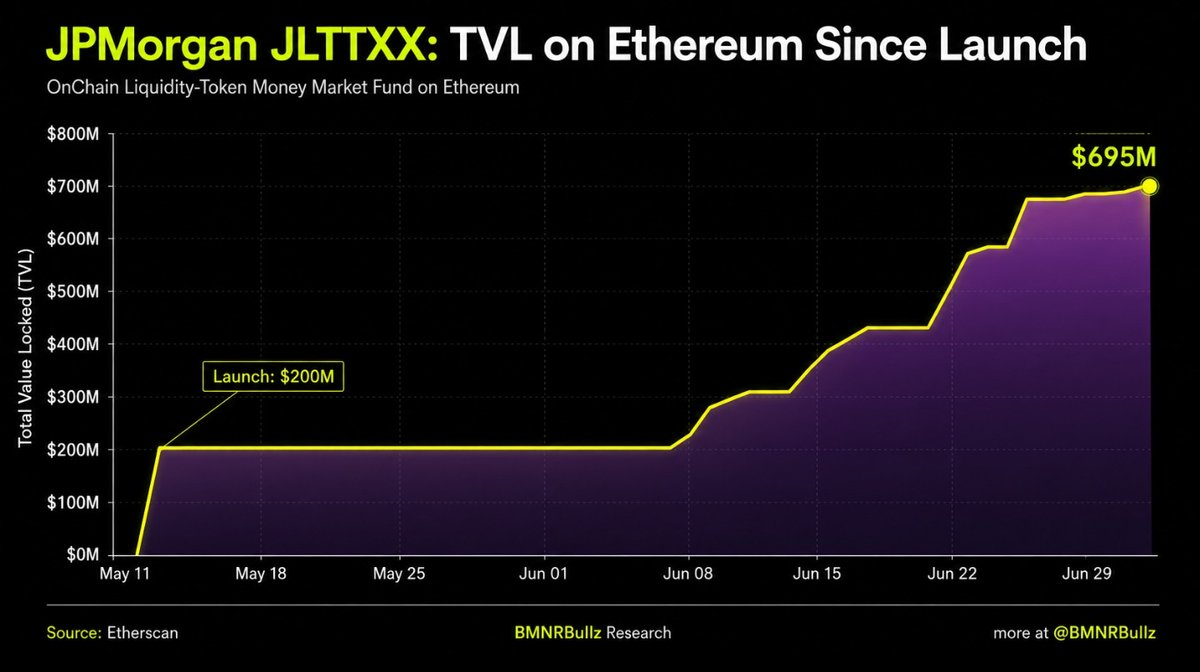
JPMorgan quietly turned a tokenized fund into one of the fastest-growing financial products in recent years.
According to reporting by crypto finance outlet The Defiant, JPMorgan’s OnChain Liquidity Token Money Market Fund (code: JLTXX) has seen its on-chain AUM grow by roughly 250% over the past month, per data from blockchain analytics platform Token Terminal. The fund operates solely on the Ethereum blockchain.
From $200M to Nearly $700M in Seven Weeks — JPMorgan Kickstarted with Its Own Capital
JLTXX launched on May 13. JPMorgan initially invested $100 million in seed capital, with Anchorage Digital serving as the custodian and participating in the initial token sale. On its first day, the fund locked up approximately $200 million in on-chain value. According to a thread from ethereuminsti, after seven weeks, this figure reached $695 million—a 248% increase—aligning closely with Token Terminal’s reported ~250% growth.
The fund’s underlying assets are extremely conservative: short-term U.S. Treasury bonds and overnight repurchase agreements fully collateralized by Treasuries or cash—identical to the safest segments of traditional money market funds. What truly differentiates JLTXX is its deployment layer. Although JPMorgan operates a private settlement network called Kinexys, JLTXX, like the bank’s first tokenized fund MONY launched in December last year, runs on the public Ethereum mainnet rather than its proprietary chain. For a bank with extensive blockchain infrastructure, choosing a public blockchain is itself a signal.
For holders of ETH, the implication is clear: Ethereum is evolving from a speculative asset into a compliant, institutional-grade ledger for financial primitives. This demand is largely decoupled from short-term price movements but contributes to long-term network usage accumulation.
Growth Driven by Stablecoin Reserve Demand
JLTXX’s rapid growth is partly fueled by its use as a reserve asset for stablecoins.
Per data disclosed by a Dune analytics dashboard, JLTXX has been added to the reserve pool of USDG, a stablecoin whose other reserves include BlackRock’s BUIDL and Superstate’s STBXX. This move reflects a growing regulatory need: stablecoin issuers require on-chain, compliant U.S. Treasury exposure that meets the standards set by the GENIUS Act. Enacted in 2025, the GENIUS Act establishes strict criteria for stablecoin backing assets—precisely where tokenized U.S. Treasury money market funds fit.
JPMorgan designed JLTXX to be purchasable with both fiat and stablecoins, effectively positioning the fund at the intersection of regulated finance and crypto-native infrastructure. JPMorgan is not alone in this space: BlackRock has already filed SEC documents for two tokenized money market products, including one that tokenizes a share class of its existing $6.1 billion Prime Treasury Liquidity Fund on Ethereum. BUIDL, BlackRock’s tokenized fund, is currently the largest such fund globally, surpassing $2.8 billion in AUM as of early 2026 and spanning eight blockchains.
For new entrants, the message is clear: stablecoin reserves represent a clearly expanding opportunity, and institutions are overwhelmingly selecting Ethereum as the foundational layer for this cake.
BitMine Buys Another $73M in ETH, Holdings Approach 5% of Circulating Supply
As traditional finance approaches Ethereum from the asset side, on-chain accumulation continues unabated.
According to a portfolio update released by BitMine Immersion Technologies (NYSE: BMNR) on Monday, the Ethereum treasury company chaired by Tom Lee of Fundstrat acquired 42,197 ETH over the past week—valued at approximately $73 million at current prices. This purchase pushed BitMine’s total ETH holdings to 5,742,237 ETH, representing about 4.8% of Ethereum’s circulating supply. BitMine’s own books list total crypto and other assets at $11.1 billion, including ETH valued at $1,800 per token, 206 BTC, a $180 million stake in Beast Industries, a $71 million stake in Eightco Holdings, and $527 million in cash and securities.
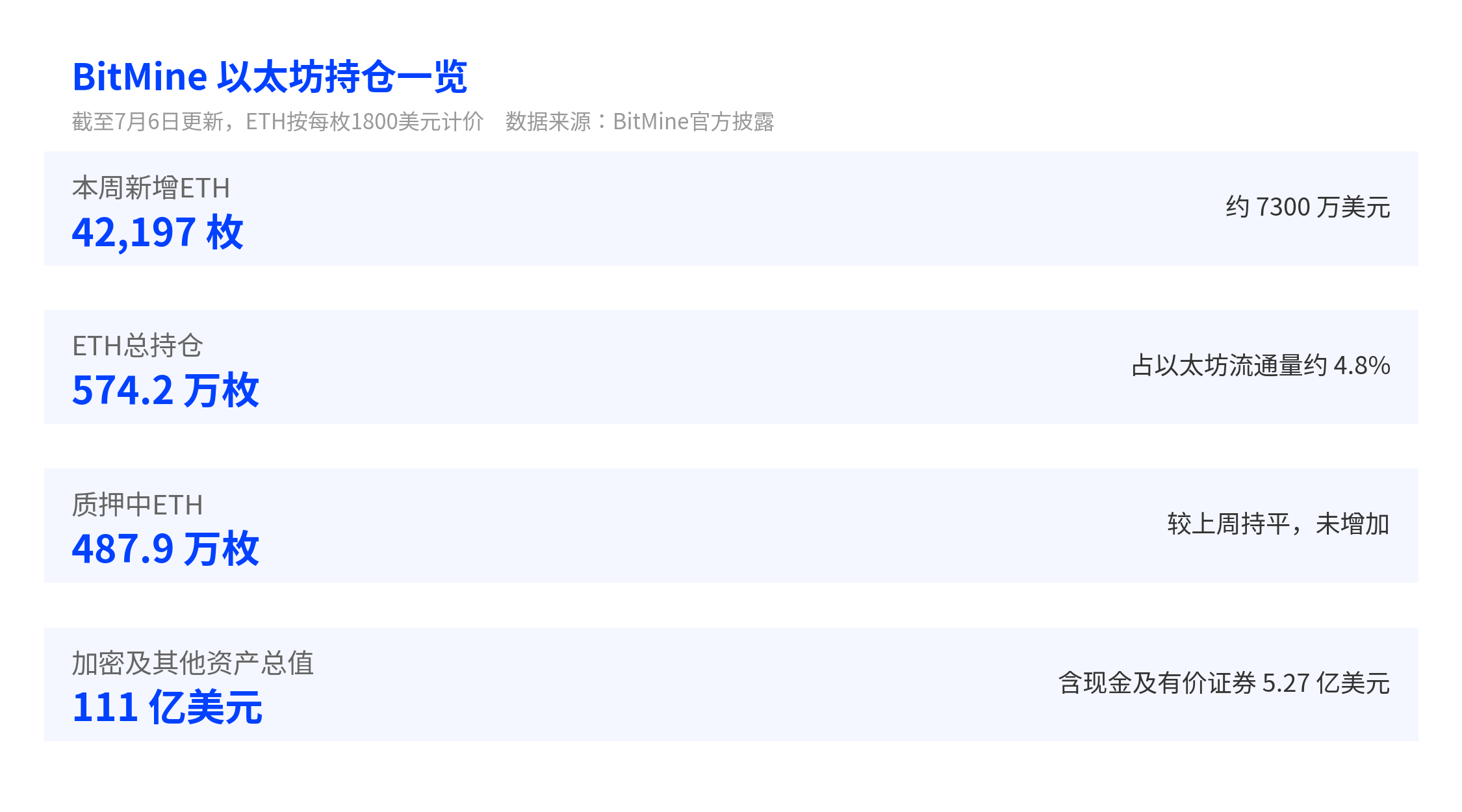
A noteworthy detail for holders: BitMine’s staked ETH remains flat at 4,879,157 ETH, unchanged from last week. This implies that newly acquired ETH was not staked. The company’s publicly stated goal is to control 5% of Ethereum’s total supply, and its weekly accumulation strategy is steadily approaching that threshold.
A risk warning is warranted: BitMine’s portfolio value is highly sensitive to ETH price volatility. The fund values ETH at $1,800 per token, while ETH’s spot price as of July 6 stood at approximately $1,747—below its accounting benchmark. In June, internal warnings surfaced regarding a potential $30 million cash shortfall; Tom Lee publicly denied any liquidity crisis. For investors leveraging BitMine’s position to go long on ETH, the dual leverage of stock and asset price creates a double-edged sword.
Price Down, Institutions Buying — How to Interpret This Divergence
When viewed together, these two narratives present a paradox: institutions are accelerating their entry, yet ETH’s price continues to decline.
Ethereum has faced significant headwinds this year. According to multiple data providers, ETH has retraced over 50% from its all-time high of ~$4,900 in August 2025. Through the first three quarters of 2026, ETH recorded three consecutive quarterly losses—the first time in recorded history. Spot Ethereum ETFs also posted net outflows in June. On-chain activity has declined too: according to Glassnode, the 14-day average of active addresses dropped from ~795,000 in early February to ~420,000 in June—a decline of ~46%.
Thus, JPMorgan’s fund growth and BitMine’s rising holdings tell a different story than the secondary market price action. Institutions are betting on Ethereum’s long-term role as a settlement layer and compliant asset base—specifically in the context of stablecoin reserves and tokenized assets. Meanwhile, the secondary market reflects short-term liquidity, sentiment, and ETF flows. These two dynamics can persist in divergence for extended periods, and neither party is guaranteed to “win” first.
For holders or prospective entrants, the operational implication is this: institutional accumulation and the tokenization narrative represent real, fundamental shifts—but they do not inherently support short-term price floors. Historically, large-scale accumulation by whales does not always signal clean buying momentum; the February whale accumulation phase was followed by a localized top. It is valid to view institutional inflows as a long-term thesis, but using them as a contrarian bottoming signal requires caution.
Author: Claude, DeepTide TechFlow
Disclaimer: Contains third-party opinions, does not constitute financial advice
The Competitive Landscape of U.S. Stock Tokenization: $3 Billion Market Cap, 5 Public Blockchains, 9 Core Assets
11 hours ago
Wall Street Cracks Down on "Shadow Stocks," Bullish Partners with Multiple Financial Giants: Bringing True Shareholder Rights to Tokenized U.S. Equities
16 hours agoTokenized Treasury Bonds Lose Momentum, Equity Tokenization Emerges as the New Battleground for RWA
08-11
The key to tokenization success: it's not about being on the blockchain, but whether it can truly measure value
08-05After Binance Alpha launches US equity memes, how far can this narrative truly go?
08-03The on-chain U.S. equity theme takes center stage, with ONDO surging 30% over three weeks—what catalyst is driving the speculation?
07-28a16z: The U.S. Needs the CLARITY Act to Seize Leadership in Stablecoin and Tokenization Standards
07-23


