Chatting with the Ondo Perps Team: U.S. Stocks as Collateral Is Just the Beginning, AI-Driven Trading Volume Will Be Key
Chatting with the Ondo Perps Team: U.S. Stocks as Collateral Is Just the Beginning, AI-Driven Trading Volume Will Be Key


Introduction
On July 7, 2026, Ondo Perps launched its public testnet. As the first perpetual futures platform to support tokenized stocks and stablecoins as margin assets for derivatives trading, Ondo Perps recorded over $100 million in trading volume within 24 hours of launch and surpassed $2 billion in volume within 48 hours.
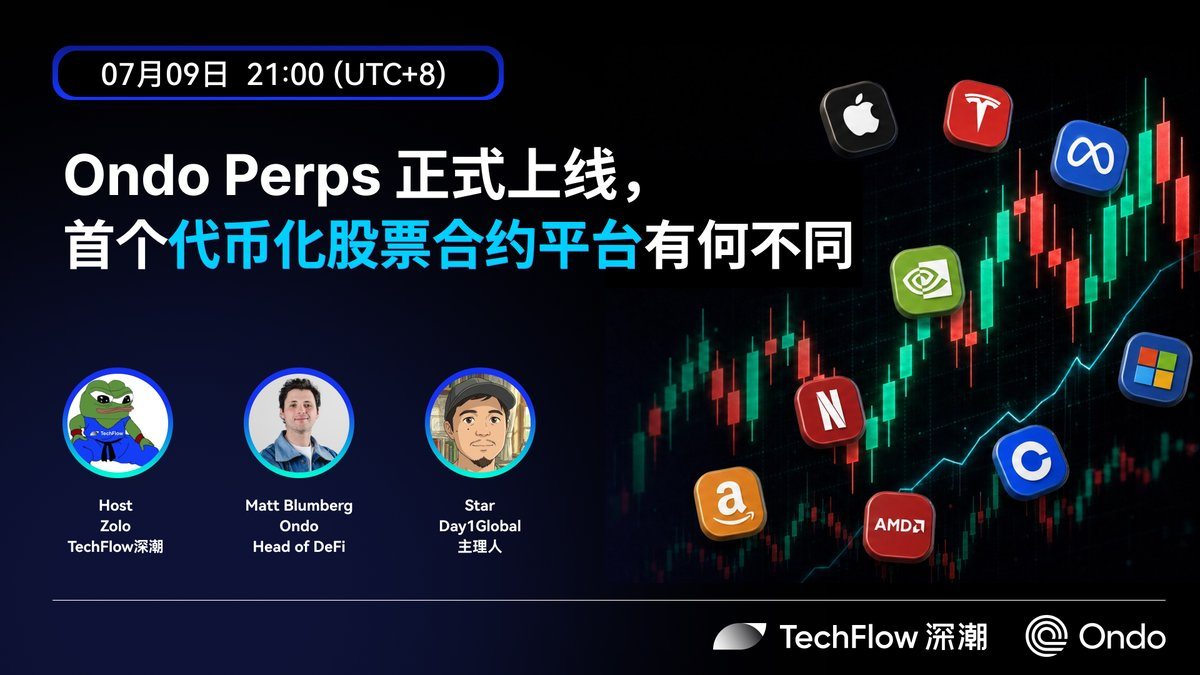
On July 9, 2026, the Ondo team will make their first appearance on DeepTide Chinese AMA, diving deep into the mechanism design, key differentiators, and strategic thinking behind Ondo Perps.
[Listen to the full AMA recording]
Guest Introduction
Hello everyone, I’m Zolo, co-founder of DeepTide TechFlow and tonight’s AMA host. It’s a great pleasure to welcome Matt and Star for this discussion.
As many of you know, Ondo Perps officially entered public testing on July 7 and achieved over $2 billion in trading volume within 48 hours. Therefore, tonight’s AMA aims to explore the underlying product mechanisms of Ondo Perps and its latest developments.
First, let’s begin with brief self-introductions from our guests.
Hi everyone, I’m Matt, currently Head of DeFi at Ondo Finance.
Ondo Finance’s mission is to enable equitable access to high-quality financial products and services for people around the globe. We believe that in many regions—including Asia—there remain vast user bases unable to easily access global capital markets. RWA (Real-World Assets) serves as a critical bridge to unlock investment opportunities for these users.
It’s a privilege to be here tonight and share insights with all of you.
Hi everyone, I’m Star, host of the podcast Day1Global.
Day1Global is a Chinese-language podcast focused on AI and Crypto. Personally, I’ve been closely following the RWA space and have conducted extensive research on Ondo. I’m honored to be here today to exchange ideas with all of you.
Asia’s Growing Significance
Welcome back, both guests.
Next, we’ll invite Matt to introduce Ondo Perps and share the project’s vision and overall roadmap for development in the Asia-Pacific community.
Before diving into Ondo Perps, let me briefly outline Ondo’s current progress.
Our first product was tokenized U.S. Treasuries—a success story we’re proud of. Today, Ondo is the second-largest issuer of tokenized U.S. Treasuries globally.
Later, we observed strong demand from users who wanted to trade equities via blockchain, leading us to launch Ondo Global Markets (on July 14, 2026, Ondo announced the rebranding of Ondo Global Markets to Ondo Stocks; henceforth, we will refer to it as Ondo Stocks). Today, Ondo Stocks has become the highest TVL tokenized securities platform.
I believe one major reason Ondo Stocks has gained popularity is its exceptional liquidity—a crucial factor. Our model differs significantly from other tokenized securities platforms, and this distinction gives Ondo Perps unique competitive advantages, which we’ll explore further later.
Regarding the Asian market, I see it as particularly vital for Ondo for two key reasons.
First, historically, Asian users had limited options for accessing U.S. equities or U.S. equity futures markets. Many existing products lack leverage functionality, resulting in higher transaction costs and lower capital efficiency—especially for smaller investors. While leverage carries inherent risks, users must fully understand this trade-off.
Second, and equally interesting: enabling users across different countries to invest in foreign stock markets more easily. For example, U.S. users often face significant hurdles when purchasing Hong Kong or South Korean stocks. As global capital markets grow increasingly international, we envision a future where anyone, regardless of location, can seamlessly participate in global equity markets through Ondo Perps—an empowering vision.
Beyond that, I find the Asian equity markets themselves highly intriguing, offering numerous compelling investment opportunities worth watching.
Liquidity & Product Innovation: Ondo’s Two Core Advantages
Now, let’s delve deeper into the unique design mechanisms behind Ondo Perps and the problems they aim to solve. Matt, please elaborate further.
We entered the Perps market because we identified a fundamental issue: liquidity.
Currently, many RWA Perp DEXs struggle to meet traders’ liquidity demands. The root cause lies in their reliance on market makers, who prioritize capital efficiency above all else.
For professional market makers, alternatives abound—they can provide liquidity on Binance or traditional financial markets. So why choose an RWA Perp DEX? After conversations with multiple institutional market-making firms, we consistently heard a core pain point: hedging on a Perp DEX requires simultaneous positioning in traditional markets. The biggest bottleneck? Collateral management.
For instance, on a Perp DEX, market makers must post stablecoins as margin. In traditional markets, they need to commit fiat capital. This dual requirement ties up capital on both sides, creating complexity and severely reducing capital efficiency.
Take a hypothetical scenario: a market maker wants to short a $100 stock. To hedge, they must buy $100 of the underlying spot. That’s $200 total capital required—compared to just ~$20 in traditional markets.
The crux? Spot assets cannot directly serve as collateral on Perp DEXs, causing capital duplication and drastically lowering efficiency.
This is precisely what Ondo Perps sets out to solve.
Given Ondo Stocks’ deep liquidity, we realized that if we built a Perp DEX allowing RWA spot assets from Ondo Stocks to be used directly as collateral, market makers could dramatically improve capital efficiency and deliver liquidity at lower cost.
Ultimately, this reduces market-making costs and delivers better liquidity and trading experience for end-users.
Beyond collateral types, how does Ondo Perps differ from platforms like Hyperliquid or DYDX?
Ondo Perps launched just Tuesday, still in its earliest stages. If there’s one area we’re most focused on right now, it’s liquidity—because without sufficient liquidity, no platform can sustain user adoption.
Despite the short time since launch, our liquidity is already comparable to Trade.xyz on Hyperliquid. Moreover, Ondo Perps hit $2 billion in trading volume within hours—exceeding our expectations. We’re thrilled by this momentum.
But even more exciting to me is what we can build on top of this tech stack: new products and novel investment opportunities.
One fascinating example is Funding Rate. Many traders like to long spot assets and short perpetuals to capture yield. On Ondo Perps, such strategies are far more capital-efficient. On Trade.xyz, you’d hold USDC on-chain and buy RWA spot separately. On Ondo Perps, you can use your held tokenized stocks directly as collateral—eliminating redundant capital usage and significantly boosting capital efficiency for funding rate arbitrage strategies.
Looking ahead, we’re also preparing for AI integration—building APIs, SDKs, and infrastructure. We envision not only human users but also AI Agents becoming key participants. Thus, every product and feature we design now asks: Can AI Agents seamlessly interact with and utilize our platform?
Let me ask Matt a few deeper questions.
First, Ondo initially focused on tokenized stocks. What’s the current user profile for these products? And why expand into a Perp DEX on top of that? Beyond institutional market makers using tokenized stocks as collateral, what other synergistic scenarios do you foresee between these two products?
To be honest, even we didn’t anticipate how popular Ondo Stocks would become after its September 2023 launch.
We identify two main drivers.
First, liquidity. Tokenized stocks aren’t a new concept—I’ve worked in this space for years. Before Ondo Stocks, several similar products existed. But our liquidity model is fundamentally different. Our superior liquidity enables a far better trading experience, making us especially appealing to whales and large traders.
Second, flexibility. Our model supports a broader range of assets. Today, users can trade over 300 different stocks via Ondo Stocks. The world evolves rapidly—today it’s NVIDIA, tomorrow SpaceX, and beyond. Because we can quickly list new tokenized assets, we continuously meet shifting investor demands.
Looking forward, no one can predict exactly which assets will dominate. But my personal view is clear: cross-border, global assets will grow increasingly important. That’s why Ondo is placing greater emphasis on Asia. We believe future global users will want easier access to international assets—and Asia will play a pivotal role.
Moreover, DeFi’s evolution around tokenized assets is still in its infancy. New product categories are likely to emerge. Currently, most offerings—like Aave or Morpho—are foundational lending protocols. That’s just step one. I foresee more sophisticated products emerging: AI-driven portfolios or professionally managed tokenized asset baskets.
Recently, we’ve observed rising demand for yield—but concerns about DeFi security persist. Meanwhile, yield options remain limited. Many users rely on Aave or Morpho, yet current returns don’t excite most investors.
We’ve seen early signs of innovation: STRC (a perpetual preferred share issued via strategy) has gained attention. Many users seek yields exceeding 4% while avoiding the volatility of Bitcoin—especially amid perceived bear market conditions.
Thus, we believe future fund managers, institutional players, and tokenized portfolio providers will be highly promising. And AI integration will transform the landscape.
U.S. Market Closed? How Ondo Perps Stays Reliable
Thank you for the detailed overview. I have one more granular question.
Ondo’s tokenized stocks currently align with U.S. market trading hours—meaning no trading on weekends, and limited pre/post-market liquidity.
So, during U.S. market closures, how are prices calculated on Ondo Perps? How is collateral ratio determined when users pledge tokenized stocks?
This is indeed a nuanced topic, requiring careful explanation.
Let me illustrate with an example.
The U.S. market closes Friday evening at 8 PM. During that window, you can observe asset price movements and Perp DEX order book data. Though weekend liquidity is thinner, trading continues—these data points inform price signals. In practice, weekend Perp market trends have already aligned closely with Monday’s opening direction. We now observe a reliable price signal forming—even if not perfectly accurate, the directional trend is generally correct.
Of course, the entire RWA Perp DEX ecosystem remains very early-stage. Daily and weekly improvements are evident. Honestly, I originally expected it would take a year or more to establish meaningful weekend price signals. But the market is maturing faster than anticipated—with increasing efficiency.
I believe that in another one to two months, with further liquidity growth, we’ll see even more impressive developments.
Another related question: if tokenized stocks maintain fixed values over weekends while Perp prices continue fluctuating, how does Ondo Perps manage risk and pricing?
We’ve extensively debated collateral valuation internally and considered multiple approaches.
One option is using Friday’s closing price directly—but we found this exposes traders to significant risk. For example, if you hold tokenized stock spot and short the corresponding Perp, a weekend price surge could trigger losses.
So, Monday–Friday, we use traditional market prices. On weekends, we calculate an Internal Market Price by aggregating diverse data sources—blending Friday’s close with weekend Perp market dynamics via weighted averaging.
We avoid relying solely on Perp market prices. Hence, we cap weekend price swings at around 10%, effectively preventing manipulation by small capital.
Most importantly, both collateral value and Perp position value are computed under the same reference pricing framework. So if a user holds $100 in tokenized stocks and shorts $100 in Perps, any weekend volatility triggers synchronized revaluation across both positions—ensuring alignment in their hedging strategy and eliminating asymmetric pricing risks.
Naturally, many complex implementation details exist. We’ve spent considerable time stress-testing extreme scenarios, aiming to minimize avoidable risks—because if users lose money, they won’t return.
Behind the Liquidity Edge: Mechanism Design & Core Moats
Thank you, Matt, for the thorough explanation.
From your insights, both Ondo Stocks and Ondo Perps boast exceptional liquidity—a standout advantage. Could you elaborate on how this liquidity edge is created? Why can Ondo achieve such tight spreads and deep order books?
To clarify, we must first understand Ondo Stocks’ mechanism design.
In most other platforms, primary and secondary markets are disconnected. The process of minting, issuing, and trading tokenized stocks often takes days—leading to inefficiencies, missed opportunities, and ultimately poor secondary market liquidity.
At Ondo, minting and redemption are nearly instantaneous. If you spot an opportunity on the secondary market, you can immediately mint on Ondo’s primary market and trade for profit—creating a highly efficient link between primary and secondary tiers. This keeps secondary prices tightly aligned with primary ones.
Instant minting and instant redemption are the core reasons behind Ondo Stocks’ outstanding liquidity. Since Ondo Perps accepts Ondo Stocks’ tokenized equities as collateral, this creates a powerful synergy—allowing Ondo Perps to inherit Ondo Stocks’ liquidity advantages.
Long-term, we aim to become the foundational liquidity infrastructure for the entire on-chain tokenized equities ecosystem. Any DeFi protocol wanting to use tokenized stocks as collateral can leverage Ondo’s proven liquidity—because users trust Ondo to always offer deep, reliable markets.
This mechanism appears to be exclusive to Ondo. What barriers protect it? Can competitors replicate this advantage quickly?
Competition is inevitable.
In fact, some rivals have begun attempting to copy our model—but their maturity level hasn’t matched ours yet. So for us, the priority isn’t fear of competition, but continuous innovation and understanding real market needs.
Ondo Perps is a perfect case in point. Only because we validated the liquidity mechanism via Ondo Stocks did we gain the confidence to launch Ondo Perps. We welcome competition—we’ve already built a high-efficiency, high-liquidity infrastructure and are now developing next-gen products on top of it.
Additionally, the RWA Perp DEX space still has few direct competitors. We’re securing early user mindshare at a critical inflection point.
Looking ahead, we’ll learn more from traditional finance.
We’ll study the most popular traditional financial products—like Yield Funds or AI-agent-driven portfolio management tools. We believe complex financial instruments will also have strong demand on-chain in the future.
Of course, our top priority remains building excellent products at every layer. Only with best-in-class liquidity and quality can we then construct more advanced financial solutions.
Crypto is inherently hyper-competitive, with open-source culture accelerating replication. Facing this reality, the only truly effective response is relentless iteration and constant innovation.
Simultaneously, we place high value on user feedback. We regularly receive requests—from trading specific stocks on-chain to improving weekend liquidity. We carefully analyze each input.
Because we believe product direction should stem from real user needs, not just internal assumptions.
Many past RWA projects focused too much on technology, ignoring actual user desires. For Ondo, listening deeply and iterating based on real user feedback remains one of our core principles.
Traditional Finance Strategies & AI: Ondo’s Next Steps
From your perspective, Ondo Stocks now covers a growing number of assets, and Ondo Perps has performed impressively post-launch. What verticals excite you next? Are there new directions Ondo plans to explore?
Actually, Ondo has recently hired heavily. When I joined two years ago, the company had fewer than 40 employees. Now we exceed 150, with dozens of roles still open. This reflects our readiness to launch many new products and explore new frontiers.
We believe this is a pivotal moment for RWA. We don’t want to miss any major opportunities.
For example, Pre-IPO equity is one we’re deeply interested in. Especially in the U.S., if companies like OpenAI or Anthropic go public, they may quickly become the most valuable firms globally. Thus, we expect massive demand for Pre-IPO assets—and we’re actively researching viable product designs.
Beyond that, I’m personally keen on non-U.S. equity markets. Recently, many U.S. investors have started eyeing South Korea and Hong Kong. This shows globalization of investing—increasingly diversified portfolios.
My view: the U.S. market is mature, but others lag behind. If you want to trade NVIDIA or Tesla on a Monday night, traditional markets offer excellent liquidity. But few other markets approach 24/7 trading capability.
That’s why I’m excited by what we’re doing: blockchain has the potential to upgrade financial infrastructure worldwide, enabling smoother, more continuous, and efficient global asset trading.
Also, we’ve brought on many new team members to research traditional financial products—ETFs, Portfolio Management, Yield Funds—all areas we’re actively exploring.
Take Fixed Income: it involves complex instruments like bonds and credit assets, harder to analyze than equities. With five years of equity market experience, I’m comfortable with stock analysis—but for these products, I rely on experts and plan to leverage AI for deeper analysis.
In traditional finance, those with insufficient capital, no connections, or located abroad often miss out on premium opportunities. Blockchain can lower these barriers, giving retail users access to products once reserved for institutions.
Thus, I firmly believe more sophisticated portfolio strategies will be a major future driver.
If I had to name my biggest excitement, it’s AI. The convergence of AI and crypto generates new opportunities every day.
You may have seen BNB Chain’s recent AI initiative—aiming to build infrastructure optimized for AI Agents. This made me wonder: if more tasks will be handled by AI Agents, why wouldn’t investment evolve along the same path?
So Ondo is actively exploring AI-RWA integration. While no formal roadmap is public yet, our team discusses this topic weekly. If you have ideas, feel free to reach out to the Ondo Perps team anytime.
Direct User Access: Bridging the Gap
Let me ask a forward-looking question.
Over the next two to three years, Matt, how do you envision the tokenized assets industry evolving?
Ondo is among the earliest pioneers in this space. Now, more players—Binance, Hyperliquid, Robinhood—are entering the arena.
So, how do you see the market shaping up in the next two to three years? What will the landscape look like?
True, competition is growing. But that’s a sign RWA is gaining traction.
When Ondo began in 2022, many doubted RWA’s viability—viewing it as high-risk with uncertain demand. We faced pressure entering a skeptical market.
Today, increased competition proves the market recognizes RWA’s value. Ondo’s early lead stems from our belief in RWA’s potential. Going forward, we’ll stay committed to identifying unmet or unsolved problems—and launching products around them.
No one can predict RWA’s state or Ondo’s form in three years. But my outlook is clear: global financial markets will gradually migrate on-chain.
Future users will access assets across nations more easily—whether RWA, Perps, or other on-chain instruments. This shift will profoundly impact the world’s financial system.
Today’s markets remain nation-bound—most investors focus on domestic assets. Many excellent companies in less mature capital markets struggle to secure funding. But through blockchain, RWA, and Perps, global investors can now access diverse national assets more readily.
This means higher capital allocation efficiency. Great entrepreneurs and companies—regardless of origin—can more easily attract global investment. I see this as one of the most transformative changes ahead.
Second, I believe future products will integrate both crypto assets and RWA. We’re already seeing shifts: Robinhood expanding into crypto and launching its own chain; Binance—originally crypto-focused—is now aggressively entering RWA. Users can already trade Ondo’s tokenized stocks on Binance.
These developments were unimaginable a few years ago. I believe technology will eventually connect all global financial markets.
Third, let’s discuss Ondo’s evolution.
Looking back at our product journey reveals strategic shifts.
Our earliest product, tokenized U.S. Treasury OUSG, targeted institutional investors—requiring KYC and high minimums. Then came USDY—many users held it via DeFi protocols primarily for yield. Later, Ondo Stocks emerged—but many users accessed it not directly through Ondo, but via centralized exchanges or DeFi platforms.
So, our initial distribution relied heavily on third parties. But as products matured, we realized the need for direct user relationships.
That’s why Ondo Perps is such a pivotal experiment: users engage directly with Ondo’s platform—not entirely dependent on intermediaries.
Going forward, we aim to extend this model to more products—building stronger, more direct relationships with users. Only then can we consistently deliver the best product experience, optimal trading opportunities, and fastest feature rollouts. If we rely solely on third-party distribution, users might miss out on innovations or suboptimal fees and service levels.
Thus, one of our core goals is to evolve Ondo into a true consumer-facing financial platform.
Thank you, Matt and Star, for your insightful sharing tonight. Our AMA is nearing its close. We look forward to the continued surprises RWA will bring to the industry—and encourage you to keep following Ondo Perps’ journey.
Disclaimer: Ondo Perps is not available in the United States, Canada, Panama, or other jurisdictions under legal restrictions. Any mention of third-party projects, products, or services herein is for illustrative or informational purposes only and does not imply endorsement, affiliation, or approval. The content shared in this AMA does not constitute an invitation, recommendation, or investment advice. All decisions should be made after consulting independent professional advice. Trading leveraged products carries substantial risk.
Compiled by: DeepTide TechFlow
Disclaimer: Contains third-party opinions, does not constitute financial advice
The Competitive Landscape of U.S. Stock Tokenization: $3 Billion Market Cap, 5 Public Blockchains, 9 Core Assets
11 hours ago
Wall Street Cracks Down on "Shadow Stocks," Bullish Partners with Multiple Financial Giants: Bringing True Shareholder Rights to Tokenized U.S. Equities
16 hours agoTokenized Treasury Bonds Lose Momentum, Equity Tokenization Emerges as the New Battleground for RWA
08-11
The key to tokenization success: it's not about being on the blockchain, but whether it can truly measure value
08-05After Binance Alpha launches US equity memes, how far can this narrative truly go?
08-03The on-chain U.S. equity theme takes center stage, with ONDO surging 30% over three weeks—what catalyst is driving the speculation?
07-28a16z: The U.S. Needs the CLARITY Act to Seize Leadership in Stablecoin and Tokenization Standards
07-23


