The on-chain U.S. equity theme takes center stage, with ONDO surging 30% over three weeks—what catalyst is driving the speculation?
The on-chain U.S. equity theme takes center stage, with ONDO surging 30% over three weeks—what catalyst is driving the speculation?


When market conditions are poor, observing which projects are still rising can be a telling indicator of which ones may continue driving momentum.
BTC has been grinding around $63,000 for nearly a month, while most altcoins remain stagnant and overlooked. The crypto market in the first half of this year has largely reflected one dynamic: after the meme coin euphoria faded, capital and attention have been searching for the next frontier.
Robinhood’s meme tokens represent part of this trend, but they too now show signs of cooling down; RWA, on the other hand, stands as another high-conviction battleground.
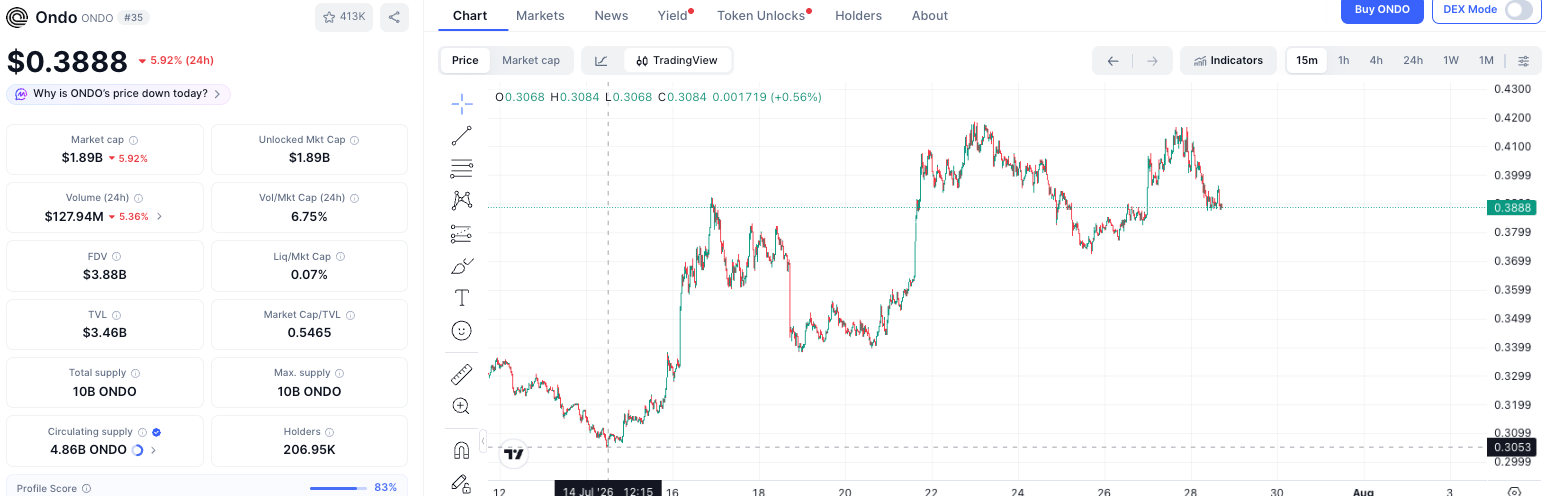
For instance, ONDO token was trading near $0.31 at the beginning of July and has now reached approximately $0.40—up nearly 30% in just three weeks. This surge could be attributed to market manipulation or tokenomics engineering—but what’s more intriguing is the broader context in which it occurred.
On Hyperliquid, spot trading volume for tokenized stocks and commodities hit $25.1 billion during the third week of July, according to Startup Fortune—marking the first time this figure surpassed trading volume for crypto assets on the platform.
Trade[XYZ] has launched on-chain contracts for SpaceX and the latest Longxin Memory, with tokenized equities now comprising 23 of the top 30 assets on Hyperliquid. Binance is following suit, capturing 56% of the CEX RWA perpetuals market share. Even the SEC is discussing opening a regulatory "innovation exemption" for tokenized stock trading.
In short, on-chain trading of U.S. equities is clearly the current mainstream narrative in crypto—and Ondo happens to be the most active player along this emerging chain.
Many of Hyperliquid's U.S. Equity Contracts Are Backed by Ondo
The recent 30% rally in ONDO would be misinterpreted if viewed merely as “another RWA-themed token pumping.” Ondo’s position in this ecosystem differs fundamentally from that of Hyperliquid or Binance.
Hyperliquid and Binance are competing for trading volume.
Trade[XYZ] holds 79% of open interest in the RWA perpetuals segment, while Binance recorded cumulative RWA perpetual trading volume of $45 billion in Q1.
To put it crudely, they’re restaurant operators—Ondo is the ingredient supplier.
The tokenized equity contracts launched on trade[XYZ] are backed in large part by Ondo Global Markets. According to AInvest, the on-chain tokenized equities integrated into Hyperliquid in May via Felix Protocol were issued through Ondo’s tokenization stack.
Data from RWA.xyz shows Ondo Global Markets commands over 70% market share in tokenized equity issuance, with TVL exceeding $5 billion and total trading volume surpassing $18 billion.
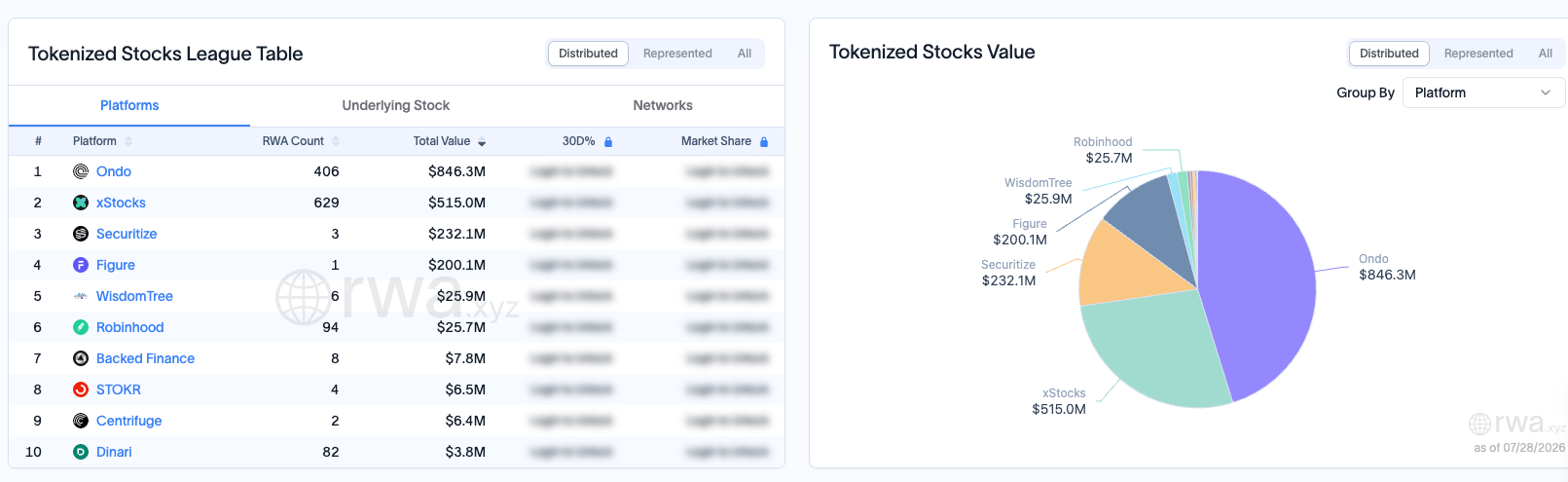
More than 260 tokenized U.S. equities and ETFs are deployed across Ethereum, Solana, and BNB Chain, distributed via platforms including Binance, Bitget, MetaMask, and Blockchain.com.
On July 15, when DTCC released its announcement, ONDO surged 18%—a significant reaction for a legacy asset. The reason? DTCC is the central clearing and settlement hub for U.S. equities, where virtually every U.S. stock transaction ultimately flows through. Ondo’s on-chain equity instruments, issued via DTCC’s tokenization service, now appear alongside BlackRock, J.P. Morgan, Goldman Sachs, and Nasdaq on the same participant roster.
This isn’t just a “partnership announcement”—it’s a distribution channel-level validation.
When Ondo Shifts from Supplier to Retailer: Perps Data Analysis
After securing over 70% upstream market share, Ondo is now moving downstream.
Launched on July 7, Ondo Perps functions as Ondo’s own trading platform—offering perpetual contracts on U.S. equities, ETFs, and commodities with up to 20x leverage.
One unique feature not yet replicated by others: users can directly post Ondo-issued tokenized equities as collateral. Holding an on-chain Apple or NVIDIA token allows direct position opening without conversion.
On Hyperliquid or other perps platforms, users must first convert their assets into USDC or USDT before using them as margin—because the exchange and asset issuer operate as separate entities. Ondo integrates issuance and trading, eliminating this friction layer.
According to DefiLlama’s RWA Perps leaderboard, as of July 28, Ondo Perps recorded $221 million in 24-hour trading volume, ranking fourth.
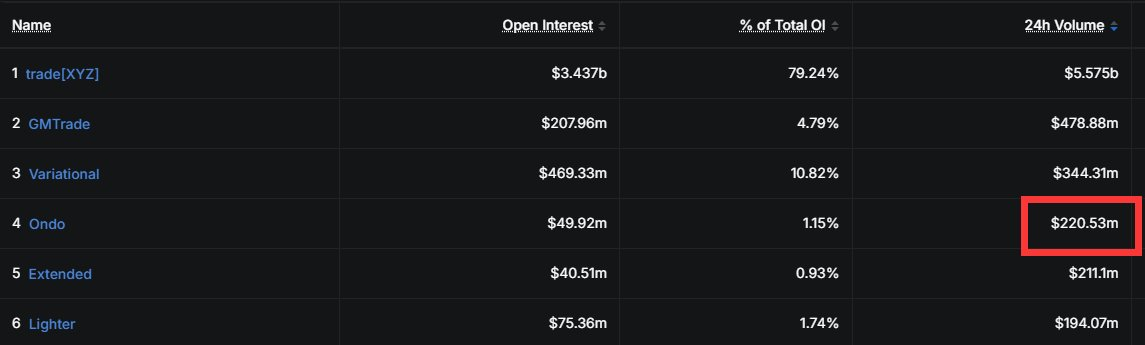
Growth is indeed rapid, but open interest sits at only $49.92 million—just 1.15% of the total market. The turnover ratio (volume divided by open interest) stands at 4.4x, indicating capital enters, trades once, and exits the same day—leaving minimal overnight positions.
For comparison, trade[XYZ]’s same metric is 1.6x, reflecting deeper capital retention.
While $221 million daily volume pales against Hyperliquid’s $25.1 billion weekly volume, Ondo Perps is targeting a different user base.
It aims to convert holders within its $5+ billion asset pool into traders, shifting revenue from issuance fees to trading fees. The key metric here isn’t whether daily volume can catch up to Hyperliquid—it’s whether open interest can grow beyond $50 million. Volume can be boosted via market-making incentives, but overnight positions cannot be artificially inflated.
Notably, DefiLlama’s RWA Perps overall leaderboard and Ondo Perps protocol page display two divergent figures—nearly a threefold difference (protocol page shows $77.53 million in 24-hour volume and $10.3 million in open interest). Stick to consistent metrics for longitudinal analysis; cross-metric comparisons risk misleading conclusions.
What About the Claim That Ondo Won’t Build Its Own Chain?
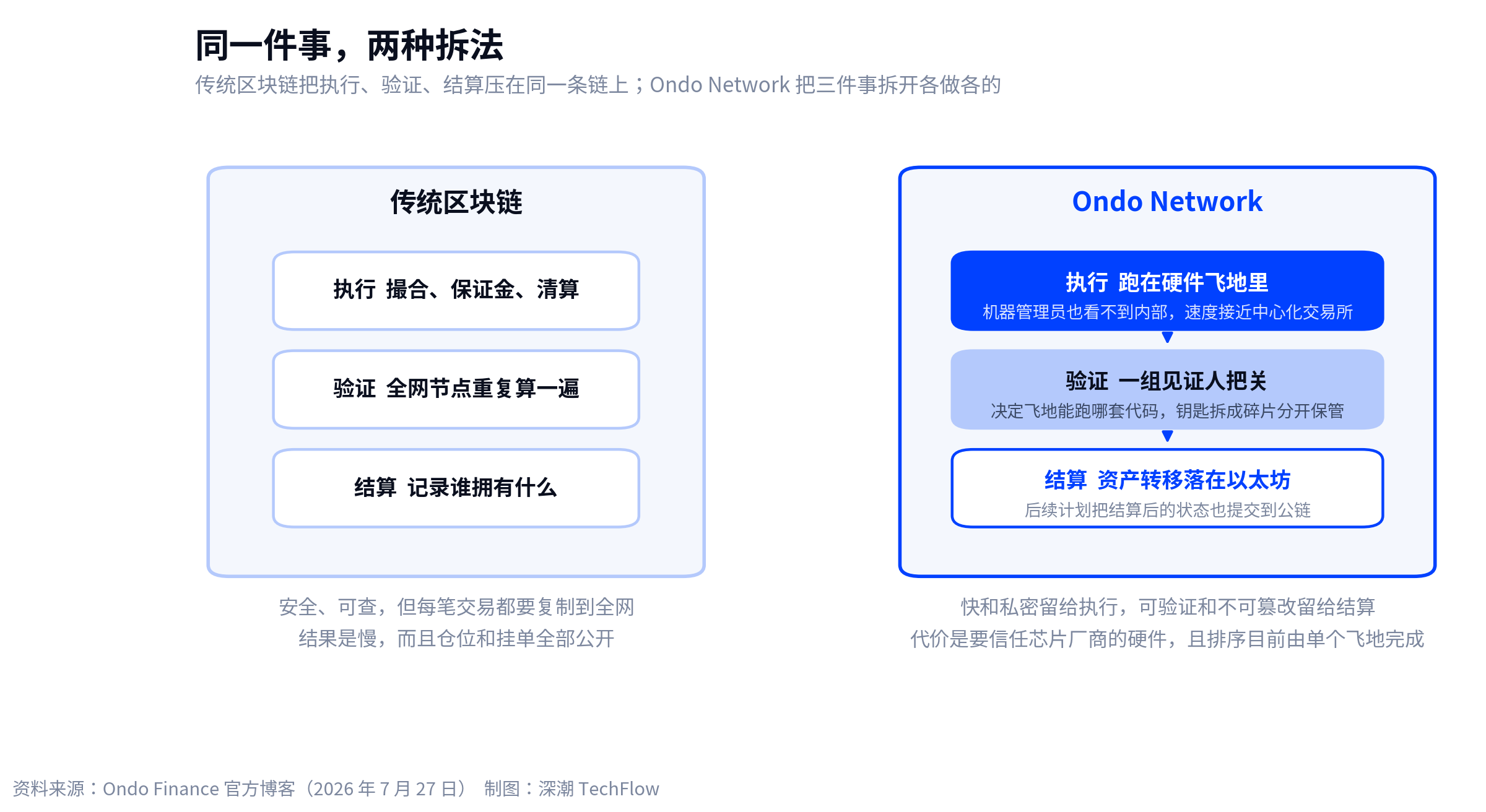
On July 27, Ondo unveiled Ondo Network, replacing the previously teased Ondo Chain L1 blockchain initiative that had been in development for over a year.
In essence, Ondo now splits execution into two layers: matching, margin, and settlement occur within secure hardware enclaves—dedicated isolated spaces inside chips where even server administrators cannot access internal operations, delivering near-CX speed. Settlement—ownership verification—still runs on Ethereum. Ondo Perps operates on this architecture.
Choosing not to build a full L1, in my view, is actually more pragmatic than forcing a monolithic L1 construction.
Two years of L1 fatigue have shown that launching a chain means rebuilding liquidity and ecosystem from scratch. Ondo already has assets deployed across Ethereum, Solana, and other chains. Isolating execution enables lightweight deployment with significantly lower risk.
However, this current architecture includes two compromises Ondo itself acknowledges.
First, execution occurs within a single enclave—not a distributed network. Transaction verification is delegated to a set of independent operators called “verifiers,” but their number, identities, and operational details remain undisclosed—raising decentralization concerns.
Second, security relies on the chip vendor. Ondo hasn’t disclosed which chip manufacturer or generation it uses, leaving chip-level security integrity uncertain.
These technical details don’t constitute buy/sell signals, but they indicate that Ondo Network currently functions more like a “verifiable centralized execution layer” rather than the fully decentralized endgame described in its whitepaper.
Nonetheless, for investors tracking ONDO token, the critical question is this: the CEO claims ONDO token will play a role in future network governance and incentive mechanisms—but all details regarding verifier economics and staking reward distribution are framed as “potential directions” with no defined timelines.
What Is Price In Today’s ONDO Rally?
Breaking it down: the 18% price move stems from the DTCC news—a valuation upgrade for Ondo’s distribution channel, specifically pricing in the “same roster as BlackRock, Goldman Sachs” status.
An additional ~10% comes from SBI Group partnership (Japan market access) and beta exposure to the broader RWA sector rally.
The July 27 announcement about abandoning L1 in favor of a dedicated execution layer had negligible impact on token price.
Thus, the catalyst signal is clear: value drivers lie in Ondo’s 70% dominance in RWA issuance and institutional distribution channels—not in technical architecture.
From an investment perspective, ONDO trades at $0.38, with a market cap of ~$2 billion, down ~65% from its 52-week high of $1.13.
If you believe on-chain U.S. equity trading will evolve into a multi-year structural trend (Hyperliquid’s weekly data alone confirms trend existence), then Ondo’s 70% issuance share provides a solid foundational thesis.
Ondo is indeed executing at scale, and tokenized equities are undeniably the version’s flagship asset. But constrained by the broader crypto market’s weakness, short-term catalysts are unlikely to drive sustained structural growth—instead, price movements reflect event-driven speculation and capital rotation.
Author: Ku Li, DeepFlow TechFlow
Disclaimer: Contains third-party opinions, does not constitute financial advice
The Competitive Landscape of U.S. Stock Tokenization: $3 Billion Market Cap, 5 Public Blockchains, 9 Core Assets
11 hours ago
Wall Street Cracks Down on "Shadow Stocks," Bullish Partners with Multiple Financial Giants: Bringing True Shareholder Rights to Tokenized U.S. Equities
16 hours agoTokenized Treasury Bonds Lose Momentum, Equity Tokenization Emerges as the New Battleground for RWA
08-11
The key to tokenization success: it's not about being on the blockchain, but whether it can truly measure value
08-05After Binance Alpha launches US equity memes, how far can this narrative truly go?
08-03a16z: The U.S. Needs the CLARITY Act to Seize Leadership in Stablecoin and Tokenization Standards
07-23
Chatting with the Ondo Perps Team: U.S. Stocks as Collateral Is Just the Beginning, AI-Driven Trading Volume Will Be Key
07-17


