After Binance Alpha launches US equity memes, how far can this narrative truly go?
After Binance Alpha launches US equity memes, how far can this narrative truly go?


Four months have passed, and Binance Alpha has finally relisted a meme coin—this time, a US stock meme coin called MarsCoin.
We were among the first media outlets to propose that US stock memes could become a dominant narrative in this phase:
「US stock memes: Robinhood Chain has finally found its big narrative」
In our previous analysis, we envisioned Robinhood Chain leading the charge on the US stock meme narrative. However, the current landscape suggests that BSC has stolen the spotlight instead.
So how should we interpret today’s market dynamics? And what might be the future trajectory of the US stock meme narrative?
It must be acknowledged that failing to anticipate Binance's involvement in advancing this narrative was a misstep in our earlier article. Binance’s long-standing strategic focus—via Binance Alpha—to capture and consolidate control over on-chain asset pricing power is well established.
We won’t delve deeply into why only Binance acts this way while other competitors do not. Instead, let’s quickly summarize why, when assessing the potential of the US stock meme narrative, one should remain vigilant about developments on BSC:
- Binance enjoys the best liquidity advantage across all CEXs. Other CEXs attempting to lead this narrative would struggle to mobilize retail sentiment effectively.
- Different CEXs prioritize distinct profit models and vary in their regulatory concerns and compliance considerations, resulting in a lack of viable competitors with both the incentive and operational capability akin to Binance’s.
- While public chains or DEXs certainly have incentives to compete—Solana, for instance, likely hopes to recreate the 2024 scenario where its meme coins thrived on Binance—neither chains nor DEXs possess the same depth of cards as Binance. Competing head-on in a single-narrative leadership race would be disproportionately effort-intensive with minimal returns.
Why expend so much space on these points? First, regardless of whether it’s this US stock meme wave or the next emerging narrative, once we accept the above logic, we should immediately monitor activity on BSC. Binance has demonstrated, through past Alphas, the ability to propel an asset to prominence—and it has the motivation to do so again. As noted, such a combination of capability and intent exists almost exclusively with Binance alone.
Yet we must temper our expectations. Not every Alpha listing leads to a “Binance Life” moment. Consider the recent “token farming” narrative driven by $ANSEM on Solana. Even if a token gets listed on Alpha, it doesn’t guarantee it will reach the same astronomical heights. Each short-term sentiment-driven rally diminishes in potency with repetition.
If your expectations around US stock memes are fueled solely by CZ’s tweet suggesting he’ll buy or sell some meme coins in the coming weeks to test new things, then consider carefully: entering at tens of millions in market cap and expecting exits at over $100M may involve unbalanced risk-to-reward ratios.

Binance Alpha listing a US stock meme is a positive development. Yet we must also recognize that heightened attention comes with a risk of excessive focus on fleeting attention-grabbing events—such as the split between Flap and Four, or speculation over whether CZ will buy in.
This reveals two truths: First, the narrative indeed holds promise, given that Binance itself endorses it. Second, the narrative remains highly immature—market participants haven’t yet taken it seriously. If the market continues to trade around speculative events like splits or CZ’s buying behavior, the narrative’s ceiling will inevitably remain limited.
Of course, in today’s market environment, expecting a US stock meme to reach a $1B+ market cap—mirroring the Ordinals-era run where ORDI surged to $2B+ before liquidity overflowed and triggered widespread “meme crafting” frenzy—is nothing short of wishful thinking. But if we aim for such a lofty ceiling under current conditions, we must imagine how US stock memes might achieve true cross-over appeal:
- Trump’s token launch, though widely known to end as a flop, still generated breakout potential simply because people believed that sustained mainstream media exposure would eventually trigger mass adoption.
- Pump.fun’s full-scale PvP format frustrated users who didn’t receive airdrops, but the fast-paced meme mechanics attracted a younger generation seeking quick gains—often recruited through peer networks, friends, or gaming communities.
US stock memes cannot merely be perceived within the community as another “new asset issuance narrative.” Current concepts—such as airdropping tokenized US stocks to holders or layering in DeFi mechanics—are insufficient to break out beyond niche circles.
Our envisioned breakout path lies in the narrative’s organic growth within the community: rising trading volume causes chain-based tokenized US stocks (primarily on Robinhood Chain and BSC) to deplete their underlying paired assets. This forces constant repurchase from public markets and re-minting on-chain to fill the gap. This was precisely why $GME on Robinhood Chain briefly became a focal point—the intense trading demand drove the tokenized GameStop stock to significant premium, prompting incremental purchases from the stock market and on-chain minting to close the arbitrage spread.
To replicate this scenario, two paths exist: one orchestrated by coordinated capital aggressively pumping a specific asset; the other emerging organically from market consensus—e.g., a particular token gaining traction due to deeper liquidity pools, meaning greater real-world equity backing and broader impact on the stock market.
But neither fully addresses the core challenge: the “transmission problem.” The narrative—that meme coins can catalyze stock price movements—must resonate with actual stock investors. If such a scenario unfolds at scale, naturally breaking out into mainstream awareness, it would be ideal. But if not, we must turn toward practical “construction logic”:
- Are the holders of the paired stock assets genuinely interested in the idea that meme coin trading can drive stock market momentum?
- Does the underlying stock itself possess meme-worthy attributes—enough historical or ongoing meme events that can fuel new narratives?
Based on these two criteria, the most promising assets are those paired with stocks like GameStop, AMC, and Wendy’s—what we call “meme stocks” (not because they lack fundamentals, but because events like short squeezes have made them culturally meme-laden).
Taking GameStop as an example: many still recall the 2021 retail squeeze saga ending in the infamous “cut the internet” aftermath. Subsequent spikes in ETH and Solana’s $GME meme coins were driven by temporary attention events—like the return of “Roaring Kitty.”
But a quick search on X reveals GameStop remains a beloved stock among retail traders. Particularly, the rumor of GameStop’s potential “snake swallowing elephant” acquisition of eBay has sparked widespread speculation. GameStop supporters continue rallying behind it:
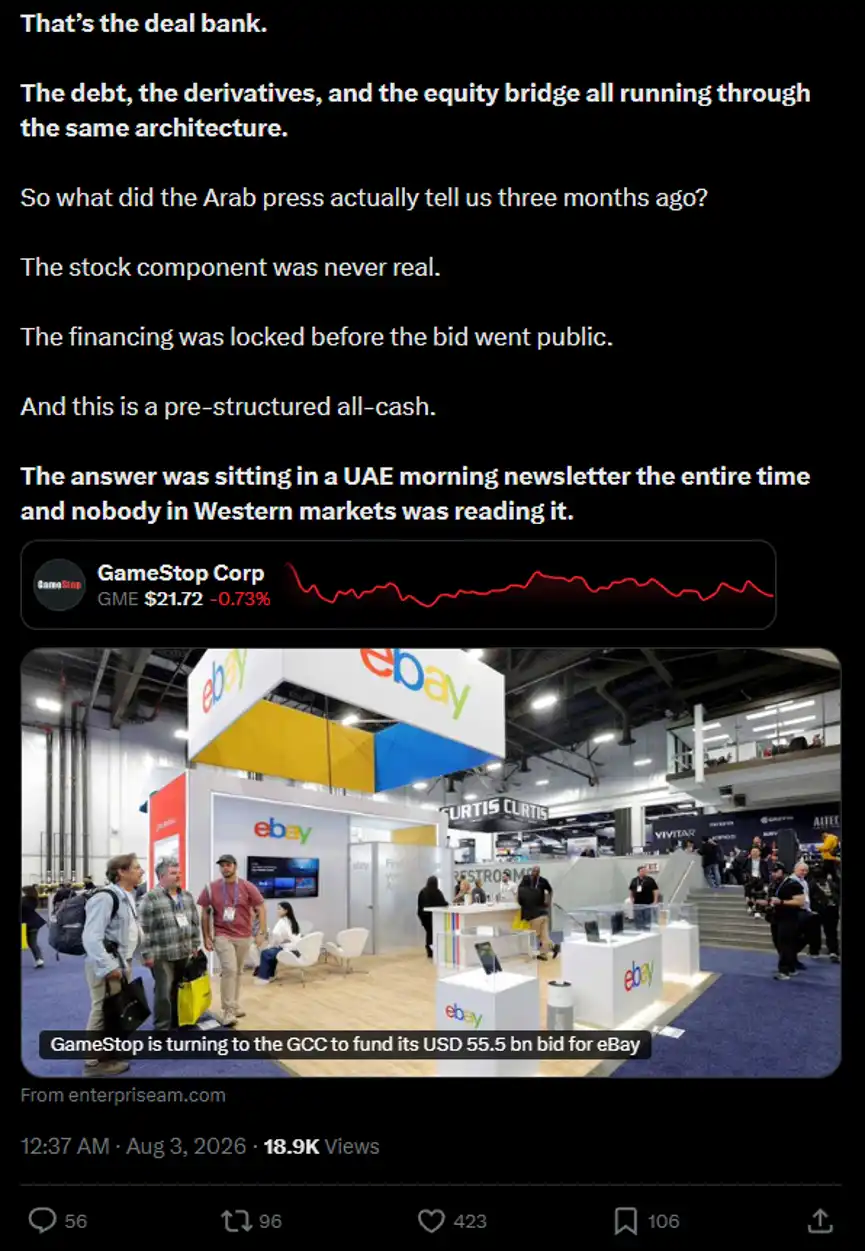
Additionally, there are numerous analyses on unusual options activity related to GameStop, and strong interest in CEO Ryan Cohen’s X posts. These GameStop followers represent the most accessible group for migration into the on-chain meme ecosystem—they even interpret minor details, like Ryan Cohen’s X profile showing only GameStop as a follow, as meaningful signals.
These seemingly community-driven posts on X mirror similar behaviors observed on GameStop’s own social presence:
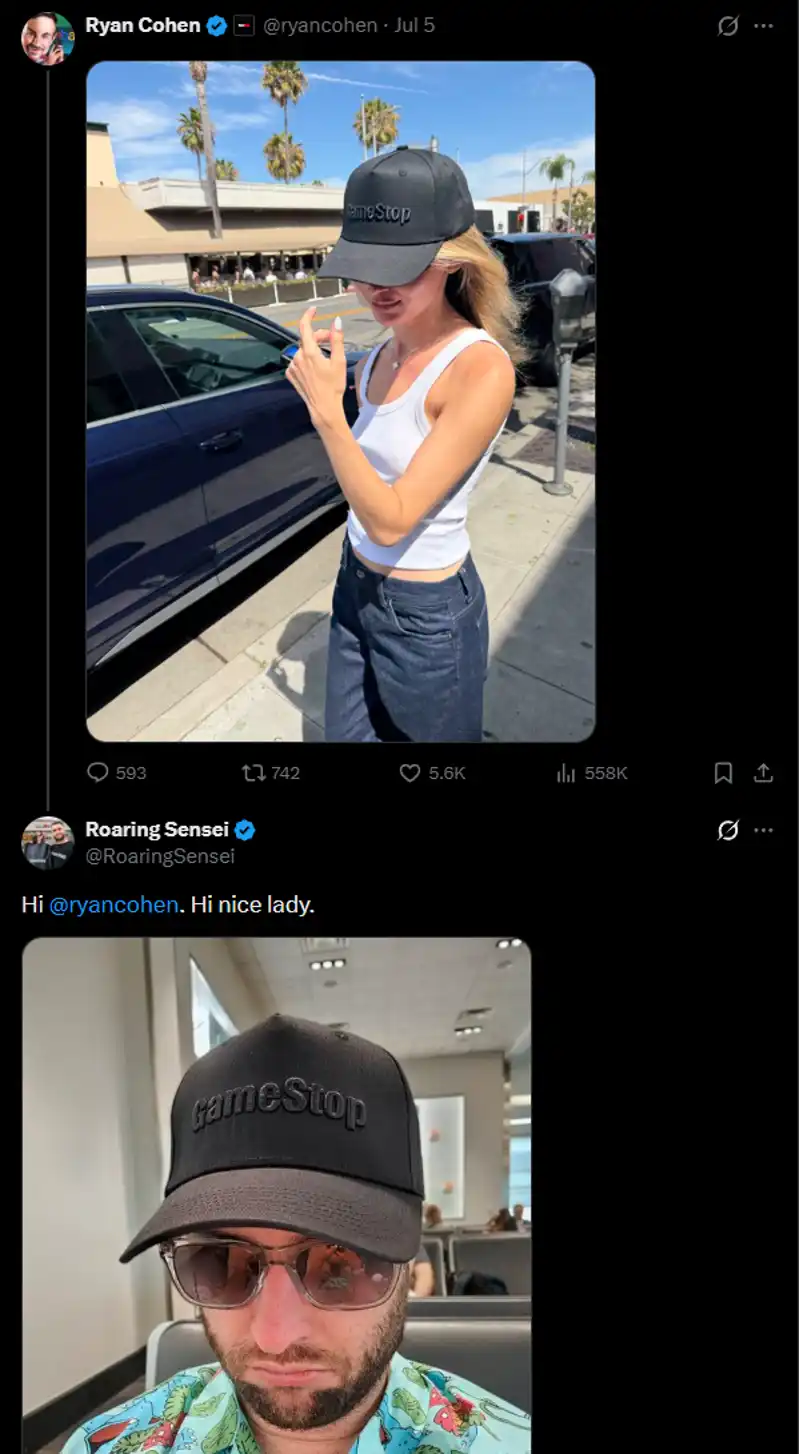
We need to systematize and propagate the narrative that “meme coins act as catalysts for stock market buying pressure”—and communicate it directly to retail stock investors. On GameStop, we see a promising start: some dedicated stock investors focused on meme stocks have already begun recognizing this dynamic:
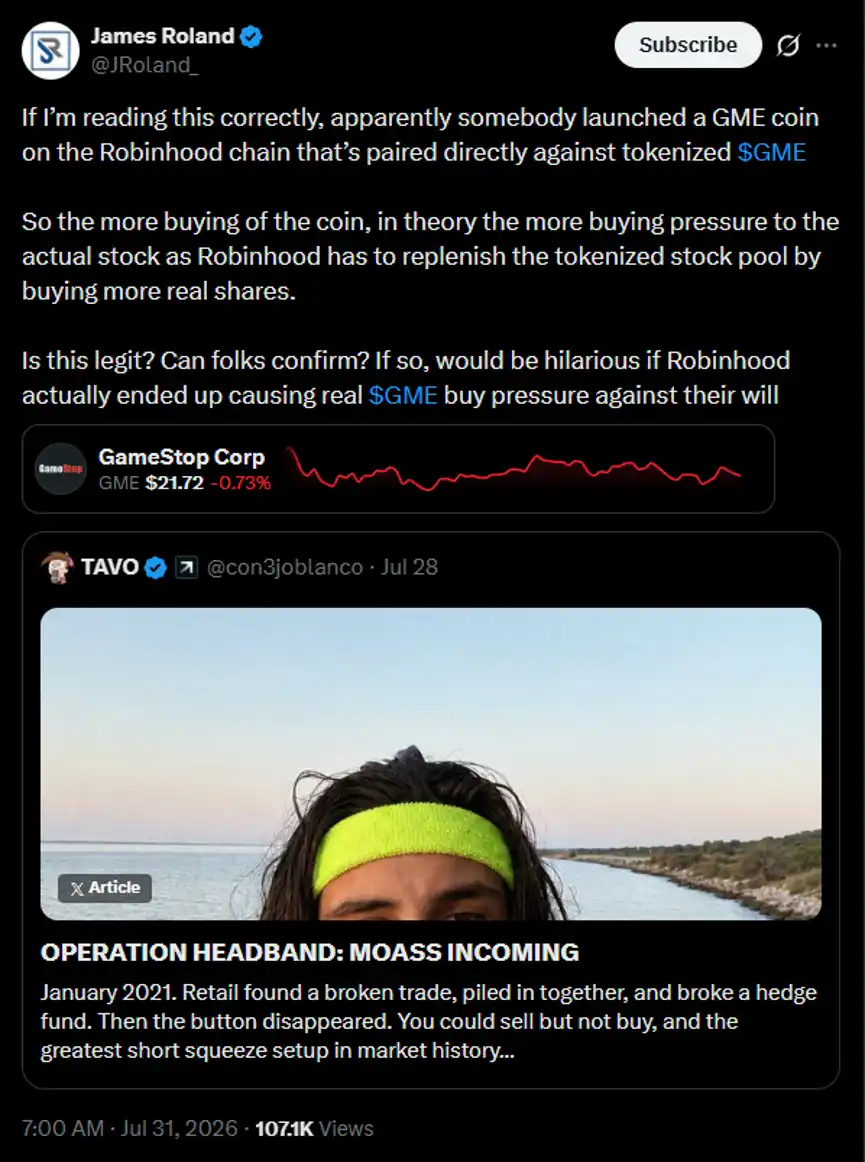
Perhaps the extensive discussion of GameStop makes you suspect bias—but in truth, I value a “predictable, ultimately breakout-capable transmission path” more than any single asset.
Due to regulatory constraints, Robinhood is highly unlikely to directly list its on-chain tokens on its main platform. Though CEO Vlad appears quite attuned to the meme ecosystem—occasionally slipping $CASHCAT into a live stream via recent searches, occasionally engaging with ecosystem projects—his scope may be limited to such gestures.
Binance has the full capacity to recreate a “Binance Life” moment in the US stock meme space—but no real necessity. The Chinese meme era was unforeseen, with no one predicting the play on Chinese tickers. Now, with US stock memes, it’s more like a racing game has emerged—Tencent follows suit with QQ Speed. There’s no need to bankrupt the original; just enable market participation on BSC. Moreover, BSC’s MarsCoin currently leads in market cap across the board.
Thus, if this narrative is to reach a legendary wealth-generation ceiling, relying solely on internal market forces is futile—it must break out. Excluding luck-based scenarios involving coordinated manipulation, the above represents our most plausible ideal pathway.
Original: BlockBeats
Disclaimer: Contains third-party opinions, does not constitute financial advice
The Competitive Landscape of U.S. Stock Tokenization: $3 Billion Market Cap, 5 Public Blockchains, 9 Core Assets
11 hours ago
Wall Street Cracks Down on "Shadow Stocks," Bullish Partners with Multiple Financial Giants: Bringing True Shareholder Rights to Tokenized U.S. Equities
16 hours agoTokenized Treasury Bonds Lose Momentum, Equity Tokenization Emerges as the New Battleground for RWA
08-11
The key to tokenization success: it's not about being on the blockchain, but whether it can truly measure value
08-05The on-chain U.S. equity theme takes center stage, with ONDO surging 30% over three weeks—what catalyst is driving the speculation?
07-28a16z: The U.S. Needs the CLARITY Act to Seize Leadership in Stablecoin and Tokenization Standards
07-23
Chatting with the Ondo Perps Team: U.S. Stocks as Collateral Is Just the Beginning, AI-Driven Trading Volume Will Be Key
07-17


