Tokenized Treasury Bonds Lose Momentum, Equity Tokenization Emerges as the New Battleground for RWA
Tokenized Treasury Bonds Lose Momentum, Equity Tokenization Emerges as the New Battleground for RWA


Key Takeaways
Unlike the recent stagnation in tokenized U.S. Treasury markets, the tokenized equities market is experiencing rapid expansion in both volume and quality.
From traditional stock infrastructure providers and fintech firms to crypto exchanges and Web3-native platforms, all are viewing tokenized equities as the next major opportunity within the RWA (Real-World Assets) ecosystem. Indeed, there are multiple distinct pathways for equity tokenization, and understanding their respective advantages, trade-offs, and positioning is crucial.
This article analyzes the strategies of players with diverse backgrounds—including Securitize, Ondo, xStocks, Robinhood, DTCC, NYSE, Nasdaq, and Coinbase.
Everyone Is Focused on Tokenized Equities
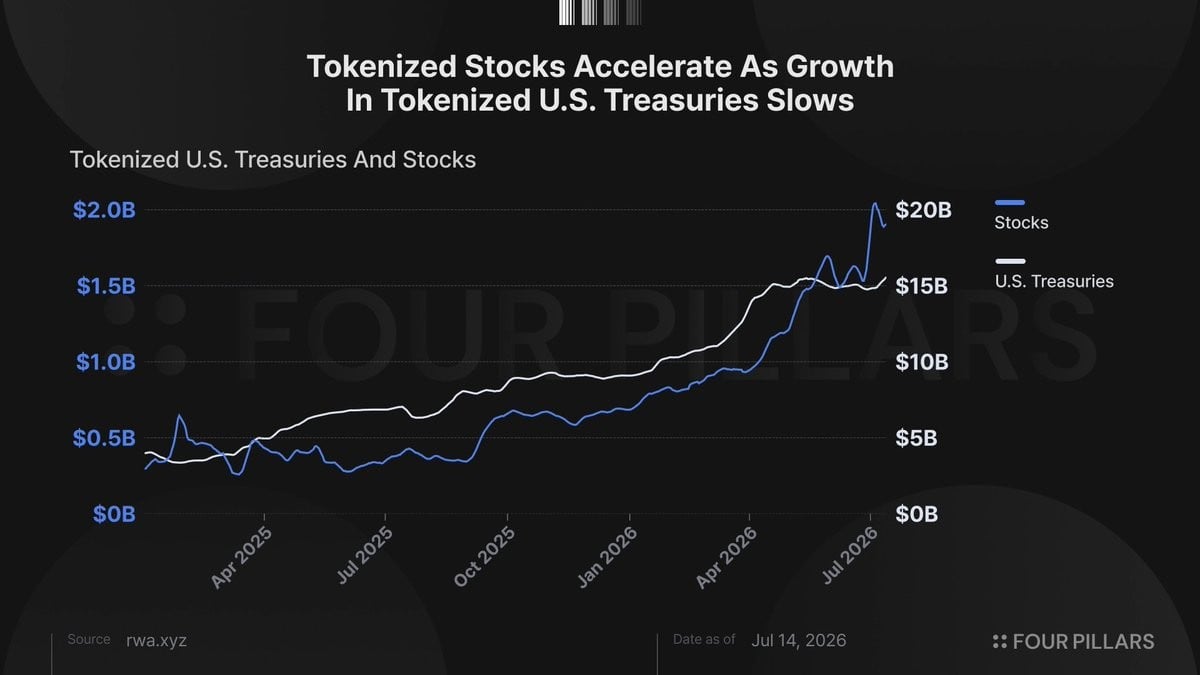
Today, regulators, banks, institutions, fintech companies, and nearly every major market participant show strong interest in tokenization. However, the term “tokenization” only recently became a focal point. The primary asset driving early market growth was unequivocally U.S. Treasuries—its rapid scaling stemmed from three key factors: the safety of U.S. government debt, relatively simple tokenization structure, and historically high yields.
The tokenized U.S. Treasury market grew from $701 million on January 1, 2024, to surpass $15 billion on April 17, 2026—a compound annual growth rate (CAGR) of approximately 3.81x, an extraordinary pace. However, after crossing the $15 billion threshold, growth has significantly slowed, with the market stabilizing near that level. Given that a large portion of demand for tokenized Treasuries comes from DeFi protocols or exchange margin use cases, the recent downturn in market conditions explains this plateau.
While momentum in tokenized Treasuries wanes, another segment of the tokenized asset space is rapidly rising in both scale and sophistication: tokenized equities. The market expanded from $291 million on January 1, 2025, to about $1.9 billion in just 1.5 years—an increase of 6.5x. From an industry perspective, whether it’s Web3-native players like Securitize or Ondo Global Markets, financial institutions like Robinhood and Coinbase, or financial infrastructure providers such as DTCC, NYSE, and Nasdaq—each either already offers tokenized equities or is actively preparing to launch.
What advantages does tokenized equities offer over traditional stock markets that have made them such a pivotal opportunity for nearly every major U.S. player? At first glance, equity tokenization may seem straightforward, but in practice, depending on the regulatory framework adopted, several distinct tokenization structures emerge—each offering different benefits. To grasp these differences, one must first understand the SEC’s classification framework for tokenized securities.
SEC’s Tokenized Securities Classification Framework
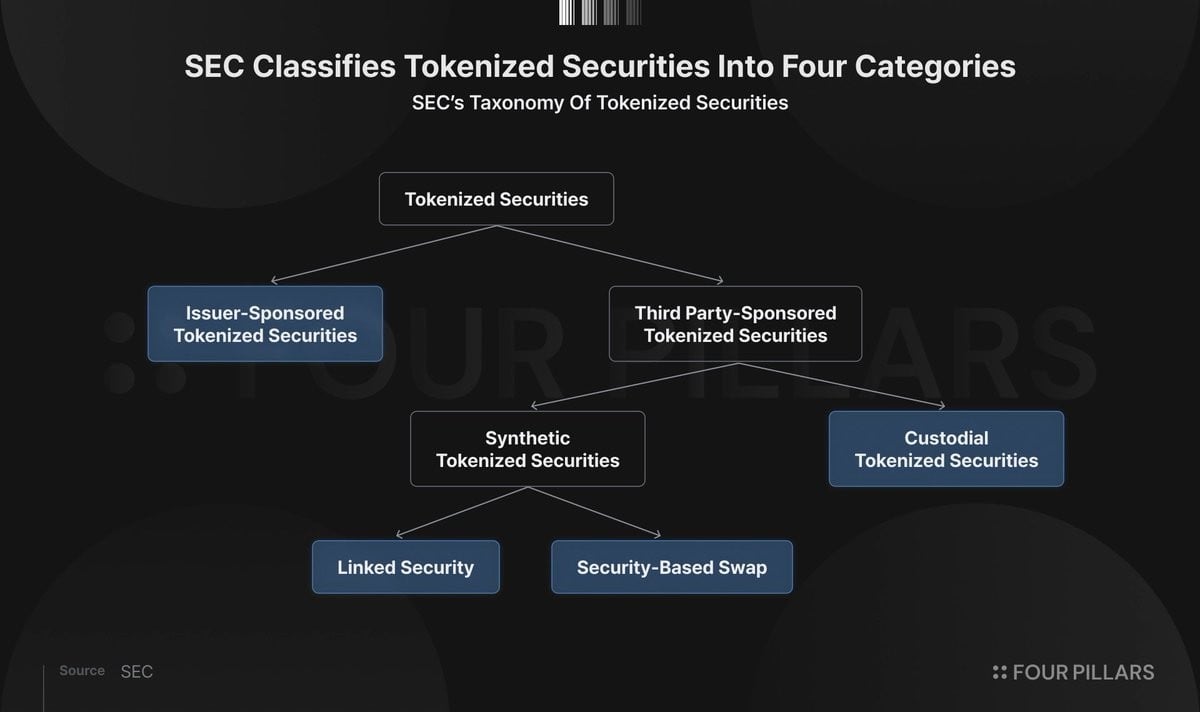
In January this year, the SEC released a statement outlining its classification framework for tokenized securities.
First, based on whether the issuer or a third party leads the tokenization, it is divided into “Issuer-Sponsored Tokenized Securities” and “Third Party-Sponsored Tokenized Securities.”
Third-party-sponsored tokenized securities are further subdivided: if the rights associated with the underlying security are themselves tokenized, it is classified as “Custodial Tokenized Securities”; if a standalone tokenized product is issued solely linked to the price, yield, events, or other characteristics of the underlying security, it falls under “Synthetic Tokenized Securities.”
Synthetic tokenized securities are then categorized by product type: if a third party issues an independent security (e.g., a debt instrument), it is termed a “Linked Security”; if it involves a derivative contract, it is classified as a “Security-Based Swap.”
Ultimately, under this framework, tokenized securities fall into four categories—equally applicable to tokenized equities:
Main Platform Analysis: Tokenized Equities
Securitize: Taking the Most Direct Route
Securitize is currently the market leader in tokenization, with a total RWA (Real-World Asset) value of $5.1 billion. Its flagship product is BlackRock’s money market fund BUIDL. Securitize holds SEC-registered broker-dealer, transfer agent, and ATS (Alternative Trading System) licenses, leveraging these regulatory advantages to pursue a “direct tokenization” model—classified by the SEC as “Issuer-Sponsored Tokenized Securities.”
Recently, Securitize extended this same model to tokenized equities. When its SPAC listed its own stock SECZ, it used its own services to tokenize and issue $180 million worth of SECZ on-chain.
The advantage of this approach is clear: existing shares can be directly tokenized while fully complying with current securities laws. Investors first register ownership via DRS (Dematerialized Record System), transferring shares previously held through DTCC or brokers, and Securitize acts as transfer agent to tokenize those shares. As a result, the tokenized share shares the same CUSIP as the original stock, inheriting all economic rights—including voting rights and claims on residual assets in bankruptcy.
However, because the tokenized stock remains essentially the same security in a different form, it also brings inherent limitations. Most notably, compliance requirements are stringent, and on-chain usage is restricted. Unlike Ondo or xStocks’ tokenized equities, Securitize’s stock tokens can only be transferred between KYC/AML-compliant whitelisted wallets, and on-chain interactions are limited to a pre-approved set of smart contracts.
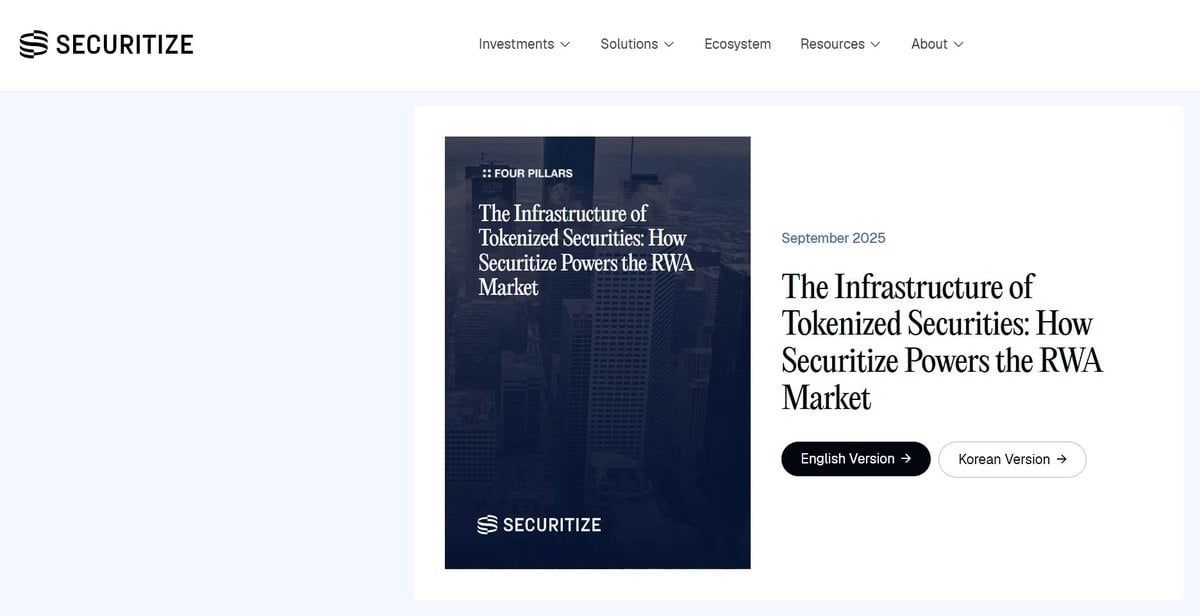
How does Securitize enforce KYC/AML and other compliance requirements on-chain? The answer lies in DS Protocol—a suite of smart contracts developed by Securitize that codify compliance throughout the lifecycle of a tokenized security—from issuance and transfer to usage, voting, and dividend distribution. Four Pillars previously published a deep-dive research report on DS Protocol, which is also featured on Securitize’s official website. Readers seeking deeper insight into how compliance is enforced at the smart contract level should consult that report.
Other platforms using a similar approach include Superstate and Figure. All operate as transfer agents. The key difference lies in the type of shares being tokenized: Securitize and Superstate tokenize shares identical to existing public stocks via the DRS system, whereas Figure issues blockchain-native share classes separately before tokenizing them.
Ondo & xStocks: Expanding Ecosystem Reach Through Accessibility
Ondo and xStocks employ a structure where, when users request tokenized equities, an offshore SPV (Special Purpose Vehicle) purchases the underlying stock and issues a tokenized debt security backed by that stock.
Take xStocks as an example: it operates a Jersey-regulated SPV called Backed Assets (JE) Limited. When users request token issuance, this SPV buys the underlying stock through Alpaca Securities in the U.S. and places it in a segregated, regulated custodial account. The SPV then issues a standalone debt security backed by these stocks, tokenizes it, and delivers it to the user.
This structure falls under the SEC’s “Linked Security” category.
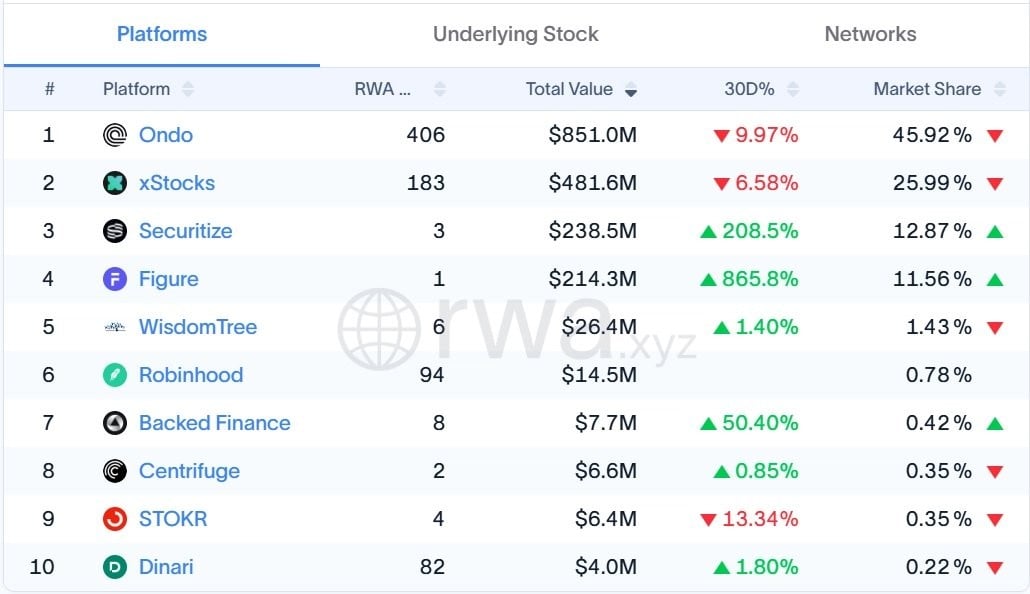
Currently, Ondo has tokenized 406 different equities with a total value of approximately $851 million; xStocks has tokenized 183, totaling around $482 million. Their market shares in the tokenized equities space stand at 45.9% and 26.0%, respectively—firmly placing them at the top two.
Their rapid growth stems from the broad accessibility enabled by this tokenization structure. Strictly speaking, they are not tokenizing the stocks themselves but rather third-party-issued debt securities backed by equities. Thus, compared to the “issuer-led” direct tokenization model, this structure imposes looser compliance requirements for distribution and secondary trading. Users can freely trade and use Ondo and xStocks’ tokenized equities across centralized exchanges (CEXs) and on-chain DeFi protocols. For instance, with xStocks, anyone can trade tokens via Jupiter DEX using a Web3 wallet or deposit them into lending protocols like Kamino to borrow stablecoins as collateral.
Yet this indirect tokenization introduces challenges: even with identical underlying assets, tokens issued by different platforms are incompatible, leading to fragmented liquidity. For example, both Ondo and xStocks back Nvidia shares, but Ondo issues NVDAon, while xStocks issues NVDAx—these tokens cannot interoperate. Moreover, due to reliance on Regulation S, U.S. investors and residents are excluded.
To address these limitations, Ondo recently acquired Oasis Pro, gaining broker-dealer, ATS, and transfer agent licenses, and is shifting toward a more compliant-friendly model. In fact, Ondo has already used these licenses to tokenize ETF shares (IVV) and stock holdings (MU) in brokerage accounts via a “Custodial Tokenized Securities” model—demonstrating the feasibility of multi-structure coexistence.
Robinhood: Can a Latecomer Make an Impact?
A new significant player has entered the tokenized equities ecosystem: Robinhood. Although it has long offered tokenized equities to European investors via Classic Stock Tokens, under the SEC’s classification, this structure constitutes a “Security-Based Swap”—Robinhood enters into derivative contracts based on stocks and then tokenizes the resulting receipts. The entire setup is highly closed, usable only within the Robinhood App.
On July 1, 2026, Robinhood launched a new service: Stock Tokens. Its tokenization structure adopts a “Linked Security” model—nearly identical to Ondo and xStocks—with similar advantages and drawbacks.
Structurally identical, but Robinhood brings clear potential: its product DNA and massive existing user base. Alongside Stock Tokens, Robinhood also launched its own mainnet, Robinhood Chain. U.S. users can now deposit stablecoins into Morpho on Robinhood Chain and earn up to 7% interest. Though entering the space later than Ondo and xStocks, Robinhood still has strong potential to scale quickly, thanks to its product iteration speed and ecosystem expansion capabilities.
DTCC, NYSE, Nasdaq: Signals of Financial Infrastructure Reimagination
Tokenization isn’t just a platform-level trend—it’s reshaping the foundational infrastructure of the stock market. Traditional settlement and trading infrastructure providers—DTCC, NYSE, and Nasdaq—are actively moving toward tokenization.
DTCC’s DTC subsidiary has received an SEC no-action letter allowing partial tokenization of certain securities on pre-approved blockchains. DTC aims to enhance collateral liquidity, extend trading hours, improve operational efficiency and settlement speed, enable programmability, and support real-time auditing. On July 15, DTC successfully completed limited tokenization of securities such as QQQ and SPY in a live production environment, including execution and collateral transfer.
NYSE submitted a rule change proposal to the SEC in April 2026 to support DTC’s tokenization pilot, enabling stock settlement in tokenized form. Additionally, NYSE is developing a new regulated exchange—the Digital Trading Platform—aiming to deliver 7×24 trading for U.S. equities and ETFs using blockchain infrastructure and supporting stablecoin deposits. In March 2026, NYSE signed a memorandum of understanding with Securitize, designating Securitize as the first potential digital transfer agent for this new platform.
Nasdaq received SEC approval for a rule change in March 2026, permitting trading and settlement of stocks in the DTC tokenization pilot in tokenized form. Nasdaq is also collaborating with Payward, Kraken’s parent company, to develop gateway services enabling seamless movement of equities between regulated Nasdaq markets and permissionless blockchain environments.
Coinbase: Which Path Will It Choose?
The final notable player is Coinbase. While it has not yet launched a tokenized equities service, it has repeatedly signaled intent since last year. In February, Coinbase launched traditional stock trading with 5×24 availability in the U.S.; at a June event, it announced it would soon offer tokenized equities.
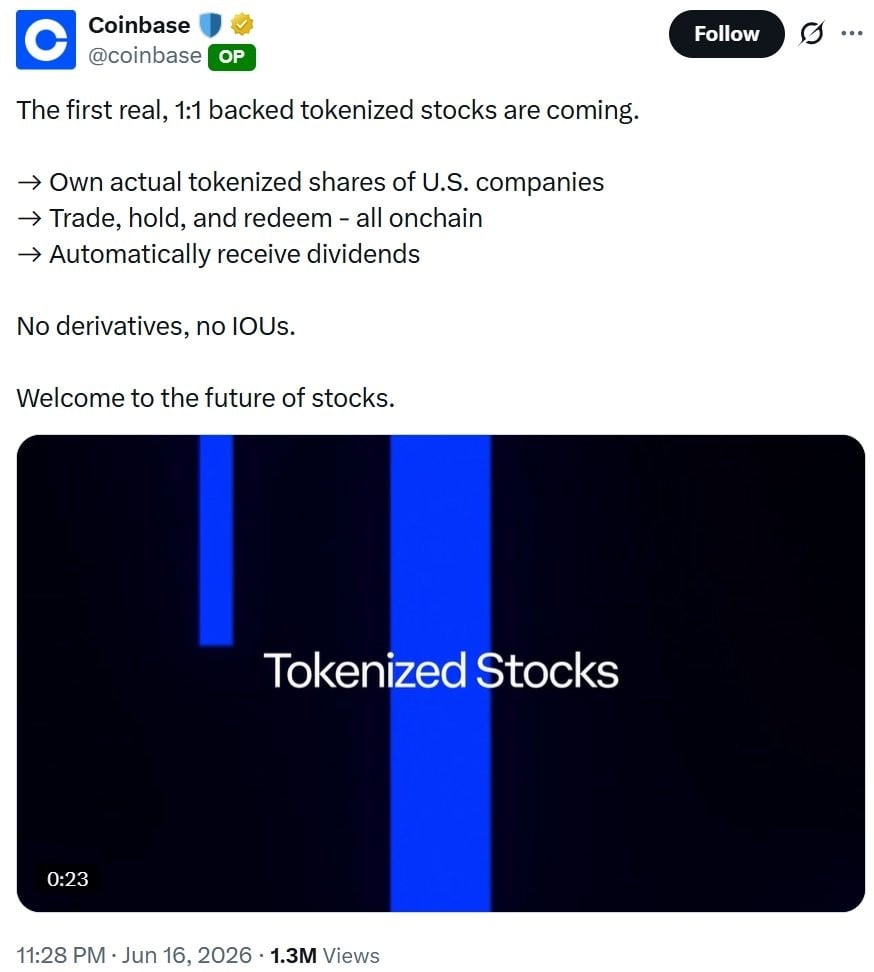
The industry closely watches how Coinbase will structure its tokenized equities. Coinbase states its service will offer 1:1 backing by real-world stocks and provide shareholder rights—but details remain undisclosed. More critically, it explicitly stated that these stock tokens will be usable on-chain, though they will not be available to U.S. customers.
If Coinbase adopts an issuer-led structure, tokens typically inherit full shareholder rights and are accessible to U.S. clients, but on-chain utility is more constrained. Conversely, the combination of “broad on-chain usability + exclusion of U.S. customers” strongly suggests a third-party structure—such as a “Linked Security.” How Coinbase ultimately chooses to tokenize equities, and how it leverages its exchange infrastructure to expand the tokenized equities ecosystem, remains to be seen.
Competition on the Same Battlefield
The goal of financial services is clear: enable anyone, anywhere, anytime, to trade any asset class through a single backend and frontend. Today’s financial systems appear close to achieving this ideal, but in reality, integration mostly occurs at the front end—while backends remain fragmented.
Equities, as one among many asset classes, are no exception. From Robinhood, born from stock trading, to Coinbase, rooted in crypto exchange, to traditional infrastructure providers like DTCC, NYSE, and Nasdaq, and Web3-native players such as Securitize, Ondo, and xStocks—all pursue different tokenization structures and strategic directions, yet all are converging toward a shared vision: tokenized equities.
What will be critical to watch next is how the U.S. and other jurisdictions view tokenized equities, how regulatory frameworks evolve, and how these shifts will reshape competitive dynamics. Furthermore, will tokenized equities become the next major catalyst for expanding the entire RWA sector—following in the footsteps of tokenized U.S. Treasuries?
The Korean market is also worth monitoring: despite high retail trading activity, RWA development remains relatively slow. How discussions around tokenized equities unfold in Korea deserves continued tracking.
Written by: 100y_eth, Compiled by: AididiaoJP
Disclaimer: Contains third-party opinions, does not constitute financial advice
The Competitive Landscape of U.S. Stock Tokenization: $3 Billion Market Cap, 5 Public Blockchains, 9 Core Assets
11 hours ago
Wall Street Cracks Down on "Shadow Stocks," Bullish Partners with Multiple Financial Giants: Bringing True Shareholder Rights to Tokenized U.S. Equities
16 hours agoThe key to tokenization success: it's not about being on the blockchain, but whether it can truly measure value
08-05After Binance Alpha launches US equity memes, how far can this narrative truly go?
08-03The on-chain U.S. equity theme takes center stage, with ONDO surging 30% over three weeks—what catalyst is driving the speculation?
07-28a16z: The U.S. Needs the CLARITY Act to Seize Leadership in Stablecoin and Tokenization Standards
07-23
Chatting with the Ondo Perps Team: U.S. Stocks as Collateral Is Just the Beginning, AI-Driven Trading Volume Will Be Key
07-17


