
ChainThink
Stay ahead, master crypto insights
Israel launches a major attack on Iran, why has BTC, the so-called safe-haven asset, failed?
Israel launches a major attack on Iran, why has BTC, the so-called safe-haven asset, failed?

2025-06-13 18:48
This morning, Israel launched multiple military strikes against Iran, with over 300 air raids, focusing on Iran's nuclear facilities, military assets, and key Iranian military figures. Israeli Prime Minister stated that the country is prepared for the possibility of a full-scale war with Iran. Iran retaliated by launching over 100 drones towards Israel, claiming to have initiated a "clean-up procedure" against the Israeli regime.

The situation between the two sides has escalated, seemingly approaching an uncontrollable edge. Every time there is a conflict, people say "the airstrikes hit their accounts", but instead, gold prices surged. Why did the so-called "digital gold" fail this time? Is the current sharp decline a good opportunity to buy low?
Timeline of the Intense Conflict Between Israel and Iran
In recent years, the confrontation between Iran and Israel has escalated from proxy wars to direct military conflicts. Nuclear issues, regional power struggles, and ideological opposition have formed the core of their tensions.

From 2020 to 2023, the conflict between Israel and Iran gradually escalated. In July 2020, an explosion occurred at Iran's Natanz nuclear facility; in November 2020, Iranian nuclear scientist Fakhrizadeh was assassinated, with external speculation linking it to Israel. In November 2021, Israel conducted a cyberattack that paralyzed the Bushehr nuclear power plant system in Iran. During this period, Iran used Lebanese Hezbollah and Hamas to launch over 150,000 rockets toward Israel. After the October 2023 Israel-Palestine conflict, the confrontation in the Gaza Strip intensified. In 2024, Hamas leader Haniyeh and Hezbollah leader Nasrallah were both killed. In April 2024, Iran launched its first attack from its territory against Israel. In October 2024, Israel carried out large-scale retaliatory air strikes against Iran.
This morning, Israel launched a military operation codenamed "Power of the Lion," conducting over 300 air raids, precisely targeting Iran's nuclear facilities, missile bases, and senior military officials (including Revolutionary Guard Commander Salami), and declared a state of emergency nationwide. The intention was to curb Iran's nuclear deterrence capability from its root.

Iran launched over 100 drones toward Israel, closed its airspace, claimed to have initiated a "clean-up procedure," and warned of attacks on U.S. military bases in the Middle East. Iranian officials responded sequentially to Israel's attack: "severe punishment, heavy cost."
The war has had an immediate impact on financial markets. Global stock markets, bond markets, and commodity markets have all experienced significant volatility. As an important component of global risk assets, the cryptocurrency market could not remain unaffected. BTC price fell sharply shortly after the news was released, and panic quickly spread through the market.
Why did BTC, as a safe-haven asset, fail today?
For a long time, BTC has been regarded by investors as "digital gold," believed to have the property of preserving and increasing value during economic turmoil and geopolitical crises. However, in this conflict between Israel and Iran, BTC not only failed to play a safe-haven role, but also saw a significant drop. There are multiple complex reasons behind this.
In summary, this is just a temporary failure of BTC's "digital gold" attribute. Over 17 years of development, BTC has undoubtedly established its status as a safe-haven asset, while also possessing characteristics of a risk asset. The combination of these two aspects actually makes BTC more attractive for investment.
The recognition of BTC as a safe-haven asset can be traced back to the Cyprus banking crisis in 2013. In May 2013, due to the rescue of banks, Cyprus introduced a "deposit tax" policy (a 9.9% tax on deposits over 100,000 euros), which put citizens at risk of direct asset shrinkage. Bitcoin trading volume in Cyprus increased by 300% in a single day, and the price rose from $60 to $260 (a 333% increase within a week).

After the Crimea incident in 2014, Russia faced Western economic sanctions, and the ruble depreciated by over 50% against the US dollar, with tighter capital controls. Russian cryptocurrency trading volume increased by 250%, and the premium rate of Bitcoin on local P2P platforms reached 15%-20%.
In 2018, the Turkish lira fell 40% against the US dollar, and annual inflation exceeded 25%, causing severe depreciation of citizens' assets. The number of users on the Turkish cryptocurrency exchange Thodex increased from 500,000 to 3 million, with Bitcoin transactions accounting for over 60%.
In March 2020, the outbreak of the global pandemic led to a stock market crash on March 12, with severe turbulence in traditional financial markets. After a short-term plunge, as the Federal Reserve introduced unlimited QE (quantitative easing) policies, concerns about fiat currency depreciation increased. After May 2020, Bitcoin prices rebounded by over 300% from the low point, and by the end of the year, it surpassed $20,000, outperforming gold (approximately 25% increase) and the S&P 500 (about 16% increase).
In March 2023, the collapse of Silicon Valley Bank (SVB) triggered a banking crisis in the United States. During the crisis, Bitcoin prices soared from $19,000 to $30,000 (a 58% increase within a month), while gold rose by 12% and the US bank stock index plummeted by 30%.

In 2024, Argentina's annual inflation rate exceeded 200%, and the peso depreciated by 70% against the US dollar throughout the year, causing severe loss of citizens' assets. The premium rate of Bitcoin on Argentine P2P trading platforms has remained consistently at 15%-20%, becoming a "digital dollar safe" for ordinary people.
Therefore, even though BTC has short-term fluctuations, in the long term, BTC continues to gain increasing attention globally despite economic downturns.
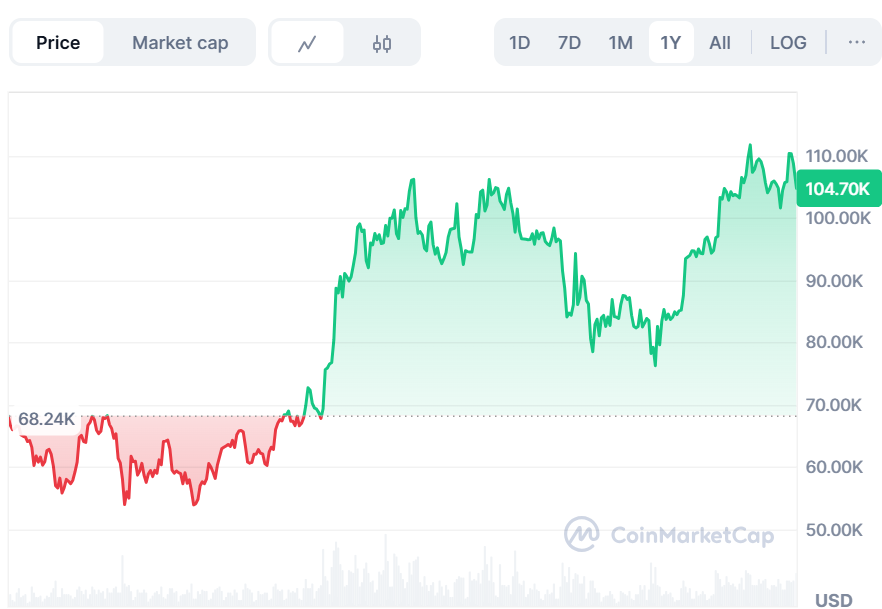
The recent drop in BTC is more due to the fact that since April, BTC has risen from over $70,000 to $110,000, a rise of nearly 45%. This large increase has created a substantial profit-taking position, thus entering a washout phase in the bull-bear battle. The range of $105,000 to $110,000 will become a relatively long-term area for position switching;
How to View This Opportunity?
Although Bitcoin prices have fallen, some analysts believe this may provide investors with an opportunity to buy low in the short term. According to Maria Gonzales, a analyst at CryptoQuant, "This is not a crash, but a market reaction to global panic. Smart money may be waiting to re-enter at $103,000."
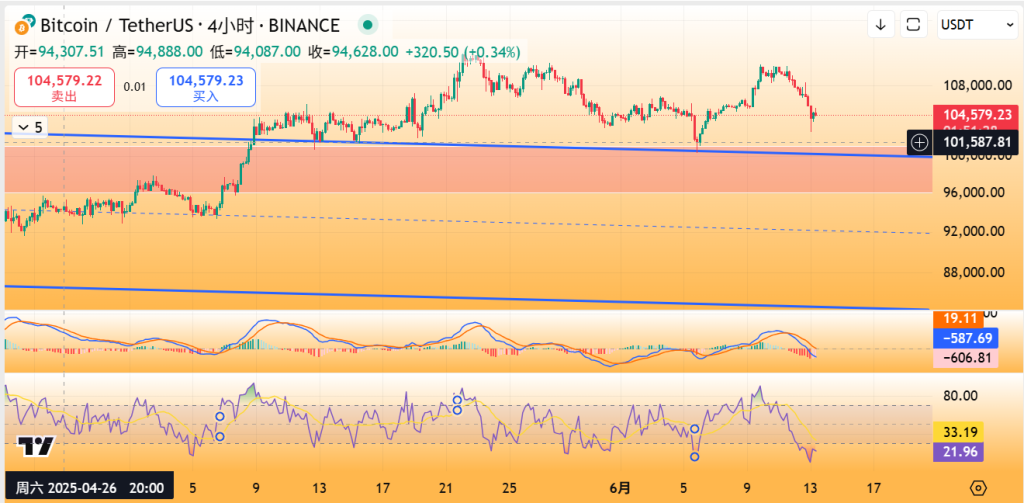
Technically speaking, the current $103,000 is a support level on the channel, and $100,000 is a psychological threshold. Additionally, the current indicators have entered oversold territory. Therefore, if the conflict event does not completely spiral out of control, a short-term low point may appear between $100,000 and $103,000. The resistance for the rebound will still be around $106,000 to $108,000. If the event gets out of control, the position conversion area could reach $95,000 to $98,000, which would be a super golden pit.
Disclaimer: Contains third-party opinions, does not constitute financial advice


AI Practical Guide
This column focuses on the real progress of Agents: technological evolution, application implementat

Crypto Weekly
Tracking on-chain movements of the smart money and institutions

Frontier Insights
Spotlight on Frontier, trending projects, and breaking events

Blowup Alert
As the 2026 crypto bear market deepens, exit scams and project blowups are becoming increasingly fre

Regulatory Watch
American Crypto Act – timely interpretations of policies worldwide

Popular Airdrop Tutorial
Selected potential airdrop opportunities to gain big with small investments

FusnChain
FusnChain