
ChainThink
Stay ahead, master crypto insights
AI + DeFi is about to take off, does AI + Stablecoin have anything going on?
AI + DeFi is about to take off, does AI + Stablecoin have anything going on?

2025-06-14 10:37
Editor's Note: 2025 is the year when the stablecoin sector is rising. The United States introduced the GENIUS Act, and South Korea's new president Lee Jae-yong is also fulfilling his campaign promises, allowing local companies to issue stablecoins. In addition to the national level, there are both previous banks such as Standard Chartered and Goldman Sachs, and later companies such as JD.com and Ant Group, all major enterprises at home and abroad are exploring the issuance of various stablecoins.
Encryption AI researcher Jeff published an article analyzing the existing problems of existing encryption + AI projects. These projects are too "AI-centric" and not enough on encryption, which makes it difficult for them to stand in DeFi. In addition, Jeff also listed some current stablecoin + AI projects worth paying attention to, translated below.
Stablecoins are one of the most important infrastructures created for cryptocurrencies. Without stablecoins, we would not have a stable currency unit for investors to put their money into (which would make building CEX, DEX, Perps, money markets, and any other vertical very difficult).
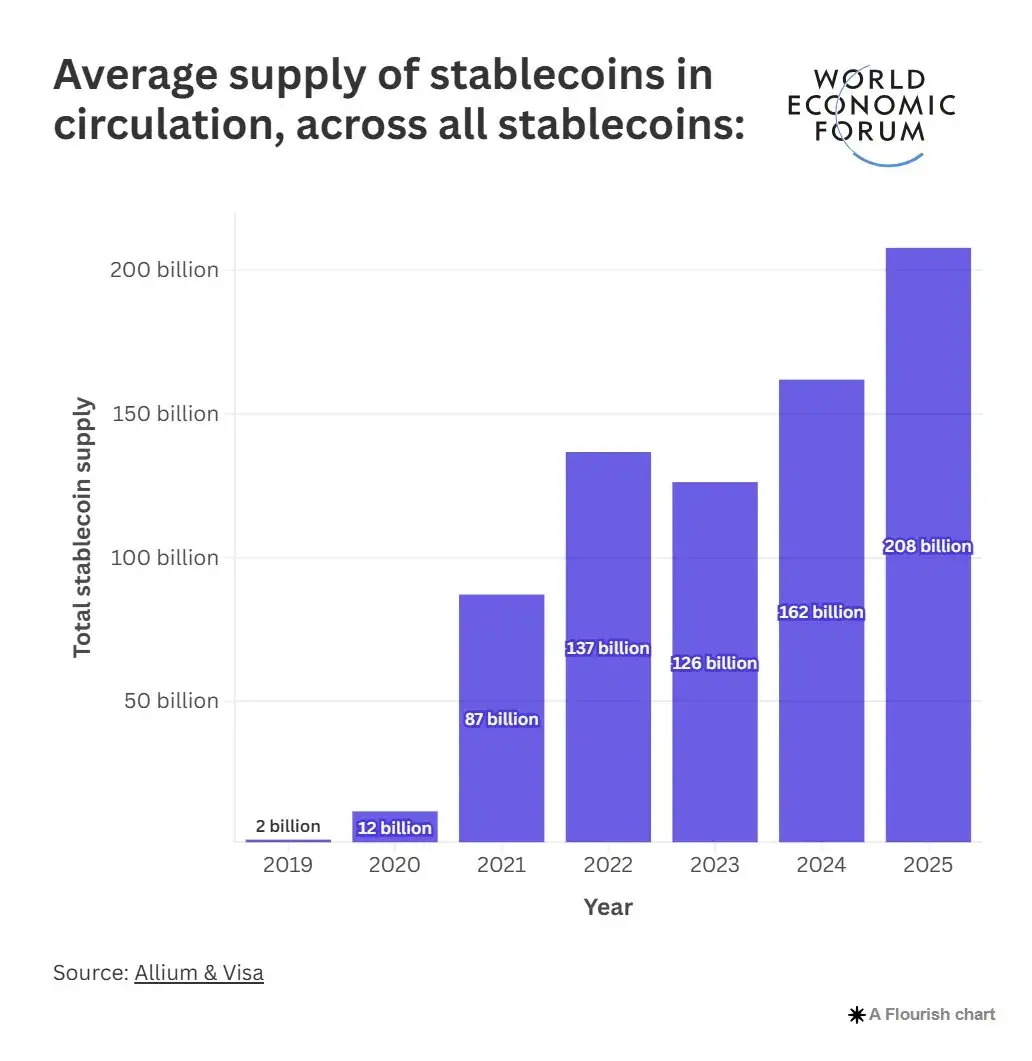
Stablecoins are rapidly becoming popular - during 2023 to 2025, the total supply, transaction volume, and velocity (frequency of stablecoin transactions) of stablecoins has sharply increased, especially in payments and cross-border transactions.
In addition, we have also seen clearer regulatory provisions and further institutional adoption of stablecoins, such as Stripe launching stablecoin financial accounts in 101 countries, Société Générale launching a USD-backed stablecoin, major banks (Bank of America, JPMorgan Chase, Citibank, Wells Fargo) exploring joint issuance of stablecoins, and large enterprises exploring stablecoin payment options to reduce Visa and Mastercard transaction fees.
Recently, CRCL's (Circle) IPO also sparked a surge in stablecoins, attracting more stakeholders. We see TradFi being further adopted while also seeing some stablecoin innovations in the AI field aimed at addressing challenges faced by service providers and users in Web3 AI.
The First Challenge
Although AI teams usually design AI tokens as a key part of the AI ecosystem (payments, governance, utility), they often invest less resources into DeFi and more into AI products.
Examples:
Virtuals Protocol uses their VIRTUAL/AGENT LP to bring good value appreciation to VIRTUAL, but also makes it difficult for agent teams and liquidity providers to provide liquidity (due to impermanent loss);
Aethir uses ATH tokens as compute payment, which pushes the token, but also increases its volatility;
Bittensor uses dTAO (alpha subnet token) to pay miners, validators, and subnet owners, participants must sell alpha tokens to get stablecoins to maintain their operations;
Although these two examples can be seen as a flywheel for AI tokens, the volatility caused by the design also prevents some key participants from joining. (BTW, these three examples are relatively good, but there are many AI teams doing quite badly in token design, especially some fair launch teams).
The increase in the number of tokens on the market, coupled with suboptimal designs, leads to low liquidity, making it difficult to build DeFi legos.
Projects Addressing the "Uneven Resource Allocation" Issue
MAITRIX—AI Stablecoin Layer
Maitrix launched over-collateralized AI-native stablecoins (AI USD) tailored for each independent ecosystem, essentially transforming unstable (but high-yield) AI economies into predictable, composable, and vibrant economies with AI-native stablecoins.
Key components of Maitrix:
CDP: Users deposit AI tokens and their derivative assets (liquid staked or staked AI tokens) through CDP to mint and burn AI USD;
Stablecoin Launchpad: AI projects can use their native tokens and derivatives to create their own AI stablecoins;
Curve War ve (3, 3) incentives: MAITRIX token ve governance, emission redirection, and bribe mechanisms similar to ve (3, 3)
StableSwap DEX: facilitates trading between various AI USD tokens.
Supported AI dollar assets (so far)
Aethir USD (AUSD) — a stable compute payment method
Vana USD (VanaUSD) — a data-based stablecoin
Virtual USD (vUSD)
ai16z USD (ai16z USD)
0G USD (0 USD)
Nillion USD
More partners are currently in discussions.
There are not many detailed documents about each AI stablecoin use case, once their whitepapers are released, I will elaborate on the technical aspects. But for now, Maitrix is the only team that has built this layer for AI projects and has already established partnerships with top AI ecosystems.
Maitrix is currently gaining attention on the testnet. The public mainnet is about to go live.
The Second Challenge
As AI continues to accelerate and expand in applications, the demand for computing resources also grows. Data centers and cloud operators need to plan their expansion in advance to meet future demands.
Enterprise-grade GPUs (such as NVIDIA's H100 and H200) are typically expensive and require significant capital.
Traditional financing methods, such as bank loans or equity investment, are often slow and complex, leading to data centers being unable to quickly expand to meet demand, this is where the next two AI projects Gaib and USDAI focus.
Projects Addressing the "Demand Problem"
The first project is Gaib.
GAIB AiFi—the first economic layer for AI and computing power, Gaib tokenizes the future cash flows of GPUs to help data centers raise funds efficiently, while providing investors with yield assets backed by real assets (GPUs).
Its basic working principle is:
Cloud/data centers package future GPU cash flows into financial products;
These cash flows are tokenized over a 6-12 month period;
Investors purchase these tokens and start receiving regular rewards;
They call this AI synthetic dollar "AID".
Each AID token is supported by a GPU financing transaction portfolio and treasury bonds or other liquid asset reserves
Floating yields are expected to be around 40% APY, which largely depends on the GPU transaction portfolio, whether it is debt financing or equity transactions (equity accounts for 60-80% or more, while the annual yield on debt is 10-20%).
So far, they have accumulated approximately $22 million in TVL incentive deposits, which are in the form of "Spice" points, and investors will be entitled to future airdrop rewards.
Additionally, Gaib has partnered with Aethir and conducted its first GPU tokenization pilot earlier this year. This pilot was just GPU tokenization/subdivision, as part of its roadmap, expanding to GPU-supported stablecoin "AID".
The second project is USD.AI
USDAI is a RWA-backed interest-bearing synthetic stablecoin launched by Permian Labs. Its is somewhat similar to Gaib but different, USDAI is a stablecoin collateralized by hardware assets (such as GPUs, telecommunications equipment, solar panels), and its operation belongs to debt financing transactions, borrowers (asset owners) receive loans from USDAI, pay interest, and these interest earnings belong to USDAI token holders.
Permian Labs is behind metastreet, a top-tier structured credit market, which provides NFT-backed loans, structured credit for illiquid assets/risk-weighted assets (watches, artworks), NFT yield rights transfers similar to Pendle (PT YT), etc.
USDAI has not yet gone live, but its target yield is 15-25% APY, with the asset portfolio divided into three stages, from 100% treasury bonds to 100% hardware assets. USDAI uses CALIBER, a system that simplifies the loan/issuance process and complies with the legal standards for bringing GPUs onto the blockchain.
Odaily Note: CALIBER: Collateralized Asset Ledger: Insurance, Bailment, Evaluation, Redemption (Collateralized Asset Ledger: Insurance, Custody, Evaluation, Redemption). This system is based on Article 7 of the Uniform Commercial Code (UCC) in the United States, converting real-world assets (such as infrastructure) into legally acceptable collateral for on-chain financing through asset tokenization and a legal framework.
To clarify, USDAI focuses on debt, with a broader range of asset types. With its CALIBER model, they can cover various use cases (wherever the demand is), while Gaib focuses more on equity, offering higher expected returns.
You can fill out form to apply as an early user, USDAI will provide additional rewards for early participants.
Other AI-Related Stablecoin Products
Almanak recently launched alUSD, an ERC-7540 version token (an extension of ERC-4626), a tokenized AI yield optimization strategy, aimed at maximizing risk-adjusted returns on stablecoin investments in Aave, Compound, Curve, Yearn, etc.
The Almanak team will soon launch a points campaign to attract liquidity and continue to expand DeFi's composability, so people can use alUSD as collateral or circulate it to maximize returns.
AIxFI project, a vault that automatically deploys USDC in DeFi protocols. Initially based on rules, and then gradually introducing AI for decision-making. Will be launched this month on Virtuals Protocol.
Future Trends
We may see another Ethena project rise that focuses on using GPUs to bring high yields to stablecoins. More importantly, how they manage their 1:1 USD peg and ensure that prices return to 1 USD in times of crisis.
In the future, we will also see more tokenized AI strategies. We have already seen that AI can better optimize yields considering gas fees, rebalancing fees, slippage, and other dynamic variables. Imagine tokenizing these strategies into highly composable "vaults", which can be used as collateral or circulated to achieve 5-10x leverage returns.
As participants like Maitrix build stablecoin infrastructure for top AI ecosystems, we will begin to see increased liquidity in Web3 AI. More AI value will start to become more composable and flow into DeFi, thereby increasing the value added to the entire Web3 ecosystem.
Although these teams are very interesting, when it comes to stablecoins, risk/peg management/redeem/liquidation mechanisms are crucial. Do your risk assessment before investing.
Original Author: 0x Jeff
Translated by: CryptoLeo, Odaily Planet Daily
Disclaimer: Contains third-party opinions, does not constitute financial advice


AI Practical Guide
This column focuses on the real progress of Agents: technological evolution, application implementat

Crypto Weekly
Tracking on-chain movements of the smart money and institutions

Frontier Insights
Spotlight on Frontier, trending projects, and breaking events

Blowup Alert
As the 2026 crypto bear market deepens, exit scams and project blowups are becoming increasingly fre

Regulatory Watch
American Crypto Act – timely interpretations of policies worldwide

FusnChain
FusnChain