Reuters Deep Dive: Zuckerberg's "Full AI Transformation" Stumbles, Meta's Aggressive Layoff Plan Halted Amid Internal Code Crisis
Reuters Deep Dive: Zuckerberg's "Full AI Transformation" Stumbles, Meta's Aggressive Layoff Plan Halted Amid Internal Code Crisis


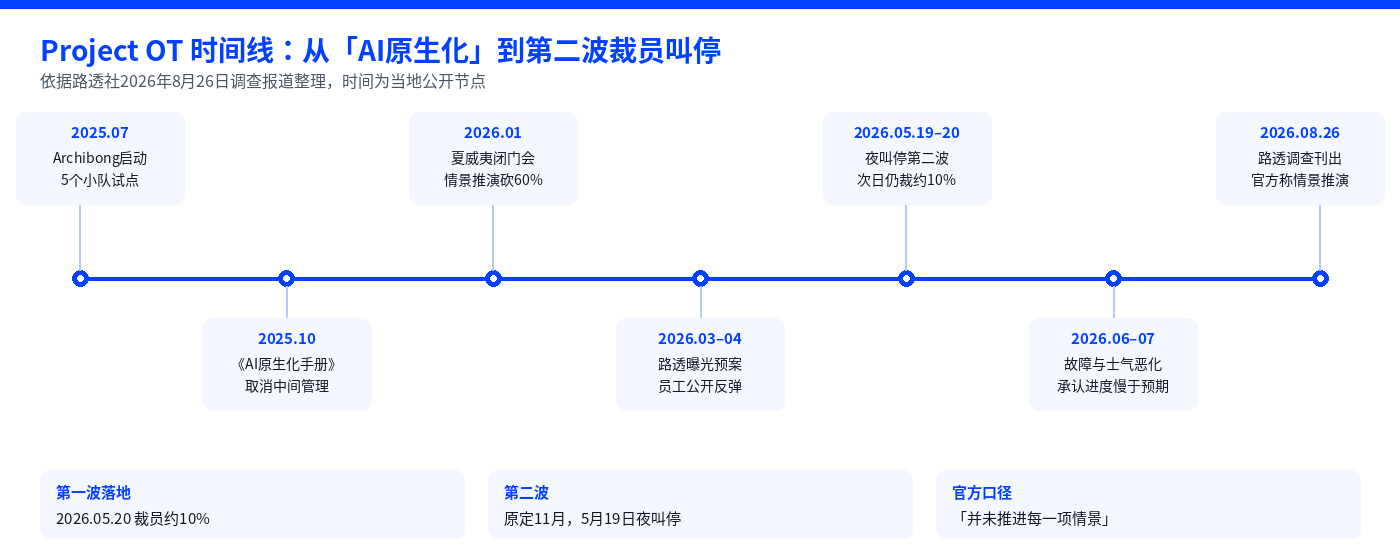
Reuters published an investigative report on August 26: In early 2024, Zuckerberg set a corporate transformation initiative using AI to replace large portions of routine human labor, codenamed Project OT (Organization Transformation). Under the most aggressive scenario, team sizes could be reduced to as low as 40% of their original scale. The plan was scheduled to roll out in two phases—May and November. On the night of May 19, he halted the planning for the second phase.
Reuters reviewed dozens of internal documents, posts, and recordings, and spoke with more than 20 informed sources. Meta acknowledged the existence of this one-year project but described it as “scenario planning,” emphasizing that it did not aim to cut 60% of the company’s workforce, nor had every proposed scenario been advanced.
Hawaii Closed-Door Meeting Sets Tone; Some Teams Could Be Cut by 60%
In January 2026, Zuckerberg convened his core leadership team at a private estate in Hawaii for the annual executive retreat. According to informed sources cited by Reuters, the meeting established a strategic direction: transforming Meta into an "AI-native" organization. One internal planning document stated that AI would assume vast amounts of daily work previously handled by thousands of employees, with virtual workers overseen by smaller, more "talent-intensive" human teams within the company.
In the scenario planning, some teams could face reductions of up to 60%. Some staff would be reassigned to new units, while others would leave. A senior HR executive estimated in another internal document that the scale of this round of restructuring could reach—or even exceed—the approximately 25% workforce reduction Meta conducted around three years prior. The reorganization was structured in two waves: first in May, then again in November, simultaneously freezing vacant positions and offboarding those deemed low-performing.
These scale details had not been publicly reported before. Meta’s written response to Reuters was clear: the most extreme scenario indeed included reductions of up to 60% for certain teams, involving both layoffs and role transfers; however, the company never intended to cut 60% of its entire workforce, and several key business units were excluded. The statement read: “As part of our company restructuring earlier this year, we asked select teams to conduct scenario planning assessing the potential impacts of role transitions, closing open positions, and layoffs.” “This ultimately led thousands of employees to transition into newly formed teams focused on priority initiatives—something already publicly reported. We did not advance every scenario in the exercise—and have never assumed they would all be implemented.”
Reuters was unable to confirm a single trigger point for Zuckerberg’s change of heart, and the company declined to arrange an interview with him.
Team Sizes Shrunk from Dozens to Three or Five; ‘Builders’ Replace Old Roles
After ChatGPT launched at the end of 2022, Silicon Valley executives became especially fascinated by “agents”: these should not merely answer questions, but autonomously place orders, book flights, and write applications. Meta internally codified this philosophy as “AI-native”—a sentence from a Project OT document reads: “AI-ready tools and agents collaborate seamlessly, workflows are automated, and new projects default to AI-first.” Externally, the company also planned to sell business-facing agents capable of scheduling and transacting to other enterprises, launching a version tailored for businesses in June.
Product lead Naomi Gleit spent a “substantial period” in Singapore offices last year. In June, she told Reuters that practices there “inspired teams in California and New York,” with many changes emerging “bottom-up.” Chief Data Officer Alex Schultz also toured Asia last year, according to three informed sources, and the group expressed admiration for local startups reengineering their organizational structures around AI.
Earlier pilots began in July 2025. Ime Archibong, who long served as Vice President of Product Management, announced in an internal post that his team would first build five “small tech squads”—each comprising two or three engineers and one designer—equipped with AI tools, replacing the former six-month product cycle with four-week sprints. He used basketball as a metaphor: “In basketball, embracing fast breaks allows you to take more shots—and better ones. Our expectation for AI tools is the same: they enable us to explore more ideas at lower cost and higher fidelity.” The next line read: “This isn’t just more fun—it’s the winning strategy in an AI-first era.”
In October 2025, members of his team released the “AI-Native Playbook,” offering a guide for other groups on how to make the shift: traditional roles for product designers and engineers disappeared, and squad members were uniformly rebranded as “builders”; middle management layers were eliminated; squads reported directly to a senior unit head; and daily priorities were handed over to “agent-assisted analysis.”
Early this year, Zuckerberg pushed Project OT into execution, demanding structural changes across leadership. By June, at least 11 units—including engineering and research—had already adopted the squad model. An internal memo stated that performance evaluations and promotions now followed a “village method”: decisions made by unit heads managing 30 to 50 people, with HR and anonymous “AI systems” providing support; squad leads managed day-to-day operations but had no formal authority. One employee assigned to manage a squad wrote on an internal bulletin board: “I didn’t go through management training, nor do I have access to ratings or management tools.” Meta emphasized to Reuters that evaluations and promotions “have always been and remain human-driven decisions—not AI.”
Traditional product teams typically consisted of 10 to 20 people: seven to 14 engineers, plus one each for product, design, data science, experience research, and data engineering. In contrast, AI-native squads in design mockups contained only 3 to 5 members. HR simultaneously sought “irreplaceable talent” and “10x performers”—theoretically, one person augmented by AI could match the output of ten, with savings from layoffs redirected toward higher compensation.
Code Increased 220%, Features Delivered Only Up 36%
The central pillar of the plan was autonomous agents. Internal data failed to sustain this axis.
CTO Andrew Bosworth wrote in an internal post at the beginning of June: code changes to internal software platforms and infrastructure increased by 220% year-over-year; actual new features or upgrades delivered to Meta users rose by only 36% year-over-year. The infrastructure team had warned as early as March about “reliability alerts” triggered by the flood of AI-generated code. In April, another internal post put it bluntly: uncontrolled agents were executing “large-scale, destructive operations humans would rarely attempt.”
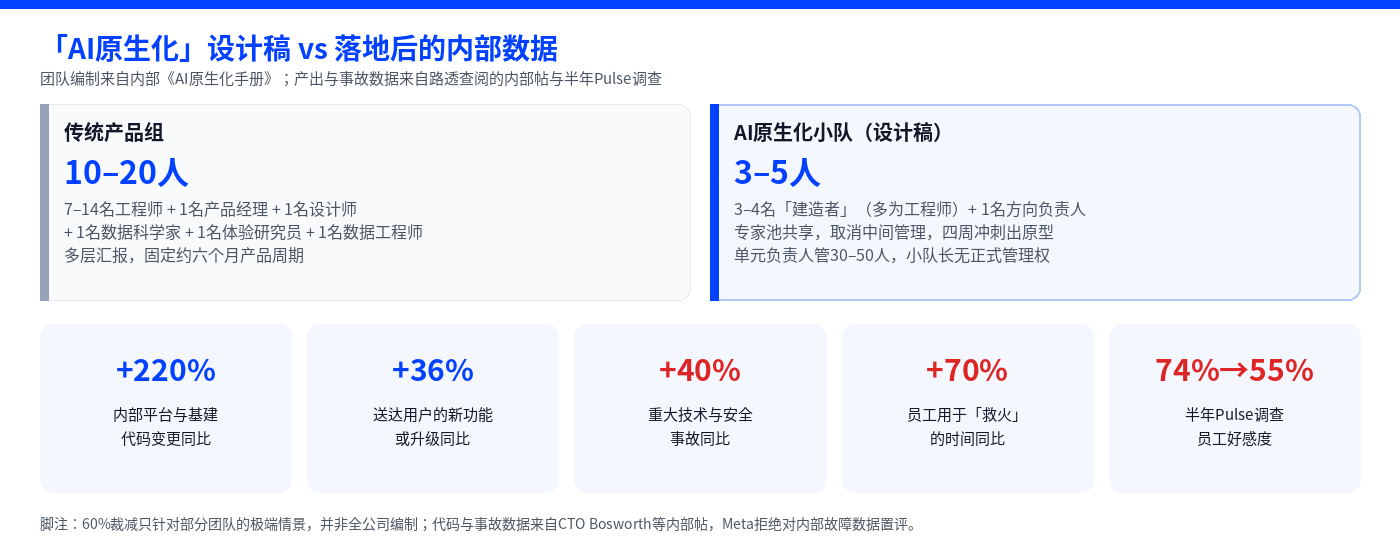
The results appeared in the same batch of internal posts. Major technical and security incidents (service outages, potential data breaches, etc.) rose 40% year-over-year; time spent by employees on “firefighting” increased by 70%. At the beginning of June, attackers exploited Meta’s AI customer service bots to breach a number of high-profile Instagram accounts, including the already-deactivated Obama White House account. Meta declined to comment on these internal failure metrics.
At an internal town hall in early July, Zuckerberg admitted the timeline had been miscalculated. In audio recordings heard by Reuters, he said, “For at least the past four months, the trajectory of agent development has not accelerated as we expected,” and that the bet on Meta’s new architecture “has not yet materialized.” He added that he hoped to see clearer returns within the next three to six months. In the same session, he acknowledged the reorganization was “not clean enough,” and that during January and February planning, senior leaders had worried “we weren’t adapting fast enough.”
On the investor side, a different question arose. Meta’s capital expenditure guidance for the year ranges from $130 billion to $145 billion, primarily allocated to AI chips and infrastructure. The Reuters investigation reported “at least $130 billion,” citing LSEG estimates suggesting this spending would consume the company’s operating cash flow in 2026. Subsequent quarterly earnings confirmed the strain: free cash flow declined 91% year-over-year.
Employees View Monitoring and Reassignment as Proxy Training—Satisfaction Drops from 74% to 55%
When the first wave landed on May 20, employees no longer believed “transformation” was merely about tool replacement. Reuters first reported in March 13 that the company was discussing layoffs of 20% or more, then reported in April about the first wave of ~10% in May 20 and possible further cuts later in the year. Informed sources told Reuters that the media coverage disrupted the original communication rhythm set by leadership.
Alongside layoffs, a large number of engineers were pulled into new units such as AI Engineering for training data. Earlier Reuters reporting noted that around 10% of the global workforce—approximately 8,000 people—were laid off in May, with another ~7,000 reassigned to AI workflow-related teams. By the end of Q2, Meta’s total workforce stood at approximately 75,500. Some forcibly reassigned employees referred to themselves internally as “conscripts.” Employees in the U.S. were also required to install keyboard and mouse tracking software to collect keystroke and cursor movement data, training agents capable of mimicking human computer behavior. Employees vented anger on internal Workplace posts and shared cold jokes; some responded to executive posts with elephant images, implying the unspoken “elephant in the room” was layoffs. Earlier reports indicated over 1,600 employees signed a petition opposing surveillance.
In Meta’s biannual Pulse survey, employee sentiment dropped from 74% to 55%. Labor organizing efforts are also intensifying. On the night of May 19, the second wave of planning was called off. The next day, the first wave proceeded as scheduled. Zuckerberg later told those who remained that he “did not anticipate any company-wide layoffs this year,” expressing hope for greater “stability.” Subsequently, the company paused keyboard and mouse tracking, allowed some reassigned employees to return to their original teams, and increased budgets for travel, team-building activities, and snacks. Employees closely scrutinized two recurring qualifiers in his statements—“company-wide” and “this year”—wondering whether team-level cuts or performance-based exits would continue downward, or whether the next round would be deferred to next year.
In June, Zuckerberg pivoted the external narrative back toward “betting on people” in an internal post: “We are the only major company placing focus on empowering people, delivering this new technology into the hands of billions of users—not primarily using it to automate work.”
Reuters’ investigative piece placed this quote after the plan had already been scaled back. Currently, Meta’s official stance on the investigation remains unchanged: “Scenario planning was not fully executed.”
Author: Claude, DeepTide TechFlow
Disclaimer: Contains third-party opinions, does not constitute financial advice
SpaceXAI to Tidy Up Subscription Chaos, Grok and Cursor to Unify Plans Within Weeks
15 days ago
JPMorgan: Oracle's Backlog Orders Up by $26 Billion, Funding Trail Raises Questions
15 days ago
The Nasdaq-100 Index futures decline widens to 1.5%
15 days agoJefferies: Expecting Fed rate hike this week, Wunsch's comments to be pivotal
15 days agoData: Bitcoin's current holding volume has decreased by 13.5% compared to September 3rd, suggesting the market may have already begun deleveraging ahead of time
15 days ago
The UK's Financial Conduct Authority is exploring regulatory exemptions for tokenized gold
15 days agoKOSPI Index drops over 3%, SK Hynix down 6.34%
15 days ago

