STRK surges 26% in a single day, as Starknet aims to spin off from Ethereum to become an AI-resistant L1
STRK surges 26% in a single day, as Starknet aims to spin off from Ethereum to become an AI-resistant L1


Just one week into October, the Ethereum Layer 2 landscape is witnessing an extremely surreal tale of ice and fire.
On one hand, a brutal purge is underway. Once-prominent projects that once carried massive capital and grand narratives are being abruptly shut down—Blast’s quiet exit, followed by Abstract, a consumer chain heavily backed by the “Fat Penguin,” announcing its closure. Users are left with nothing but a final ultimatum: migrate across chains before year-end.
On the other hand, the long-dormant veteran L2 Starknet (STRK) has taken a completely different path: within 24 hours, STRK’s price surged nearly 26%.
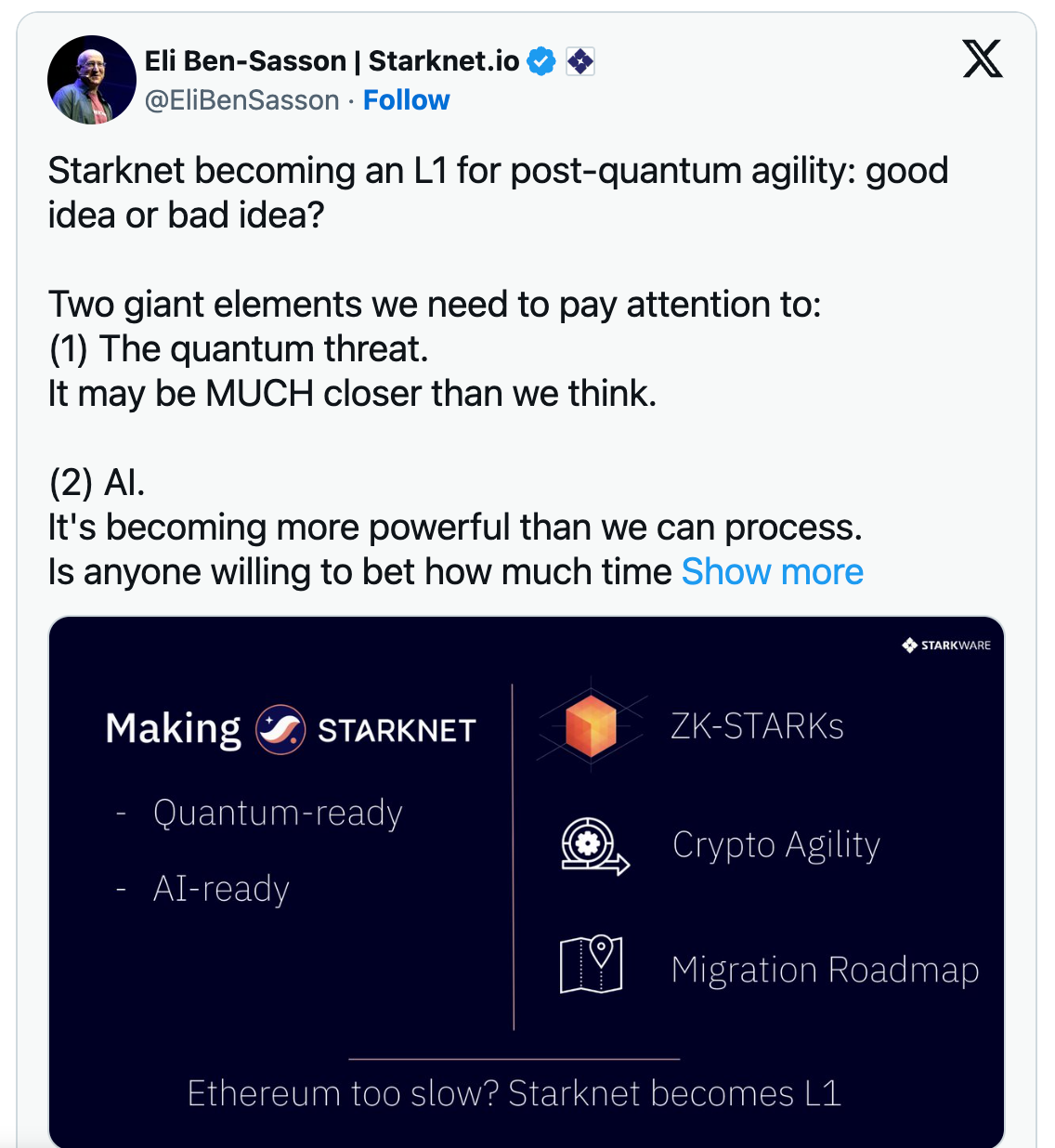
Beneath the speculative frenzy lies no breakthrough super-app in its ecosystem, nor a revival of air-drop hopes. Instead, it’s propelled by a bombshell vision unveiled by Starknet’s founder, Eli Ben-Sasson:
Starknet is actively exploring a full departure from Ethereum, aiming to become a fully independent, post-quantum, AI-resistant Layer 1 by 2027.
In a winter where L2s are collapsing in succession, why does Starknet suddenly sing the tune of “breaking away and flying solo”? Behind this theatrical move lies a cryptographic earthquake triggered by OpenAI—and a masterfully executed leveraged narrative strategy.
The Cryptographic Anxiety Triggered by OpenAI’s “Dimensional Strike”
To grasp the brilliance behind Starknet’s sudden “exit from Ethereum” narrative, we must return to the core panic gripping the crypto community over the past 48 hours.
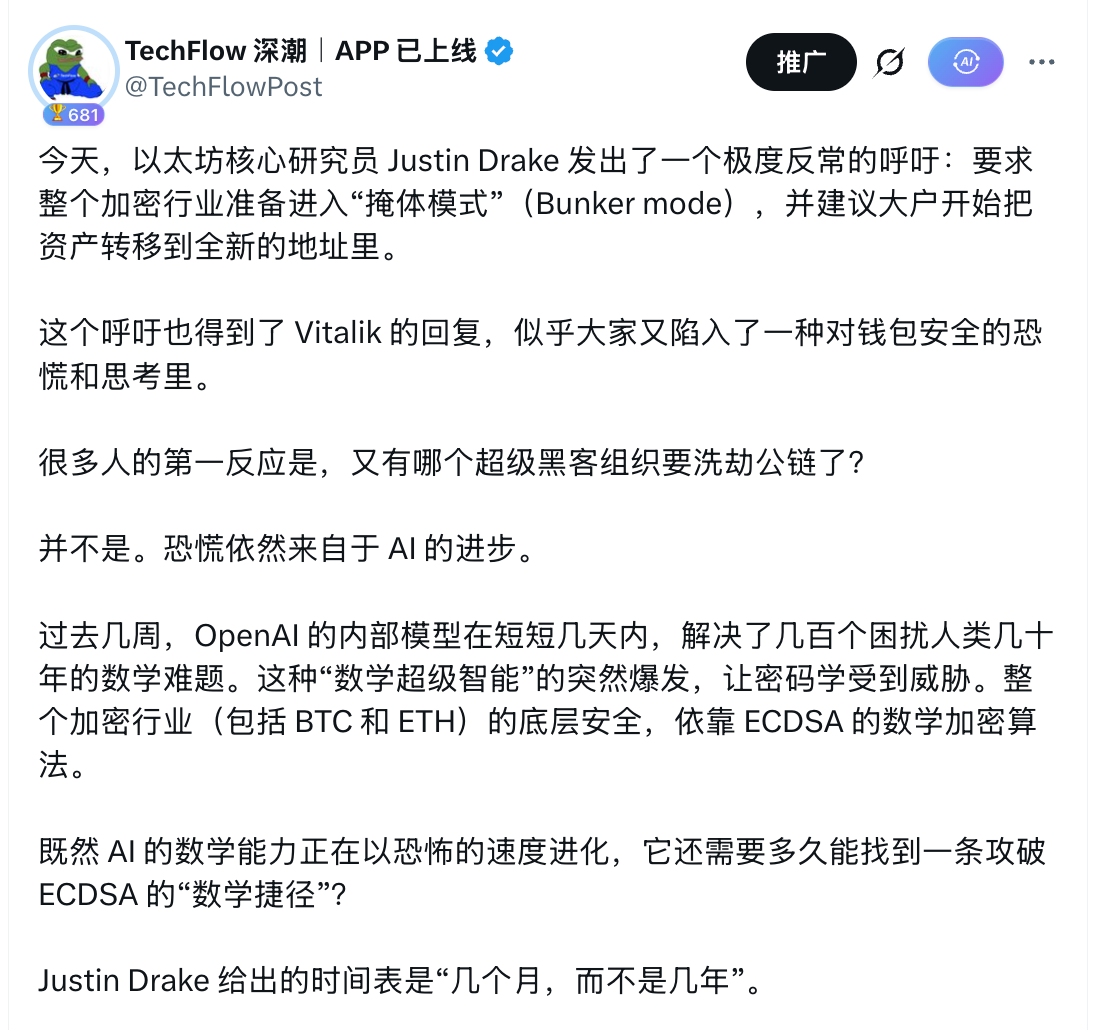
This anxiety isn’t baseless. It was ignited by Justin Drake, a core Ethereum researcher, who issued a dire warning on social media, urging all major players to enter “bunker mode”—recommending funds be moved to brand-new addresses never used for transactions.
The catalyst? OpenAI’s recent demonstration of “mathematical superintelligence.” In an astonishingly short time, AI rapidly solved multiple mathematical conjectures that had eluded humanity for decades. This exponential leap in logical reasoning has alarmed the cryptography community: the elliptic curve digital signature algorithm (ECDSA), which underpins Bitcoin and Ethereum’s security, is vulnerable due to its rich algebraic structure—making it a prime target for AI to discover shortcut pathways. Drake pessimistically predicts that such a breakthrough could occur not in years, but within months—well before practical quantum computers emerge.
The entire market plunged into extreme insecurity, as capital scrambled to find safe havens capable of resisting this AI-driven dimensional strike.
Narrative Hijacking: What’s Starknet’s Ace Up Its Sleeve?
It was precisely at the peak of this panic that Eli Ben-Sasson, founder of StarkWare, made a perfectly timed entry.
He starkly contrasted timelines: Ethereum’s mainnet migration to post-quantum cryptography is scheduled for late 2029; Bitcoin lacks even a clear roadmap.
But if Starknet were to transition into an independent Layer 1, it could break free from Ethereum’s settlement layer constraints, self-govern its cryptographic upgrade cadence, and achieve this historic milestone by 2027.
Technically, Starknet indeed has the foundation to make this claim. Most mainstream blockchains rely on elliptic curves—the Achilles’ heel. Starknet, however, uses the STARK proof system, whose mathematical backbone is built on pure hash functions. As cryptographers widely acknowledge, hash functions have minimal algebraic structure, making them far more resistant to both AI and quantum attacks seeking elegant mathematical shortcuts.
Additionally, Starknet natively supports account abstraction and has already successfully implemented post-quantum signature verification on its mainnet this year.
For Starknet—long constrained by Ethereum’s mainnet, trapped in endless L2 commoditization warfare—this narrative shift couldn’t come at a better time. Riding the anti-AI wave, it seamlessly rebrands itself as the “Ark of the Future” in the coming crypto world.
The Hollow Reality Beneath the Leverage Mania
With the grand narrative unleashed, the secondary market responded instantly: STRK surged 26% in a single day. But beneath the surface noise, this euphoria remains deeply speculative and fundamentally hollow.
According to data cited by CoinMarketCap, while prices soared, STRK’s futures open interest (OI) jumped over 53%, and futures trading volume reached five times that of spot volume.
This means the price surge wasn’t driven by large spot capital, but by alert derivatives longs using news-driven momentum to execute high-leverage squeeze trades.
In this “zero-cost” call-to-action environment, the community hasn’t yet seen a formal on-chain governance proposal—everything remains confined to the founder’s Twitter discussions.
More pressing issues loom: transitioning from L2 to L1 isn’t merely a code change.
As an L2, Starknet’s biggest strength has been leveraging Ethereum’s $trillion-level economic security. Once independent, it must build its own consensus network from scratch, recruit validators, stake assets to defend against attacks, and bear the full cost of data availability. With STRK having shed most of its historical highs, assuming the security and data costs of a standalone L1 is no small burden.
Moreover, severing ties with Ethereum means voluntarily cutting off access to the largest DeFi liquidity pool and trust infrastructure.
The Inevitable End of L2’s False Prosperity
Placing Abstract’s shutdown countdown alongside Starknet’s solo-flight vision reveals the true state of today’s crypto industry.
The era of “launching a generic L2 and achieving billion-dollar valuations overnight” has ended. When real on-chain demand fails to cover infrastructure hard costs, projects face only two paths: either exit like Abstract, or, like Starknet, leverage an extreme, grandiose narrative to forcibly carve out a blood-soaked path for market cap reconstruction.
For investors, AI undermining traditional cryptography is a serious long-term concern—but Starknet’s current rally is more akin to a successful leveraged pulse fueled by panic.
Until formal governance votes are passed and economic security models are proven, this “anti-AI breakthrough” crypto ark remains nothing more than a sketch drawn on Twitter.
In a market defined by zero-sum competition, the only survival rule is to appreciate the power of narrative—while never betting your portfolio on unproven visions.
Author: Gemini, DeepFlow TechFlow
Disclaimer: Contains third-party opinions, does not constitute financial advice
Anthropic Revenue Explodes—Why Is the AI Market Still Diving?
9 days ago
From Institutional Settlement to Open Ecosystem: Can Canton Replicate Robinhood Chain’s Development Path?
9 days ago
Podcast Notes | Taiki Maeda: Continue Bullish on ZEC to $20,000 – Buy Bitcoin a "Quantum-Resistant" Insurance
10 days ago
Former PayPal President: How to Rebuild the Payment System in the Age of AI Agents After Apps and Buttons Disappear?
10 days ago
$20 Billion Short, How OpenAI Revenue Controversy Is Impacting AI Market Trends
10 days ago
Optimism Takes Over Multiple L2s Including Unichain—Is Single-Point Risk on the Rise?
11 days ago
Building the "AWS of the AI Era": B.AI Unveils Major Upgrade to Multimodal Matrix and Responses API, Unlocking Computational Advantages to Establish an Inclusive Intelligent Foundation
12 days ago


