Pearl: Can AI Inference and Mining Coexist? | Project Introduction
Pearl: Can AI Inference and Mining Coexist? | Project Introduction


During Ethereum’s early PoW years, miners used consumer-grade GPUs with the Ethash algorithm. An RTX 3060 could achieve roughly 48 MH/s on Ethash. At the time, some people wondered whether a single GPU could simultaneously mine and run AI models, since both mining and AI rely heavily on GPU compute.
This idea didn’t take off because the two tasks stress different aspects of GPU performance. Ethash demands high memory bandwidth and performs fixed-difficulty hashing. In contrast, AI requires massive tensor core floating-point throughput and tens of gigabytes of VRAM—features dominant in data center cards like the H100. While a gaming laptop GPU can mine or barely run small models, it cannot efficiently perform both tasks concurrently.
Vitalik Buterin made a judgment on this back in 2019: if a useful and easily verifiable computation could be found, cryptocurrency mining could become a tremendous social asset—but he concluded this was probably unattainable.
Pearl claims to have achieved it. Vitalik’s earlier skepticism is prominently featured on Pearl’s official website.
Pearl is an independent proof-of-work blockchain with its native token PRL. Instead of repeatedly computing hashes, miners now perform matrix multiplication—the same operation executed at every layer of neural networks. The design enables the same GPU computation to simultaneously produce blocks and generate verifiable AI computations.
The project describes this as “energy, data, and money converging in a single operation.” Bitcoin binds energy and money; AI ties energy and data; monetization links data and value. Previously, these three elements only met pairwise. Pearl aims to unite all three within one matrix multiplication.
Proof-of-work has been quiet for years. The last generation of chains that sparked serious discussion were largely abandoned years ago. Subsequent excitement centered around L2s, modularity, and restaking. A new PoW chain is rare—so what is PRL, now valued at $430 million, trying to accomplish?

What Problem Is It Trying to Solve?
A key feature of Bitcoin’s proof-of-work is that the computation performed by miners has no relation to real-world utility. With the same electricity, running a model could generate tokens, images, or useful outputs—many feel mining seems wasteful by comparison.
The real challenge isn’t making mining “useful,” but maintaining permissionlessness. Permissionless means anyone can participate without registration or approval. Bitcoin’s security model depends on this: regardless of what computation is done, the cost remains uniform. Once work becomes valuable in the real world, miners gain incentives to cut corners or choose cheaper inputs. Thus, the issue isn’t whether mining can be useful—it’s whether it can be useful while remaining tamper-proof.
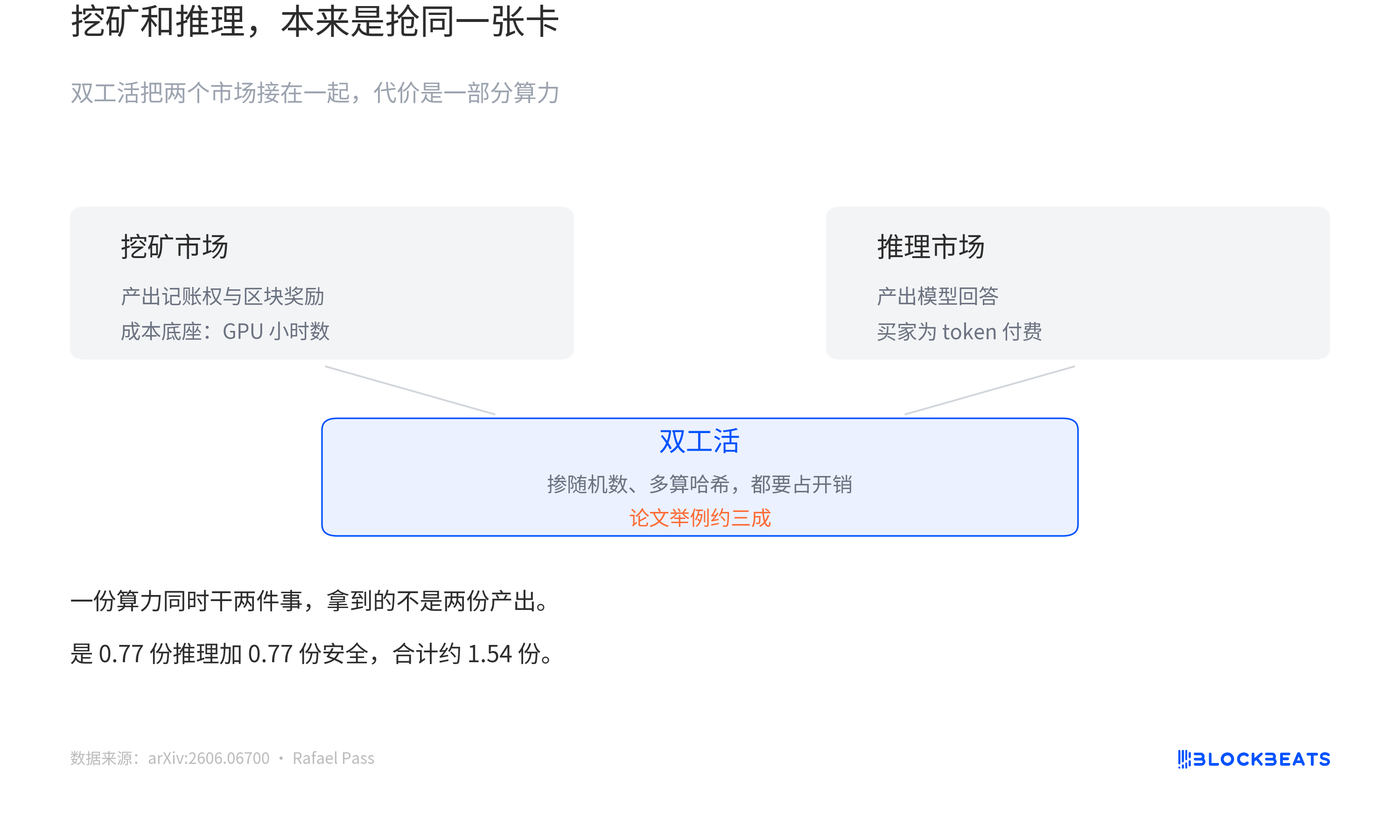
Pearl’s own claim is to replace Bitcoin’s random hashing with matrix multiplication, allowing GPUs to treat proof-of-work as a byproduct of AI inference load. The whitepaper directly uses the term “2-for-1.” Put simply, previously, a batch of GPUs had only two options: either mine (burning power for coins) or run models (burning power for tokens). Pearl aims to merge these into one unified activity.
This idea has been scrutinized. Cryptographer Rafael Pass’s paper *The Economics of Proof-of-Useful-Work* categorizes computational tasks into three types: pure mining, pure inference, and dual-purpose work that produces both. Dual-use isn’t free—Pass notes that a single unit of compute doing two things yields about 1.5 units of output, not two. If costs are low enough and token demand is high, block rewards effectively subsidize inference prices, attracting compute that would otherwise be idle. Mathematically, this holds up—but the three variables involved—cost, token price, and inference demand—are outside Pearl’s control. Notably, the paper’s footnotes reveal the author was consulting for Pearl Research Labs during the work.
Pearl’s Operational Logic
To understand how this works, we must first unpack “matrix multiplication”—a well-established operation fundamental to neural networks.
A matrix is a table of numbers arranged in rows and columns. Two matrices can be multiplied only if the number of columns in the first matches the number of rows in the second. Each cell in the result matrix is computed by multiplying corresponding elements from a row of the first matrix and a column of the second, then summing them. For example, if the first row of matrix A is [1, 2] and the first column of matrix B is [5, 7], the top-left cell of the product is 1×5 + 2×7 = 19. Other cells follow the same rule.
In AI models, each layer’s computation can be expressed as “input × weights.” A user’s input (e.g., a text prompt) is converted into a vector and multiplied by the layer’s weight matrix, producing an output that passes through a nonlinear activation function before being sent to the next layer. As models grow larger, these multiplications reach trillions per inference. GPUs are optimized precisely for such structured multiply-add operations—explaining why mining GPUs and AI accelerators are built from similar chip architectures.
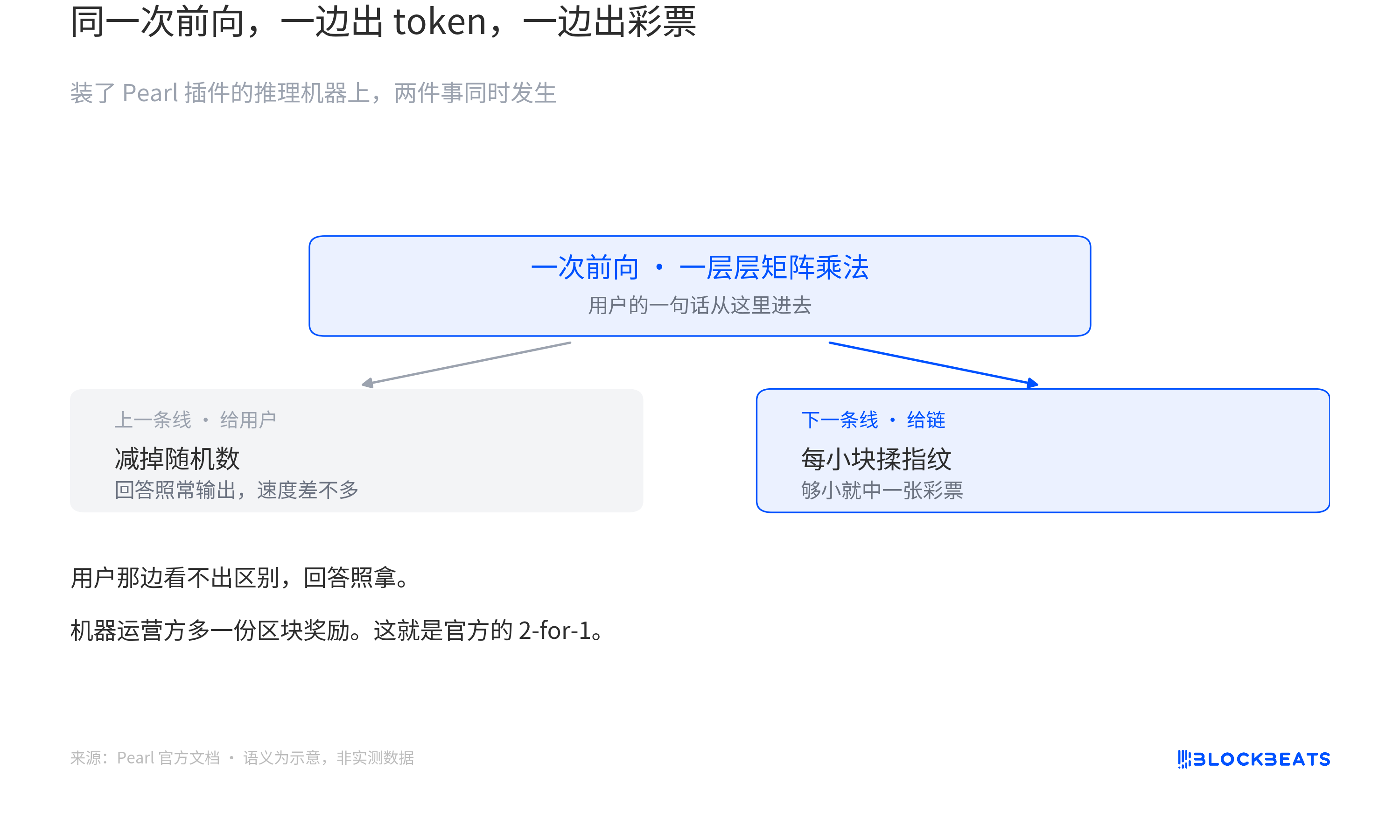
In theory, here’s how it works: a user asks a chatbot a question. The server’s GPU begins running the model, layer by layer, performing matrix multiplications. If the machine runs Pearl’s plugin and a certified open-source model, each multiplication is simultaneously used as proof-of-work. After completing a small chunk, the GPU computes a fingerprint. If the fingerprint is sufficiently small, it wins a lottery—earning a block reward. To the user, there’s no perceptible difference: answers arrive as usual, possibly even cheaper. The same computation generates both tokens and coins.
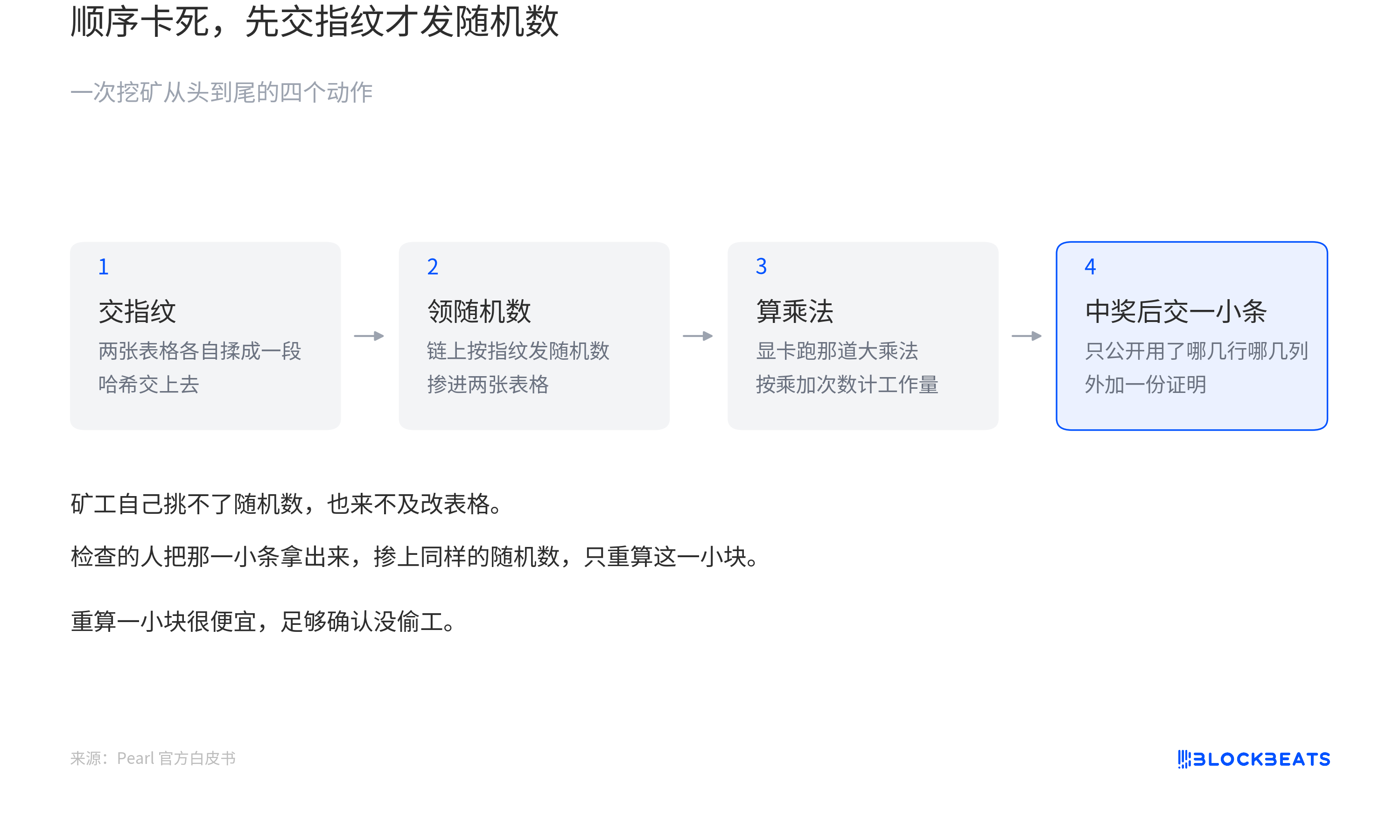
For this system to work, cheating must be prevented. Miners hold two matrices and must submit a fingerprint derived from them. This “fingerprint” is a hash computed across all values in the matrices, compressed into a short string. Only after the blockchain verifies this fingerprint does it reveal which random numbers should be injected into the matrices—locking their structure so the miner cannot alter them afterward. The protocol calls this step “adding noise”—in plain terms, inserting random values into the matrices based on the fingerprint. How many and where they’re inserted are determined by the fingerprint, not the miner.
Without noise injection, shortcuts exist. The difference between a clean matrix product (A × B) and a noisy version involves only three correction terms—large in magnitude but cheap to compute. Since miners already possess clean A and B, they can precompute the correct answer, then add just the three cheap corrections to fake the noisy result—avoiding the full matrix multiplication entirely. It’s like knowing the answer to a test question (e.g., 3987 × 2913), then adding small adjustments to make it look like you worked it out.
Thus, the protocol doesn’t require miners to submit the final result—only the input rows used and a proof. Validators extract those parts, inject the same noise, recompute only that small section, and verify the fingerprint. Re-computing a tiny fragment is computationally cheap but sufficient to detect cheating. If sensitive data (e.g., proprietary weights or user inputs) is involved, a zero-knowledge proof can be added to confirm computation occurred without exposing the actual matrices.
Where Is It Now?
On Hugging Face, the organization *pearl-ai* hosts four certified models: Llama 3.3 70B, Llama 3.1 8B, Qwen3 30B, and Gemma 4 31B. Officially dubbed “certified variants,” these aren’t retrained—they’re compressed into Pearl’s quantization format, enabling inference and mining via the plugin. The precision loss is minimal: Gemma 4 31B’s MMLU score drops from 90.93 to 90.56. As of October 9, 2026, these models had downloaded between 195 and 6,424 times over the past 30 days, with likes totaling 0, 3, 5, and 6 respectively.
A commercial pathway also exists. In May 2026, Pearl partnered with Together AI to launch an API for running the Gemma model. According to Together’s announcement, invocation pricing was 25% cheaper than standard APIs, with the discount covered by future token value.
Models are live, code is open-source—but then nothing more followed. In June 2026, researcher Abhinaba Basu published *The Usefulness Gap in Proof-of-Useful-Work*, measuring real-world activity. Based on estimated network hashrate of ~24 EH/s (~320,000 RTX 3090-class GPUs), total power consumption reached ~112 MW—yet useful AI computation output was zero.
The study examined 8,012 miner work units. All had inference-capable hardware, yet only 4,803 contained matrix multiplication-related strings in their mining software—zero entries related to machine learning frameworks. The author also wrote a custom miner using randomly filled matrices, successfully mined across NVIDIA, AMD, CPU, and Apple Silicon platforms, earning 44 valid shares from the pool. In design, data submission and coin mining can be unified—but in practice, they are completely separate.
So what’s actually running on the network? According to Kryptex pool statistics, global hashrate has surged to 46.37 EH/s, difficulty at 2.26 TH, block time ~203 seconds, block reward 2,271.03 PRL, daily minting ~966,000 PRL, token price ~$1.30. Over six months, hashrate nearly doubled—most of the growth comes from filling matrices with random numbers. What’s happening in practice? Simply buying GPUs, plugging them in, filling them with random data, and waiting for payouts.
What Are the Problems?
Imagine a cafeteria posting a notice: “Whoever chops 100 pounds of vegetables gets paid.” Chopping is real—effort, time, and knife skill are required. But the sign only checks if 100 pounds were chopped—not what kind of vegetables. So someone brings in a truckload of rotten leaves, chops exactly 100 pounds, collects wages. They did chop vegetables, spent effort—just not the kind the kitchen needs.
Pearl is stuck in exactly this trap. The protocol checks whether the fingerprint matches, whether the result truly equals the matrix product, and whether the work meets difficulty requirements. Its formal design includes a statistical gate to filter out obviously tampered inputs. These checks pass. But it does not verify where the two matrices came from. Therefore, miners can freely create two random-number matrices—same difficulty, same fingerprint, same chance to win—except the resulting output is useless to anyone. The protocol validates the mathematical relationship, not semantic relevance. “Usefulness” here is a business problem, not a cryptographic guarantee.
This isn’t speculation. Per the earlier report, the sampled machines all ran models—yet their mining software contained zero inference code. The author’s own random-filled matrices earned pool-recognized shares. Current network hashrate hovers around 45 EH/s—overwhelmingly driven by random data entry.
The scale mismatch is telling. The paper presents a counterfactual: if Pearl operated as advertised, a 24 EH/s network should have generated ~7.7 million GPU-hours of useful AI compute daily. The paper also introduces a metric called “value destruction ratio”—Pearl’s measured value is 1.0, matching Bitcoin, while Filecoin is ~0.64.
Miners aren’t accepting inference jobs not because they don’t understand, but because they’ve done the math. The paper estimates coupling inference and mining reduces effective compute by ~10%–30%. This means accepting real inference jobs requires software changes, adapting to variable request patterns—and sacrificing part of your compute capacity upfront. In low-token-price years, this math quickly turns negative.
How might this be solved? The paper outlines several paths. One is to regulate the source of matrices—requiring miners to use client-provided tables. Pearl’s current plugin and certified models move in this direction: deliver models and plugins to miners, who then run real inference and mine alongside. But enforcement is voluntary—miners still decide based on economics.
Another path is verifying whether matrices resemble real ones. Real model weights exhibit distinct statistical properties compared to random numbers. But the paper rejects this approach: miners can simply adjust the distribution slightly to fool detection—at near-zero cost. Other proposed solutions remain distant: signing model provenance requires a public key infrastructure from model providers. Using trusted hardware to prove origin requires trusting chip vendors and adds latency. Reward differentiation—paying more for real data—requires a base of willing paying customers first.
Pearl’s development team is Pearl Research Labs. Omri Weinstein is co-founder and CEO, a title confirmed in Together AI’s collaboration announcement. He is a complexity theory researcher at Hebrew University and one of the authors of the foundational paper.
Another contributor, Ilan Komargodski, appears in the Hugging Face organization list—his exact role (employee or consultant) lacks public verification. Erez Badash, lead author of the Hawkeye paper on GPU bit-level reproducibility, is also linked.
Bittensor has validators score model outputs submitted by miners, with consensus governed by a system called Yuma. io rents out GPU capacity on-demand for ML tasks. Pearl bets on a narrower assumption: the matrix multiplication used for block production itself has real-world demand.
It bets that inference demand will grow large enough to consume all block-producing compute. At that point, miners will naturally realize that taking real inference jobs is more profitable than filling random matrices. If that never happens, Pearl remains merely a GPU mining chain with different mathematics—its outputs stem from AI but mean nothing to any specific user.
Original: LawDong BlockBeats
Disclaimer: Contains third-party opinions, does not constitute financial advice
Anthropic Revenue Explodes—Why Is the AI Market Still Diving?
10 days ago
From Institutional Settlement to Open Ecosystem: Can Canton Replicate Robinhood Chain’s Development Path?
10 days ago
Podcast Notes | Taiki Maeda: Continue Bullish on ZEC to $20,000 – Buy Bitcoin a "Quantum-Resistant" Insurance
11 days ago
Former PayPal President: How to Rebuild the Payment System in the Age of AI Agents After Apps and Buttons Disappear?
11 days ago
$20 Billion Short, How OpenAI Revenue Controversy Is Impacting AI Market Trends
12 days ago
Optimism Takes Over Multiple L2s Including Unichain—Is Single-Point Risk on the Rise?
13 days ago
Building the "AWS of the AI Era": B.AI Unveils Major Upgrade to Multimodal Matrix and Responses API, Unlocking Computational Advantages to Establish an Inclusive Intelligent Foundation
13 days ago


