Hedge funds forced to liquidate positions to cut losses, U.S. 10-year Treasury yield may break through 6%
Hedge funds forced to liquidate positions to cut losses, U.S. 10-year Treasury yield may break through 6%


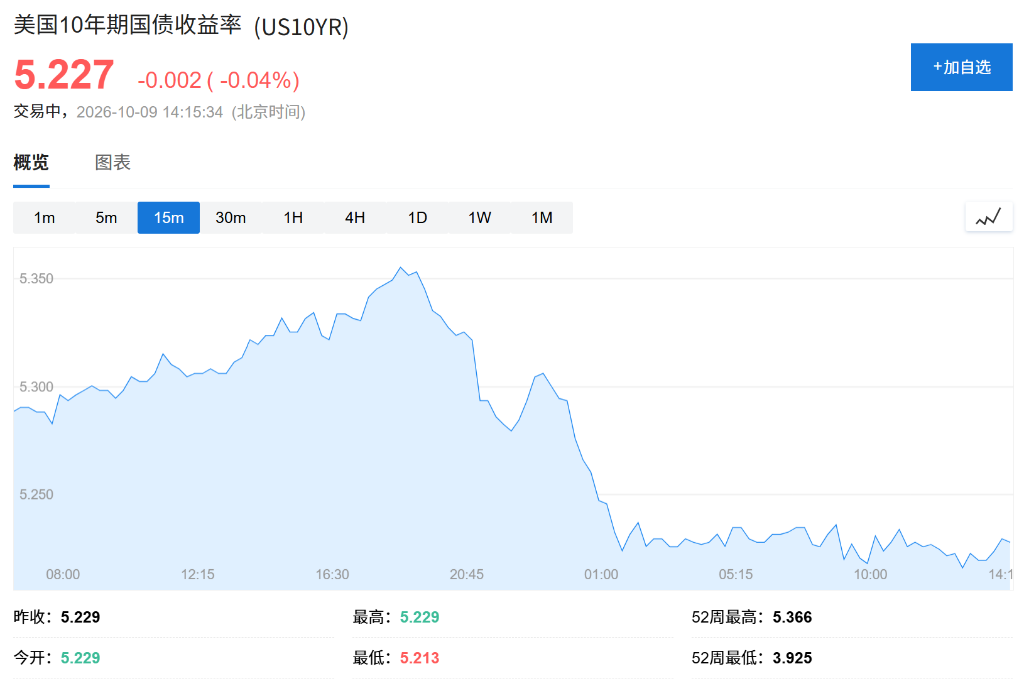
The world's largest bond fund, Pimco, has issued a warning that the U.S. 10-year Treasury yield faces the risk of breaking above 6%, marking the first time in 26 years the benchmark has reached such a level.
Pimco’s Chief Investment Officer, Dan Ivascyn, told the Financial Times that a further sharp rise in the 10-year yield from its current 5.29% level is "achievable." He noted that over recent weeks, leveraged investors such as hedge funds have suffered sustained losses in this $32 trillion market, forcing them to liquidate positions and triggering technical selling pressure—a key factor driving yields higher. Ivascyn also warned that if the 10-year Treasury yield climbs to 5.5% or above, risk assets including equities and credit bonds would face "a significant decline."
This surge in yields has already begun to impact the real economy. Data shows that as of the week ending October 8, the average rate for 30-year fixed-rate mortgages in the U.S. rose to 7.4%, up 12 basis points from the previous week—the highest level since 2023—adding further financial strain on American households just weeks before the pivotal midterm elections.
Stop-loss Selling Fuels Negative Feedback Loop
Ivascyn’s warning echoes widespread investor concerns across the market. Multiple market participants have previously cautioned that the U.S. Treasury market is entering a "vicious cycle"—persistent sell-offs are pushing yields to new highs, which in turn forces more market participants, including real estate investment trusts (REITs), to offload bonds, amplifying downward pressure.
Ivascyn explicitly stated that a significant portion of recent market activity is directly linked to "negative technical factors" and "stop-loss actions by platform-based hedge funds and other leveraged investors." He emphasized that from a short-term trading perspective, a breach of 6% in the yield "is certainly possible."
The current U.S. 10-year Treasury yield stands at its highest level since the early 2000s, driven by factors including inflation concerns sparked by Trump-era Iran conflict, a surge in AI-driven corporate debt financing, and market expectations of robust U.S. economic growth. Inflation environments are particularly unfavorable for bonds, as they offer investors a fixed stream of income.
Risk Assets Under Pressure, Private Markets Show Emerging Risks
Ivascyn warned that further upward pressure on U.S. Treasury yields would weigh heavily on risk assets. While U.S. equity indices remain near historical highs, the negative impact on certain corporates is already evident—this month, borrowing costs for the lowest-rated corporate bonds surged to 17%, the highest since May 2020, driven both by rising Treasury yields and increased demand for higher risk premiums from investors.
Outside public markets, Ivascyn anticipates that higher U.S. Treasury yields will "unravel problems in private markets at a slower pace," with commercial real estate being especially vulnerable. He highlighted the presence of "significant fragile capital structures and weak fundamentals" in this sector.
High Yields May Self-Correct; Global Debt Markets Offer Opportunities
However, Ivascyn also pointed to an inherent balancing mechanism within rising yields. He believes that as yields continue to climb, investors will gradually shift more capital into U.S. Treasuries to lock in higher returns—acting as a "natural ceiling" on further yield increases. This trend has already shown early signs, with strong demand observed in this week’s U.S. 10-year and 30-year Treasury auctions.
On the global front, Ivascyn sees more compelling alternatives. He stated that Pimco "does not share the same level of concern as some others about the U.S.'s ability to sustain its current fiscal deficit levels," while also emphasizing that "there is no need to hold only U.S. bonds." He highlighted the investment value of Australia’s "high-quality credit" bonds and noted that despite the United Kingdom facing "its own challenges," its bond yields remain higher than those in the U.S. Markets in Canada and Germany—especially when denominated in USD—also offer "very attractive yields and stronger initial fiscal positions."
By: Zhang Yaqi, Wall Street Insights
Disclaimer: Contains third-party opinions, does not constitute financial advice
CZ: Looking forward to meeting with community supporters in Thailand during the November BBW event
19 mins ago
Optimism Takes Over Multiple L2s Including Unichain—Is Single-Point Risk on the Rise?
32 mins ago
SWI Group Completes Approximately $895 Million Financing, Aims to Repurpose Bitcoin Mining Facilities into AI Compute Infrastructure
39 mins agoSouth Korea Plans to Expand Security Tokenization to Stocks, Bonds, and Funds; Relevant Regulations Expected to Take Effect in February 2027
46 mins agoPre-market crypto-related stocks in the U.S. market rise broadly, with ABTC up nearly 5%.
52 mins agoa16z Releases Seventh Edition of Consumer AI Applications Ranking: ChatGPT Remains Top, Claude Web Version Rises to Third
55 mins agoUkrainian President: Ready to Sign Ceasefire Guarantee Agreement, Calls on U.S. to Maintain Pressure on Russia
1 hour ago
